Alabama is making a costly mistake on COVID-19 recovery funds. Here’s a better path forward.
When the Alabama legislature gathered for a special session in September, it made a short-sighted and costly mistake. Lawmakers chose to allocate $400 million in American Rescue Plan Act (ARPA) money—about 20% of Alabama’s federal COVID-19 relief funds—to help finance a $1.3 billion prison construction plan.
Alabama prisons are decrepit, dangerous, and massively overcrowded to such an extent that the U.S. Department of Justice (DOJ) has sued the state over the unconstitutional conditions. Raiding funds designed to help people and communities recover from pandemic-related economic distress will do nothing to make Alabama more humane and inclusive, particularly when Black Alabamians are three times more likely to be incarcerated than white Alabamians due to discriminatory practices in policing and incarceration.
The state has a better path to build a more sensible criminal justice system and avert a potential federal takeover. New buildings to house the same old problems won’t get us there. Real change will require meaningful changes to sentencing and reentry policies.
Solid job growth in October as the recent surge in the pandemic recedes
Below, EPI economists offer their initial insights on the October jobs report released this morning. After disappointing job growth numbers in August and September, a solid 531,000 jobs were added in October.
What to watch on jobs day: October job growth expected to mildly improve as COVID-19 caseloads recede
Over the last couple of months, the resurgence of the Delta variant has made it abundantly clear that the ebbs and flows of the pandemic continue to exert powerful effects on the labor market. After increasing, on average, over 1 million jobs in June and July, job growth slowed to less than 300,000, on average, for August and September. While COVID-19 caseloads have slowed between September and October, they continue to be higher than experienced in June and July, suggesting that we will see a mild improvement—not a huge windfall—when the latest employment data are released on Friday.
For the reference week of the October jobs data, average daily COVID-19 caseloads stood at 78,987. This is a significant (43.5%) improvement over the average daily COVID-19 caseloads during the September reference week: 139,920. All else equal, this should translate into economic growth, as workers begin to feel it is safer to resume in-person job search and employment and consumers become more willing to purchase in-person services. The decline in October COVID-19 caseloads, however, does not mean we are back to the levels earlier in the summer. October’s levels were over twice as high as the average daily caseloads during the reference week in July (33,711 cases).
Similarly, OpenTable shows mild improvement in restaurant customers between September’s and October’s reference weeks. While seated diners in September were down 12.6% compared with the same week in 2019, the number of diners was down 8.4% in October. Although the 8.4% drop in seating relative to the pre-pandemic period is less than what we saw in September, it is still not as promising as the smaller 5.7% drop in July’s reference week compared to July 2019. This likely means the October labor market did not see the kind of growth we experienced in June or July, but some improvement from the disappointing September level is likely.
The Build Back Better Act’s macroeconomic boost looks more valuable by the day
In previous work, Adam Hersh highlighted how the Infrastructure Investment and Jobs Act (IIJA) and the Build Back Better Act (BBBA) could provide a backstop against the possibility that economic growth slows due to slack in aggregate demand for goods and services in the next couple of years. Over the past few months, a pronounced uptick in inflation convinced far too many that the U.S. economy actually faced the opposite problem of macroeconomic overheating—an excess of aggregate demand.
But late last week, the Bureau of Economic Analysis (BEA) released data making it clear that the U.S. economy is not overheating and that aggregate demand support in 2022 and 2023 could be vital to continued economic growth. Given this, the macroeconomic boost provided by the BBBA in coming years could be valuable indeed.
New analyses of minimum wage increases in Minneapolis and Saint Paul are misleading, flawed, and should be ignored
This week, researchers at the Federal Reserve Bank of Minneapolis released two analyses of the economic impact of several recent increases in the separate citywide minimum wages in Minneapolis and Saint Paul. The authors of the two separate, but linked, analyses interpret their findings as suggesting that the series of minimum wage increases reduced employment in the Twin Cities, but this conclusion is not supported even by the results presented in their own reports.
The data and methodology used in the study are simply not sufficient to distinguish between the effects of the minimum wage increases and other changes in employment happening around the same time. Even more problematic are the studies’ unsuccessful attempts to estimate effects through 2020, when the study’s methodology is unable to separate the effects of the minimum wage from the devastating impact of the pandemic on the two cities’ service-sector workforces. In fact, the studies’ findings implausibly suggest that the entire decline in restaurant employment during the pandemic is due to the minimum wage increases, as opposed to lockdowns, curfews, and pandemic-related declines in consumer spending on eating out.
Yes, the Build Back Better Act is fully paid for
EPI director of research Josh Bivens took to Twitter to refute critics’ most recent claim that the Build Back Better Act (BBBA) is only “fully paid for” due to accounting gimmicks. The claim, Bivens stresses, is “bad economics,” adding that BBBA is indeed fully paid for. Read the full Twitter thread explaining why below.
Children whose parents couldn’t find decent work? Underserving of a modest unconditional tax credit. Millionaire heirs? Deserving of maintenance of a zero tax rate on inherited capital gains. 2
— Josh Bivens (@joshbivens_DC) November 2, 2021
Latina Equal Pay Day: Latina workers remain greatly underpaid, including in front-line occupations
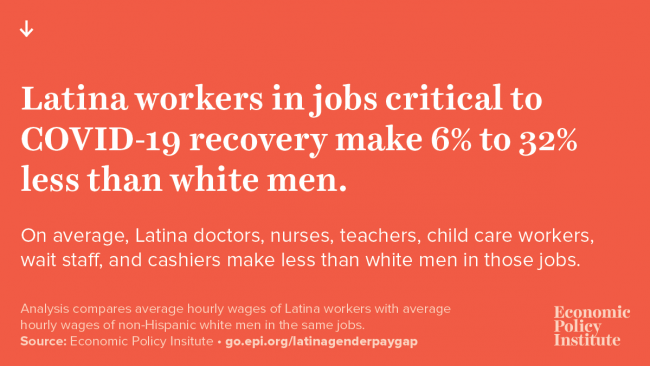
October 21 is Latina Equal Pay Day. Last year, a typical Latina worker who worked full-time, year-round earned only 57 cents for every dollar earned by white, non-Hispanic men. This means that Latinas on average must work nearly 22 months to earn what white, non-Hispanic men earn in 12 months.
The infographics below take a closer look at average hourly wages of Latinas and non-Hispanic white men employed in major occupations at the center of national efforts to address COVID-19, based on our previous analysis of Current Population Survey data from 2014-2019. These occupations include front-line workers in health care and essential businesses like grocery stores, those who have borne the brunt of job losses in the restaurant industry, and teachers and child care workers. We found that Latina workers make between 6% to 32% less than non-Hispanic white men in these occupations.
Few Midwestern states are providing premium pay to essential workers, despite American Rescue Plan funding
Key takeaways
- The American Rescue Plan Act (ARPA) allocated $195 billion in fiscal recovery funds directly to states.
- One of the key uses of the funds was for premium pay for front-line workers impacted by the pandemic, which would disproportionately benefit Black and Brown workers and women.
- However, only two Midwestern states—Michigan and Minnesota—are using American Rescue Plan funding to provide premium pay (also called “hazard pay”) for low-wage essential workers.
- This breaks down to just 2% of funds allocated to Midwestern states being used for premium pay. Essential workers deserve better.
The American Rescue Plan Act (ARPA) presents a historic opportunity for state and local governments to shape their region’s economic recovery and also address the long-standing inequities that the pandemic continues to expose and worsen. One straightforward way that ARPA money could be used to combat these inequities is boosting the wages of the disproportionately Black and Brown workers and women who have been on the front lines of the public health and economic crisis. However, few Midwestern states have opted to do so; data on states’ allocation of ARPA funds thus far show few resources being put towards premium pay.
ARPA allocated $195 billion in fiscal recovery funds directly to states, with billions more also directed to counties, cities, tribal governments, and other units of local government. Interim rules developed by the Department of the Treasury designate four allowed uses for ARPA funds: including investments for infrastructure; assistance to households, small businesses, and nonprofits, and industries impacted; propping up state government services impacted by tax shortfalls; and premium pay.
Among the four uses, premium pay in particular would help lift up marginalized workers impacted by the pandemic. Premium pay” (also sometimes called hazard pay, even sometimes called “hero pay” by businesses) for workers “in critical infrastructure sectors who regularly perform in-person work, interact with others at work, or physically handle items handled by others.” This includes jobs in child care, health care, grocery stores, meat processing, transportation, and public health.
Job Openings and Labor Turnover Survey reflects a decline in both job openings and hires after Delta variant surge
Below, EPI senior economist Elise Gould offers her initial insights on today’s release of the Job Openings and Labor Turnover Survey (JOLTS) for August. Read the full Twitter thread here.
The fall in job openings and hires for August is consistent with the #JobsReport for the same month and the uptick in separations (due to an increase in quits) is not surprising as covid caseloads increased about five fold between July and August. pic.twitter.com/3b0r194qFw
— Elise Gould (@eliselgould) October 12, 2021
Weak job growth in September as Delta variant leaves its mark
Below, EPI economists offer their initial insights on the September jobs report released today. After a relatively weak August, only 194,000 jobs were added in September.