No wage thief should be labor secretary
By now, anyone following Andrew Puzder’s nomination to be the secretary of labor knows that the restaurant chain he leads has a long history of cheating its workers out of wages they earned. Not just the franchisees that own the bulk of the Carl’s Jr. and Hardees restaurants, but CKE itself, the franchisor corporation, has been found guilty of wage theft and compelled to pay back tens of thousands of dollars of wages stolen from workers earning poverty level wages. The U.S. Department of Labor, which he seeks to head, is the agency that busted Puzder’s corporation.
Today, the New York Times reports that Puzder violated immigration laws, too, not in his role as CEO of the restaurant chain, but in his private life. For years, Puzder employed a housekeeper who was not authorized to work in the United States, and also failed to pay employment taxes.
Puzder wants to be the chief enforcer of the nation’s labor laws, but his history of flouting those laws makes it clear that he is unfit for the job. Puzder’s violations of immigration law make him a strange choice to be a cabinet officer in President Donald Trump’s administration, given the president’s near hysteria about the presence of undocumented immigrant workers in the United States.
Don’t fix what isn’t broken: Why Betsy DeVos’ radical agenda for U.S. public education makes no sense
As the Senate prepares to vote on the nomination of Betsy DeVos, President Trump’s pick for secretary of education, it is critical to confront a key (but not always explicit) assumption. DeVos asserts that “U.S. schools are failing,” and many senators assume that to be the case. But is this true? And if so, in what ways? Answering these questions is very important, as strategies to fix failing schools should be very different from those designed to improve schools that are already doing well.
A new analysis of changes in U.S. student performance over the past decade strongly suggests that our nation’s schools are not failing. Rather, they have made real progress on two related issues we care deeply about: boosting student achievement and closing race-based achievement gaps. This analysis, by economists Martin Carnoy of Stanford University and EPI’s Emma Garcia, uses a reliable and valid gauge—reading and math scores on the National Assessment of Educational Progress (NAEP), commonly known as “the Nation’s Report Card.”
My alma mater has its priorities all wrong
The University of Michigan and most of its alumni long for a national champion football team, or at least a team that can beat Ohio State. What the school and its publicly-elected Regents are willing to pay to get such a team is alarming, especially when compared with its willingness to pay for scholars and researchers.
Michigan is committed to paying head coach Jim Harbaugh’s top three assistants $1 million each per year. Harbaugh got an eye-popping $7 million contract to leave the NFL and restore glory to Michigan’s wolverines. But these are millionaire assistant coaches.
The Associated Press and the Detroit Free Press report that the defensive coordinator, Don Brown, and the offensive coordinator, Tim Drevno, have been retained with contracts worth more than $10 million combined over the next five years. The passing coordinator, Pep Hamilton, was lured from the Cleveland Browns with a four-year, $4.25 million deal.
Michigan is a state whose biggest city’s infrastructure is nightmarishly bad, whose school buildings are crumbling, and which only recently emerged from bankruptcy. Another large city, Flint, is in receivership and saved money by cutting corners on the safety of its water supply, leading to the poisoning of thousands of children and other residents.
But the state can afford to make its top school’s assistant coaches millionaires.
Why can’t it then pay overtime to its postdoctoral researchers or give them raises to $47,476 as it planned to before a federal judge blocked the Department of Labor’s overtime rule from taking effect? The University of Michigan was a leader in the campaign to fight the overtime rule, claiming it couldn’t afford to pay its PhD researchers for the 15-20 hours of overtime they work in an average week. University officials claimed U of M couldn’t even afford to give the postdocs raises of $3,000-$5,000 to put them above the threshold that permits exemption from overtime pay.
But it can afford to make millionaires of the assistant coaches.
This says something appalling about how far the University of Michigan and its current leaders have strayed from the mission of the university, which is one of the oldest public research universities in the nation. They value winning football games far more than they value the core research done by the university’s young scholars. They have little respect for either the researchers or the work they do.
As an alumnus of the University of Michigan Law School, it makes me sick.
Read more on this topic: Universities oppose paying their postdocs overtime, but pay coaches millions of dollars.
What to Watch on Jobs Day: President Trump inherits a slowly but steadily recovering economy
When the January jobs numbers come out on Friday, I expect we will see an economy that is continuing to slowly, but steadily recover from the Great Recession. By all measures, the labor market is on the road to (but not yet arrived at) full employment. Further, the economy the Trump administration has inherited shows no obvious risks like a wildly overvalued stock or housing market, as such there’s no particular reason to expect it to be thrown off track.
Regardless of which party is in power, we will continue to track the state of the labor market and what it means for people across demographic and educational and socioeconomic circumstances on these pages. Up-to-date and accurate reporting is only possible through the work of the Bureau of Labor Statistics (BLS). The latest BLS commissioner, Erica Groshen, has ended her four year term, during which she continued the proud tradition of both Republican and Democrat BLS commissioners in overseeing high-quality, transparent, and independent data collection and analysis. BLS data allow researchers, policymakers, the media, and consumers to better understand and interpret the goings on of the labor market. The statistics generated by the BLS allow us to form a clear picture of the economy.
Over the recovery, we’ve continued to see confirming evidence from multiples data series that the economic recovery is widespread but incomplete. Recently, there has been talk about what the “true” unemployment rate is. The BLS has an “official” unemployment rate, which is the number of people classified as unemployed—if they do not have a job, have actively looked for work in the prior 4 weeks, and are currently available for work—divided by the number of people in the labor force (the sum of the employed and unemployed). If you want to get more details on this, see BLS’s very clear page of definitions. This “official” measure is also referred to as the U-3. But the BLS actually has six different measures of labor market underutilization, U-1 through U-6.
Fed likely to stand pat today on interest rates: Right call, but important to understand why
The Federal Reserve is widely expected to keep the interest rates it controls unchanged today, after raising rates at its last meeting of the Federal Open Market Committee. This decision would be welcome. It’s important, however, to not just applaud the decision, but to explain why it was the right one: Much of the commentary in the run-up to today’s meeting stresses “uncertainty” as the reason for the Fed’s expected decision. This view implicitly takes the Fed’s main job as calming jittery financial markets.
In reality, the most compelling reason for the Fed to stand pat and give the economy “room to run” (in Chair Yellen’s phrase) is not found in financial markets, but in labor markets. In these labor markets there are no signs at all that wage growth is accelerating at a rate that would spur overall price inflation over the Fed’s 2 percent target. Some measures of wage growth have seen some good pick-up in recent months, but even these remain below what wage growth should be in a healthy economy. Meanwhile, some recent measures of wage growth show continued flatness, and are putting a substantial downward drag on overall price growth. Last week’s data on gross domestic product showed that on the Fed’s key price barometers—“core” prices for consumption goods (excluding volatile food and energy)—saw inflation decelerate rapidly, to 1.3 percent over the last three months.
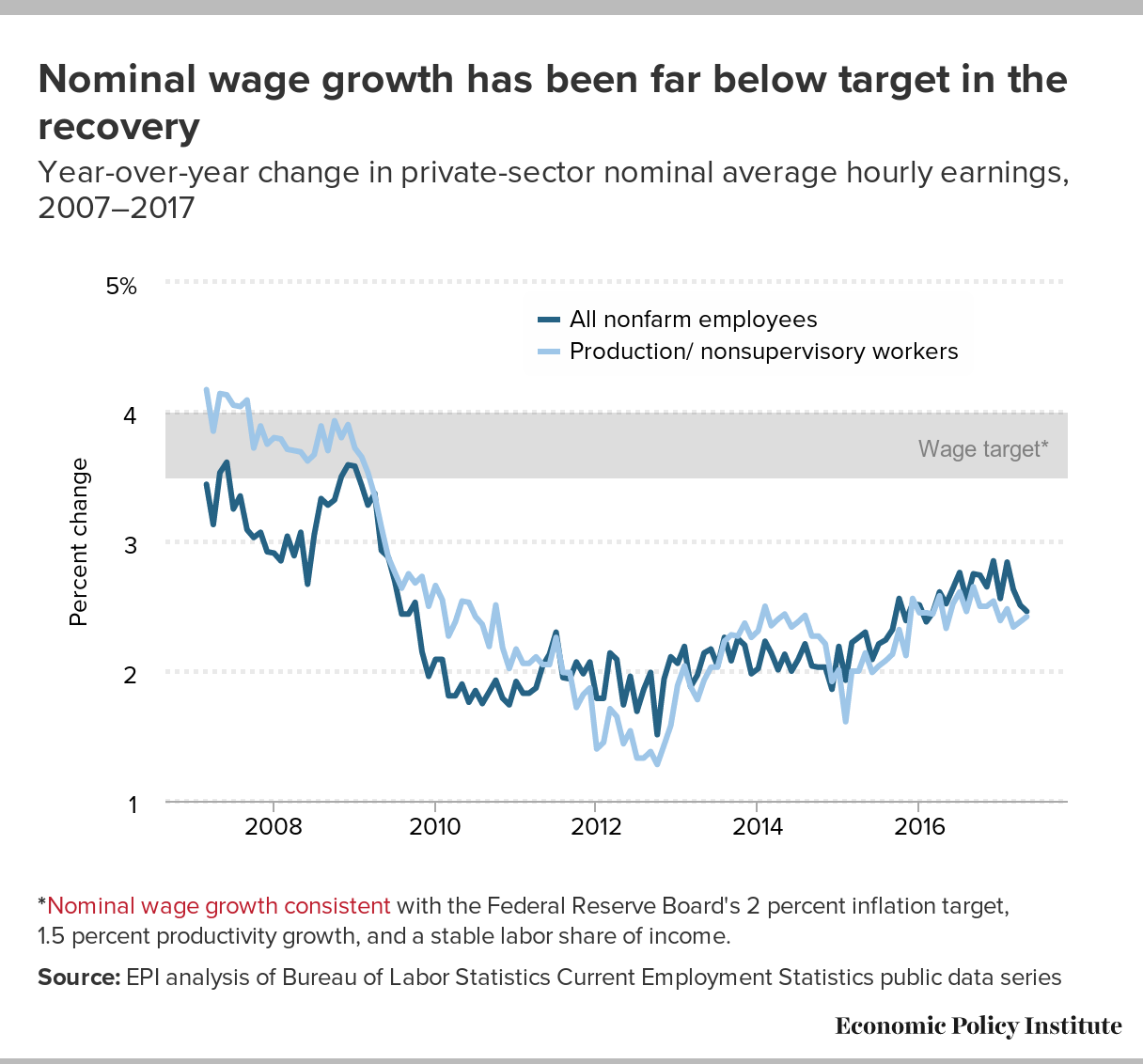

This is inflation far below the Fed’s stated 2 percent long-run target. Consistently missing the inflation target from below is actually a more-damaging mistake than allowing inflation to exceed the target for a short spell. And until there are signs that labor market tightening has led to genuine full employment that is generating nominal wage growth of 3.5 percent consistently, it is not time to raise interest rates.
Trump leaving LGBTQ nondiscrimination executive order in place signals approval of reasonable mandates for federal contractors
Last night, the White House said that President Trump would leave in place the Obama administration’s executive order that prohibits federal contractors and subcontractors from discriminating against employees on the basis of sexual orientation or gender identity in hiring, firing, pay, promotion, and other employment practices.
It goes without saying that not revoking workplace protections for LGBTQ workers is an extraordinarily low bar for supporting LGBTQ workers. A president who truly supported LGBTQ workers would be pushing for broader legislation that prohibits discrimination, like the 2015 Equality Act, which would provide clear, fully-inclusive non-discrimination protections for LGBTQ people.
Trump’s jobs goals would require massive immigration or forcing elderly Americans to work at unprecedented rates
On the White House website, the Trump administration announced a new goal of adding 25 million new jobs over the next ten years, an extraordinarily audacious, or simply innumerate, target. If their plan were successful, it would require raising employment rates well above what we can realistically hope for given the aging of the population and historical evidence on these rates. Now I happen to love optimistic agendas, but to the extent that this goal is not fantasy based on “alternative facts,” it can mean only one of two things: either the United States needs an enormous influx of immigrants, or a much higher share of the elderly population needs to be put to work.
The addition of 25 million new jobs would bring the number of employed from 152 million to about 177 million workers, which the administration hopes to achieve in ten years. Note that this is a very generous interpretation of the administration’s target, because the Congressional Budget Office (CBO) already projects 2027 employment to be higher by about 8 million, largely due to population growth. In other words, CBO’s projections imply that business-as-usual management of the economy would accomplish one-third of the administration’s goal without any extra effort. Normally when evidence-based policymakers talk about potential new jobs they want to create, they frame this in terms of jobs above already-established baselines. But, let’s grade the Trump proposal on the generous curve I noted above.
8 years of the Lilly Ledbetter Fair Pay Act
This Sunday, January 29th, marks the eighth anniversary of the Lilly Ledbetter Fair Pay Act, which helps to prevent pay discrimination. While there is no silver bullet to end gender and racial pay disparities (though we have some ideas here and here), ensuring that workers can use the legal system to receive equal pay for equal work is crucial. The Lilly Ledbetter Fair Pay Act lets workers do just that, by giving them the right to file suit 180 days after the last pay violation and not only 180 days after the initial pay disparity.
The research is conclusive: pay differentials exist and sometimes to a grave degree. Women of color face an extra penalty in the labor market and that shows up in their significantly lower wages. Typical black women are paid 65 cents on the typical white male dollar, while Hispanic women are paid a mere 58 cents on the dollar.
Furthermore, wage gaps are a problem across the wage distribution and among workers of every education level. As you can see in the chart below, women are paid less than men at every level of education. Among workers with a high school degree, women are paid 78 percent of what men are paid (or 78 cents on the dollar). Among workers who have a college degree, the share is 75 percent, and among workers who have an advanced degree, it is 73 percent.
Racial gaps in wages, wealth, and more: a quick recap
Recently, I had the opportunity to present some key facts on 1A, a new NPR news program, about the state of black America. Drawing heavily upon research by my colleague Valerie Wilson and her co-author William Rodgers III, I reported on the economy for black workers and the overall disparities that remain, and, in some cases, continue to worsen. Since that hour went by fast (and you might have missed it), I want to reiterate some of those points briefly here.
Black-white wage gaps are larger today that they were 35 years ago. For both men and women who work full time, the regression adjusted racial wage gap has widened since 1979. The figure below shows that, relative to the average hourly wages of white men with the same education, experience, metro status, and region of residence, black men make 22.0 percent less, and black women make 34.2 percent less.
Adjusted average hourly wage gaps relative to white men by race and gender, 1979—2015
| All white women | All black women | All black men | |
|---|---|---|---|
| 1979 | 37.8% | 42.3% | 16.9% |
| 1980 | 36.8% | 41.1% | 17.7% |
| 1981 | 35.7% | 40.2% | 17.5% |
| 1982 | 34.3% | 39.6% | 19.2% |
| 1983 | 33.1% | 38.3% | 17.7% |
| 1984 | 32.1% | 38.4% | 18.1% |
| 1985 | 32.3% | 38.1% | 20.3% |
| 1986 | 31.3% | 36.9% | 18.6% |
| 1987 | 30.5% | 36.0% | 18.6% |
| 1988 | 30.0% | 36.7% | 18.5% |
| 1989 | 28.1% | 35.3% | 20.0% |
| 1990 | 27.1% | 34.7% | 19.8% |
| 1991 | 25.7% | 32.2% | 19.8% |
| 1992 | 24.3% | 31.9% | 20.9% |
| 1993 | 23.1% | 30.9% | 20.3% |
| 1994 | 23.0% | 32.2% | 19.1% |
| 1995 | 23.9% | 31.5% | 20.3% |
| 1996 | 23.7% | 33.9% | 22.7% |
| 1997 | 24.0% | 33.5% | 22.3% |
| 1998 | 23.7% | 31.8% | 19.8% |
| 1999 | 24.4% | 32.1% | 19.7% |
| 2000 | 24.7% | 31.9% | 19.7% |
| 2001 | 23.6% | 33.0% | 21.9% |
| 2002 | 22.5% | 32.7% | 20.6% |
| 2003 | 23.0% | 31.5% | 21.8% |
| 2004 | 23.0% | 31.3% | 21.2% |
| 2005 | 22.4% | 32.3% | 23.0% |
| 2006 | 23.1% | 31.3% | 21.7% |
| 2007 | 22.8% | 32.4% | 23.2% |
| 2008 | 22.7% | 32.4% | 23.6% |
| 2009 | 22.9% | 32.0% | 23.1% |
| 2010 | 21.8% | 31.6% | 21.1% |
| 2011 | 20.8% | 31.8% | 21.0% |
| 2012 | 22.1% | 33.5% | 21.4% |
| 2013 | 22.0% | 32.6% | 22.2% |
| 2014 | 21.3% | 32.2% | 22.8% |
| 2015 | 22.5% | 34.2% | 22.0% |

Note: The adjusted wage gaps are for full-time workers and control for racial differences in education, potential experience, region of residence, and metro status.
Source: EPI analysis of Current Population Survey (CPS) Outgoing Rotation Group microdata
President Trump’s alternative facts have foreigners and bureaucrats, not the top 1 percent, reaping the gains from economic growth
It’s no secret that we at EPI have been skeptical about President Trump’s commitment to a policy agenda that would deliver the goods for low and middle-income Americans. His campaign proposals were nearly across-the-board great for high-income households and corporate business, but bad for most American workers. His nominees for key economic posts have been consistently hostile to policies that boost bargaining power for low and middle-wage workers. And now we have his inaugural speech, in which he specifies the groups he thinks have won and lost over recent decades in the American economy.
This speech is clarifying in that he identifies foreigners and “a small group in our nation’s Capital [sic]” as the big winners. Totally absent from his speech is the “small group” that has actually done very well and whose gains genuinely crowded-out potential growth for the vast majority of American households: the top 1 percent.
It’s unclear what evidence Trump could be referring to when decrying that “small group in our nation’s Capital” as the winners in recent decades. Since the recovery from the Great Recession began, for example, federal spending has grown more slowly than in nearly every other post-war recovery.