Job chart in Romney’s economic plan seems wrong still funky
UPDATE, June 15, 11:37 a.m.: Ah, mystery of the funky-seeming Mitt Romney jobs numbers revealed (see below for my puzzlement)—it’s a measure of full-time jobs reported in the household survey. I guess half of this is my fault—they do reference the “full-time” aspect when talking about data from the 1970s—but the rest of the chart and paragraph just talk about “job growth.”
But I will note that this is the first time I’ve ever seen full-time jobs from the household survey used to measure job market performance over business cycles. And I’m not convinced it’s a useful innovation; in fact, I think it’s pretty obvious cherry-picking.
Say five people get brand-new jobs that provide 30 hours of work per week while five more see their hours cut from 40 to 34 hours. I’d say this is 120 hours of net new additional work being demanded in the economy; but using the full-time jobs from the household survey would simply say that it’s five “jobs” lost. This just doesn’t seem useful to me.
Also, since the Romney chart ends in June 2011, it might be useful to know what happened to their preferred number in the 11 months since then: 2.25 million jobs added. The industry-standard of economists measuring recessions and recoveries—the payroll survey—has 1.7 million jobs added over those same 11 months, so I do wonder which the campaign would cite if asked.
Lastly, I’d note that there is an obvious sector, full of full-time jobs, that has seen a particularly hard time since the June 2009 beginning of recovery: the public sector. Since June 2009, 600,000 state and local jobs have been lost, and in 2009, about three-fourths of these jobs were full-time.
I was asked to comment on the speech Mitt Romney made in front of the Business Roundtable, so I decided to do some light background reading: Believe in America: Mitt Romney’s Plan for Jobs and Economic Growth.
I noticed something odd in the jobs section of the plan—this chart (ripped directly from the Romney PDF):

I know jobs numbers and recoveries, and these looked wrong to me. For one, the absolute peak-to-trough employment loss following 2007’s Great Recession was 8.8 million jobs (between Jan. 2008 and Feb. 2010) not the 8.9 million that the chart claims.
And given that this is the peak job loss, this means, by definition, that anything measured after this trough couldn’t be negative, as the chart implies. I also know that the U.S. economy didn’t begin adding jobs after the 2001 recession until the second half of 2003, so the 2001 numbers looked off, too.
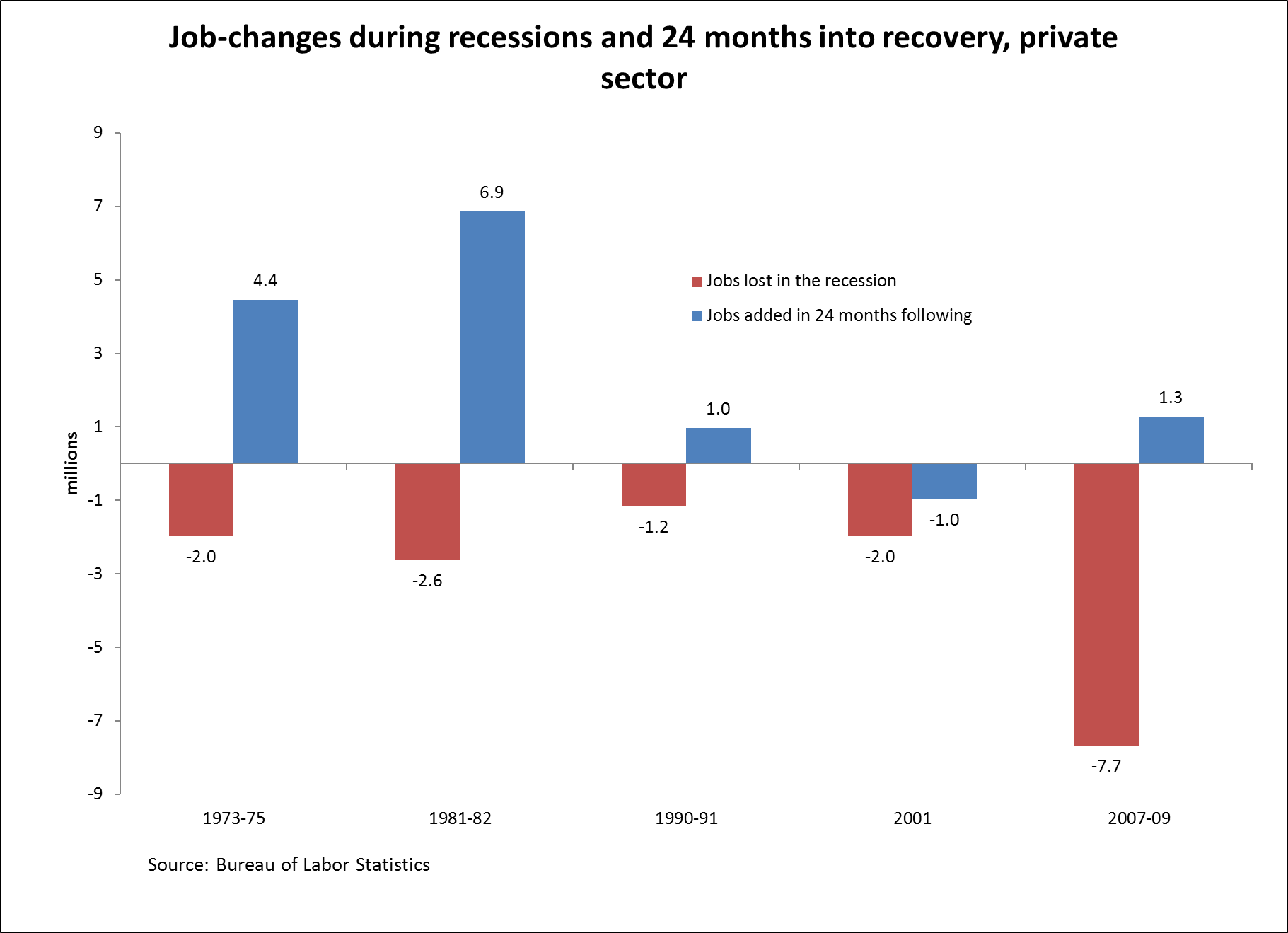
So I decided to do the chart correctly—actually show job losses during the official recessions (i.e., not just employment peak to trough) and the 24 months following and sure enough:

Romney’s numbers are all slightly off, which is odd.
Odder is that the respective performance of the recoveries following the 2001 and 2007-2009 recession are reversed. Look closely at the the last two sets of bars in the respective figures.
The Romney chart has jobs growing in the first 24 months of recovery following the 2001 recession, but shrinking in the first 24 months following the 2007-2009 recession. That’s the opposite pattern of what actually occurred—jobs shrank for the first two years after the 2001 recession and grew modestly in the first two years after the 2007-2009 recession.
I’ll note that we also tried to match the Romney numbers with quarterly data, with household-survey employment counts, with household-adjusted-for-payroll concepts survey data … nothing worked.
A little curious as to what’s going on here.
And since there’s been lots of discussion about the relative health of the private and public sectors, here’s the correct graph for private-sector jobs only.
Update to yesterday’s blog post “Fiscal hawks’ double standard for Social Security cuts vs. tax cuts”
This is an update to yesterday’s blog post “Fiscal hawks’ double standard for Social Security cuts vs. tax cuts.”
The Committee for a Responsible Federal Budget (CRFB) subsequently updated the table in their blog post, adding a column with average scheduled (i.e., promised) initial Social Security benefits for 2050. This is certainly an improvement, but their revised table still only depicts the relative comparison between initial benefits under the Bowles-Simpson plan and payable benefits. Here’s what their table would show with the additional relative comparison between initial benefits under the Bowles-Simpson plan and scheduled benefits (the lightly shaded column).

Under the Bowles-Simpson plan, medium earners reaching the normal retirement age in 2050 would see an initial benefit cut of 6 percent relative to scheduled benefits. And as CRFB duly notes in their blog post, the Bowles-Simpson proposal to use a “chained” consumer price index for cost-of-living adjustments would further reduce all beneficiaries’ benefits in subsequent years relative to scheduled benefits—a benefit cut that compounds annually, as explained in this EPI Briefing Paper.
Claims about the efficacy of fiscal stimulus in a depressed economy are based on as-flimsy evidence as the Laffer Curve?! Seriously false equivalence
Peter Orzsag calls the claim that the debt-to-GDP ratio can be lowered by providing a fiscal boost to a depressed economy the “Laffer curve of the left.” For those who have real lives and may not get the reference, the “Laffer curve” refers to the theoretical possibility that one can raise overall tax revenues by cutting tax rates. The intuition is that cutting tax rates provides incentives for working longer and saving more. In turn, this will boost economic growth sufficiently to bring in more revenue despite rates having been cut. The claim that it is relevant to the U.S. economy has been discredited empirically (and a long time ago).
In light of this, Orzsag’s claim that the “Laffer curve of the left seems to have as much empirical relevance as the original Laffer curve” is not only odd but also flat wrong.
Orzsag’s target is clearly a recent paper by DeLong and Summers that shows fiscal stimulus in a depressed economy has multiple salutary effects, not just on economic growth but even on long-run budget measures (like the debt-to-GDP ratio). The paper shows stimulus boosts near-term growth directly by relieving the constraint of insufficient demand; it boosts productive investments by giving firms an incentive (i.e., more customers coming in the door) to expand capacity; and it keeps chronic long-term unemployment from turning into a permanent erosion of workers’ skills (i.e., economic “scarring”). The assumptions about the strength of each of these effects that are needed to make fiscal stimulus debt-improving in a depressed economy are probably pretty close to real-life parameters.
Let’s do some simple math with widely-agreed upon parameters, even ignoring some of the supply-side measures DeLong and Summers examine. I’m going to round very aggressively here, but it doesn’t affect results much.
Today’s publicly-held debt is about 70 percent of GDP (call it $10.5 trillion on a base of GDP that is $15 trillion). Let’s say we decided to undertake fiscal stimulus in the form of $150 billion spent on high-multiplier activities like extending unemployment insurance, giving aid to states, or investing in infrastructure (we actually need more than this, but it’s a nice round 1 percent of overall GDP, so we’ll stick with it).
The “fiscal multipliers” on these activities are roughly 1.5, meaning they generate $1.50 in economic activity for every dollar spent on them (actually, it may be quite a bit higher, but we’ll take 1.5 as given).
So, (roughly) a year from now, this stimulus has increased the level of GDP by $225 billion (i.e., the $150 billion stimulus multiplied by 1.5). This extra GDP does indeed lower the budget deficit by bringing in more revenue. A reasonable estimate, based on CBO data, is that when the economy is operating below potential, each 1 percent increase in GDP growth yields a cyclical reduction in the budget deficit of about 0.35 percent of GDP. So, this $225 billion in additional output leads to a $79 billion improvement in the budget deficit, making the “net” fiscal cost of the stimulus just $71 billion ($150 billion minus the $79 billion offset from higher growth).
This $71 billion “net” cost of stimulus increases debt by roughly 0.7% ($71 billion divided by the current $10.5 trillion public debt). But GDP has increased by 1.5 percent. Given the current debt-to-GDP ratio of 70 percent, this means that this measure actually declines because the stimulus has increased debt by 0.7 percent but GDP by 1.5 percent.
None of these parameters, by the way, are particularly contested.1 And let’s say they’re slightly wrong, and that instead of outright improving the debt-to-GDP ratio, providing fiscal stimulus in today’s depressed economy actually makes it slightly worse – say it’s only 80 percent self-financing in terms of its impact on debt-to-GDP ratios. Would this really justify calling claims that providing fiscal stimulus in depressed economies does not damage public finances “the Laffer Curve of the left”? Not by my read of the evidence.
1. For those who like analytical solutions, all of the preceding boils down to: So long as the initial debt/GDP ratio is higher than [(1/multiplier) – fiscal clawback ratio], then fiscal stimulus reduces the debt to GDP ratio. The “fiscal clawback ratio” is simply how much a 1% boost to economic growth leads to a reduction in the budget deficit (measured also as a share in GDP). For the arithmetic above, the multiplier of 1.5 and a clawback ratio of .35 means that fiscal stimulus would reduce debt/GDP for any initial debt ratio above 32%.
Take much more conservative assumptions – a multiplier of 1 and a clawback ratio of just 0.25. Then, stimulus is debt/GDP reducing for all initial debt ratios above 75%.
Also note that this means the calculus for whether or not stimulus reduces the debt/GDP ratio gets more favorable as the initial debt ratio rises, a perhaps counter-intuitive result.
Fiscal hawks’ double standard for Social Security cuts vs. tax cuts
The Committee for a Responsible Federal Budget (CRFB) has taken sides in a scuffle between Social Security advocates and former Senator Alan Simpson. This scuffle concerns Simpson’s colorful defense of Social Security proposals within the report he co-authored with fellow Fiscal Commission co-chair Erskine Bowles—a report CRFB has gone to great lengths to champion.
CRFB was responding to a letter signed by young budget and social insurance experts—myself and others at EPI included—disagreeing with Simpson’s claim that the Bowles-Simpson proposals would strengthen the program for our generation. The merits of these proposals aside, CRFB is shamelessly cherry-picking baselines in response to the letter. Whereas CRFB and other fiscal hawks use a current policy baseline for almost all budget projections—e.g., assuming the continuation of the Bush tax cuts past their scheduled expiration—CRFB doesn’t adopt the same convention when it comes to Social Security. This is hypocritical and reveals what can only be described as a biased policy agenda.
In order to minimize the severity of the Bowles-Simpson cuts, CRFB’s defense of the Bowles-Simpson Social Security plan revolves around a comparison of projected future benefits proposed by Bowles-Simpson relative to benefits payable under current law. However, comparing benefits under Bowles-Simpson to payable benefits assumes that Congress will allow an abrupt 25 percent reduction in Social Security benefits when the trust fund is exhausted in 2033 since Social Security is prohibited from borrowing and benefits are generally funded through a dedicated payroll tax rather than general revenue.1
Social Security’s finances are routinely analyzed using scheduled rather than payable benefits—if for no other reason than the system would always appear to be in actuarial balance if projections were based on payable benefits. On a more practical level, it is inconceivable that Congress would allow draconian cuts to fall on elderly retirees. Unlike active workers, who can theoretically save more (or put off retirement) when benefits are cut, elderly retirees are usually viewed as having few other financial recourses. Thus, even in the unlikely event that nothing is done to shore up the system before the trust fund is exhausted, Congress would almost certainly use general revenues to pay promised benefits. Similarly, Congress routinely prevents scheduled cuts to Medicare physician reimbursements (the so-called “doc fix”). In other words, the difference between the current policy baseline and the current law baseline reflects the difference between what budget analysts assume future Congresses are likely to do versus what is currently set in legislation, including scheduled or automatic tax increases and benefit cuts.
Fiscal hawks—including CRFB—overwhelmingly use a current policy baseline to advocate staunch deficit reduction measures because these baselines show a much larger rise in public debt over the long-term, largely due to assumptions about the continuation of temporary tax cuts and the inability of Congress to contain health care cost growth. If CRFB wants to deviate from past practice and score the Bowles-Simpson plan relative to current law, they should also acknowledge that the plan proposes cutting taxes by $1.4 trillion relative to current law, all in the name of deficit reduction.2 Indeed, the plan “saved” $4.1 trillion over a decade relative to an adjusted current policy baseline, whereas continuing the Bush-era tax cuts will cost $4.4 trillion relative to current law.3 (Without the Bush tax cuts, there would not have been a fiscal commission.) Likewise, CRFB should argue in favor of leaving Social Security out of deficit discussions entirely, since by their definition Social Security is in long-run actuarial balance.
Using a current policy baseline when analyzing tax policies or clamoring for near- and long-term deficit reduction while cherry picking a current law baseline to justify Social Security benefit cuts is a gimmicky double standard that reflects a bias toward cutting social insurance programs.
1. Exceptions to this rule include the current payroll tax holiday and income taxes levied on Social Security benefits for high-income beneficiaries, which revert to Social Security.
2. Estimate based on CRFB’s Moment of Truth Project July 2011 re-estimate of the Bowles-Simpson plan relative to CBO’s March 2011 current law baseline for an apples-to-apples comparison over FY2012-21.
3. This is not an apples-to-apples comparison because the Bowles-Simpson adjusted current policy baseline assumed the Bush tax cuts would expire for households with adjusted gross income above $200,000 ($250,000), for a revenue increase of roughly $700 billion relative to full continuation, but even adjusting accordingly the two are very much in the same ballpark.
The long-term budget outlook has improved dramatically over the last three years
Yesterday, the Congressional Budget Office (CBO) released its annual Long Term Budget Outlook (LTBO), which projects federal spending, revenues, deficits, and debt over the next 75 years. There are many points of controversy with regards to the LTBO, not the least of which is that it’s pretty ridiculous for CBO to pretend it knows what health care costs will look like in 2087. Personally, I think that CBO’s LTBO provides a lot more heat than light, and I would be the first to applaud if CBO decided to only release ten-year budget projections (in themselves subject to a huge margin of error).
Nevertheless, there is still value in looking at the change in projections from one year to the next. The figure below clearly shows that over the past three years CBO’s extended current law budget projections—which assumes no changes are made to the law—have improved drastically.
2009: CBO projected that debt held by the public would rise from around 60 percent of GDP to just over 300 percent of GDP in 75 years.
2010: CBO markedly improves its 75-year outlook, which now shows debt rising to just over 110 percent of GDP. This improvement largely reflected passage of the Affordable Care Act (ACA), which prioritized reducing long-run deficits and slowing the rate health of care cost growth (the predominant driver of long-run deficits).
2011: CBO again improves its outlook, now projecting debt rising to 87 percent of GDP in the first 30 years but then actually falling to 75 percent over the next 45 years. This improvement was largely due to three changes in CBO’s assumptions and projections: (1) lower costs for the new ACA health insurance exchange subsidies; (2) higher taxable wages due to the employer-sponsored health insurance excise tax (pushing worker compensation away from the tax-free health coverage); and (3) a slightly higher long-run economic growth rate.
The ultimate goal of budget reform is to reach “fiscal sustainability,” a point at which public debt is growing no faster than the economy (stabilizing debt relative to national income, i.e., ability to pay). According to 2011 LTBO projections, the federal government had already achieved long-run “fiscal sustainability.”
2012: For the third straight year in a row, CBO favorably revises its long-run budget outlook: Starting in 2014, public debt is projected to fall by 0-3 percentage points each year. The public debt is shown to be fully paid down by 2070, and within 75 years the federal government is projected to have accrued reserve surpluses equal to about a third of the economy.

This improvement is primarily due to two factors. First, the Budget Control Act (the result of last summer’s debt ceiling crisis) cuts spending by over $2.1 trillion through 2021, and because of the way CBO indexes discretionary spending for inflation in its projections, it continues to reduce deficits in subsequent years. And second, CBO changed the way it projects health care cost growth. In the past, it used the average growth rate over the last 25 years, but in this report it calculated a weighted 25-year average that puts more weight on recent years. This new methodology does a better job of taking into account the fact that health care costs have been slowing recently, possibly evidence that the ACA has exceeded expectations.
Budget wonks will rightly point out that the projections in question are CBO’s extended baseline, which assumes no changes to current law. This means that the Bush-era tax cuts expire next year, the sequestration cuts also go into full effect next year, the Alternative Minimum Tax will apply to more upper middle-income households, and Medicare reimbursements to doctors will be allowed to fall dramatically. But with the exception of the sequestration trigger, all those other factors were also present when CBO made their projections in 2009, 2010, and 2011. The fact is the fiscal outlook of the federal government has improved dramatically in the last three years.
More importantly, this report clearly shows that the path toward fiscal sustainability includes allowing some—if not all—of the Bush-era tax cuts to expire and fully implementing and protecting the Affordable Care Act.
Not all debt is created equal, David Brooks
New York Times columnist David Brooks went all out in heralding the “debt is evil” stigma in his column yesterday. Regrettably, this blanket condemnation of borrowing as intemperate or immoral, intergenerational theft is all too pervasive among Washington’s policymaking elite, and all too wrong: Not all debt is created equal and suggesting otherwise impedes sound fiscal policy.
Economic actors borrow money for a wide array of activities, and both businesses and households know better than to apply a universal value judgment to debt. Borrowing money for college tuition allows for human capital accumulation, which will hopefully yield a high rate of return; borrowing money to take to the casino is widely viewed as imprudent, as the expected rate of return at any casino is negative. Businesses borrow money to build factories, buy equipment, finance research and development, and engage in other productive activities that add value to the economy. Financial firms leveraging themselves the way of Long-Term Capital Management (using debt to proportionally magnify both risk and potential returns), on the other hand, adds systemic financial risk and zero—more likely negative—economic value. Similarly, there are good and bad reasons alike to run federal budget deficits. What matters much more than the accumulation of nominal debt is the purpose of the borrowing and the ability to repay the amount borrowed.
Brooks laments that the “federal government has borrowed more than $6 trillion in the last four years alone, trying to counteract the effects of the [dotcom and housing] bubbles.” Yes, the implosion of the housing market and the ensuing financial crisis and recession forced Congress to borrow heavily as the cyclical portion of the budget deficit ballooned and fiscal policy was used to arrest a steep economic contraction, propping up aggregate demand and the financial sector alike. The alternative, however, was a depression that would have swollen budget deficits regardless, while greatly impeding our ability to repay debt because of lost income and economic scarring reducing future potential income. Indeed, policymakers’ failure to restore full employment—which still necessitates much more deficit-financed stimulus—is producing such scarring effects: The U.S. economy is still running $861 billion—or 5.3 percent—below potential output and the Congressional Budget Office has downwardly revised projected potential output for 2017 by 6.6 percent since the onset of the recession. That is real, welfare-reducing economic waste resulting from insufficient public borrowing—borrowing that could have put productive resources to use instead of allowing them to atrophy.
Economists Lawrence Summers and Brad DeLong compellingly argue that given present U.S. economic conditions (where the Fed cannot singlehandedly stabilize the economy), deficit-financed stimulus is actually self-financing. Essentially, if nominal interest rates are below long-run trend real GDP growth adjusted for reduced economic scarring effects and improvements in the cyclical budget deficit resulting from stimulus, a dollar of debt more than pays for itself in the long-run. CBO projects real GDP growth will average 2.4 percent over the next 25 years, whereas the yield on 10-year Treasuries is only 1.55 percent (hovering around a record low); high bang-per-buck fiscal stimulus passes any reasonable cost-benefit analysis test so long as the economy remains mired well below potential in a liquidity trap.
What Brooks misses entirely is that any value judgment regarding debt boils down to the opportunity cost of debt and the value added of the tax or spending program being deficit-financed—particularly in ways that affect the ability to repay debt.
Example 1: The Bush-era tax cuts were entirely deficit-financed, adding some $2.6 trillion to the public debt between 2001 and 2010, while failing to produce even mediocre economic performance (the 2001-2007 Bush economic expansion was the weakest since World War II). Numerous economists believe that, between their dismal efficacy and the reduction in national savings they induced, the Bush tax cuts decreased long-run potential output.
Example 2: If the rate of return on infrastructure spending exceeds the cost of financing, it makes sense to borrow money to build a bridge, or better yet repair a bridge (the cost of repair increases with time and preventative maintenance is much more cost effective than rebuilding infrastructure from scratch). As my colleague Ethan Pollack points out, the case with infrastructure is a clear cut “win-win-win” because it raises potential future output, making the incurred borrowing relatively easier to pay back, and infrastructure spending increases actual present output and employment (reducing cyclical deficits). And today, the opportunity cost of infrastructure investment is at historic lows.
There is good debt and wasteful debt alike, just as both constructive editorializing and gibberish can be found scrawled across op-ed pages. Brooks’ failure to recognize any economic context or nuance only feeds the misguided debt hysteria that has pushed most of Europe back into recession and encouraged U.S. policymakers to give up job creation in favor of premature, counterproductive austerity.
‘Simplistic Keynesians’ still right about the economy
Brad DeLong links to what he calls a “DeLong-Summers ‘Simplistic Keynesians’ Smackdown Watch“—a piece by Ken Rogoff calling “dangerously facile” those who argue for the “simplistic Keynesian remedy that assumes that government deficits don’t matter when the economy is in deep recession; indeed, the bigger the better.”
Since “simplistic Keynesianism” is a pretty good description of my diagnosis and remedy for today’s U.S. economic troubles, and since I don’t want to ever be “dangerously facile,” I read both the Rogoff commentary and the Reinhart, Reinhart, and Rogoff (2012) paper that it links to.
I did learn one thing—it turns out that my earlier post about the likely provenance of a Rogoff claim about the potential damage from high public debt isn’t quite right—but the new provenance of this claim isn’t right either.
There’s not much particularly new in either piece. Instead, they recycle the finding that, looked at over several centuries, there is an odd threshold of debt-to-GDP ratios—90 percent—that sees growth beneath the threshold run about 1 percentage point higher per year than growth above the threshold. They then do the arithmetic and argue that every year that the public debt-to-GDP ratio is over 90 percent is a year of GDP growth 1 percent lower than it would otherwise be and voila, the damage from high debt has been documented.
Or not. We’ve already noted why we think this threshold, while it might be an interesting (if odd and deeply atheoretical) curiosity, has no relevance to current U.S. policy debates (and yet somehow the 90 percent scare-mongering won’t stop—see David Brooks’ latest invocation of it).
The main reason for this judgment is that the causality between slow growth and high public debt is extremely two-way. There have almost surely been times when exogenous decisions to add to public debt have hampered countries’ growth. But there have also surely been times (and many more times, in my guess) when slow growth has led directly to rising debt-to-GDP ratios. And when this is the case, noting a simple negative correlation between GDP growth and a particular debt-to-GDP threshold tells us nothing about how dangerous—or, more likely, useful—a policy of further fiscal support would be.
And, there is no doubt that the increase in public debt over the past four years in the U.S. is directly the result of the Great Recession, and not a cause of it. Further, adding to this public debt going forward (so long as it was intelligently spent on job creation) would not only not harm the economy, it would reduce the debt/GDP ratio.
To be blunter, applying results gleaned from the over 80 percent of the country-years in their high-debt sample period that began before World War II, as well as the other clear-as-day cases where high debt was driven by slow growth (Japan in the 1990s and 2000s) does nothing to aid policy analysis about fiscal support in the here-and-now.
The authors even miss an obvious clue regarding those episodes in their data where high debt is driven by slow growth—the failure of elevated public debt to lead to upward pressure on interest rates. High public debt-to-GDP ratios combined with no upward pressure on interest rates is a key tell that it’s likely that below-potential growth is driving the debt ratio and not vice-versa.
Further, if interest rates are not pushed up by rising debt-to-GDP ratios, there is no mechanism for rising debt to impede growth. The authors gloss over this—just noting that “the growth-reducing effects of public debt are apparently not transmitted exclusively through high real interest rates.” More likely, the growth-reducing effects of public debt are simply non-existent when economies are deeply depressed.
Lastly, the paper makes a mistake that I think is key to understanding why policymakers keep getting blindsided by bad news (like the last two-months’ poor job growth) that just should not be that surprising: it assumes that economies naturally heal themselves from recessions, and quite quickly.Read more
Union decline and rising inequality in two charts
One hallmark of the first 30 years after World War II was the “countervailing power” of labor unions (not just at the bargaining table but in local, state, and national politics) and their ability to raise wages and working standards for members and non-members alike. There were stark limits to union power—which was concentrated in some sectors of the economy and in some regions of the country—but the basic logic of the postwar accord was clear: Into the early 1970s, both median compensation and labor productivity roughly doubled. Labor unions both sustained prosperity, and ensured that it was shared. The impact of all of this on wage or income inequality is a complex question (shaped by skill, occupation, education, and demographics) but the bottom line is clear: There is a demonstrable wage premium for union workers. In addition, this wage premium is more pronounced for lesser skilled workers, and even spills over and benefits non-union workers. The wage effect alone underestimates the union contribution to shared prosperity. Unions at midcentury also exerted considerable political clout, sustaining other political and economic choices (minimum wage, job-based health benefits, Social Security, high marginal tax rates, etc.) that dampened inequality. And unions not only raise the wage floor but can also lower the ceiling; union bargaining power has been shown to moderate the compensation of executives at unionized firms.
Over the second 30 years post-WWII—an era highlighted by an impasse over labor law reform in 1978, the Chrysler bailout in 1979 (which set the template for “too big to fail” corporate rescues built around deep concessions by workers), and the Reagan administration’s determination to “zap labor” into submission—labor’s bargaining power collapsed. The consequences are driven home by the two graphs below. Figure 1 simply juxtaposes the historical trajectory of union density and the income share claimed by the richest 10 percent of Americans. Early in the century, the share of the American workforce which belonged to a union was meager, barely 10 percent. At the same time, inequality was stark—the share of national income going to the richest 10 percent of Americans stood at nearly 40 percent. This gap widened in the 1920s. But in 1935, the New Deal granted workers basic collective bargaining rights; over the next decade, union membership grew dramatically, followed by an equally dramatic decline in income inequality. This yielded an era of broadly shared prosperity, running from the 1940s into the 1970s. After that, however, unions came under attack—in the workplace, in the courts, and in public policy. As a result, union membership has fallen and income inequality has worsened—reaching levels not seen since the 1920s.
By most estimates, declining unionization accounted for about a third of the increase in inequality in the 1980s and 1990s. This is underscored by Figure 2, which plots income inequality (Gini coefficient) against union coverage (the share of the workforce covered by union contracts) by state, for 1979, 1989, 1999, and 2009. The relationship between union coverage and inequality varies widely by state. In 1979, union stalwarts in the northeast and Rust Belt combined high rates of union coverage and relatively low rates of inequality, while just the opposite held true for the southern “right to work” states. A large swath of states—including the upper Midwest, the mountain west, and the less urban industrialized states of the northeast—showed lower-than-national rates of inequality at union coverage rates a bit above or a bit below that of the nation. More importantly, as we plot the same relationship in 1989, 1999, and 2009, those states move as a group towards the less-union coverage, higher-inequality corner of the graph. The relationship between declining union coverage and rising inequality is starkest in the earlier years (between 1979 and 1989). After 1999, union coverage has bottomed out in most states and changes in the Gini coefficient at the state level are clearly driven by other factors, such as financialization and the real estate bubble.
MORE: View interactive graphic of union decline and rising inequality in the U.S.
Colin Gordon is Professor of History at the University of Iowa and a Senior Research Consultant at the Iowa Policy Project
Adding to Joe Nocera’s piece: A revival of the labor movement is necessary to preserve our democracy
It was good to see Joe Nocera’s column today affirming Tim Noah’s recent call for a revival of the labor movement, saying “if liberals really want to reverse income inequality, they should think seriously about rejoining labor’s side.” I would add that such a revival is necessary to rebuild the middle class and to preserve our democracy.
I’m proud that EPI has provided a lot of great research addressing the role of unions in the economy, ranging from: the impact on firms and competitiveness; the impact on the wages and benefits of union and nonunion workers; the impact on wage inequality; the flawed nature of the current process for choosing union representation; and much more. Here’s a brief guide:
- See a talk by Paul Krugman addressing the problem of income inequality, including the problem of eroded unionization. Krugman expresses some of the same sentiment as Nocera, paraphrasing “we didn’t know what we were missing until they were gone.” Pieces by Tom Kochan and Beth Shulman, and by Harley Shaiken, echo his arguments.
- Testimony by me, and another by Rutgers professor Paula Voos, articulate the importance of unions for American workers and the role unionism can play in rebuilding the middle class.
- Matt Vidal and David Kusnet provide 12 case studies from a variety of industries, including nursing, meatpacking, and janitorial, to show how unions can benefit workers and communities while making companies more productive. They also illustrate the damage inflicted when union representation is removed.
- Professor John DiNardo of the University of Michigan describes his and other research that unionization does not cause businesses to fail. Using a ‘regression discontinuity’ technique, DiNardo compares places that unionize to those that don’t and finds that differences in representation election outcomes were very similar: The near-losers are a very good “control group” for firms where the workers have just won the right to bargain collectively. DiNardo says: “This research provides evidence that this causal effect of union recognition is zero and has been zero since at least the 1960s, which is how far back we can go with the available data. In short, the biggest fear voiced by employer groups regarding unionization—that it will inevitably drive them out of business—has no evidentiary basis.”
- EPI Research and Policy Director Josh Bivens shows why unions are not to blame for the loss of U.S. manufacturing jobs, and that in fact, the real culprits are manipulated currency rates that make U.S.-made goods overly expensive. A dysfunctional health care system that burdens responsible employers with outsized costs, and high executive and managerial salaries, also contribute to any lack of competitiveness.
- Richard Freeman of Harvard University, perhaps the world’s leading labor market economist (I think so at least), writes that an overwhelming majority of workers say in surveys that they want a stronger collective voice on the job, and believe that a union would be good for their firm as well. Freeman’s findings “suggest that if workers were provided the union representation they desired in 2005, then the overall unionization rate would have been about 58%.”
- To get a picture of the broken process of union representation elections where employers freely intimidate workers, read Kate Bronfenbrenner’s report. Private-sector employer opposition to workers’ efforts to form unions has intensified and become more punitive than in the past. Employers are more than twice as likely to use 10 or more tactics—including threats of and actual firings—in their campaigns to thwart workers’ organizing efforts.
- Last, see the statement in support of the Employee Free Choice Act by me, along with Richard Freeman of Harvard and Frank Levy of MIT, citing the recent unprecedented growth of inequality in household income and the urgent need to give workers more bargaining power. Forty prominent economists signed the original statement, including three Nobel Prize winners, agreeing that the reform would be an overall benefit to the economy, and would provide a boost to workers when they need it most. Other economists later added their voices by signing the same statement, which resulted in close to 200 more signatories. The statement is available for download in both its original and updated versions.
We still have a long way to go to achieve racial equality
Washington Post columnist Richard Cohen recently illustrated how much overt racial bigotry against blacks has been reduced. He used the case of Wesley A. Brown, the first African American graduate of the United States Naval Academy. Brown was the first to “successfully endure the racist hazing that had forced the others to quit.” When Brown joined the Naval Academy, if blacks dared to enroll, they were harassed to force them out. Today, there is a building in the Naval Academy named in Brown’s honor.
Cohen is correct. Today, black children know that there is no occupation that is categorically off limits to them. They can grow up to be president, an idea that seemed farfetched just a few years ago.
On the other hand, the picture Cohen painted would have looked starkly different had he focused less on interpersonal discrimination and more on institutional discrimination. By “institutional discrimination,” I am referring to the ways that the normal policies and practices of social institutions like the educational system, the labor market, and the criminal justice system serve to maintain racial inequality.
Cohen celebrates the end of legally enforced segregation, but fails to acknowledge that we still live with a great deal of de facto racial segregation. A large number of our neighborhoods are racially segregated, which means that many of our schools are racially segregated. Segregation concentrates black children not merely in majority-black schools, but also in schools where a majority of students are in poverty. While, in theory, there are no limits facing black children, children born into economically disadvantaged families, in economically disadvantaged communities, who then attend economically disadvantaged schools have the odds stacked against them.
One reason black families are disproportionately economically disadvantaged is because blacks are still about twice as likely as whites to be unemployed. This was the case in the 1960s, and it remains true today. This basic relationship holds true at all education levels. Black high school dropouts are about twice as likely to be unemployed as white high school dropouts. Black college graduates are about twice as likely to be unemployed as white college graduates. Research shows that employers still have a preference for hiring whites over blacks.
Our criminal justice system is another site where policies and practices systematically disadvantage blacks. As the book Dorm Room Dealers illustrates, white middle-class youth use illicit drugs and sell illicit drugs, but this population is much, much less likely to be incarcerated for these offenses than are poor black youth engaging in the same activities. Michelle Alexander’s The New Jim Crow goes into greater detail about how our illicit drug policies and practices produce institutional discrimination against African Americans.
Cohen is correct. There is no better time to be black in America than today. While this is a true statement, we also still have a long way to go before there is equal opportunity for all.