Bernard ‘B’ Rapoport remembered
Last night’s memorial service for Bernard Rapoport at the St. Regis Hotel in Washington brought together hundreds of his family members, friends, and colleagues. Everyone in attendance treasured his enthusiasm, generosity, and thirst for economic justice and fairness. “B,” as he was affectionately known, founded American Income Life Insurance and was one of EPI’s longest-serving board members. I was privileged to attend a service that mixed politics, religion, and humor in a celebration of a life well lived.
MORE: EPI statement on Rapoport’s passing
President Bill Clinton topped a list of past and current Democratic politicians who spoke of B’s loyalty, persistence, and progressive values. As Sen. Tom Harkin (Iowa) remarked, B was the rare political donor who pushed politicians and the government to demand more from the rich, rather than to cater to them. B was born poor (unlike most rich people), yet he never deluded himself into thinking that he was a self-made man. He knew that the government and our system of laws, the education he received, and his employees were all critical to his success.
Despite being a millionaire and a CEO, B never bought into the notion that as a “job creator” he was entitled to a lower tax rate than the folks who worked for him. He never thought that the government owed him anything. He also vehemently rejected the belief that the nation would be better off if the rich got continually richer at the expense of the many. As President Clinton said, B never tuned in to the message of greed and egotism that has characterized the last 35 years of politics in Washington.
Instead, B learned and subsequently taught a very different lesson: “As I grew up I realized when too few have too much and too many have too little, we do not have a sustainable society.”
Addressing unfair expectations for the next wave of educators
I regularly encounter, as I travel around the country, teachers who are dispirited by what they feel is an unrestrained contempt for their calling and career. These teachers feel that this contempt, initially expressed by politicians and “experts” with no classroom experience, has been repeated so frequently that it has spread to the public at large. They feel they are being blamed for all the inequities in American society, and are expected to rescue children from impoverished families and communities with no support from others in society. They feel abused by demands that they discard curriculum it has taken them years to develop, curriculum they are convinced has inspired children who had little prior interest in school, to love learning and inquiry. They do not believe that requirements that they focus on preparing students for standardized tests is respectful of the educational process or their own expertise, because such tests reflect only a tiny part of the knowledge and skills children need. These teachers are embittered and feeling put upon by those who claim to represent the interests of poor children but express this interest by trying to destroy the public education system that is the only institution attempting to serve these children. The teachers I meet all consider some colleagues to be inadequate and would like to see them leave. But the teachers I meet insist that poor performers are a small minority in their schools, and resent the now-popular and, they feel, indiscriminate witch hunt to cleanse schools of incompetents.
Last week, I addressed the 2012 graduates of the School of Education of Loyola University–Chicago. Anticipating (correctly, as it turned out) that these young people shared many of the feelings of the experienced teachers I have described, I urged these students to have the confidence to resist the now-conventional attack on public education and their teachers. Here is what I said to them:
Thank you, Dr. Fine, President Garanzini, Dean Prasse, faculty, parents, and guests.
Congratulations to the graduates.
Good luck as you embark on new responsibilities in one of the most important enterprises with which our society can entrust you – the preparation of the next generation.
Yet you leave here in a national climate of mistrust for all government, including public education. You are entering a highly politicized field where facts are too easily ignored.
In medicine, and in all fields, we know you can’t design proper treatment if your diagnosis is factually flawed.
Yet in education, conventional and widely shared diagnoses are based on fantasy, with little relation to facts.
Understanding these fantasies requires you not only to be good educators, but sophisticated citizens, capable of questioning data and penetrating the relationships between schools and the society that they reflect.
Politicians of both parties, leading educators, and philanthropists like Bill Gates who increasingly influence education policy, repeat incessantly that our schools are failing, especially for disadvantaged children. Past efforts at improvement, and vast increases in spending, have accomplished little or nothing, they say. Achievement gaps between disadvantaged and middle class students have narrowed little, so as the proportion of white children declines, this failure of our schools weakens our nation, rendering it unable to compete internationally.
In truth, this conventional view relies upon imaginary facts.
You may be surprised to learn that African-American elementary school student achievement, in Illinois and nationwide, has been improving so spectacularly that in math, the average black student now performs better than about 90% of all black students performed less than a generation ago.
What’s more, black elementary school math performance is now better than white performance was in the previous generation.
Let me repeat: black elementary school students today have better math skills than white students did only twenty years ago.
These data come from the National Assessment of Educational Progress, a federal sample that is the only reliable source on student achievement over time in this country.
The gains have been almost as great for middle-schoolers in math, and for elementary school students in reading,
Most gains were posted in the 1990s, before the test-obsessed accountability system called “No Child Left Behind,” a law whose flawed premise was that it was necessary to force educators to pay attention to minority students. Read more
Video: Cambridge Forum discussion on the U.S. and globalization
The Cambridge Forum hosted a videotaped mini-conference on the impact of global engagement on the U.S. and world economies on April 16. Speakers and topics included University of Massachusetts Amherst economic professor Robert Pollin on the “Globalization of Labor: Is a Race To the Bottom Inevitable?”; Economic Policy Institute Director of Trade and Manufacturing Policy Research, Robert Scott, on the “Globalization of Capital: The Rise of the Multinationals”; editor-at-large of The American Prospect and Washington Post columnist Harold Meyerson on the “Globalization of Markets: Do Corporations Need American Consumers?”; and Harvard Kennedy School of Government Professor of International Political Economy Dani Rodrik, who delivered the keynote address on his book, The Globalization Paradox (New York: W.W. Norton & Company, Inc.).
Each participant delivered brief remarks and engaged in wide-ranging question-and-answer sessions with the audience that were moderated by Robert Kuttner, co-founder of The American Prospect (Note: Kuttner is an EPI co-founder and board member). You can watch videos of all four speakers below:

Paging the congressional ophthalmologist
Sometimes it all seems to come together in a perfect storm of bewildering congressional myopia. This seems like one of those times.
This weekend, as many as 236,300 Americans without work will lose their unemployment insurance as a consequence of the “compromise” that Congress passed in February to save the payroll tax cut and UI extension. This is on top of the estimated 173,000 of the jobless who already lost their benefits this year. Some will inevitably argue that this is a good thing because extending benefits keeps people from taking available jobs. This is a wildly deceptive claim. The research shows that in some cases, the availability of unemployment insurance allows people greater flexibility to find jobs that better match their skills, but it’s not causing anyone to give up work entirely. In fact, unemployment insurance keeps discouraged job seekers from giving up their search for work, and adds a meager source of income to those individuals who are the most likely to spend their income and bolster overall aggregate demand.
The real problem is that there simply are not enough available jobs. Yet, instead of strengthening programs that help these and other people still struggling in the wake of the Great Recession, the Republican-controlled House voted yesterday to slash $310 billion in funding for such programs to avoid the previously agreed-upon cuts to the defense budget. What’s perhaps most shocking about this vote is that it comes despite the fact that an overwhelming majority of Americans—both Democrats and Republicans—favors reductions in defense spending over cuts to other domestic programs.
Cutting important social protections and reducing assistance to people in need is only going to push more Americans into poverty. But in the cruelest of ironies, some members of Congress were not content with shooting America in the foot; they voted to blind her as well. On Wednesday night, House Republicans voted to defund the Census Bureau’s American Community Survey, an incredibly powerful source of data for examining state and local economic trends, and one of the primary tools that the government uses to track poverty!
Some might argue that all of this constitutes the House’s attempt to commit the crime and then hide the evidence. I’ll give them the benefit of the doubt that it is just plain short-sightedness.
Larry Summers shrewdly reframes tax simplification
Last week, economists Martin Feldstein and Larry Summers sparred over tax reform on a panel discussion hosted by the Brookings Institution’s Hamilton Project. It is widely agreed that Washington is overdue for and likely headed toward comprehensive tax reform in the next few years. Any compromise on a long-term deficit reduction package will necessitate more revenue and a quarter-century has passed since the last major scrubbing of the tax code (though the Tax Reform Act of 1986’s revenue- and distributional-neutrality makes it an inappropriate benchmark for reform). Most of the reform proposals have focused on broadening the tax base—i.e., eliminating or curbing tax expenditures—rather than raising marginal tax rates to increase revenue. Tax reform is also typically couched in the objectives of simplifying the tax code, reducing economic distortions, and creating a “pro-growth” tax code.
Summers raised an excellent point about the tax reform discourse, particularly the way tax simplification is spun by many advocates. Simplifying the tax code is often falsely equated with reducing the number and scale of marginal tax rates. The House Republican budget, for instance, proposed consolidating the income tax to two brackets—of just 10 and 25 percent—as the cornerstone of “simplifying the tax code and promoting job creation and economic growth.” But in the age of tax return software, Summers argued that tax rates don’t add to complexity; the complicating factor is calculating taxable income. Even before TurboTax, citizens managed to navigate a much longer schedule of marginal tax rates; the tax code had at any time between 24 and 26 marginal tax rates between World War II and 1978. The tax code was also much more progressive, particularly at the top of the income distribution, and income growth was evenly shared over this period. At present, compressing the number of marginal tax rates (currently at six) would only further decouple the contours of the tax code from the increasingly uneven distribution of income gains.
Reform is often framed in terms of broadening the tax base and simplifying the code in tandem, but Summers noted the two are often contradictory objectives. Base broadening inherently increases the amount of taxable economic activity, which in some circumstances can actually make the tax code more complex. Summers gave the example of repealing the exclusion on owner-occupied home sales from capital gains taxation, which would broaden the tax base and raise revenue but unquestionably increase complexity for many filers. Summers downplayed the need for simplification—at least as it’s often thought of—in this tradeoff, and instead endorsed base broadening in ways that increase revenue and the perception of tax fairness.
The complex nature of the tax code favors—both in effect and appearance—those with numerous financial planners and accountants, including dozens of Fortune 500 companies paying nothing in taxes. The tax code needs to be cleaned in ways that inhibit tax gaming and avoidance—best accomplished by reducing tax loopholes that allow for income shifting, such as the preferential rates on capital gains and dividends or the tax deferral for U.S.-multinationals’ foreign source income. That largely amounts to base broadening. Flattening the schedule of marginal income tax rates, on the other hand, would not improve tax compliance or simplify the tax code but would markedly reduce both tax fairness and revenue. When push comes to shove, much of what is peddled as “tax simplification” is nothing but an attempt to further undermine tax progressivity and reduce effective tax rates for upper-income households; doing so would amount to a tax cut, not tax reform.
Senate health committee hearing stresses importance of paid sick time
As my colleague, Ross Eisenbrey, pointed out earlier, the Senate Committee on Health, Education, Labor and Pensions held a very important hearing today (in honor of the upcoming Mother’s Day holiday this weekend) looking at the balance between work and family. This work/family balance has become one of the most ubiquitous sources of economic stress for millions of American families.
One of the important policy proposals covered at the hearing was providing a minimum number of paid sick days to all workers. As Judith Lichtman of the National Partnership for Women and Families noted during the hearing, 40 million workers have no paid sick time to care for themselves or family members when they get sick. Most of the evidence presented at the hearing in favor of providing this important policy was compelling, and it should be clear by now that paid sick time is essential for working families’ economic security. The personal testimony of Kimberley Ortiz about her lack of job security and the penalties she faced at work when she needed to take care of her sick son was particularly compelling and powerful.
In the Senate hearing, Juanita Phillips, Director of Human Resources of Intuitive Research and Technology, spoke about the flexibility her company provides to her workers. She attributes these characteristics—e.g. flexible work hours, paid time off, parental benefits (including short term disability)—to why her company is rated the country’s No. 2 best small business to work for by the Great Place to Work Institute.
Given this, it’s surprising that she argues against the Health Families Act. She claims her company will be punished for already doing the right thing. As an economist, that argument simply makes no sense. To her company, the law is what we economists call a “nonbinding constraint.” They currently provide 15 days of paid time off to new employees for use immediately, and 20 days of paid time off at three years of service. The bill proposes only 7 days.
It doesn’t add up. The one thing Phillips said that could explain her company’s position, is their concern about losing their competitive edge to recruit and retain the best talent. So, she admits the policy is a good one, but doesn’t want to encourage others to engage in it as well. Let’s just say that keeping millions of American families stressed so that a couple of high-road companies get a better pool of resumes when they offer job openings seems like a bad trade-off to me.
This issue is too important to our working families—particularly those at the middle and low end of the wage scale. Furthermore, in the context of similar legislation that was passed in Connecticut, the bill would be of very little cost to businesses, even including those businesses that are not already in compliance with the law.
Organized business’s knee-jerk opposition to paid sick days legislation
The Senate Committee on Health, Education, Labor, and Pensions is holding its Mother’s Day hearing today, and the main subject is paid sick leave, something every working mother needs. Sen. Tom Harkin (D-Iowa) and Rep. Rosa DeLauro (D-Conn.) have introduced a bill, the Healthy Families Act (S. 984/H.R. 1876), to mandate that every employee receive at least seven days of paid time off for illness each year. Everywhere in the civilized world, employees have the right to at least some minimum amount of paid leave when they or their children are sick or when they have to see a doctor—everywhere except in the United States.
The organized U.S. business community—represented by the Washington lobbyists and dozens of giant trade associations—fiercely opposes giving American workers this right.
Why? Because business owners don’t want to be told what to do by anybody, least of all by the government. They consider themselves entitled to force employees to choose between working while sick, taking leave without pay (if the employees are lucky enough to have the right to take unpaid leave), or being fired.
At this morning’s hearing, the business community was represented by the Society for Human Resources Management, which reflexively takes the position that workers should not have legal rights; they should not, for example, have the legal right not to be fired without just cause, they should not have the right to a minimum wage, they should not have the right to unpaid leave to care for family members, they should not have the legal right to advance notice that their office, store or factory will be shut down, etc. The SHRM position is that wages, benefits, and protections should be left to the whim of the employer, or in fancier terms, to market forces.
As usual, the SHRM witness is testifying this morning that her business treats its employees well, giving its employees with three years or more of service 20 days of paid leave. The implication is that left alone, businesses will treat employees as well as they can afford to, and everything will be for the best.
But this benign view is not true. Absent legislation, businesses will treat employees only as well as they want to, even if they can afford to do much more. Even businesses whose CEOs are paid millions of dollars a year can deny all or most of their workers any paid sick leave at all. This problem is so widespread that about 40 percent of the private-sector workforce has no right to even a single day of paid sick leave. That’s 40 million people—mostly low-wage workers who are barely scraping by—who go unpaid if they get sick or if they have to take time off to care for a sick family member.
The SHRM witness argues that a mandate is “inflexible,” and that’s true. It should be inflexible; the whole point is to guarantee a basic, minimum right to workers—most of whom are women—that they need very badly. Nothing would prevent a business from doing more, as the SHRM witness’ business already does.
SHRM’s alternative arguments against the paid sick leave legislation are altogether astonishing. SHRM’s witness argues that providing generous benefits is a competitive advantage to her company that would be lost if every business were compelled by law to provide them, ignoring that the bill’s mandate is for only seven days of paid leave, rather than the 20 days her business provides, leaving plenty of competitive advantage.
“We provide generous paid leave so that we can continue to be an employer of choice for employees and applicants in our area. What we do not want is a government-imposed paid leave mandate to take away our competitive edge over other employers.”
And finally, she argues that it is somehow degrading to be told what to do by the government:
“Organizations such as ours that are already extremely successful with flexible workplace outcomes should not be brought down to the mediocre level that regulatory approaches would be trying to get not-so-well-run companies up to achieving.”
The silliness of these arguments is pretty good evidence that the business community has no good reason (no economic reason) to oppose the Healthy Families Act. Their opposition is ideological: They own the businesses, and no one has the right to tell them (the 1 percent) how to treat their workers—not even a government of the people, by the people, and for the people.
Grasping at Chinese straws
The Commerce Department released another depressing report on the U.S. trade deficit this morning, our monthly reminder of the huge gap between globalization’s economic reality and American economic policymaking.
In March, we bought about $52 billion (28 percent) more from the rest of the world than we sold. From first quarter 2011 to first quarter 2012, the deficit on goods and services rose almost 8 percent, with China representing almost two-thirds of our non-oil deficit with the rest of the world.
Yet, over the past year or so, a drumbeat of analysis in the establishment business press has been telling us to stop worrying; our chronic trade imbalance with China will soon disappear. New York Times columnist Eduardo Porter last week summed up the happy scenario: Chinese wages and transpacific transportation costs are rising and the Chinese are allowing their currency to appreciate. The implication is that rather than exerting unpleasant political pressure on China, we should trust in the natural workings of the market and the good common sense of the Chinese leaders who “appear to understand the need for change.”
Don’t hold your breath.
Porter is correct that wages are rising in China faster than they are in the United States. But to get a perspective, check out the Bureau of Labor Statistics’ numbers on international labor costs in manufacturing, where the latest data—for 2008—is that Chinese manufacturing costs are a little over 4 percent of U.S. levels. Yes, they probably have risen since then, but the gap is still immense and will clearly not be closed anytime soon.
Moreover, the narrowing of the gap may have as much to do with U.S. workers getting less as Chinese workers getting more. The corporate poster boy for looking at the bright side is General Electric, which has moved some production of a few heavy appliances back to the U.S. from China. What the poster leaves out is that GE workers who used to make $22 an hour are now making $13.
It is also true that rising fuel costs are making it more expensive to import large, heavy products from across the Pacific. But that hardly means that production will move back to the U.S. Thanks to the North American Free Trade Agreement, multinational producers of big appliances and autos and parts who find importing from China too expensive, are moving to Mexico where labor costs are 18 percent of what they’d pay in the U.S.
Finally, Porter writes that the Chinese strategy of manipulating their currency to keep their exports cheap and imports expensive “may be turning the corner.” He notes that the Chinese, while they don’t want to appear caving to American pressure, have quietly allowed the renminbi to appreciate 40 percent against the dollar since 2005.
Just so. And over that time our trade deficit with China has grown by over 45 percent, suggesting how large China’s comparative advantage in trade has become. Moreover, despite the endless parade of American officials to Beijing pleading for more currency appreciation, the Chinese apparently think they’ve already done enough. Porter himself quotes China’s premier Wen Jiabao to the effect that the dollar-renminbi now may “have reached equilibrium level.”
Thus, there is little evidence that either the market or the Chinese leadership intend to rescue the U.S. from its trade quagmire.
Unfortunately, neither is there evidence that American leaders—from either party—intend to take responsibility for doing it themselves. Not only do they have no strategy to deal with the trade deficit, but President Obama and congressional Republicans are busily preparing for yet another of the so-called free trade agreements—this one to a group of countries around the Pacific rim—that have allowed our multinationals to off-shore production for the American consumer for over three-and-a-half decades.
But the market will not be denied; eventually we will balance our trading account. So, in the absence of a proactive policy, GE will be the model—the relentless lowering of American wages and living standards until the gap with workers in China and Mexico is closed.
Andrew Biggs is at it again
Comic Demetri Martin has this advice: “Only people in glass houses should throw stones, provided they are trapped in the house with a stone.”
Feeling trapped might explain the American Enterprise Institute’s Andrew Biggs’ penchant for stone throwing, such as accusing public pensions of projecting rosy rates of return (in Biggs’ view, anything higher than Treasury bond yields) despite the fact that he once hyped Social Security private accounts with promises of riches galore.
His latest: charging the National Institute of Retirement Security with advocating stone throwing—or at least window breaking—in order to stimulate the economy (apologies for the colliding metaphors).
Specifically, Biggs says NIRS ignores the cost to taxpayers in its research on the economic impact of public pensions, likening this to advocating window breaking as a way to create jobs for glaziers. Aside from the fact that the report in question repeatedly cites taxpayer costs, author Ilana Boivie is straightforward about the fact that her study measures the gross (not net) economic impact, as even Biggs eventually acknowledges. Thus, the economic stimulus from pensions can be compared to other forms of saving or spending without being limited to a specific counter-factual.
Biggs seems to think the relevant comparison should be with cutting public pension benefits and refunding the cost to taxpayers, as if they could be cut without damaging employee recruitment or retention—and, by extension, public services. He also cites another potential counter-factual: What would happen to the economy if state and local governments switched from traditional defined benefit pensions to 401(k)-style defined contribution plans? In theory, contributions to retirement plans should increase to make up for these plans’ inefficiency due to high fees and a lack of risk pooling. In practice, 401(k) contributions tend to be grossly inadequate, since anxiety, it appears, is not a good motivator. So such a switch would more likely lead to a decline in saving, an increase in consumption spending, and a short-run boost to our economy, albeit for all the wrong reasons (in other words, it would be rather like breaking windows to boost the economy). In the long run, you’d have to factor in an upward redistribution of wealth to high-income households who benefit the most from these accounts and whose higher saving rate would be a drag on our demand-constrained economy.

Perhaps Edward Hicks' "Peaceable Kingdom" is the kind of earthly paradise Andrew Biggs envisions.
You can see how it gets complicated. Not for Biggs, though. For him, increasing savings in private accounts would lead to an earthly paradise, making Americans “not only richer, but also happier, healthier, more familial, smarter, and more active citizens.”
He said this back in the day when he was promoting President George W. Bush’s plan to partially privatize Social Security. Of course, Biggs took into account the cost in the form of reduced guaranteed benefits…
Actually, he didn’t. Which gets back to Biggs’ habit of accusing others of sins he’s committed. Maybe he feels trapped by Dean Baker in a crystal palace of Social Security privatization, and this is the only way he can think of getting out?
Price of a diploma: Class of 2012 faces tough job market, rising costs, and increasing debt
There was a great article in Monday’s Wall Street Journal that discussed the tough job market the Class of 2012 is facing. Many of these new graduates will be competing with the graduating classes of 2011 and 2010 just to get on the bottom rungs of the career ladder. While it’s well-documented that graduating into a depressed labor market lowers lifetime earnings potential on average, today’s young graduates have additional hurdles to worry about: rising higher education costs and crippling student debt.
At EPI, we, with economist Heidi Shierholz, recently released an analysis of the labor market for recent high school and college graduates. The results are predictably grim, with unemployment rates for both sets of graduates spiking at the beginning of the Great Recession and falling very slowly in the recovery.
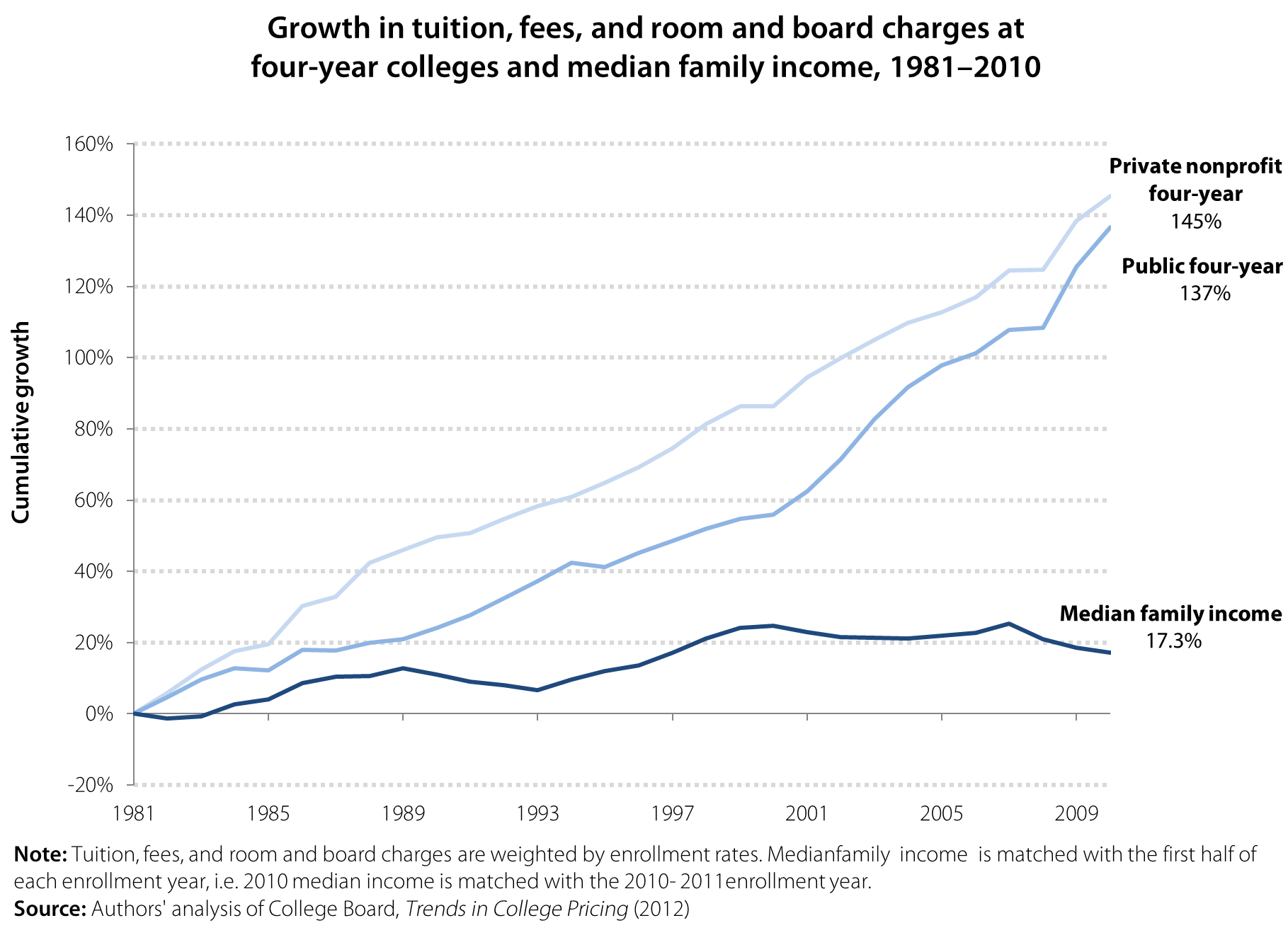
The report also highlighted the rising cost of obtaining a college degree. The figure below shows that the cost of higher education has been rising faster than family incomes for decades, making it harder for families to pay for college. From the 1981–82 enrollment year to the 2010–11 enrollment year, the cost of a four-year education increased 145 percent for private school and 137 percent for public school. Median family income only increased 17.3 percent from 1981–2010, far below the increases in the cost of education, leaving families and students unable to pay for most colleges and universities in full.
Unsurprisingly, a large majority of students and recent graduates take on debt to pay for college. Two-thirds of recent college graduates have student loans, and trends indicate that the number of student loans is increasing. Between 1993 and 2008, average student debt for graduating seniors increased 68 percent, from $14,410 to $24,238. Average debt for graduating seniors at public universities was $21,105 in 2008, and average debt for graduating seniors at private non-profit universities was $28,888 (authors’ analysis of Project on Student Debt 2010). In taking on these loans, students are taking a risk and hoping that they will be able to quickly secure work to begin paying them off after graduation. In recent years, and through no fault of their own, a growing number of graduates have been on the wrong side of this risk, with harsh consequences. Although most student loans have a grace period of six months before repayment begins, recent graduates who do not find a stable source of income may be forced to postpone payment though deferment or forbearance, miss a payment, or worst of all, default altogether on their loans. Deferment and forbearance are short-term fixes, however, and ultimately increase the amount borrowers owe once each period ends. Missed payments and default can ruin young workers’ credit scores and set them back years when it comes to saving for a house or a car.
Even worse, these young workers do not have a strong safety net on which to rely during the volatile job-seeking process.
Young workers are often ineligible for unemployment insurance, for example, because they must first meet state wage and work minimums during an established reference period—a reference period during which they are often in school and not working. Many new graduates are likely turn to their families for assistance. In 2011, 54.6 percent of 18- to 24-year-olds were living with their parents, an increase of 3.4 percentage points since 2007. This option is not, obviously, available to all young graduates. In short, young workers are being squeezed from multiple angles and their plight constitutes yet another instance of how damaging our tolerance of an underperforming economy truly is.
Additional findings and more analysis on the labor market facing young high school and college graduates can be found in our report, The Class of 2012: Labor market for young graduates remains grim.