Union decline and rising inequality in two charts
One hallmark of the first 30 years after World War II was the “countervailing power” of labor unions (not just at the bargaining table but in local, state, and national politics) and their ability to raise wages and working standards for members and non-members alike. There were stark limits to union power—which was concentrated in some sectors of the economy and in some regions of the country—but the basic logic of the postwar accord was clear: Into the early 1970s, both median compensation and labor productivity roughly doubled. Labor unions both sustained prosperity, and ensured that it was shared. The impact of all of this on wage or income inequality is a complex question (shaped by skill, occupation, education, and demographics) but the bottom line is clear: There is a demonstrable wage premium for union workers. In addition, this wage premium is more pronounced for lesser skilled workers, and even spills over and benefits non-union workers. The wage effect alone underestimates the union contribution to shared prosperity. Unions at midcentury also exerted considerable political clout, sustaining other political and economic choices (minimum wage, job-based health benefits, Social Security, high marginal tax rates, etc.) that dampened inequality. And unions not only raise the wage floor but can also lower the ceiling; union bargaining power has been shown to moderate the compensation of executives at unionized firms.
Over the second 30 years post-WWII—an era highlighted by an impasse over labor law reform in 1978, the Chrysler bailout in 1979 (which set the template for “too big to fail” corporate rescues built around deep concessions by workers), and the Reagan administration’s determination to “zap labor” into submission—labor’s bargaining power collapsed. The consequences are driven home by the two graphs below. Figure 1 simply juxtaposes the historical trajectory of union density and the income share claimed by the richest 10 percent of Americans. Early in the century, the share of the American workforce which belonged to a union was meager, barely 10 percent. At the same time, inequality was stark—the share of national income going to the richest 10 percent of Americans stood at nearly 40 percent. This gap widened in the 1920s. But in 1935, the New Deal granted workers basic collective bargaining rights; over the next decade, union membership grew dramatically, followed by an equally dramatic decline in income inequality. This yielded an era of broadly shared prosperity, running from the 1940s into the 1970s. After that, however, unions came under attack—in the workplace, in the courts, and in public policy. As a result, union membership has fallen and income inequality has worsened—reaching levels not seen since the 1920s.
By most estimates, declining unionization accounted for about a third of the increase in inequality in the 1980s and 1990s. This is underscored by Figure 2, which plots income inequality (Gini coefficient) against union coverage (the share of the workforce covered by union contracts) by state, for 1979, 1989, 1999, and 2009. The relationship between union coverage and inequality varies widely by state. In 1979, union stalwarts in the northeast and Rust Belt combined high rates of union coverage and relatively low rates of inequality, while just the opposite held true for the southern “right to work” states. A large swath of states—including the upper Midwest, the mountain west, and the less urban industrialized states of the northeast—showed lower-than-national rates of inequality at union coverage rates a bit above or a bit below that of the nation. More importantly, as we plot the same relationship in 1989, 1999, and 2009, those states move as a group towards the less-union coverage, higher-inequality corner of the graph. The relationship between declining union coverage and rising inequality is starkest in the earlier years (between 1979 and 1989). After 1999, union coverage has bottomed out in most states and changes in the Gini coefficient at the state level are clearly driven by other factors, such as financialization and the real estate bubble.
MORE: View interactive graphic of union decline and rising inequality in the U.S.
Colin Gordon is Professor of History at the University of Iowa and a Senior Research Consultant at the Iowa Policy Project
Adding to Joe Nocera’s piece: A revival of the labor movement is necessary to preserve our democracy
It was good to see Joe Nocera’s column today affirming Tim Noah’s recent call for a revival of the labor movement, saying “if liberals really want to reverse income inequality, they should think seriously about rejoining labor’s side.” I would add that such a revival is necessary to rebuild the middle class and to preserve our democracy.
I’m proud that EPI has provided a lot of great research addressing the role of unions in the economy, ranging from: the impact on firms and competitiveness; the impact on the wages and benefits of union and nonunion workers; the impact on wage inequality; the flawed nature of the current process for choosing union representation; and much more. Here’s a brief guide:
- See a talk by Paul Krugman addressing the problem of income inequality, including the problem of eroded unionization. Krugman expresses some of the same sentiment as Nocera, paraphrasing “we didn’t know what we were missing until they were gone.” Pieces by Tom Kochan and Beth Shulman, and by Harley Shaiken, echo his arguments.
- Testimony by me, and another by Rutgers professor Paula Voos, articulate the importance of unions for American workers and the role unionism can play in rebuilding the middle class.
- Matt Vidal and David Kusnet provide 12 case studies from a variety of industries, including nursing, meatpacking, and janitorial, to show how unions can benefit workers and communities while making companies more productive. They also illustrate the damage inflicted when union representation is removed.
- Professor John DiNardo of the University of Michigan describes his and other research that unionization does not cause businesses to fail. Using a ‘regression discontinuity’ technique, DiNardo compares places that unionize to those that don’t and finds that differences in representation election outcomes were very similar: The near-losers are a very good “control group” for firms where the workers have just won the right to bargain collectively. DiNardo says: “This research provides evidence that this causal effect of union recognition is zero and has been zero since at least the 1960s, which is how far back we can go with the available data. In short, the biggest fear voiced by employer groups regarding unionization—that it will inevitably drive them out of business—has no evidentiary basis.”
- EPI Research and Policy Director Josh Bivens shows why unions are not to blame for the loss of U.S. manufacturing jobs, and that in fact, the real culprits are manipulated currency rates that make U.S.-made goods overly expensive. A dysfunctional health care system that burdens responsible employers with outsized costs, and high executive and managerial salaries, also contribute to any lack of competitiveness.
- Richard Freeman of Harvard University, perhaps the world’s leading labor market economist (I think so at least), writes that an overwhelming majority of workers say in surveys that they want a stronger collective voice on the job, and believe that a union would be good for their firm as well. Freeman’s findings “suggest that if workers were provided the union representation they desired in 2005, then the overall unionization rate would have been about 58%.”
- To get a picture of the broken process of union representation elections where employers freely intimidate workers, read Kate Bronfenbrenner’s report. Private-sector employer opposition to workers’ efforts to form unions has intensified and become more punitive than in the past. Employers are more than twice as likely to use 10 or more tactics—including threats of and actual firings—in their campaigns to thwart workers’ organizing efforts.
- Last, see the statement in support of the Employee Free Choice Act by me, along with Richard Freeman of Harvard and Frank Levy of MIT, citing the recent unprecedented growth of inequality in household income and the urgent need to give workers more bargaining power. Forty prominent economists signed the original statement, including three Nobel Prize winners, agreeing that the reform would be an overall benefit to the economy, and would provide a boost to workers when they need it most. Other economists later added their voices by signing the same statement, which resulted in close to 200 more signatories. The statement is available for download in both its original and updated versions.
We still have a long way to go to achieve racial equality
Washington Post columnist Richard Cohen recently illustrated how much overt racial bigotry against blacks has been reduced. He used the case of Wesley A. Brown, the first African American graduate of the United States Naval Academy. Brown was the first to “successfully endure the racist hazing that had forced the others to quit.” When Brown joined the Naval Academy, if blacks dared to enroll, they were harassed to force them out. Today, there is a building in the Naval Academy named in Brown’s honor.
Cohen is correct. Today, black children know that there is no occupation that is categorically off limits to them. They can grow up to be president, an idea that seemed farfetched just a few years ago.
On the other hand, the picture Cohen painted would have looked starkly different had he focused less on interpersonal discrimination and more on institutional discrimination. By “institutional discrimination,” I am referring to the ways that the normal policies and practices of social institutions like the educational system, the labor market, and the criminal justice system serve to maintain racial inequality.
Cohen celebrates the end of legally enforced segregation, but fails to acknowledge that we still live with a great deal of de facto racial segregation. A large number of our neighborhoods are racially segregated, which means that many of our schools are racially segregated. Segregation concentrates black children not merely in majority-black schools, but also in schools where a majority of students are in poverty. While, in theory, there are no limits facing black children, children born into economically disadvantaged families, in economically disadvantaged communities, who then attend economically disadvantaged schools have the odds stacked against them.
One reason black families are disproportionately economically disadvantaged is because blacks are still about twice as likely as whites to be unemployed. This was the case in the 1960s, and it remains true today. This basic relationship holds true at all education levels. Black high school dropouts are about twice as likely to be unemployed as white high school dropouts. Black college graduates are about twice as likely to be unemployed as white college graduates. Research shows that employers still have a preference for hiring whites over blacks.
Our criminal justice system is another site where policies and practices systematically disadvantage blacks. As the book Dorm Room Dealers illustrates, white middle-class youth use illicit drugs and sell illicit drugs, but this population is much, much less likely to be incarcerated for these offenses than are poor black youth engaging in the same activities. Michelle Alexander’s The New Jim Crow goes into greater detail about how our illicit drug policies and practices produce institutional discrimination against African Americans.
Cohen is correct. There is no better time to be black in America than today. While this is a true statement, we also still have a long way to go before there is equal opportunity for all.
Center for Public Integrity makes a strong case for more regulation and better enforcement
Business groups and conservatives constantly attack the federal government for overregulating. They claim that businesses are “drowning in a sea of regulations” and that job creation and profitability are being sacrificed in favor of a nanny state. Workplace safety rules, in particular, have been a favorite target of the Chamber of Commerce and other business associations, but the fact is that the federal government regulates too little, not too much. Most of the 4,500 workplace fatalities and 50,000 occupational disease deaths each year could be prevented with better rules, more diligent employers, and better enforcement by the Occupational Safety and Health Administration.
The Center for Public Integrity has begun publishing Hard Labor, a series of articles exploring this reality, and the first two stories make for compelling reading. One describes the consequences of OSHA’s inability to issue a combustible dust standard to protect against the kind of fires and explosions that have killed 130 workers since 1980, injured another 800-plus, and caused more than 450 accidents. Factory managers ignore hazards in plain sight—for example, piles of metallic dust that crackle with static electricity and ignite into small fires every week. Nothing is done to prevent the build-up, despite the past occurrence of catastrophic explosions at the same company that left some workers dead and others with gruesome, debilitating injuries. Finally, the critical elements come together and instead of a small fire, another terrible explosion occurs as airborne dust ignites, and more workers die from horrendous burns.
OSHA has no standard that addresses this hazard in spite of the pleas of union representatives and the urgings of the federal Chemical Safety Board, which has jurisdiction to investigate explosions and recommend preventive standards but has no power to issue them. OSHA hasn’t regulated, and workers continue to be burned, disfigured and killed unnecessarily.
Industry representatives resist any new standard, reflexively making the same tired arguments about flexibility and cost they always make. But as the story points out, in the case of grain dust explosions, an industry that fought OSHA’s efforts to issue a standard now realizes that the standard has saved workers’ lives and saved the companies money. The National Grain and Feed Association, which at one point sued OSHA to block the grain dust rule, recognizes today that the standard was win-win regulation, and that the grain industry is financially better off as a result of the rule and the unprecedented reduction in deaths and injuries it achieved.
The second Hard Labor story focused on the weakness of OSHA’s enforcement of the rules it already has on the books. Violations that cause the death of a worker result in an average fine of less than $9,000, and companies contest every citation, no matter how justified. The chances of an executive being indicted as a criminal for intentional or recklessly indifferent acts or omissions that kill their employees are infinitesimal, and the penalties are tougher for someone who harasses a wild burro on federal land than for an employer who sends a worker into a known hazard that causes the worker’s death.
The Center for Public Integrity is doing a real service by publishing these stories that reveal just how weak OSHA’s standards and enforcement are, and how light the regulatory burden that OSHA imposes really is. In the case of workplace safety and health, we need more regulation, not less.
New York Times pension reporter ignores inconvenient truths
Just once, I wish Mary Williams Walsh would write a story about public employee pensions that included key information that isn’t convenient to an agenda of doing away with or greatly reducing public employee pensions. Every story she writes, including her most recent, seems designed to scare the public, make public employees look bad, their unions look greedy, and government administrators seem weak or stupid.
In her most recent piece, Walsh lends great support to those claiming that public pension plans are erring (or even dissembling) in using assumptions about annual rates of return for their assets that are unrealistically high. The further claim is that using more “reasonable” rates of return (i.e., lower ones) will show the “true” crisis in public pensions.
Walsh writes: “The typical public pension plan assumes its investments will earn average annual returns of 8 percent over the long term, according to the Center for Retirement Research at Boston College. Actual experience since 2000 has been much less, 5.7 percent over the last 10 years, according to the National Association of State Retirement Administrators.”
This may seem like bloodless analysis, but it’s not—it’s giving great aid to a bogus argument forwarded by ideologues that are deeply hostile to public pension plans on principle. Because most plans look to be in decent shape based on current actuarial standards that justify assuming 8 percent rates of return, these ideologues have to claim that these assumptions are somehow wrong. But pointing to returns over the past 10 years as evidence of this is ridiculous because it completely ignores the fact that the U.S. and world economies experienced the biggest financial downturn in 80 years! How can Walsh be surprised that returns over a period that included two recessions have been subpar? This isn’t front-page news or news at all. It would be news if returns over that period had met expectations.
Even more serious is Walsh’s distortion of the National Association of State Retirement Administrators’ report, which was a very positive statement about the returns public employee plans have achieved:
Although public pension funds, along with most other investors, have experienced sub-par returns over the past decade, median public pension fund returns over longer periods exceed the assumed rates used by most plans. As shown in Figure 1, median annualized investment returns for the 20- and 25-year periods ended June 30, 2011, exceed the most-used investment return assumption of 8.0 percent. For example, for the 25-year period ended June 30, 2011, the median annualized return was 8.5 percent.
Walsh quotes the professed doubts of Edward McMahon, a fellow at the anti-government Empire Center for New York State Policy, that even a 7 percent return on investment can be safely assumed. But McMahon is not a neutral observer; he’s a right-wing, anti-union ideologue with an agenda to do away with public employee defined benefit pensions altogether. It is not news to me that the Empire Center has long wanted to cut public employee benefits and compensation, but Walsh would have done most readers a service by mentioning that to her readers.
Just once I wish Walsh would cite Dean Baker’s opposing analysis, which is based on the fact that the stock market is currently priced low enough, as measured by the ratio of prices to earnings, to justify expected returns of 8 percent or more. As Baker, the co-director of the Center for Economic and Policy Research, points out, individuals who sold Social Security privatization with visions of never-ending 8-10 percent stock market returns back when price-to-earnings ratios were at historic highs (hence making inflated returns hugely unlikely) now have the gall to attack pension plans that expect returns of 7.5 percent when price-to-earnings ratios have returned to historic norms (norms generally consistent with long-run returns of 8 percent).
What does this detour into what people claimed during fights over Social Security privatization have to do with the attack on public pensions? Earlier, I referred to ideologues like McMahon pushing the claim that projected returns of 8 percent for public pension plans are unrealistically high. How do I know this claim is ideology instead of professional judgment? Well, because in 2003 McMahon claimed that replacing public pensions with 401(k) plans would be fair for employees because they could expect returns of 9.75 percent.
In short, what at first seem like wonky debates over appropriate rates of return have actually degenerated into misinformation campaigns waged by committed opponents of public pensions. The rates these plans are assuming today are in line with actuarial practice and (much more importantly) economically reasonable. I’m sorry that this view doesn’t advance the much juicier story of a fiscal crisis coming, but it’s based on the facts.
How’s that immigrant-bashing thing workin’ for ya?
A majority of Alabama’s politicians apparently believe that they can improve their state economy by chasing away the undocumented workers who live there. By making them criminals (turning them into illegal aliens), denying them basic services like water and electricity, and terrifying their families, they hope to rid the state of people they see as a burden on taxpayers and competitors for scarce jobs. Well, after a year’s application of this medicine (June marks the first anniversary of the passage of HB 56), how’s the experiment coming along? Has the economy been jump-started or even improved?
Apparently not.
Let’s start with job creation. Has Alabama created more jobs than its neighbors over the last year? No; in fact, it’s both below the regional average and well below the national average. Alabama’s employment growth has been only one-seventh the national average (0.2 percent vs. 1.4 percent). The United States has regained about 43 percent of the jobs lost at the bottom of the recession; Alabama has only recovered about 9 percent of the jobs it lost.

Figure 1: Source: EPI analysis of Local Area Unemployment Statistics public data sets
Has it made the state or its workers richer or better off? No, apparently not. Even with fewer workers, personal income per worker fell in Alabama during the two quarters that followed enactment of HB 56, while in the neighboring states, it was unchanged.

Figure 2: Source: EPI analysis of Current Employment Statistics and Bureau of Economic Analysis National Income and Product Accounts public data
How about unemployment? Has chasing away all of those immigrants opened up tens of thousands of existing jobs for native Alabamans and cut the number of unemployed more than Alabama’s neighbors? No, not exactly. Compared to all four of its neighboring states (Tennessee, Georgia, Mississippi, and Florida), Alabama’s unemployment fell a little faster over the past year—2 percentage points vs 1.7 percentage points—but Alabama lost 52,000 workers from its labor force in less than a year while the labor force grew in the four neighboring states. Alabama doesn’t have a positive story to tell.

Figure 3: Source: EPI analysis Local Area Unemployment Statistics public data series
Far from being an economic panacea, the early returns suggest that HB 56 has not been good for Alabamans in terms of job creation or personal income. Immigrant-bashing isn’t the path to prosperity.
Conservatives say CEO compensation levels are fine now that it takes 10 hours to earn a typical worker’s annual compensation
There have been some interesting responses by conservatives to the new data Natalie Sabadish and I have released on the CEO-to-worker pay ratio. Apparently, our study reporting that CEO pay has fallen during the fiscal crisis and is far down from the dizzying heights of the tech bubble in 2000 is taken to mean that that any concern about the growth of top incomes is now out-of-date and inappropriate.
Conservative columnist Wynton Hall at Breitbart.com writes:
“A graph by the Economic Policy Institute shows that while the relative pay of CEOs shot up in the 1990s, it has since fallen by nearly half, a trajectory that hardly supports the class warfare rhetoric of Occupy Wall Street and the Obama Administration.”
And Greg Mankiw also touted our findings, writing, “The relative pay of CEOs skyrocketed during the 1990s and has since fallen by about half.”
The attention and the recognition of the accuracy of our empirical work are much appreciated. A few comments are in order. First, it seems that these folks are celebrating that a non-problem, at least in their view, has been solved. After all, I don’t recall conservatives being upset by the roughly $20 million CEO pay packages in 2000 or the $18 million CEO packages in 2007. So, it is hard to understand why they feel so gratified by CEO compensation packages averaging $11 or $12 million in 2011.
Second, while it is true that the CEO-to-worker compensation ratio fell from 411.3 in 2000 to 209.4 in 2011, that still means that CEO compensation is spectacularly high. For instance, that means that the average CEO earns in 10 hours what a typical worker earns in an entire year. Moreover, as we reported in our study (page 4):
“CEO compensation in 2011 is very high by any metric, except when compared with its own peak in 2000, after the 1990s stock bubble. From 1978–2011, CEO compensation grew more than 725 percent, substantially more than the stock market [which grew less than 400 percent] and remarkably more than worker compensation, at a meager 5.7 percent.”
The trend in CEO compensation since 1965 is in the figure. Two measures are presented, one where stock options granted are included and the other where stock options exercised are included. In either measure of CEO compensation, the growth between 1978 ($1.3 or 1.4 million), 1989 ($2.5 or 2.6 million), or 1995 ($5.6 or $6.2 million) and 2011 ($11.1 or $12.1 million) is pretty astounding and very hard to justify. Exactly how does one justify/explain that CEO compensation has doubled since 1995?

Figure 1: Note: “Options granted” compensation series includes salary, bonus, restricted stock grants, options granted, and long-term incentive payouts for CEOs at the top 350 firms ranked by sales. “Options exercised” compensation series includes salary, bonus, restricted stock grants, options exercised, and long-term incentive payouts for CEOs at the top 350 firms ranked by sales. Sources: Authors’ analysis of data from Compustat ExecuComp database, Bureau of Labor Statistics Current Employment Statistics program, and Bureau of Economic Analysis National Income and Product Accounts Tables
One more time: Public debt incurred when the economy is depressed does not damage the economy
I was on PBS’ NewsHour last night, talking austerity. I’m against it. Ken Rogoff from Harvard was also on, and he’s actually against it too. One point of disagreement came up, though, when I made the argument that public debt incurred when the economy is depressed causes no economic damage (in fact, it acts instead as a useful palliative).
Rogoff disagreed in principle and then said something kind of startling—that increases in deficits and debt could lead to incomes in the near-ish future (i.e., less than 30 years from now) that are “20 percent lower.”
I’m assuming this claim has some relation to a Congressional Budget Office estimate of the effect of one particular fiscal scenario (the “alternative fiscal scenario,” or AFS) that projects the effects of large increases in budget deficits in coming decades on economic growth (see table below from the CBO report (p. 28)). The mechanism is that rising deficits increase interest rates which lead to lower private investment and a stronger dollar, which leads in turn to higher trade deficits and rising foreign debt.

Set aside for a second whether or not there are some problems with these calculations—both in relying on the AFS to make predictions and in how to apportion the impact of higher interest rates between crowded-out domestic investment versus increased trade deficits. The more salient point is simply that there is nothing in the CBO analysis that rebuts my larger point: Potential damage from increased public debt does not materialize when this debt is taken on when the economy is depressed. Here’s the CBO on the issue (p. 21 in the linked report):
“… when the economy has substantial unemployment and unused factories, offices, and equipment, federal budget deficits—and thus additional debt—generally boost demand, thereby increasing output and employment relative to what would occur with a balanced budget. … CBO’s estimates in this chapter [ed: estimates about the output-depressing effects of budget deficits and extra public debt] do not take those short-run effects on demand into account. Indeed, the estimates reflect the assumption that over the long run, output is always at its potential level”
In short, the potential output-depressing effects stemming from budget deficits that the CBO is estimating only hold when “output is at its potential level.” Or to say it another way, the exact way I said it earlier, extra public debt incurred when the economy is depressed (i.e., output is not “at its potential level”) causes no economic damage.
And in fact, when extra public debt is incurred when the economy is depressed, the boost it gives (if spent wisely) to economic output can easily be large enough to actually reduce overall the overall debt/GDP ratio by boosting the denominator and by spurring enough additional tax collections to actually self-finance part of the extra debt. How are people so sure that the extra debt incurred in recent years hasn’t led to any of the downsides from crowding out or upward pressure on the value of the dollar? Simple—interest rates have not risen. And remember, the entire economic chain wherein incurring public debt leads to crowding-out and trade deficits is through upward pressure on interest rates. And, since the depressed economy is putting ferocious downward pressure on interest rates, there is no damage done.
Until the economy recovers and this downward pressure on interest rates relents, additional increments of public debt do not hurt, and scare-stories about the 20 percent income loss possible 25 years from now because of deficits do not change this calculus at all.
Four disturbing consequences of Pelosi’s tax retreat
For the past few months, I (and others in favor of allowing the Bush-era tax cuts for the rich to expire) had worried that once we got into the lame duck session, congressional Democrats would let their position slip and start supporting extending tax cuts for couples with income above $250,000 (individuals above $200,000). But I thought at the very least it would happen in the last month or two, when the pressure was really being brought to bear.
Turns out, it happened a lot sooner than that. Yesterday, House Minority Leader Nancy Pelosi (D-Calif.) signaled support for allowing the Bush-era tax cuts under $1 million to expire. Pelosi explained, “It is unacceptable to hold tax cuts for the middle class hostage to extending multi-billion dollar tax breaks for millionaires, Big Oil, special interests, and corporations that ship jobs overseas.”
Yes, I understand that “tax breaks for millionaires” sounds better in a press release than “tax breaks for households with income over $200,000, or $250,000 for couples.” And perhaps she felt forced into this, worrying that she might not be able to hold her caucus at the $250,000 mark, opting instead to retreat to more defensible terrain before the battle royal later this year.
But this shift has a number of very disturbing consequences:
1) Slipping to the right.This will now be the left pole of the debate. The Democratic Party has moved from opposing the Bush-era tax cuts to supporting 80 percent of them, to now supporting nearly 90 percent of them. And yet these concessions have been given for free, without any countervailing progressive demands. This is just more evidence that the tax debate is shifting further to the right. Pelosi may have done this for short-term advantage, but in the long run, these shifts tend to be very difficult to reverse.
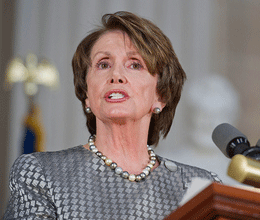
(From Flickr Creative Commons by nasa hq photo)
2) More spending cuts. Given that the Bush-era tax cuts cost $2.6 trillion over the last decade and will cost over $4 trillion in the next decade, this concession will put even greater pressure on the budgets of vital safety net and public investment programs.
3) The definition of “middle class” is losing relevance. The previous definition of the middle class as being anyone under the $250,000 threshold was already a severe stretch. After all, you’re talking about people who (1) are making five times that of the typical American household (which makes closer to $50,000 a year in combined income), and (2) whose incomes are higher than 98 percent of American households. To now extend the definition of middle class to people who make 20 times that of the average household and whose income is greater than over 99 percent of households is to define away the entire concept of the middle class.
4) Bigger tax cuts to the highest-income Americans. This shift isn’t just a huge boon to upper-income households making between $250,000 and $1 million in income. In fact, about half of these additional tax cuts would go toward households with over $1 million in income. This is because the cut-off—be it $250,000 or $1 million—represents the portion of a taxpayer’s income that is subject to the continued tax cut. So the previous Democratic position—which remains President Obama’s public position—is that if you make over $250,000, you still get to keep your tax cuts for all your income below that threshold and only have to pay higher rates on income above that threshold. Revising the threshold up to $1 million basically means that all income between $250,000 and $1 million also retains its tax cuts, and as it turns out, about half of those tax cuts will go to people with income over $1 million.
As Jared Bernstein said, we’ll let the game theorists argue over whether this helps or hurts the Democrats’ negotiating position. But even if this does give the Democrats the upper hand in negotiations, what then? The whole point is to enact a tax code that can adequately fund the social safety net and public investments that we need to create a stronger economy with equal opportunity for all. Retaining the tax cuts for most people making over $250,000 and reducing the tax increase that people making over a $1 million would be subject to, makes that job significantly more difficult, if not impossible.
Increasing New Jersey’s minimum wage helps the economy and the state’s lower-income earners
With New Jersey joining several other states in considering raising its minimum wage, it is appropriate to do some myth-busting around the minimum wage, in particular addressing myths around who comprises the minimum-wage workforce, and what the employment impact of increasing the minimum wage would be.
EPI’s analysis of the New Jersey proposal shows that 307,000 workers will be directly helped by raising the New Jersey minimum wage from $7.25 an hour to $8.50 an hour (because their current wages fall between those points), with another 233,000 workers benefiting indirectly (those whose wages are slightly above the new minimum wage who would see their wages increased modestly). The prevailing misconception is that most minimum-wage workers are middle-class teenagers working part-time for extra spending money. The facts tell a different story. Of those workers benefiting from the proposed minimum wage increase, slightly over half (55 percent) are female, more than four in five (85 percent) are 20 years of age or older, and nearly four in five (79 percent) work more than part-time (29 percent work mid-time, between 20-35 hours a week, and 50 percent work full-time, 35-plus hours a week). More than 3 in 4 workers (76 percent) benefiting from an increase in the minimum wage have a high school diploma or more—and nearly half (46 percent) of workers affected are white non-Hispanic (as seen in Figure 1). Over 282,000 New Jersey children have a parent who would benefit from increasing the minimum wage.

Figure 1: Source: EPI Analysis of 2011 Current Population Survey, ORG data
GDP impact and job creation
The EPI analysis of the impact of the proposed minimum wage increase shows that those workers benefiting (both directly and indirectly) from increased wages, will see an additional $439 million in wages in the first year following the proposed minimum wage increase. For those benefiting, the average increase in their annual income would be $810.
In the first year following the increase in the minimum wage, we estimate that increased spending by workers who see a raise will boost GDP by $278 million. Wage increases resulting from indexing to inflation would result in further GDP boosts in future years. Economists widely recognize the relationship between GDP growth and employment growth. Our model shows that 2,420 full-time equivalent (FTE) jobs would be created in the first year as a result of the GDP boost resulting from New Jersey’s proposed minimum wage increase. These jobs would be concentrated within New Jersey, since lower-income workers disproportionately spend their wages locally to meet the immediate needs of their families.
The minimum wage as defense against further erosion of wages
As seen in Figure 2, New Jersey saw significant erosion of low wages (those at the 20th percentile) between 2009-2011. New Jersey’s $0.60 erosion of wages at the 20th percentile was the 11th greatest wage loss of all states, exceeding the national low-wage erosion by $0.14. With unemployment rates remaining high, employers do not have to provide wage increases to get and keep the workers they need. Since well over half (56 percent) of those receiving additional income as a result of the proposed minimum wage increase fall in the bottom two income quintiles, it is clear that slowing this wage erosion would significantly help lower-income workers.

Figure 2: Source: EPI analysis of Current Population Survey, ORG data. Note, “Low Wage” = wage at the 20th percentile. Figure shows change in the 20th percentile real wage between 2009 and 2011.
Increasing New Jersey’s minimum wage is the right thing to do for several reasons. It is smart economics, boosting a weak economic recovery that has New Jersey firmly in its grips, and it improves the well-being of working families still reeling from the effects of the Great Recession.