The Federal Government Shouldn’t Directly Contribute To America’s Job-Quality Problem
As President Obama searches for ways to improve the wages of American workers by giving them a boost in bargaining for better job quality with their employers, he is limited by the dysfunctionality of Congress, which because of Republican opposition is unlikely to help even with a minimum wage increase. But the president, who manages the vast amount of work the government does through private contractors, should consider what he can do to set reasonable standards for the pay and compensation of the millions of employees of those federal contractors.
As EPI has estimated again and again, far too many people working for private firms— but for the benefit of the federal government, with their wages ultimately paid by the taxpayers—are likely working for poverty wages. This is unacceptable; it is damaging to those workers and their families, and it hurts the economy by reducing demand for goods and services—currently a problem of crisis proportions.
In November 2000, an EPI briefing paper by Chauna Brocht, The Forgotten Workforce, estimated that 162,000 federal contract workers earned less than the then-poverty level wage of $8.20 an hour (by poverty-level wage, we mean a wage for a full-time, full-year worker that would not lift a family of four out of official poverty). Most of the low-wage employers were large businesses and most were defense contractors.
What to Look for in the State of the Union
President Obama will deliver his State of the Union this coming Tuesday, the 28th. It seems obvious that no big new policy initiative that requires action from Congress will pass in the next year, given DC gridlock. This is a real shame, because the crisis of joblessness and failure to fully recover from the Great Recession remains the single largest economic challenge facing the country, and solving it would require a serious course correction on policy. The most reliable fix for this crisis of joblessness would be simply allowing public spending to rise to levels that characterized every other recovery since World War II. Even better would be to allow this spending to rise to levels characterizing the recovery from the similarly steep early 1980s recession. In short, what is needed is not some historically unprecedented stimulus program, but simply an end to the historically unprecedented austerity program now underway.

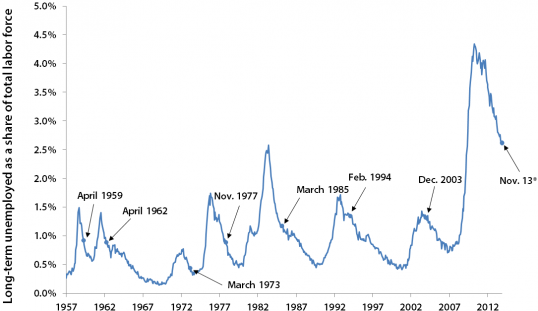
And it’s pretty easy to specify where the first $25 billion or so of this spending should be allocated: extending the Emergency Unemployment Compensation (EUC) program for long-term unemployed workers—a program begun in June 2008 when the unemployment rate was significantly lower than today and when long-term unemployment was literally half as high. I’d be shocked if the president did not issue a forceful call to pass EUC for the upcoming year.
After this, a substantial program of public investment would be most welcome, boosting job-growth and economic activity in the short-run and boosting productivity in the longer-run. The talking point mobilized in favor of infrastructure investment—that it once was a bi-partisan priority—has the rare virtue of being true even today, so long as one listens to policy analysts and not politicians. For example, Martin Feldstein, Chair of the Council of Economic Advisors under Ronald Reagan, has endorsed a deficit-financed increase in infrastructure investment (granted, he endorses plenty of other things in that column that I’m not on board with, but the point remains). And Ken Rogoff, an economic adviser to John McCain in 2008, has also noted that infrastructure investment would be hugely beneficial in the current economic climate.1
Are House Republicans Sore Winners?
Treasury Secretary Jack Lew sent a letter to Congress yesterday warning that the federal government probably will breach the statutory debt limit in late February. To remind those who may have forgotten, there is no credible evidence that the U.S. economy is running up against any genuine economic constraint on debt. Interest rates remain historically low and federal budget deficits are actually closing historically rapidly. Yet because the United States (almost alone among advanced countries) has an arbitrary limit on the amount of outstanding federal debt that must be periodically renewed through legislative action, approaching the statutory debt limit provides members of Congress the chance to flirt with severe economic damage simply by refusing to raise the limit.
The House GOP leadership claimed that they did not want to get “even close” to a default. However, a spokesperson for House Speaker Boehner said a clean bill to raise the debt limit would not pass the House without some concessions to Republicans in order for them to “save face.” These concessions presumably would be more spending cuts. Given what should be considered a GOP “win” in the recent Murray-Ryan budget deal, one wonders what more do they want? It is worth taking a closer look at the GOP win in the budget deal and compare it to what might have been.
The chart below displays nondefense discretionary budget authority from fiscal year 2006 to fiscal year 2021 (when funds are appropriated by Congress, agencies are given budget authority to incur financial obligations—i.e., spend money). Nondefense discretionary spending includes spending for public investments such as roads, bridges, sewage systems, basic scientific research, and education—all the things that boost long-term economic growth. The Budget Control Act (BCA), the law that gave us the sequester, along with other steep cuts that have attracted less attention, specifies the limits on discretionary spending until 2021. It is specified in nominal dollar amounts, which rise over time. In inflation-adjusted terms, however, the spending is constant. But a better way to measure public spending is as a percentage of GDP—basically looking at public spending in relation to income available to pay for that spending.
The Robots Are Here and More Are Coming: Do Not Blame Them for our Wage or Job Problems
The “robots are coming” narrative dominating discussions of the economy was popularized by Erik Brynjolfsson and Andrew McAfee in their 2011 book, Race Against the Machine. They have built on that theme in the richer, deeper The Second Machine Age (W.W. Norton, 2014). The first half of the book provides a valuable window, at least for a non-technologist like me, into past developments and the future trajectory of digitization. Their claim is that digitization will do for mental power what the steam engine did for muscle power—that is, quite a bit, transforming our lives at work and play.
The remainder of the book dwells on the role of digitization in generating both bounty (more consumer choice and greater output, wealth, and income) and spread (greater inequalities of wages, income, and wealth). In treating these topics, they heavily rely on the work of others. As in their last book, they do not provide much direct evidence of the connection between technological change and wage inequality. I study these issues and believe they are wrong to tightly link digitization and robots to wage inequality and the slow job growth of the 2000s. Although the authors claim “technology is certainly not the only force causing this rise in spreads, but it is one of the main ones” my fear is that this book, like their last one, will fuel the mistaken narrative that technology is responsible for our job and wage problems and that we are powerless to obtain more equitable growth.
Let me start where we agree and where I very much appreciate their argumentation. Brynjolfsson and McAfee are very clear that we are experiencing a dramatic growth in wage, income, and wealth inequality; that living standards have faltered for a significant share of the population; and that these are challenges that must be addressed. They rightly fear that current inequities will generate greater future inequity: They argue that current wealth solidifies and expands inequality through the political process and worry that inequality impedes social mobility—the degree to which a child’s chances are linked to his or her parents’ current station. Inequality begets greater inequality. I appreciate their refutation of denialism and ‘so whatism’.
Their weakest case is that digitization is associated with the slow job growth of the last 15 years. The authors review all the reasons why economists find such a claim untrue, including 200 years of history disproving a link between technology and slow job growth. They propose a few reasons why things may be different now. However, their only evidence is that employment and productivity grew in tandem for many decades but became decoupled in the late 1990s and offer their “reading of technology” as an explanation. In fact, there’s a simple answer to the riddle of slow job growth: slow economic growth resulting from the collapse of two asset bubbles and inadequate policy responses. Job growth occurs when economic growth exceeds productivity. Simply put, if workers can produce 2 percent more this year than last year, the economy can grow 2 percent without adding any employment. Thus, the economy must grow faster than productivity to create jobs, something that has not happened in the unique circumstances of the 2000s.
Recommitting to Dr. King’s Goals Would Help All Working Families
Monday’s celebration of Dr. Martin Luther King Jr.’s legacy presents the perfect opportunity to reflect on how far the country has come and to acknowledge the undeniable advancements African Americans have made, and to consider the goals that remain unmet. Last year, EPI released the Unfinished March, a series of reports that detailed the remaining steps to fully achieve the goals of the March on Washington for Jobs and Freedom, the setting for King’s “I Have a Dream” speech. Yet to be achieved are the hard economic goals, critical to transforming the life opportunities of African Americans. They include decent housing, adequate and integrated education, full employment, and a national minimum wage that can realistically lift a family out of poverty.
The employment trends for African Americans over the past decade, as seen in this week’s Economic Snapshot, show just how much work remains to be done just to achieve the goal of full employment. While the economic woes of the past few years have worsened labor market prospects for all workers, for African American workers the employment situation is significantly worse, akin to depression-level conditions. An estimated 19.6 percent of black workers (nearly one in five) were unemployed at some point in 2013. Furthermore, given unemployment projections for 2014, it is likely that 17.4 percent of black workers will be unemployed at some point this year.
Needless to say, it doesn’t have to be this way. Recommitting ourselves to achieving Dr. King’s goals means implementing policies that would aid all U.S. workers, including large-scale ongoing public investments, the restoration of public services and public-sector employment cut in the recession and its aftermath, and the renewal of federal unemployment insurance benefits. Passing these policies would not only celebrate Dr. King’s legacy, but also help working families, of all races, across the country.
New Analysis of the Labor Market Outcomes of Employment- and Family-Based Immigrants Can Improve Policymaking
Unlike other developed countries such as Australia and Canada, the U.S. government simply does not collect and analyze enough information on the labor market outcomes of immigrants who are issued visas that grant them legal permanent resident (LPR) status. Especially when it comes to longitudinal data that track the same immigrants over time in order to see how their situation has changed. This dooms policymakers to make uninformed decisions based on assumptions or that are influenced by lobbying from interest groups. That’s why new (and as-of-yet unpublished) research from Professors Mark Rosenzweig (Yale University) and Guillermina Jasso (New York University) is groundbreaking: it analyzes data from Princeton University’s New Immigrant Survey (NIS) and offers a glimpse at how immigrants in the United States are performing in the labor market over time and by visa category.
The NIS “is a nationally representative multi-cohort longitudinal study of new legal immigrants and their children to the United States,” and one of the most useful data sets available on U.S. immigrants. The first cohort of immigrants participating in the NIS were interviewed in 2003, and follow-up interviews were conducted from 2007 to 2009. Rosenzweig recently presented their research based on these survey data at an informative conference on family immigration hosted by the U.S. Department of Homeland Security and the Organisation for Economic Cooperation and Development (OECD). He showcased some of the first analyses of the NIS’s longitudinal data on the labor market performance of immigrants who came to the United States through the Diversity Visa (DV) lottery and the employment-based (including spouses) and family-based immigrant visa categories; the latter of which represent two-thirds of all immigrant visas issued (by far the highest share in the OECD), and allow foreign citizens to join a spouse or parent who is a U.S. citizen or LPR, or to join the son, daughter, or sibling of a citizen already in the United States. (Lindsay Lowell of Georgetown also presented notable new research and findings documenting the growth of the family-based visa category in the United States since the 1970s.)
Seth Harris’s Legacy: Lives Saved, Wages Restored, Pensions Secured, and a More Effective U.S. Department of Labor
The Deputy Secretary of Labor for the last five years is not well known outside his agency (deputy secretaries are never well known, they’re supposed to avoid the limelight), but his record—the Department’s record of achievement during his tenure—deserves to be known and praised by every American who cares about justice and an economy that delivers shared prosperity. Seth D. Harris was appointed by President Obama in 2009, but he had already spent eight years at the Department as an aide and counselor to Secretary Robert Reich and as an Assistant Secretary under Secretary Alexis Herman. As Secretary of Labor Tom Perez said yesterday, no official since Frances Perkins in the 1930s has understood every aspect of the agency’s mission as thoroughly as Seth Harris, and the agency was much smaller then! It’s unlikely that anyone so knowledgeable will ever serve at the Department of Labor (DOL) again.
When Harris and Secretary Hilda Solis took office in 2009, the Department of Labor was a demoralized agency with poor operating systems and a disappointing record of declining enforcement and regulations that undermined the agency’s mission in important ways. With Secretary Solis’s support, Deputy Secretary Harris, as chief operating officer of the department, completely turned things around.
Partnership or Putsch?
This article originally appeared on Project Syndicate.
In 2010, I sat across the table from Assistant US Trade Representative Barbara Weisel, who was responsible for negotiating the Trans-Pacific Partnership (TPP), the mega-regional free-trade treaty among Vietnam, Malaysia, and ten other Pacific Rim countries that President Barack Obama’s administration wants to conclude in the coming weeks. At the time, I was Senior Policy Adviser for the US House of Representatives’ Committee on Education and Labor – a position that made me the top congressional staff member responsible for upholding labor standards in international trade treaties.
The purpose of the meeting was for Congress to understand what steps the Obama administration was taking to protect American workers from being forced into unfair competition with workers from low-wage trading partners. I asked Weisel what I thought was a simple question: “What is the White House’s position on democracy?” Weisel claimed not to understand, so I explained: A majority of congressional Democrats supported the principle that the United States should sign trade agreements only with countries that are democracies.
Other democracies feel the same way. For example, trade agreements negotiated by members of the Commonwealth of Nations (formerly the British Commonwealth) contain just such a provision. The logic is obvious: If we in developed democracies had lacked the right to protest, speak out, organize unions, and vote for representatives of our choosing, we would never have ended child labor or established the eight-hour workday. Having used these rights to raise our own living standards, we should not now put developed countries’ workers in direct competition with workers who lack the basic freedoms needed to improve their own conditions.
No Matter How We Measure Poverty, the Poverty Rate Would Be Much Lower If Economic Growth Were More Broadly Shared
In an op-ed for the New York Times, Jared Bernstein discusses the relationship between GDP and poverty. He explains that growing inequality, not slowing GDP, led to a higher poverty rate than we would have had if economic growth were broadly shared. We create the same graphic in The State of Working America. Not surprising as Jared is a co-author on previous versions. I’m replicating the same idea below using the historical relationship between GDP and poverty from 1959 to 1979 to predict poverty to 2012. As you can see, poverty hits zero by the early 1990s. We choose a different end date in creating the prediction, which changes the estimated date poverty falls to zero, but the same basic fact remains: Poverty falls fast and would be erased from the United States had economic growth been as broadly shared as it had been in the years leading up to the late 1970s.
Many commentators, researchers, and others have argued that the official poverty measure fails to fully take into account the government tax and transfer system, which has accomplished much to reduce absolute deprivation. Some transfer programs are accounted for in the official poverty measure,including Social Security and unemployment insurance. Others, such as food stamps, housing assistance, and the earned income tax credit are not included in the official poverty measure. The Supplemental Poverty Measure (SPM), created by the Census Bureau, effectively takes many of these into account while simultaneously altering the threshold at which poverty is measured against.

Class War: The View From the Board Room
This post originally appeared on The American Prospect.
The Vice-President for Governmental Affairs has just finished his report to the corporate board of directors. “Thanks, Ted,” says the Chairman. “You and your Washington staff have done a great job. Getting that little amendment inserted in the budget bill will save us at least $25 million next year. …. Questions or comments? Paul?”
Paul, the hedge fund CEO: “I’m worried about the big picture down there in Washington, Ted. It’s a mess. Deficit out of control.The anti-business attitude. Not to mention incompetence. Can’t even run a website for their own health care program. Pathetic.”
“Amen,” says Hank, who used to run a tobacco company. “What bugs me is Obama’s complaining about inequality. Just whips people up. Saw them last night on the TV news, in front of a McDonald’s somewhere, screaming for more money. Makes you sick. Want money? Get a job!”
“Actually Hank, those people already have a job,” says Cliff from Silicon Valley. “And lucky to have it. Plenty more out there ready to take their place.”