The bottom line on Trump and the economy: We’re not in good hands
If you follow the news, it’s hard to avoid the constant claims that President Trump has made, taking credit for a strong economy. This claim raises a bunch of questions, but a tl;dr assessment of the Trump economy in 2018 is pretty simple: It’s good, but not great. The Trump administration deserves zero credit for its pockets of strength. And everything they’ve done on economic policy indicates that they will be terrible macroeconomic managers, and will bungle any challenge that comes their way in the next few years.
The longer version of this is below.
The economy going into 2018: Good, but not great
By almost any measure, the economy today is stronger than it has been in a decade. But that’s a really low bar! This decade began with the worst economic crisis since the Great Depression, and the economy’s growth has been severely hamstrung ever since. After eight-and-a-half years of steady recovery, the unemployment rate today sits at 4.1 percent, lower even than its pre-Great Recession level. This is unambiguously good news. But other measures of health in the job market tell a bit less-rosy story.
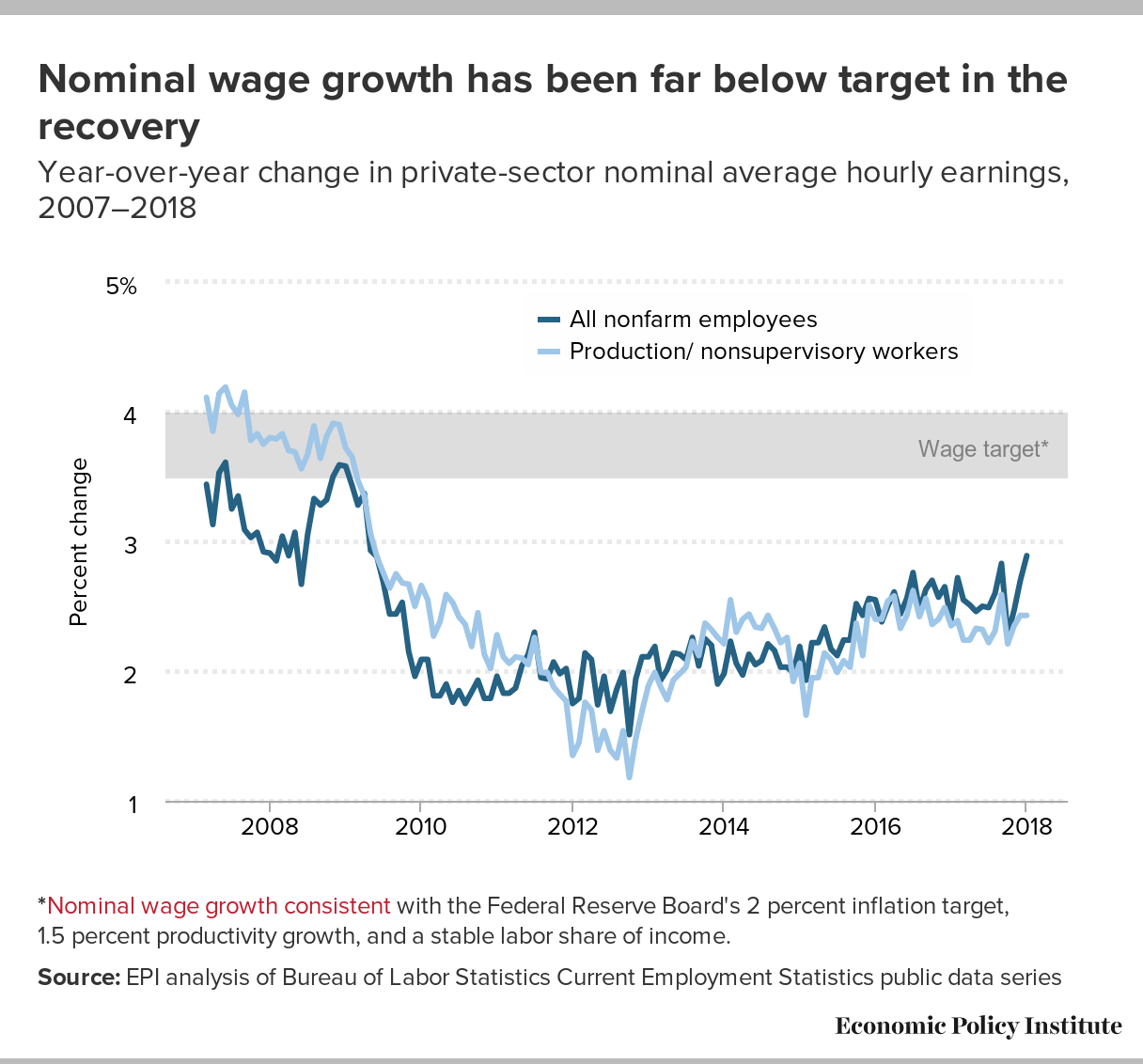
For example, the share of “prime-age” adults (between the ages of 25 and 54) with a job remains below its pre-Great Recession peak even after years of improvement. We would need to add millions more jobs to push it back to levels it reached in the not-so-distant past of the early 2000s. Wage growth also remains distressingly weak, and this wage weakness has blunted the incentive for employers to make productivity-enhancing investments. After all, there’s not much point in spending money to economize on labor costs when workers are cheap and easy to find.

Why economics tells us that crediting the TCJA for wage increases is just PR
After the passage of the GOP Tax Cuts and Jobs Act (TCJA) in December, multiple companies announced decisions to give out bonuses or raise wages for workers and claimed that these decisions were driven by the corporate tax cuts embedded in the TCJA. Since proponents of the tax bill sold it to the public based on claims that corporate rate cuts would trickle down to typical workers, it’s no surprise those proponents would point to these companies’ announcements and claim vindication for their claims. And far too much reporting took the claims of corporations at face value, though some recent exceptions stand out as being much better at evaluating those claims.
While we’re not surprised by the cynicism of these corporate claims, that doesn’t change the fact that there is absolutely no economic evidence to think they’re true. What these companies are doing amounts to nothing more than PR. As we’ll detail, immediately handing out bonuses and raises is simply not how the economic theory that links corporate tax cuts to wage growth works. And we aren’t the only ones pointing this out. Companies are engaged in a clear campaign to gin up support for unpopular corporate tax cuts by crediting each new check they write to those tax cuts.
We’ve spent plenty of time detailing why we think corporate tax cuts won’t actually end up raising wages in the real-world, but even the theory that links corporate tax cuts to wages looks nothing like the campaign corporations are currently engaged in.
Here’s how that economic theory actually works: Corporate tax cuts increase the after-tax returns to owning capital like stocks and bonds. These higher after-tax returns induce households to save more. Higher after-tax profitability incentivizes firms to invest more and the new savings needed to finance these investments come from increased household savings in response to higher returns. The resulting investments in plant and equipment give workers better tools with which to do their jobs, and this boosts productivity (how much income or output is generated in an average hour of work). In turn, these increases in productivity are seamlessly translated into across-the-board wage growth.
The Trump administration’s attempt to dismantle the fiduciary rule: A year in review
February 3, 2018 marks one year since President Trump issued a Presidential Memorandum to “review” the fiduciary rule. This was just two weeks into his administration, a clear signal that undermining this common sense rule is a top priority for the administration.
If fully implemented, the fiduciary rule would require that financial professionals presenting themselves as investment advisers act in their clients’ best interests. The rule is needed because “conflicted” advice leads to lower investment returns, causing real losses for workers saving for retirement—an estimated $17 billion a year—for the clients who are victimized. The rule would prohibit common practices such as steering clients toward investments that pay the adviser a commission but provide the client a lower rate of return. It was exhaustively researched by the Department of Labor and debated over several years, survived several court challenges, and was completed in 2016. It was supposed to be implemented on April 10, 2017.
However, unscrupulous players in the financial industry are working to kill the rule so they can continue fleecing retirement savers—and the Trump administration is doing everything it can to help them out. Here’s the rundown of the fiduciary rule shenanigans from Trump’s first year:
February 3, 2017: President Trump issues a Presidential Memorandum ordering the Labor Department to needlessly reexamine the fiduciary rule.
UN Secretary General’s report on migration highlights the need for government action and cooperation, but lacks key guidance on labor migration
The United Nations Secretary General (UNSG) released a report in January 2018 titled Making migration work for all, that laid out four “considerations” to guide governments negotiating a Global Compact for Migration, an agreement to promote more “safe, orderly, and regular” international migration. The four considerations focus on how to maximize migration’s benefits, increase labor migration, address the legitimate security concerns of unauthorized migration, and address issues arising as a result of mixed flows of migrants and refugees.
The report is aimed primarily at governments that are major destination countries for migrants, urging them to open doors wider to legal migrant workers, protect migrant workers during recruitment and employment abroad, and during their return to their home countries or re-integration there, and to offer protection to vulnerable migrants who are not refugees but nevertheless require some form of protection.
While the report offers many thoughtful and useful recommendations, there are no priorities among the long list of “shoulds” and no analysis of the trade-offs between competing recommendations. For example, is there competition or are there trade-offs that must be balanced between opening doors wider to migrant workers and protecting the rights and labor standards of local, destination country workers? Can both be done while ensuring that migrant workers are fully protected?
What to Watch on Jobs Day: How the Trump administration stacks up against an economy on autopilot
Friday marks the first full year of Bureau of Labor Statistics Employment Situation reports since the beginning of the Trump administration. Put simply, overall economic growth and the labor market are healthier today than they’ve been in years, and President Trump and his supporters have been quick to claim credit for this relative health. These are ridiculous claims. An analogy might help. A person’s health is a function of many variables: genetics, diet, exercise, and environmental factors, for example. Eventually, of course, almost everyone will at some point in their life need access to quality medical care to remain healthy. But, noting that somebody is healthy at a given point in time says nothing about whether their doctor is competent or not. The Trump administration was handed an economy and a labor market whose health had improved radically (if too slowly) over the preceding eight years, and which was trending steadily in an even better direction. Macroeconomic trends tend to have lots of momentum, so we shouldn’t be shocked that this recovery has continued. But nothing the Trump administration has done has boosted its trajectory.
Friday’s jobs report will give us an opportunity to look at the last year in the context of what we would have expected from an economy that was completely on autopilot, just moving along its preexisting trajectory.
EPI’s Autopilot Economy Tracker focuses on four key measures: the unemployment rate, the prime-age employment-to-population ratio, wage growth, and payroll employment growth. Here I’ll take each in turn—I’ll look again on Friday to see what story the newest data tell.
Providing unpaid leave was only the first step; 25 years after the Family and Medical Leave Act, more workers need paid leave
February 5, 2018 marks the 25th anniversary of the Family and Medical Leave Act (FMLA), which allows eligible employees to take up to 12 weeks of unpaid, job-protected leave within a calendar year for a serious health condition, the birth of a child or to care for a newly born, adopted, or foster child, or to care for an immediate family member with a serious health condition. While it’s important to celebrate this important milestone, stopping there on the national level has been a huge mistake. Because eligibility is limited based on size of firm, work hours, and tenure at job, the FMLA only provides access to an estimated 56 percent of the workforce. But the largest loophole in the FMLA is that it is unpaid, so many workers who would want to take advantage of it to care for themselves or a family member, simply cannot afford to.
Only 13 percent of private-sector workers have access to any paid family leave, which means that 87 percent do not. Due to this widespread lack of paid family leave, workers have to make difficult choices between their careers and their caregiving responsibilities precisely when they need their paychecks the most, such as following the birth of a child or when they or a loved one falls ill. This lack of choice can often lead workers to not take any leave or cut their leave short; about 45 percent of FMLA-eligible workers did not take leave because they could not afford unpaid leave and among workers who took time off for caregiving responsibilities, about one-third of leave-takers cut their time off short due to cover lost wages.
The distribution of workers with paid family leave is skewed toward higher-wage workers. As shown in the figure below, workers in the top 10 percent of the wage distribution are six times more likely to have paid family and medical leave to care for themselves or a family member when coping with a serious health condition or to care for a new child in their family than workers in the bottom 10 percent. This bears repeating: only 4 percent of the lowest-wage workers have access to paid family leave. The disparities are stark, but even among the highest paid workers, only about one-fourth have paid family leave.
Year one of the Trump administration: Normalizing itself by working for the top 1 percent
Tomorrow, President Trump is set to deliver his first State of the Union speech, in which he will likely provide a triumphalist account of the economic policy changes made during the first year of his presidency. But despite big talk on the campaign trail about how he would stand up for the forgotten working man (for Trump, it was always men who were left behind), the first year of the Trump presidency has been no triumph for typical American workers. Instead the big winners over the past year have been the already rich.
This really shouldn’t come as a surprise. Trump’s was crystal clear in his inaugural address about who he considers the cause of American workers’ disempowerment: foreigners. This diagnosis is stunning not just in how wrong and bigoted it is, but how cynically it attempts to distract from the privileged group that really was reaping gains that should have been broadly shared—the top 1 percent and their enablers. His agenda of continuing the upward redistribution of income to this top 1 percent while scapegoating immigrants and allegedly nefarious foreign governments is essentially the orthodoxy among the Republican Congressional majority, and it will do nothing to help America’s workers.
The cynicism is clearest when considering the signature piece of legislation signed by Trump, the Tax Cuts and Jobs Act (TCJA). The TCJA provides a number of temporary tax cuts to households, most of which will accrue to those at the top of the income distribution. But it saves its permanent tax cuts for the nation’s corporations, whose profits eventually flow overwhelmingly to the richest households in America. By 2027, when the household tax cuts have expired but the corporate tax cuts remain, the top 1 percent will see 83 percent of the gains from the TCJA. Corporations have been so giddy about the windfall they’ve reaped from the TCJA that they’ve mounted an absurdly transparent public relations campaign on its behalf, claiming that every bonus and wage increase they have bestowed since its passage was somehow the result of it—even those that occurred before the TCJA actually took effect. This is, needless to say, not how economics argues that tax cuts can potentially boost wages. It’s also important to note that in any given year about half of all workers see raises, and nearly 40 percent receive bonuses. In short, it is extremely likely that not a single worker who wasn’t a high-placed CEO or corporate manager has seen a raise because of the TCJA. And if they got a bonus this year because of the TCJA, it was a likely a one-time attempt by their employer to sneak in a deductible expense before the tax cuts made these deductions less profitable, and no future TCJA-linked bonuses will be seen again.
White House framework calls for a vast increase in immigration enforcement on the backs of DREAMers, while only legalizing 16 percent of the undocumented population
Yesterday the White House one-page framework for a legislative deal to provide a permanent immigration status to DACA recipients was made public, which is in addition to the four-page memo released on January 9 that included the Department of Homeland Security’s priorities for an “immigration deal.” The new one-page memo includes a long list of far-reaching demands to “reform” the immigration system, in exchange for remedying the crisis that President Trump himself imposed on the nearly 700,000 immigrants who were brought to the United States as children by their parents, and who voluntarily availed themselves to the U.S. government after they were promised that they would be protected and not deported by the Obama administration.
President Trump’s latest demands for major changes to the U.S. immigration system include additional legal authority to deport unauthorized immigrants, $25 billion in new funding for more border security and immigration enforcement agents, an end to the diversity visa program, and cuts to permanent immigrant visas for family reunification, among other things. All of this would be in exchange for putting up to 1.8 million DACA recipients and DREAM Act-eligible immigrants on a path to citizenship.
It is notable that the Trump administration is willing to extend the possibility of legalization and citizenship beyond just the current 700,000 DACA recipients, but doing so would still only legalize 16 percent of the total unauthorized immigrant population (1.8 million out of 11.3 million). DACA recipients and potential DREAMers themselves have made it clear that they reject a path to citizenship if it means that their parents and the millions of unauthorized immigrants left behind will be terrorized through a vastly expanded national deportation apparatus and additional border militarization, plus sharp cuts to future immigration levels.
Lessons from today’s GDP report: Long-expected rebound in productivity finally seems to be happening, and no reason for Fed to raise rates in their next meeting
The Bureau of Economic Analysis (BEA) reported this morning that gross domestic product (GDP—the widest measure of economic activity) grew at a 2.6 percent annualized rate in the last quarter of 2017. This was down slightly from the 3.2 percent growth rate of the third quarter of 2017.
Today’s data also lets us examine how the economy grew over the year that ended in December 2017. Between the end of 2016 and the end of 2017, the economy grew by 2.5 percent. This is a faster rate of growth than what prevailed in either 2015 (2.0 percent) or 2016 (1.8 percent), but it is far from unprecedented. Growth was faster in both 2013 and 2014, for example (2.7 percent growth in both of those years).
Importantly, the recent pickup in GDP growth is largely the result of faster productivity growth. Employment growth actually slowed in 2017 while output growth rose, which implies a pickup in productivity (the amount of economic output generated in an average hour of work). As I wrote almost a year ago, this pickup in productivity growth should not come as a surprise—productivity growth has been extraordinarily slow in recent years but it generally reverts to long-run averages. Further, the source of recent productivity growth weakness was clear—it was a continuing casualty of the enormous shortfall of demand caused by the Great Recession and its subsequent slow recovery. As the economy worked off this demand shortfall, it was always quite likely that a rebound in productivity growth would follow.
Davos is Trump’s kind of town
The global punditry is all a twitter this week with the prospect of Donald Trump going to Davos—the chic winter gathering place of the world’s rich and powerful.
The media narrative is that this will be a titanic clash of opposites. Populist, “America First” Trump confronting the high-minded capitalist builders of the global economy.
“It’s going to be a hell of a show,” a Vox writer assures us. “Fox in the Globalist Henhouse?” headlines the New York Times. The internationalist intellectual Niall Ferguson explains that: “Trump is as loathed by the elites of Western Europe as he is by the elites of Manhattan.”
No doubt many of Manhattan’s rich and powerful would agree with Trump’s Secretary of State (the former CEO of Exxon) that the president is a moron. But so what? Rather than drain the Washington swamp he pumped it even more full of Wall Street financiers, international business interests and lobbyists from virtually every sleazebag business interest in the country.