Eliminating the forced transfer of technology and production to China is critical
Late last month, the Office of the United States Trade Representative (USTR) issued its “Findings on the Investigation Into China’s Acts, Policies, and Practices Related to Technology Transfers, Intellectual Property, and Innovation Under Section 301 of the Trade Act of 1974”. The report re-confirmed previous findings concerning China’s reliance on forced transfer of technology and production from U.S. aerospace companies in return for market access. Just this week, USTR released its list of proposed tariffs on Chinese products.
While the findings of the report and the proposed tariff list represent steps forward in addressing this critical matter, findings and proposed lists alone won’t stop China from engaging in this unfair trade practice. The Trump administration should move quickly to implement a comprehensive strategy which includes:
- Placing tariffs on Chinese aerospace parts, components, and subassemblies that cost U.S. jobs;
- Filing a complaint (preferably joined by the European Union) at the World Trade Organization (WTO) against China’s unfair trade practices regarding forced transfers and subsidies to its aerospace industry; and,
- Making the elimination of forced transfers of technology and production a priority in bilateral and multilateral dialogues, including discussions over the U.S.-EU Transatlantic Trade and Investment Partnership (T-TIP).
Transfers of production and technology from U.S. aerospace and related companies are a serious matter. Among other things, they cost U.S. aerospace jobs and lead to a further decline in our aerospace industrial base in at least four different but related ways: First, jobs that may be associated with the transfer of technology and production are lost; second, the skills that accompany the transfers are lost leading to a further decline in our industrial base; third, future jobs are lost as China (and other countries) utilizes the transfer from the United States to create and strengthen their own aerospace companies that compete directly with U.S. companies; and fourth, the technology and production that would have led to more U.S. jobs through the development of innovative products is lost.
While China continues to utilize every tool available to establish a strong aerospace industry, up until now, the United States has done little to stop China from forcing the transfer of technology and manufacturing to develop its own industry. Far from implementing any strategic policy to stem this transfer, the U.S. government has largely left it up to U.S. aerospace companies to either comply with China’s forced transfer demands, or be shut out of China’s market. While the precise details of these transactions are not public, numerous reports shed light on how China plays the world’s two large commercial aircraft producers, Boeing and Airbus, against one another.
Social Security is looking like a pretty good investment these days
In 2005, President George W. Bush attempted to partially privatize Social Security. He centered his argument for this change on the claim that people would fare better investing in asset markets than contributing to Social Security. The privatization push proved highly unpopular, as research from EPI and others highlighted the high transition costs and investment risks.
Nevertheless, the belief that Social Security amounts to a low-risk but low-return investment persists, hampering proposals to expand the popular program. This is unfortunate, as Social Security looks better than ever in comparison to low-performing 401(k)s and IRAs.
As shown below, a young worker today with average career earnings will receive Social Security retirement benefits equivalent to total employer and employee retirement contributions plus a 5.7 percent annual rate of return. This “internal rate of return” is not much lower than the 7.0 percent net return for 401(k)-style defined contribution plans between 1990 and 2012, and it’s higher than more recent returns for these plans and IRAs (3.1 percent and 2.2 percent, respectively, over the 2000–2012 period).
Social Security internal rate of return, medium earner aged 21 in 2018 with average life expectancy at retirement (retirement benefits only)
| Medium Earner | |
|---|---|
| Based on Current Contribution Rate | 5.7% |
| Based on Contribution Rate after Eliminating Shortfall | 5.0% |
| Based on Full Cost Rate | 4.5% |

Source: Author's calculations based on inflation, average wage, and cohort life expectancy projections in single-year tables underlying the 2017 Social Security Trustees Report; and the "medium earner" in Michael Clingman and Kyle Burkhalter, "Scaled Factors for Hypothetical Earnings Examples Under the 2017 Trustees Report Assumptions," Social Security Administration Actuarial Note, July 2017. Assumes retirement at normal retirement age (67).
This calculation doesn’t take Social Security’s projected long-term shortfall into account. But even if we closed the shortfall by raising the contribution rate from 10.0 percent to 12.6 percent (excluding contributions going toward disability benefits), the internal rate of return for a medium earner would be 5.0 percent.
Though Social Security is primarily funded through worker contributions, a small share of the cost is paid for by taxes on the benefits of better-off retirees that revert to the program. If these taxes on high earners were eliminated so that the entire cost of retirement benefits were funded by worker contributions, the internal rate of return for a medium earner would be a healthy 4.5 percent, still an excellent return for such a low-risk investment.
Rates of return on 401(k)-style plans vary widely and are subject to market downturns. To reduce the risk of worse outcomes, most investors, especially retirement savers, would choose a secure 5 percent return over a volatile return averaging 7 percent, since, contrary to popular belief, investment risk doesn’t disappear over long time horizons.
The SEC’s “Regulation Best Interest” is in the best interest of Wall Street, not retirement savers and other investors
On Wednesday, the Securities and Exchange Commission (SEC) issued over 1,000 pages of proposed regulations relating to the conduct of financial professionals. Among other things, the proposals specify that brokers must act in the best interest of clients, limit the use of terms like “financial adviser,” and require financial professionals to provide clients with short descriptions of their legal obligations to the client and of their compensation structure.
At first blush, these appear to be positive, albeit incremental, steps. In fact, their purpose is not to protect investors, but to present an alternative to the much stronger protections in a Department of Labor (DOL) rule that requires financial professional offering investment advice to retirement savers to adhere to a fiduciary standard. While the DOL rule remains in place for the time being, the Trump administration has delayed its full implementation and enforcement, and it has been challenged in court by financial industry players. EPI has estimated that these delays will cost investors $18.5 billion in higher fees and lower net returns over the next 30 years.
The SEC’s proposed “best interest” standard, which to unsuspecting investors may sound similar to the DOL’s fiduciary standard, is in fact much weaker. Though it would prohibit brokers and other financial professionals from steering clients toward clearly unsuitable investments, financial professionals are already prohibited from doing so under current rules. While these rules prevent brokers from—say—recommending highly risky investments to risk-averse clients, they don’t prevent them from promoting higher-cost but “suitable” investments when similar lower-cost investments are available.
The SEC proposals, unlike the DOL rule, do not prohibit commissions and other forms of compensation that create conflicts of interest between financial professionals offering advice and their clients. Though some egregious practices may be curbed, the practical impact of the SEC proposals is unclear because the Commission does not define “best interest.” If anything, dissenting Commissioner Kara Stein says the proposed regulations appear designed to provide financial professionals with guidelines on how to adhere to the letter of the law with written disclosures, policies, and procedures—but no meaningful changes to actual practices. Moreover, enforcement is likely to be weak, because investors would not be able to sue brokers for violating the “best interest” standard, but would only have recourse to private arbitration under the auspices of the Financial Industry Regulatory Authority (FINRA), an industry-funded body. As Commissioner Stein put it, a better name for these proposals is “Regulation Status Quo.”
Teacher unions and students’ long-term economic prospects
A recent academic paper by economists Michael Lovenheim and Alexander Willén argues that men who lived as school-age children in states where teachers were allowed to bargain collectively are less likely to work as adults and, when they do work, they earn significantly less than men who grew up in states where teachers were not allowed to bargain collectively.
There are at least three reasons to be deeply skeptical of their findings.
First, the chain of causal links is extremely circuitous. The reasoning runs from a student’s initial potential “exposure” to teachers’ right to collective bargaining all the way through to the conclusion that this “exposure” significantly worsened labor market outcomes decades later as an adult. In most of their analysis, the authors rely on data that let them know the state where a person was born and the employment situation of that same person in a single year between the ages of 35 and 49. The researchers use this information to construct a simulated educational history for each adult, where they assume that the person attended K-12 school in the state where they were born. The researchers, however, don’t actually know that an individual lived in the state of birth while at school age, or whether the school the individual attended was unionized, or even whether the individual attended a public or private school. Instead, the paper’s conclusions hinge on the idea that students born in states with collective bargaining for teachers were more likely to be “treated” by collective bargaining than students in “control” states where teacher collective bargaining was not permitted. This is possible, of course, but the methodology leaves substantial room for other factors that might explain the observed differences in labor market outcomes of adults who were born in different states. The states that denied teachers the right to bargain collectively, for example, include 11 southern states, which have many long-term trends in common other than collective bargaining rights, including industry and age structure, income distribution, climate, and rapid population growth.
The Trump administration doubles down in the Wall Street Journal on why trickle-down really does work
Kevin Hassett, the chair of the Trump administration’s Council of Economic Advisers (CEA), wrote an op-ed in the Wall Street Journal this week mounting a defense of the Tax Cuts and Jobs Act (TCJA)—the tax cut passed by congressional Republicans and signed into law by the president at the end of last year. It starts out badly, railing against “leftists from Marx to Piketty (?!)” and doesn’t get much better from there.
It is an objective fact that the cut’s direct benefits are extraordinarily regressive, with 83 percent of these benefits going to the top 1 percent of households when it’s fully phased-in. Most of this regressivity is due to the very large cut in corporate taxes enacted as part of the TCJA. Ownership of corporations, and capital assets generally, is extremely concentrated in richer households, so, the direct effect of cutting taxes on capital is to funnel money to the top.
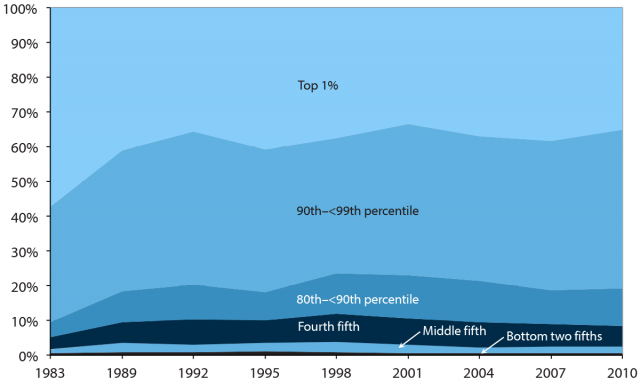
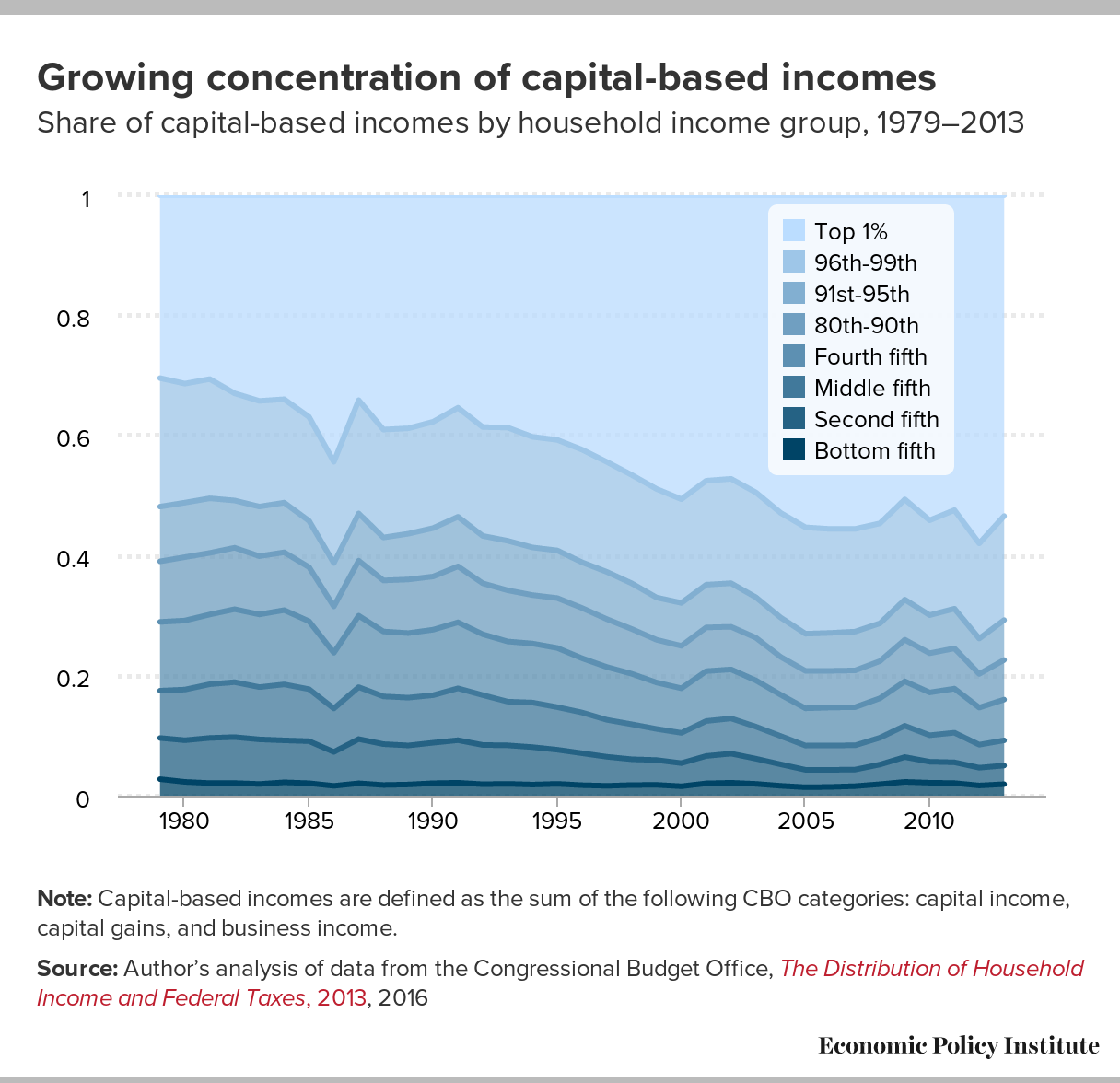
But Hasset insists indirect effects will trickle down to benefit the rest of us. His operating theory is almost quaint in how antiquated it is: “…workers do well when their employers do.” This leads him to claim that “when profits go up, capital investment goes up, and wages follow.”
For Tax Day, a reminder that economic arguments for the GOP tax plan have no theoretical basis
On Tax Day, Republicans in Congress will surely be trying to tout the benefits from the Tax Cuts and Jobs Act (TCJA) that they passed in December. It’s still far too early to make big claims about what the data shows about the effect of the TCJA, but it’s worth remembering why we should be very doubtful that any benefits at all will accrue to typical American families from the largest— and only permanent—feature of the TCJA, the cuts in corporate income tax rates.
The TCJA’s likely effect on the economy depends on whether the economy remains demand-constrained or not. Below, we’ll lay out why the TCJA is bad policy regardless of whether or not today’s economy remains demand-constrained.
When the economy is demand-constrained, there is not enough overall spending in the economy—or “aggregate demand”—to pin the economy at full employment. If the economy still suffers from a lack of aggregate demand, as we believe is likely the case, then tax cuts can boost demand—and thereby employment—by increasing the post-tax income of households and businesses.
The TCJA is generally not defended on the grounds that it will boost demand. The reason why is clear: the tax cuts that make up the bulk of the TCJA—tax cuts for the rich and big corporations—are by far the weakest fiscal stimulus to aggregate demand. High-income households are more likely to save the money they receive from a tax cut than low- and moderate-income households. This means that much of the TCJA will end up as savings in the pockets of rich households rather than a boost to aggregate demand. Corporate tax cuts don’t rate any better on this core, for the same reasons. In the short run, the benefits of corporate tax cuts flow to shareholders. The top 1 percent owns 40 percent of total stocks. In short, corporate rate cuts are simply tax cuts for the rich by another name. Tax cuts for low- and middle-income households would have provided about three times as much bang for the buck as the TCJAs tax cuts for the rich and big corporations, as would have increases to income support programs or infrastructure spending.
All of this is why defense of the TCJA (and tax cuts for rich people generally) assume the economy is not demand-constrained and is already at full employment. In this case, the claim is that cuts to the corporate rate give companies higher after-tax profits with which they can pay dividends to shareholders. This increases corporations’ incentive to undertake investment in new plant and equipment. And because the increase in the post-tax return to capital owners’ savings induces households to save more (or attracts more savings from abroad), these desired new investments can be financed without being choked off by rising interest rates. The resulting increase in capital investment gives workers more and better tools to work with, which boosts labor productivity and eventually wages.
How do our job creation recommendations stack up against a job guarantee?
A discussion broke out on Twitter last week about a recent paper I wrote on what role the government can and should play in creating jobs. The discussion centered on how this paper overlaps with and is different from a job guarantee proposal detailed in a series of papers by William Darity and Darrick Hamilton (often co-authored with Mark Paul, with others, particularly Pavlina Tcherneva, contributing analyses of job guarantees in recent years). Twitter is a tough place to have a substantive discussion, particularly one in which you’re disagreeing with people you have a lot of respect for, so I’ve decided to spend more than 280 characters on this. Because the contrast on Twitter was between our recommendations and the Darity and Hamilton proposals, I’ll focus on their framework in what follows.
Areas of overlap between our job creation recommendations and a job guarantee
Darity, Hamilton, and Paul’s latest job guarantee proposal was released last month by the Center on Budget and Policy Priorities. The best summary statement of it comes from their own paper: “The federal job guarantee would provide a job, at non-poverty wages, for all citizens above the age of 18 that sought one.” While job creation is the key goal of their proposal, their plan also hinges on these jobs producing goods and services that private markets are not producing—especially public investments. They identify two key benefits of the job guarantee as:
Macroeconomic stabilization. The job guarantee would function as a robust automatic stabilizer in the economy, maintaining levels of employment during economic downturns through direct hiring, and freely allowing workers to flow from the jobs program to the private sector during economic boom times.
The provision of socially useful goods and services. During the Great Depression, the Works Progress Administration (WPA) and Civilian Conservation Corps (CCC) were public employment programs designed to put Americans back to work…. These programs, implemented under the Roosevelt administration, provided goods and services that benefited all Americans by facilitating the logistics and technological expansion of our public infrastructure…..Under a job guarantee, even those who do not receive employment via the NIEC will likely benefit through the increased provision of public goods and socially desirable goods and services.
A balanced budget amendment would be extraordinarily dangerous for the economy
The House is set to take up a balanced budget amendment this week, which would limit federal spending in each fiscal year to federal receipts in that year. Putting aside for a moment the chutzpah of House Republicans trying to pass a balanced budget amendment (BBA) just a few months removed from their passage of a $1.5 trillion tax cut that went largely to the richest households and big corporations, the simple fact is that the economic consequences of a balanced budget amendment range from extremely bad to catastrophic. The reason for this is that a BBA would amplify any negative economic shock to the economy and would thereby turn run-of-the-mill recessions into disasters.
When the economy enters a recession, government deficits increase as tax revenues decline and government spending on programs such as unemployment insurance increase. These “automatic stabilizers” are incredibly important as they cushion the blow to the economy from a recession. For example, researchers at Goldman Sachs found that the shock to private sector spending from the bursting of the housing bubble was larger than the shock that led to the Great Depression of the 1930s. Given this larger initial shock, why didn’t we have another Great Depression, with unemployment rates approaching 20 percent and beyond, in 2009–10? The simple reason is that the mechanical increase in the deficit from tax reductions and increased transfer payments absorbed a lot (not enough, but a lot) of this shock, and automatic stabilizers were either non-existent or a lot smaller in the 1930s. Having these programs in place to absorb recessionary shocks is one of the great economic advances of the past 80 years—and getting rid of them by imposing a BBA makes as much sense as outlawing computers or antibiotics. To comply with a BBA as a recession approached, Congress would have to offset any mechanical increase in the deficit by raising taxes or cutting spending. The increased taxes or spending cuts would further drag on the economy, raising the deficit again and requiring still further tax increases or spending cuts. This vicious cycle would amplify the damage to the economy. Essentially this vicious cycle would lead to a large increase in the fiscal multiplier, with each dollar in spending cuts leading to output losses of about $2.50.
The Federal Reserve could try to counteract this drag on the economy by cutting interest rates. But the extent to which they would be able to mitigate the damage may be extremely limited, for a couple of reasons. First, while the Fed can certainly restrain growth by raising interest rates, spurring growth by cutting rates is often ineffective; a dynamic often referred to as rate cuts akin to “pushing on a string.” Further, with current chronic downward pressure on aggregate demand, so-called “secular stagnation,” characterizing the U.S. economy in recent decades, it is likely that the Federal Reserve would be constrained by the zero-lower bound (ZLB) on interest rates—as it was during the Great Recession. Since interest rates cannot be moved (for too long or too far) below zero, when the Federal Reserve hits the ZLB they will be unable to offset any further drag on the economy through conventional monetary policy.
New UN data on international migrants highlights special responsibility for destination countries in the Global Compact for Migration
Large movements of refugees and migrants around the world since 2015, many in response to humanitarian crises, have led to a global negotiation at the United Nations (UN) to create a new Global Compact for Migration (GCM). The GCM will be a non-binding international agreement to establish a new regime for cooperation on international migration that can maximize the benefits of migration and better protect migrants in vulnerable situations. While governments—minus the United States—continue to negotiate the GCM, it’s important to step back and reflect on the lives at stake. The latest UN report and data on migration from the UN Population Division helps by providing a snapshot of migrants around the world. These data can assist policymakers who are currently negotiating the GCM’s substantive provisions, who should remember to take into account their special responsibilities to protect the human rights of all migrants who live and work within their borders.
The UN Population Division reported that there were 258 million international migrants worldwide in 2017, meaning that 3.4 percent of people had been living outside of their country-of-birth for at least one year. The number of international migrants rose by 10 million from 248 million in 2015, but was unchanged as a share of the global population. The number of migrants in 2017 is an increase of 50 percent from 173 million in 2000, rising 0.6 percent from 2.8 percent of the global share of the population in 2000. Almost 75 percent of international migrants are of prime working age, meaning between the ages of 20-64. Men were 52 percent of international migrants in 2017 and women 48 percent.
By continent, Asia hosted 80 million international migrants, Europe 78 million, North America 58 million, Africa 25 million, Latin America 9.5 million, and Oceania 8.4 million. Europe’s population would have declined between 2000 and 2015 had it not been for the arrival of international migrants.
What to Watch on Jobs Day: Multiple measures indicate the presence of labor market slack
I’ve written a lot about wages in recent months. In March, I detailed trends in wages through 2017 in a report, with specific emphasis on growing inequality both across the wage distribution and between black and white workers. My “What to Watch on Jobs Day” blog post last month, as well as my statement on jobs day, tried to put wage growth in perspective by comparing multiple measures of wage growth and showing how many of them fell short of levels that would be needed to confidently declare the economy at full employment. On Friday’s Jobs Day, I will look at wage growth once again, as well as other measures of labor market slack which indicate that the economy has yet to unambiguously reach full employment.
Wage growth is a really important measure of labor market strength, and while slow wage growth is not just an indication that the economy remains below full employment, by definition slow wage growth means there continues to be some slack in the labor market. Slow wage growth tells us that employers continue to hold the cards, and don’t have to offer higher wages to attract workers. In other words, workers have very little leverage to bid up their wages. Slow wage growth is evidence that employers and workers both know there are still workers waiting in the wings ready to take a job, even if they aren’t actively looking for one. But, you say, the unemployment rate is 4.1 percent. Where are these workers waiting in the wings? The focus of this blog post and what I’ll be looking at on Friday (along with wages) are the other measures that similarly indicate there remains a non-trivial amount of slack in the labor market. I’ll argue that we can actually see this “waiting in the wings” in the data in other measurable ways, aside from weak wage growth.
Last week, my colleague Josh Bivens highlighted one underappreciated measure of labor market flows: the share of the newly employed that come from out of the labor force. One might be tempted to believe that the labor force represents a rather static and cleanly-defined group of people: those who have a job or those who don’t but want one and are actively looking for one. If that were the case, then the total labor force wouldn’t fluctuate so much and only the unemployment rate would move up and down at different points in the business cycle. But, the labor force itself ebbs and flows, even relative to the working-age population.