An economically and fiscally responsible budget from the Congressional Progressive Caucus
Earlier today, the EPI Policy Center released The Budget for All: A technical report on the Congressional Progressive Caucus budget for fiscal year 2013, which details the composition and effect of this year’s budget alternative from the CPC. While the policies in the Budget for All reflect the decisions of CPC leadership and staff, the EPI Policy Center provided the CPC with technical assistance in developing, scoring, and modeling CPC policies and their cumulative budgetary impact.
First and foremost, the Budget for All would address our most pressing challenges by financing up-front job creation measures and sustained public investments. Overall, the Budget for All would allocate $2.9 trillion for front-loaded stimulus and investments in human and public capital over FY2012-22 relative to current law. This would include:
- $227 billion for a direct jobs program modeled off of Rep. Jan Schakowsky’s (D-Ill.) Emergency Jobs to Restore the American Dream Act;
- $247 billion in increased transportation outlays relative to current law, including $50 billion in immediate investments for 2012, $53 billion in rail investments, and $30 billion for an infrastructure bank;
- $135 billion over FY2012-2022 in tax credits to foster hiring, innovation, manufacturing, and insourcing jobs to the U.S.;
- $183 billion to reinstate the Making Work Pay tax credit from 2013-2015 (the payroll tax holiday would be allowed to expire on schedule Jan. 1, 2013);
- Undoing the Budget Control Act (both the discretionary spending caps and the automatic sequestration cuts), which would increase nondefense (NDD) discretionary outlays by $583 billion; and
- $1.6 trillion in additional NDD spending for domestic priorities in areas including education, scientific research, and health.
By the end of the budget window (FY2022), NDD spending would total 3.5 percent of GDP, compared with 2.5 percent under current law, 2.4 percent under Obama’s budget request, and 2.1 percent under Wisconsin Rep. Paul Ryan’s budget. By FY2022, NDD spending would be 38 percent higher than under current law, 46 percent higher than under Obama’s budget, and 65 percent higher than under the Ryan budget. On average, over the 10-year window, NDD spending in the Budget for All would total 4 percent of GDP, slightly above the 3.9 percent of GDP historical average over FY1962-2011.

The Budget for All is committed to protecting and strengthening Social Security, Medicare, Medicaid, and the Affordable Care Act, and in stark contrast to the Ryan budget, proposes no benefit cuts. The budget would build on health care reform by offering a public insurance option and negotiating lower Medicare pharmaceutical prices. Regarding national security, the Budget for All would responsibly end the war in Afghanistan and overseas contingency operations while realigning spending by the Department of Defense toward domestic priorities.
To adequately fund budget priorities while achieving a responsible fiscal path, the Budget for All proposes progressive tax code reforms that would ask more from the most fortunate in our society. These would include adding higher tax rates for millionaires and billionaires, eliminating the preferential treatment of capital income over earned income, taxing accumulated wealth, taxing financial speculation, and responsibly pricing carbon (rebating a quarter of revenue to low-income households). Regarding the Bush tax cuts, the Budget for All would let the top two rates expire on schedule (following Obama policy) and temporarily extend the 28 percent and 25 percent brackets, phasing them out as the economy strengthens. The Budget for All’s individual income tax rate reforms would save $1.7 trillion relative to full continuation of the Bush-era tax cuts and $1.3 trillion relative to Obama policy.
The Budget for All is economically responsible and fiscally sustainable throughout the budget window; it increases near-term deficits, reduces long-term deficits, and sustains greater public investments throughout the budget window. And equally as important, it does so without engaging in budgetary gimmicks; the Budget for All finances the likely continuation of the Alternative Minimum Tax patch and the Medicare physician payments “doc fix” over the next decade.
In short, this budget proves that there is a sensible, credible alternative to governing than the one put forth by Ryan, which would eviscerate the social safety net and other important programs. The Budget for All demonstrates that we can fulfill Americans’ top priorities—investing in a strong economic recovery and fostering shared prosperity—while meeting respectable fiscal targets and preserving the legacies of the New Deal and the Great Society.
Congressional Progressive Caucus’ Budget for All addresses our national priorities
On Monday, the Congressional Progressive Caucus released its Budget for All, a stark contrast and credible alternative to the misguided budget proposed by House Budget Committee Chairman Paul Ryan (R-Wis.).
Every budget reflects national priorities, not just a bottom line. The Budget for All would meet our most pressing challenges by increasing near-term job creation and public investments, strengthening economic security programs, realigning spending by the Department of Defense to domestic priorities, and financing government responsibly over the long run with progressive revenue sources that place our nation on a sustainable fiscal trajectory. The Budget for All is “fiscally responsible,” provides sound economic stewardship, protects the middle class, and supports upward mobility.
The most pressing challenge facing the United States is the ongoing jobs crisis, which the Budget for All acknowledges with $2.9 trillion in front-loaded job creation measures and sustained public investments. The budget would allocate $227 billion for a direct jobs program that puts Americans back to work through public service, as was done during the Great Depression. Transportation infrastructure investment would be increased by $241 billion (50 percent) over the next decade to boost employment and lay the foundations for economic growth. Nondefense discretionary (NDD) spending in areas including education, scientific research, and health would be increased by $1.6 trillion relative to current law. By the end of the budget window in 2022, NDD spending would be the same as in 2007 (as a share of GDP) and be 65 percent higher than under the Ryan budget and 50 percent greater than under the Obama budget.
The Budget for All would protect and strengthen vital social insurance programs such as Social Security, Medicare, Medicaid and the Affordable Care Act, maintaining commitments to provide economic security in retirement and health care to seniors, children, and the disabled. The budget would protect and build on health care reform by offering a public insurance option and negotiating lower Medicare pharmaceutical prices. And the Budget for All would essentially close the 75-year shortfall in the Social Security trust fund without cutting benefits by eliminating the cap on taxable earnings that has allowed the highest earners to pay an ever-shrinking share of wages to Social Security in recent decades.
This progressive budget would realign defense priorities towards domestic ones. The war in Afghanistan would be responsibly ended and spending by the Department of Defense would be gradually cut, with the savings allocated to domestic investments.
Lastly, the Budget for All would adequately fund all of these priorities with progressive tax reforms, largely by asking more from the highest-income households that have seen both sizable income growth and large reductions in taxes over the past decade. Higher tax rates would be added for millionaires and billionaires, and the preferential treatment of capital income over earned income would be eliminated. The 2001 and 2003 income tax rate cuts for high-income households would be gradually phased out over a decade, while lower tax rates and tax credits for working families would be preserved. Taxes on financial speculation, carbon emissions, and accumulated wealth would address societal challenges while raising large sums of revenue.
The EPI Policy Center provided technical assistance in developing, scoring, and modeling the Budget for All. The technical documentation of the details of the budget plan and the scoring of its measures are available on our site. We unequivocally conclude that the Congressional Progressive Caucus budget achieves fiscal sustainability, but more importantly, it does so while spurring economic recovery, strengthening Social Security, Medicare, Medicaid and the Affordable Care Act, and investing in human and public capital. The Budget for All, in short, sets a path that strengthens job growth, improves competitiveness, enhances economic security, lessens inequality and provides avenues for upward social mobility. This budget proves that there is a credible and sensible alternative to Rep. Ryan’s attempt to dismantle government and rebate the tax bill to the already well-off.
Economists arguing that there is indeed such a thing as a free lunch … as long as people are willing to eat it
Brad DeLong and Larry Summers have a new paper out that’s worth reading. Little in it is brand-new to obsessive followers of the fiscal policy debates of the past few years, but it’s a very useful compendium of evidence.
Their basic argument is that the effectiveness of fiscal policy support (say, like the Recovery Act) quite likely remains substantially under-estimated by most well-known models and assessments (and even these well-known models already make a powerful case for its effectiveness). They, in fact, go so far to say that:
“A combination of low real U.S. Treasury borrowing rates, positive fiscal multiplier effects, and modest hysteresis effects [i.e., the “scarring effects” of recessions – see here] is sufficient to render fiscal expansion self-financing”
To put this simply, fiscal support pays for itself, even in narrow budgetary terms (let alone in broader economic terms). This is a key lesson – one we have tried to impart before in a policy memo:
“The original Recovery Act spurred income creation that resulted in higher tax collections and lower safety-net spending, substantially blunting its bottom-line impact on deficits”
And in congressional testimony:
“While this caution may be useful, it should be made clear that the case for full self-financing over time of temporary fiscal support in an economy stuck in a liquidity trap is actually not totally implausible…”
Why is this point—that well-designed fiscal support programs are significantly or even totally self-financing—so important? Well, for some reason, far too many policymakers (even, or especially, ones who self-identify as Democrats, who one would think would be friendlier to calls for fiscal support for job creation) have settled on the mantra that short-term stimulus can only be done if coupled with long-term deficit reduction. There never was a real substantive reason for this stance – even if the Recovery Act, for example, had not come with any induced deficit offset at all, it would have added all of 2 percent to the long-run fiscal gap of the United States.
But, once one allows for the very real possibility that well-designed fiscal support adds nothing to long-run deficits, the logic of holding it hostage in the name of concern over long-run deficits falls apart completely. In short, holding up short-term fiscal support in the name of extracting long-run promises on deficit reduction makes about as much sense as insisting that a house with drafty windows that’s also on fire can only have the flames doused if somebody can be found to simultaneously do some caulking.
Report to Congress confirms large benefits, modest costs of new EPA rules
The Office of Management and Budget just posted a draft of its annual report to Congress on the benefits and costs of federal regulations. This official documentation of all major regulations reviewed by OMB includes an individual listing of the benefits and costs of all such rules finalized by the Obama administration through Sept. 30, 2011 (the end of fiscal year 2011). This listing, Table D-3 found on pages 126-128, includes nine final rules issued by the Environmental Protection Agency and two final rules issued jointly by EPA and the Department of Transportation.
If the monetized benefits and costs of these 11 individual rules are tabulated (hereafter referred to as the “Obama EPA rules”), the results are strikingly positive. As the table at the end of this post indicates:
- The benefits of the finalized Obama EPA rules are valued at $98 billion a year (all figures in 2010 dollars). Most of the benefits come from saving lives and other health benefits, but also include economic benefits such as reduced fuel expenditures by consumers or increased worker productivity.
- The compliance costs of the Obama EPA rules amount to just $8.3 billion a year, or far below one one-thousandth of the economy.
- The net benefits from these rules is $90 billion a year. The ratio between benefits and costs is 12-to-1.
- Using methodology I wrote up previously, I estimate the economic benefits from the joint EPA/DOT rules alone, connected to fuel efficiency and greenhouse gas standards for cars, amount to about $13 billion a year, or more than the compliance costs for all 11 Obama EPA rules.
Since the OMB report is designed to cover data only through the end of the previous fiscal year, it does not include EPA’s “air toxics” rule that was finalized on Dec. 16, 2011. This rule has significant compliance costs, amounting to $10 billion a year, but much larger benefits, amounting to $64 billion a year (using the midpoint of the benefit range). Combining this rule with the rules in the OMB report, the benefits of Obama EPA rules finalized to date amount to $162 billion a year, compared to compliance costs of $18.3 billion a year (about one one-thousandth of the economy). The net benefit figure for this combination of EPA rules is $144 billion a year.
Cost-benefit data should not be considered precise, and there are many complexities to such analysis that have not been fully addressed (such as many benefits are not monetized). Nonetheless, the magnitude of the net benefits of the Obama EPA rules shown by this data indicates that they are likely to be of much value to the nation.
Annual costs and benefits of major EPA rules finalized during the Obama administration, through Sept. 30, 2011 (in millions of 2010 dollars)
*These rules are joint EPA/DOT rules Source: Table D-3, Draft 2012 Report to Congress on the Benefits and Costs of Federal Regulations and Unfunded Mandates on State, Local, and Tribal Entitities. EPI converted the data from 2001 dollars to 2010 dollars using the GDP deflator  |
Ryan’s budget cuts would cost jobs
All budget proposals should be evaluated first and foremost by how they address the most important problems facing the nation. Today that problem is joblessness. Unemployment is still elevated at 8.3 percent, the highest in a generation, while the average duration of unemployment is still at peak levels (about 40 weeks). Poverty rates for young children (under the age of 6) are at their highest recorded levels, while the number of households in extreme poverty (earning incomes of less than $2 per day) has doubled since the mid-1990s. Although the economy has added 735,000 jobs in the last three months, even at this rate it would still take five years before the labor market fully recovered. In short, any policy that fails to address job creation—or at least fails to extend the economic provisions that we’ve already put in place—should be rejected.
Paul Ryan’s latest budget doesn’t just fail to address job creation, it aggressively slows job growth. Against a current policy baseline, the budget cuts discretionary programs by about $120 billion over the next two years and mandatory programs by $284 billion, sucking demand out of the economy when it most needs it and leading to job loss. Using a standard macroeconomic model that is consistent with that used by private- and public-sector forecasters, the shock to aggregate demand from near-term spending cuts would result in roughly 1.3 million jobs lost in 2013 and 2.8 million jobs lost in 2014, or 4.1 million jobs through 2014.*
Of course, this leaves out taxes. Ryan’s proposal involves cutting taxes on corporations, eliminating the Alternative Minimum Tax, maintaining the Bush tax cuts and preferential rates on capital gains and dividends, and consolidating the rate structure into two brackets, 10 percent and 25 percent. He says he’ll pay for these tax cuts (excluding the Bush tax cuts, which are already currently in effect) by eliminating tax expenditures, so it won’t result in revenue loss.
Now, temporary tax cuts can create jobs because they pump more money into the economy and boost consumer and business spending. The payroll tax holiday is one such example. But the fact that Ryan’s tax proposal won’t change net revenue levels in the near-term means that its economic effects will be minimal – and it will certainly not materially offset the job declines stemming from spending cuts. Worse, the composition of Ryan’s tax-shift means that it will likely result in a small job loss because it shifts the tax burden from high-earners to middle-class households. Low-income households will also face higher taxes because Ryan would allow certain tax credits like the Earned Income Tax Credit, Child Tax Credit, and the American Opportunity Tax Credit to fall from their current levels. Redistributing money away from people who spend more of each marginal dollar of disposable income (low- and moderate-income households) to those with much higher savings rates (high-income households) is broadly recognized as leading to a decline in aggregate demand.
*2-year figure in job-years
What’s good for Apple is … just good for Apple
In a conference call with investors Monday, Apple CFO Peter Oppenheimer argued that the company could not repatriate its $65 billion (yes, with a ‘b’) in earnings and investments held overseas because the corporate income tax constituted too large a “disincentive” to do so. This was apparently the latest in a lobbying effort by Apple to have Congress institute a repatriation “tax holiday” similar to one passed in 2004, that saw hundreds of billions of dollars of foreign-held corporate earnings brought back to the country under preferential tax rates.
Calls for another corporate tax holiday have been growing in the past six months, with various pieces of legislation introduced in the House in 2011 that would reward companies that repatriate profits with a low tax rates. These calls for a repatriation holiday are often bipartisan (House legislation introduced in the summer of 2011, for example, is co-sponsored by Utah Democrat Jim Matheson and Texas Republican Kevin Brady).
It is important to note that a repatriation holiday solves no economic problem at all … unless one defines Apple investors’ obligation to pay taxes as a problem.
The best economic case made in favor of such a holiday is that by encouraging U.S. corporations to return their overseas holding to the domestic economy, this will greatly increase the supply of investment capital that can be mobilized to help businesses increase capacity.
But, as we’ve noted over and over again, U.S. businesses today still are not using anywhere near the full amount of capacity they already have. And access to cheap credit for corporations is historically easy. And business investment is the one area of the economy that is actually growing historically fast. And corporations are already sitting on historically large amounts of investable capital. In short, there is no plausible reason at all to think that repatriating foreign earnings provides any relief to the actual economic problems facing the U.S.
What a holiday would do, especially given the 2004 holiday, is convince U.S. corporations that profits earned abroad will always be given an opportunity to be brought home at very low tax rates in the future. And this will provide further incentives to firms to increase the share of their profits that are earned abroad, which means increasing the share of jobs and capacity that is held abroad.
Apple (and other multinationals) already has the chance to defer taxation on profits held overseas – this is a substantial tax benefit already. There is no public policy case at all for giving them and other multinationals another holiday from corporate taxes. Luckily, the Obama administration seems unswayed so far by Apple’s complaints.
State Department right to ban Alaskan fish processing jobs from J-1 visa Summer Work Travel program
Representatives of fish processing companies in Alaska are complaining about the possibility that they might lose access to 4,000 to 5,000 temporary guest workers they hire each year through the State Department’s “Summer Work Travel” (SWT) program, a part of the J-1 visa Exchange Visitor Program originally designed to facilitate a cultural exchange between Americans and citizens of other countries. The companies worry that they won’t be able to find enough workers this summer and that the whole industry will be negatively impacted as a result. The fundamental problem is that the industry has come to depend on an exploitable foreign workforce instead of hiring U.S. workers.
The J-1 SWT program was not designed to be a temporary foreign worker program. Its purpose is to facilitate a cultural exchange between foreign college students and American residents. If fish processors need a workforce, they should look to unemployed Alaskans and other Americans first, and if they still can’t find enough workers, there are other work visa programs that are more appropriate (for example, the H-2B program). Secretary of State Hillary Clinton and the State Department should not be persuaded by the fish processors or the two U.S. Senators from Alaska, who have urged the secretary to spare the industry from a ban on using J-1 SWT student workers.
 The concern of the fish processors likely stems from an Associated Press story about a leaked memo outlining a number of changes to the SWT program the State Department might implement this year. This includes prohibiting the employment of SWT student workers in seafood processing plants and other potentially dangerous workplaces.
The following is an excerpt from the statement of purpose in the Fulbright-Hays Act, the legislation that created the J-1 Exchange Visitor Program which includes SWT. It clearly states what the program is designed to do:
The purpose of this chapter is to enable the Government of the United States to increase mutual understanding between the people of the United States and the people of other countries by means of educational and cultural exchange; to strengthen the ties which unite us with other nations by demonstrating the educational and cultural interests, developments, and achievements of the people of the United States and other nations, and … thus to assist in the development of friendly, sympathetic, and peaceful relations between the United States and the other countries of the world.
Even if you read the entire Fulbright-Hays Act, you won’t find anything that suggests a congressional intent to provide employers with a temporary workforce or to help them fill labor shortages. It’s clear the SWT program is not primarily a guest worker program; it is intended to facilitate a cultural exchange. The State Department’s new Guidance Directive outlines this clearly. The work component of this cultural exchange is designed to allow the SWT student worker to interact with Americans and to allow him or her to earn enough money to travel to and within the United States. This allows foreign students from lower-income backgrounds to visit the United States when they otherwise might not be able to afford it. From that perspective, it’s a good thing, but it’s impossible to argue with a straight face that J-1 student workers in Alaskan fish processing plants are experiencing the cultural exchange envisioned in the Fulbright-Hays Act.
A recent investigation revealed an example of what SWT recruiters for fish processing jobs tell potential participants about the cultural exchange program they offer:
“We’re looking for hard workers who are not afraid to work every single day, up to 16 hours a day,’’ said Sarah Russell of Leader Creek Fishing in the village of Nakenak [sic]. “You will make a lot of money in a very short period of time and you won’t spend it anywhere because there’s really nothing to do in Nakenak, other than work.”
That says it all.
Russell admits the J-1 SWT student workers will work long hours – double all-day shifts to be exact. If you work 16 hours a day, when will you have time to interact with other Americans? Perhaps in the workplace? Probably not, since the plant is likely to be staffed with many other SWT workers from around the world. Russell also notes that the job is located in an isolated location with nowhere to shop and nothing to do. I assume that also means there are no cultural or educational activities available locally. How are SWT student workers supposed to interact with Americans and learn about American culture if they live far from them and are working for two-thirds of the day? (Presumably they sleep during the eight hours they have all to themselves.) Quite simply, they can’t, and that’s why it doesn’t make sense to allow fish processing jobs in the SWT program. Read more
Wisconsin one year later
We recently passed the one-year anniversary of the “uprising” in Wisconsin, which began with a governor allegedly trying to wrestle with state fiscal challenges, and quickly became the focal point for an outright attack on public sector workers. Underlying Gov. Scott Walker’s position was a belief that public sector workers were impeding the state’s economic performance. In the midst of draconian cuts to public sector employment, there emerged outlandish claims that Wisconsin’s economy was leading the nation in job growth. No single month’s employment numbers should be relied on to tell the story of what’s happening in a state economy. But looking at the longer trend provided by year-over-year data is instructive.

Figure 1 Source: EPI analysis of BLS data
EPI looks at state employment trends on a monthly basis (the most recent state level data are Jan. 2012 data). Looking comparatively at all states often tells an interesting story, but sometimes it’s good to drill a little deeper, or to look through a lens that examines regional trends.
As seen in Figure 1, overall non-farm employment since Jan. 2011 has rebounded in the Midwestern states surrounding Wisconsin, with Michigan leading the region with Jan. 2012 employment 1.6 percent higher than in Jan. 2011. Wisconsin stands out in the region, lagging with employment significantly lower — by 0.5 percent — in Jan. 2012 than a year earlier.

Figure 2 Source: EPI analysis of BLS data
While Figure 1 showed trends over the last year in overall employment, Figure 2 shows trends in private sector employment. Wisconsin appears to have returned to a “break even” point by Jan. 2012 (noting the caveat above that single month “trends” should be used with extreme caution), but it is still very clearly an outlier amongst its neighboring states.
Our colleagues at the Center on Wisconsin Strategy wrote in June that Gov. Walker should be neither credited (nor blamed) for employment trends that result from factors outside his influence. The trends we see above, however, are substantially within his influence. We and others have cautioned repeatedly that states that close their budget gaps by laying off public sector workers do so at the peril of their overall economy. To be clear, we are not talking only of the fact that unemployed public sector workers will be added to state unemployment rolls (though they have been in states across the country), but that their ability to contribute to the economy is curtailed by their unemployed status. Because public sector workers are a vital part of every state economy—firefighters, teachers, police officers and department of health officials all buy clothing, groceries, and movie-tickets just like private sector workers—laying them off hurts us all by reducing economic activity, which holds back the recovery.
Fair-minded people would surely agree that we want our governments to make smart policy choices. The data above underscore the results of two policy choices. In one choice, the decision to rescue the auto sector, we see that the result is Michigan leading the region in employment growth. In the other choice, the decision to lay off thousands of public sector workers, we see that the result is Wisconsin lagging behind the region (indeed, the nation) in employment growth.
Public investment and the social contract
On Wednesday I participated in a panel discussion called Public Investment: Key to Prosperity, sponsored by Americans for Democratic Action. Leaving aside the broader case for public investments, I’d like to point out that this topic is important not just because we continue to underinvest in infrastructure, education, and innovation, but because public investments are a powerful messaging tool for progressives. The right is exceedingly effective at demonizing all government spending as wasteful and, in the era of deficit hysteria, greedy as well because it forces us to pass debt on to future generations.
But public investments, which make up about half of all domestic (non-security) discretionary spending, are exactly the opposite of this characterization—they are investments made now, but their benefits accrue to society over decades and sometimes centuries (the Erie Canal has been in operation for nearly 200 years!). The left does well talking about the importance of individual programs, but unless we can start linking it all (or at least many) together under a single conceptual umbrella, we’ll keep losing the budget battles that happen at the macro level.
This message gets to the broader social contract. Elizabeth Warren’s hyper-viral video is really about the role that public investments play in an individual’s success, and the debt that successful taxpayers owe back to society in the form of higher tax rates. For a deeper look at this, check out The Self-Made Myth, which shows how many successful business leaders—from Warren Buffet and Ben Cohen to Donald Trump and Ross Perot—owe their success to government’s investment in them.
China continues to lean against the wind on need for currency revaluation
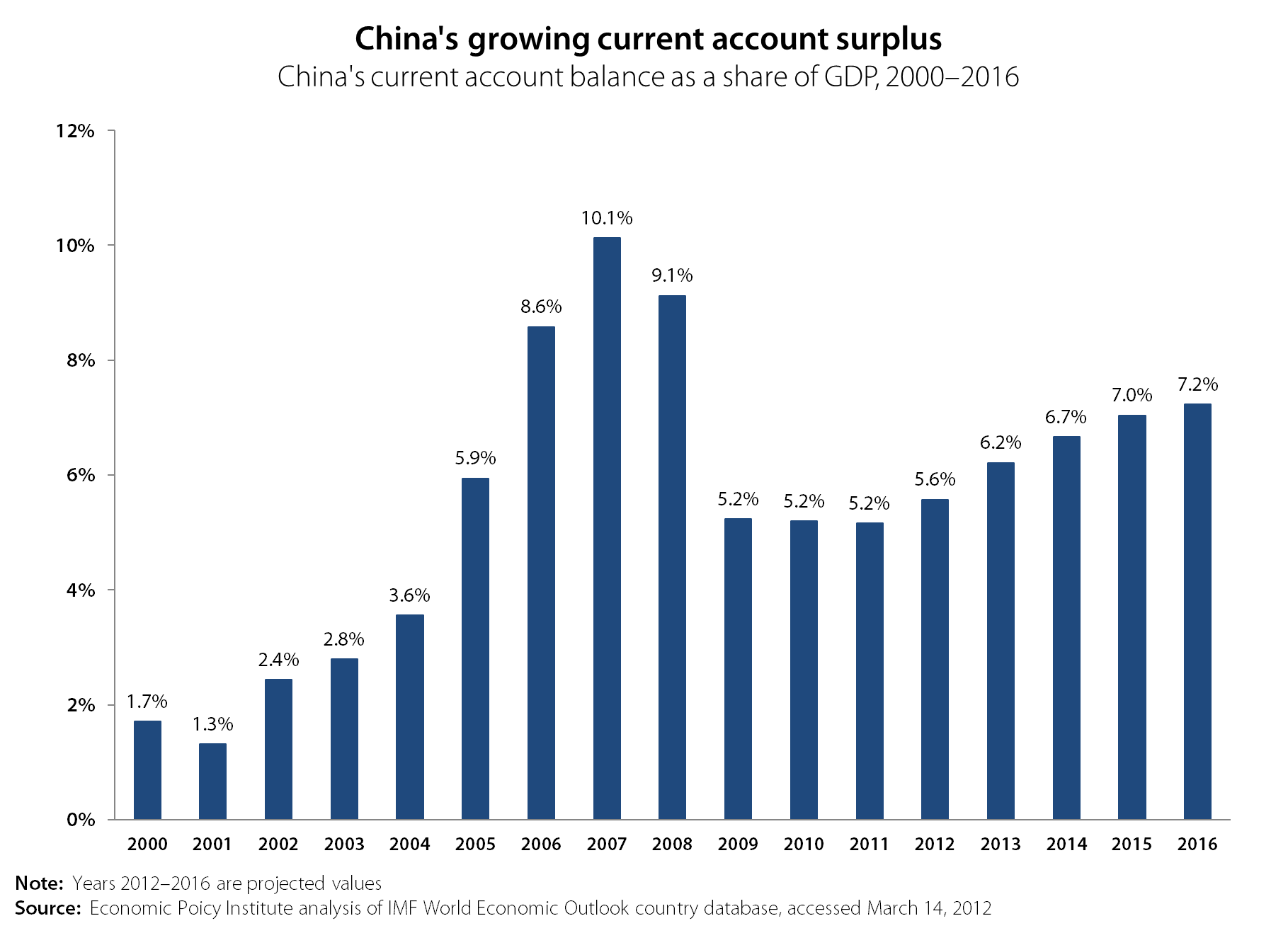
Chinese Premier Wen Jiabao claimed in remarks Wednesday that the yuan’s exchange rate may be close to an equilibrium level. Premier Wen claimed China has already achieved basic balance in international payment, which he defined as a current account surplus below 3 percent of gross domestic product. However, recent data and forecasts from the International Monetary Fund show that although China’s current account surplus is still recovering from the recession, it has never fallen below 5.2 percent of GDP. The IMF projects that China’s current account balance will increase to 7.2 percent of GDP by 2016.
Recent estimates by William R. Cline and John Williamson of the Peterson Institute show that China’s currency remains at least 24 percent undervalued relative to the U.S. dollar. Although China’s currency has been allowed to fluctuate against other currencies, China firmly controls the value of the yuan against the dollar, because the United States is the chief market for China’s exports. Recent appreciation in the yuan (also known as the renminbi) has not been sufficient to reduce China’s global trade surplus to a sustainable level. In 2011, the U.S. trade deficit with China reached $301.6 billion, 14.6 percent more than in 2010. In Jan. 2012, the monthly U.S. trade deficit with China increased again to $26.0 billion, an increase of 12.6 percent over levels in Dec. 2011.
China invested over $330 billion in purchases of new foreign exchange reserves in 2011, and historically about two-thirds of those reserves have been held in U.S.-dollar denominated assets. China is illegally intervening in foreign exchange markets to artificially suppress the value of its currency against the dollar and other currencies. This acts like a subsidy on all Chinese exports, and a tax on all U.S. exports to China. It also limits U.S. exports to every other country in the world because China is our top competitor in world export markets.
History demonstrates that China will not significantly revalue the yuan unless it is faced with threats of significant tariffs or other trade restraints. Congress threatened to impose tariffs in 2005, when the currency was even more undervalued, and China began to revalue but then stopped. Now, China is declaring the problem solved when in reality, it’s far from solved.
Paul Krugman has denounced China for its “predatory” trade policies. Fred Bergsten has described China’s currency intervention as the “largest protection measure adopted by any country since the Second World War – and probably in all of history.” Taking strong measures to end China’s currency manipulation will be good for Chinese consumers because it will lower prices of oil and other commodities in China. It will also create more jobs in the United States and other countries, because it will increase exports and shrink trade deficits. The time has come for the United States to declare China a currency manipulator and to threaten large, across-the-board tariffs unless and until they revalue enough to shrink their massive global trade surpluses.