Guestworker expansions don’t belong in comprehensive immigration reform
In a CNN opinion piece published Jan. 28, Tamar Jacoby, the president and CEO of ImmigrationWorks USA, shows amazing disdain for the one-third of Americans working low-wage jobs. She claims that they shouldn’t want the jobs they have because they can find more productive and better paying work. Jacoby thinks a job as a home health aide is beneath the aspirations of native-born Americans. So much for the dignity of work!
Dr. Martin Luther King Jr. criticized Jacoby’s way of thinking about “low productivity” work in a famous speech to striking sanitation workers just before he was assassinated:
If you will judge anything here in this struggle, you’re commanding that this city will respect the dignity of labor. So often we overlook the worth and significance of those who are not in professional jobs, or those who are not in the so-called big jobs. But let me say to you tonight, that whenever you are engaged in work that serves humanity, and is for the building of humanity, it has dignity, and it has worth. One day our society must come to see this. One day our society will come to respect the sanitation worker if it is to survive. For the person who picks up our garbage, in the final analysis, is as significant as the physician. All labor has worth.
The fact is that 40 million Americans work in extremely low wage jobs and are either grateful to have them or unable to find anything better. It’s shocking Read more
Today’s teachable GDP moment: Slower government spending => slower GDP growth
Today’s GDP report was unexpectedly disappointing, but the economy is likely not entering recession. The downward drag on GDP growth that pushed into negative territory was mostly exerted by changes in private inventories (which are volatile and unlikely to provide a consistent drag on GDP going forward) and a large reduction in defense spending that is also unlikely to be repeated.
The large drag imposed by this defense cutback, however, illustrated the valuable point that fiscal contraction is contractionary: When government spending drops, the economy suffers. The rest of the economy is simply not growing strong enough to make up for losses in demand due to government spending cuts. And while the defense drag this quarter was extraordinarily large, the trend has been steadily declining public support to the economy for some time now.
The downward trend in government spending can be illustrated by taking a look at current government expenditures, relative to potential gross domestic product. We look at expenditures as a percent of potential GDP because it does not allow a decline in actual GDP (or a slowdown in its growth) to make this ratio look bigger. What we’re looking for is a policy-induced rise (or failure to rise) in the importance of public spending, and expressing this spending as a share of potential GDP better isolates this policy effect. Read more
What we read today
Here are a few of the links that EPI’s research team clicked through during the last couple of days:
- “Payroll Tax Cuts May Boost the Economy More than You Think” (TaxVox)
- “U.S. Income Inequality Worse Than Many Latin American Countries” (Huffington Post)
- “Nicholas Stern: ‘I got it wrong on climate change – it’s far, far worse‘” (The Guardian)
- “Obama wants to tackle poverty and inequality. So why is his economic team so focused on the deficit?” (Washington Post)
- “Failures” (Paul Krugman)
- “Your Biggest Carbon Sin May Be Air Travel” (New York Times)
- “The Force: How much military is enough?” (New Yorker)
Louisiana retirement plan ruled unconstitutional
The cash balance retirement plan Louisiana Gov. Bobby Jindal recently signed into law for state workers was declared unconstitutional by a state district judge because it did not pass the Louisiana House of Representatives with a two-thirds majority. The cash balance plan would shift considerable risk onto workers without addressing the issue of unfunded liabilities caused by elected officials’ failure to keep up with required contributions.
Jindal has announced that he will appeal the decision. But this isn’t the only legal challenge the plan faces. The IRS is also considering whether the plan fails the Social Security equivalency test, which exempts some public-sector workers from participating in Social Security as long as government employers provide a retirement benefit at least equivalent to Social Security benefits. As Michelle Chen wrote in an In These Times blog post, Republicans around the country are using “pension panic” to push through policies that are both half-baked and anti-worker.
When and what kind of deficit reduction matters most: The danger of aggressive 10-year deficit targets in the current budget debate
In the aftermath of the American Taxpayer Relief Act of 2012 (i.e., the lame-duck budget deal, ATRA for short), many in Washington have urged 10-year deficit reduction targets that are trillions more than the $600 billion reduction already locked in by ATRA. While many of these calls for increased deficit reductions have been inchoate (as noted here), others have been more reasonably grounded. Yet, we think that nearly all demands for specific, ambitious 10-year deficit reduction targets are likely to be terribly counterproductive in the current debate
The primary reason for this is simple: Without a sharp focus on when and what kind of deficit reduction should happen, these calls can easily lead policymakers to embrace measures that will surely hamper economic recovery. And this recovery should be the primary focus of these policymakers. The output gap in 2012—essentially the difference between actual economic output and output that would have been produced had all productive resources in the economy been put to work—will likely register just shy of $1 trillion, or 5.6 percent of the economy. This is $1 trillion in national income that the country is forfeiting each year simply due to the continued weakness in aggregate demand—weakness that would likely be exacerbated by any aggressive deficit reduction in the next few years. This depressed state of the economy makes the timing and composition of any proposed deficit reduction crucial. And yet these crucial details are generally not a primary focus in 10-year deficit reduction targets that are dominating the debate.
In regards to timing, deficit reduction that imposes a drag on growth really should not begin at all until the economy moves much closer to full employment. Read more
The importance of revenue revisited: Minimizing the drag of austerity
Via Ezra Klein comes a must-read leaked memo from Senate Budget Committee Chairwoman Patty Murray (D-Wash.) to Senate Democrats ahead of fashioning a Senate Budget Resolution. It’s an excellent chronology of the deficit reduction enacted in the 112th Congress—a hefty $2.4 trillion expected to take effect and $3.6 trillion if sequestration goes into effect—and the looming phases of the Beltway budget fights following the American Taxpayer Relief Act (i.e., the lame-duck budget fight, or ATRA for short).1
Klein hones in on tables depicting the fundamentally unbalanced nature of deficit reduction in the 112th Congress: Ignoring sequestration, 70 percent of policy deficit reduction measures (i.e., excluding additional debt service savings) enacted came from spending cuts as opposed to revenue, and if sequestration takes effect as scheduled, the share of spending cuts ratchets up to 80 percent. Murray’s memo contrasts these ratios with a 51 percent revenue share proposed by the Simpson-Bowles Co-Chairs’ report and 52 percent in the Senate’s bipartisan “Gang of Six” proposal. Hence Murray’s conclusion:
“Revenue Must be Included in Any Deal. Tackling our budget challenges requires both responsible spending cuts and additional revenue from those who can afford it most.”
She’s absolutely right, but the memo hits only on the budgetary half of why compositional balance is important. Accepting on face value that the 113th Congress will pursue more deficit reduction measures (more forthcoming from us on this premise)—at the very least replacing sequestration in chunks or entirety—including progressive revenue is critical for minimizing the economic drag of austerity. Read more
Huge disparity in funding for immigration enforcement vs. labor standards
In a new, well-documented report, Immigration Enforcement in the United States: The Rise of a Formidable Machinery, the Migration Policy Institute (MPI) calculated that the government’s price tag for immigration enforcement in 2012 was $18 billion. The report made headlines by highlighting the fact that this figure amounts to 24 percent more than it costs to fund the five main U.S. law enforcement agencies combined. But MPI offered another important juxtaposition in the report that has failed to receive much attention: the abysmally low level of funds the government commits to enforcing labor standards and protecting the rights of workers in the United States.
MPI reviewed the budgets of the National Labor Relations Board (NLRB) and the Labor Department’s Wage and Hour Division (WHD) and Occupational Safety and Health Administration (OSHA), concluding that in 2010, the “combined budgets for [the] three main federal labor standards regulatory agencies was $1.1 billion … compared to the $17.2 billion budgets for DHS’s two immigration enforcement agencies.” Analyzing the most recent federal budget data available, EPI has found that even when including additional federal agencies whose primary purpose is to enforce labor standards (the Mine Safety and Health Administration (MSHA), the Office of Federal Contract Compliance Programs (OFCCP), and the National Mediation Board (NMB)), in 2012, the total amount Congress appropriated to enforce labor laws and regulations amounted to only $1.6 billion—about 9 percent of what was spent enforcing immigration laws last year.

The labor enforcement agencies are staffed at only a fraction of the levels required to adequately fulfill their missions.Read more
The congressional GOP has smothered a more rapid economic recovery
PBS’ Frontline has an interesting piece on the GOP response to President Obama’s election in 2008, reporting that, “After three hours of strategizing, they decided they needed to fight Obama on everything.”
Part of this “everything” was the efforts of the new administration to end the Great Recession and restore the economy back to full health. From the start, the GOP sought to block measures that a wide swath of economists agreed would provide help to boost the economy and bring down unemployment. This obstructionism has been a constant theme throughout the past four years, and it continues today.
Congressional Republicans have made it clear that they intend to use every bit of leverage they can to force cuts to domestic spending in the coming year. This leverage includes threats to not raise the statutory debt ceiling and/or force a federal government shutdown after March 27, when the standing appropriations continuing resolution (CR) expires. This, of course, would represent the long-promised repeat of the spring and summer of 2011, when congressional Republicans secured over $500 billion in domestic spending cuts in CR fights and another $2.1 trillion in spending cuts in exchange for incrementally raising the debt ceiling by an equivalent amount—better known as the Budget Control Act (BCA) of 2011.
The BCA cuts have already done damage, and will all-but-surely slow growth in the rest of 2013 as well. The various components of the BCA accounted for about one-third of the total fiscal drag exerted by the major components of the “fiscal cliff” that was facing Congress ahead of the lame duck budget deal. And the components of the BCA account for 48 percent of the remaining fiscal drag unaddressed by the deal—a drag that is poised to shave 1.0 percentage point from real GDP growth in 2013. House Republicans have voted to replace the Defense cuts contained within the sequester—again rapidly approaching, following its postponement to March—in it with deeper domestic spending cuts, leaving a drag of 0.8 percentage points from the BCA for 2013, all while threatening to use the debt ceiling and CR as leverage to get their way.
If this ideologically driven objective of deeply cutting spending is met, this will represent just one more way that the GOP Congress has managed to delay full recovery from the Great Recession. The evidence continues to pile up Read more
Are the job polarization data robust?
This post is the fourth in a short series that assesses the role of technological change and job polarization in wage inequality trends.
In an earlier post, John Schmitt showed that “job polarization”—the expansion of low- and high-wage occupations at the expense of occupations in the middle—did not occur in the 2000s, (and therefore could not be responsible for rising wage inequality in the 2000s). In this post, I examine how well the key figures at the heart of the “job polarization” analysis really fit the underlying data. I begin with a closer look at the data for the 1990s, the decade that appears to conform most closely to the patterns implied by the job polarization explanation for wage inequality.
In a recent piece critical of research myself, John, and Larry Mishel are doing on technology and wages, Dylan Matthews makes a lot of our interpretation of the following chart for the 1990s. The chart, which we prepared for a paper presented at a conference earlier this month, shows the change between 1989 and 2000 in the share of total employment in 100 different occupation groups arrayed by their average wage level (labeled “skill percentile”):
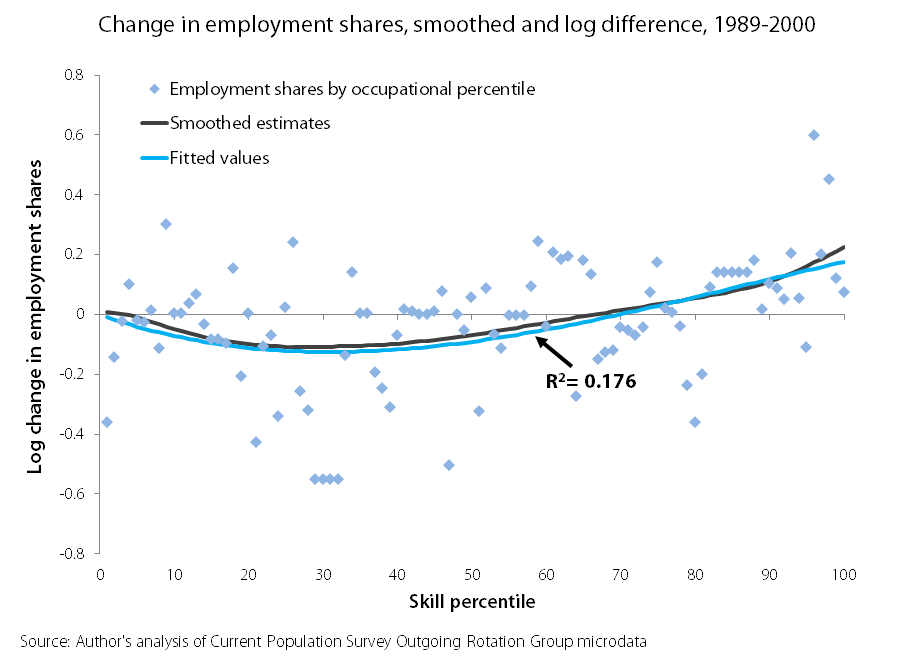
The two lines are statistically smoothed versions of the individual data points, which appear as blue diamonds. Both lines show a rough U-shape that is consistent with the standard story of job polarization: employment increases were largest at the top and bottom of the skill distribution and smallest in the broad middle. Read more
What we read today
Here’s some of the thought-provoking content that EPI’s research team enjoyed reading today:
- “The increasingly isolated GOP” (The Plum Line)
- “Sequester And Shutdown Could Be More Likely Than A Fight Over The Debt Ceiling” (Capital Gains and Games)
- “Why Grandma Owes More on Her Credit Cards Than You do” (Demos)
- “Crumbling Infrastructure, Crumbling Democracy: Infrastructure Privatization Contracts and Their Effects on State and Local Governance” (Employment Policy Research Network)