iPhone 5 is being produced under harsh working conditions still in violation of basic labor rights
By Scott Nova and Isaac Shapiro
Information from Apple’s own factory auditor, the Fair Labor Association, and new reports in Chinese media show that the iPhone 5 is being produced by employees:
- Who work far more hours than allowed by Chinese law;
- Who are not paid for all the hours they work;
- Who lack any true voice in the workplace to advocate for necessary reforms
- Who partly consist of thousands of students who are being coerced to work, in a practice that Chinese media outlets characterize as “forced labor”
In short, any excitement over any new capabilities of the iPhone 5 demands to be tempered by a realistic appraisal of the unacceptable working conditions for the Chinese workers producing it. These conditions are explained in some detail below; a fuller analysis by our organizations of what changes in labor practices have and have not been made at Foxconn (Apple’s lead supplier in China) over the past year is forthcoming. Read more
Card check survives as way to choose a union
If you believed the Wall Street Journal Washington Wire headline or the rhetoric of Arizona’s attorney general, you’d think the right to use card check to select a union as a bargaining representative had been struck down by a U.S. district court. But it always helps a little to read the court’s decision. And having done so, I’m happy to report that the obituary for card check as a way to select a union was premature, at best.
Arizona, goaded by the Koch brothers and anti-union businesses, passed a constitutional amendment declaring that secret ballot elections are the only permissible way to select an employee representative in Arizona. In other words, card check elections are illegal. (“The right to vote by secret ballot for employee representation is fundamental and shall be guaranteed where local, state or federal law permits or requires elections, designations or authorizations for employee representation.”) Federal law protects card check elections, so the National Labor Relations Board sued Arizona in federal court, and the court issued a decision on Wednesday. Read more
Would full passage of Obama’s Jobs Act have added another million jobs?
In his convention speech last night, former President Bill Clinton claimed that, “We could have done better, but last year the Republicans blocked the President’s job plan, costing the economy more than a million new jobs.” According to Glenn Kessler of the Washington Post’s Fact Checker, this claim was “merely a fuzzy and optimistic projection.” This is flat-wrong, and the evidence cited by Kessler to support his claim is far “fuzzier” than the counterfactual impact of the American Jobs Act (AJA).
The problem revolves around the baseline against which policy changes are scored. With the benefit of hindsight, we know pretty well how many jobs would have been created relative to what actually happened in terms of 2012 policy changes. The article linked to by Kessler, and on which he hangs his criticism, is full of quotes from forecasters saying that the AJA wouldn’t add to jobs because, “Some of this is just extending support that was already in place,” and implicitly would happen anyway. We now know that this is wrong—much of what was called for in the AJA turns out not to have supported the economy in 2012 (because it was never passed). And if it had been, the effects would have been … to add over a million jobs to the economy. Wonky details follow. Read more
Elizabeth Warren on why you should read State of Working America too many American families are struggling to get ahead
People are buzzing about former President Clinton’s speech to the Democratic convention last night. And the man clearly knows how to communicate ideas about economic policy. But for my money, it was Elizabeth Warren who got it spot-on:
“I’m here tonight to talk about hard-working people: people who get up early, stay up late, cook dinner and help out with homework; people who can be counted on to help their kids, their parents, their neighbors, and the lady down the street whose car broke down; people who work their hearts out but are up against a hard truth—the game is rigged against them… It wasn’t always this way.”
This isn’t just a good translation of policy analysis into English—it could also pretty much serve as the press release for a book EPI is officially releasing next week: The State of Working America, 12th edition.
The State of Working America (SWA, around here) is the comprehensive reference tracking trends in wages, incomes, and wealth of American families, and it focuses particular attention on low- and middle-income workers and their families—the same group Warren was talking about last night. We’ve never intended SWA to be a policy manifesto—it has always instead been a “just the facts” kind of project. But this year, we decided to connect some awfully obvious dotsRead more
Seniors spend almost three times more on out-of-pocket health costs
Almost all seniors are covered by Medicare and most also have supplemental coverage. Nevertheless, out-of-pocket (OOP) health expenditures are higher for seniors than younger households because seniors tend to be in worse health. Though the weak economy and the 2006 Medicare prescription drug benefit have moderated growth in OOP spending, per capita costs are nearly three times higher for seniors than for younger households ($2,849 versus $997).
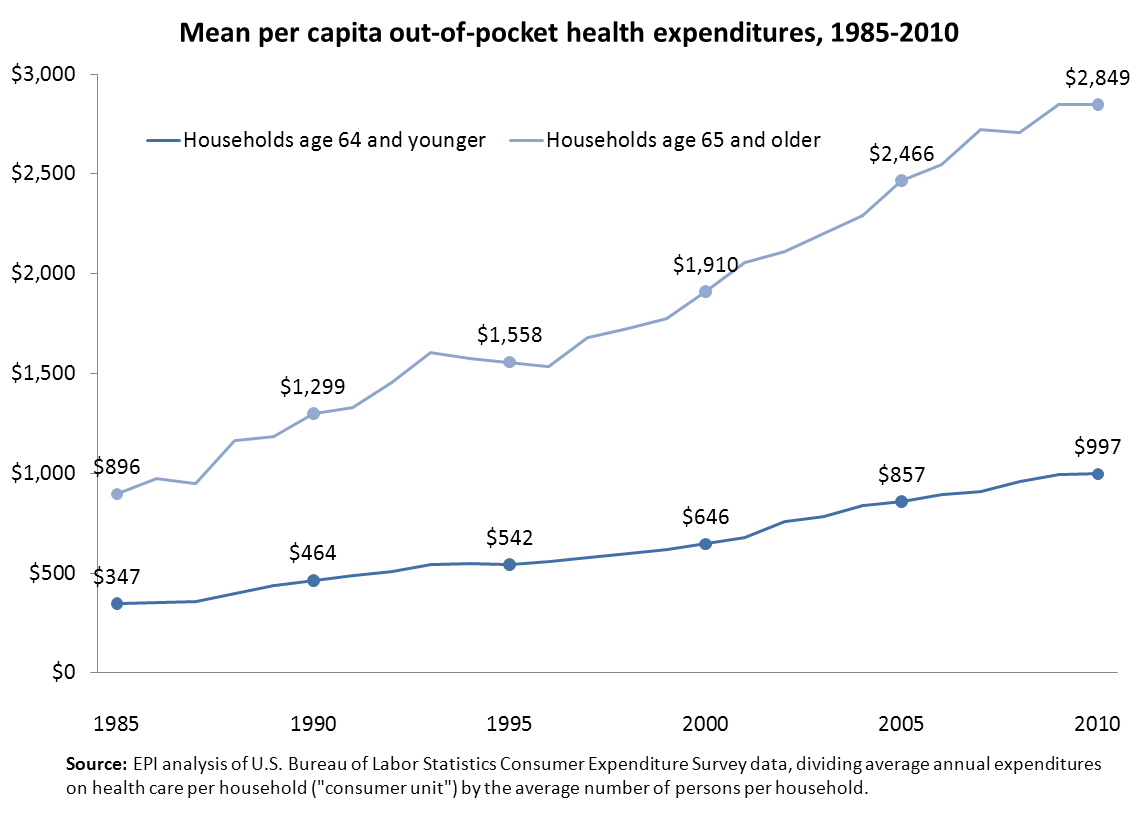
OOP costs have grown significantly faster than inflation over the past 25 years—at an average annual rate of 4.4 percent across all age groups (4.7 percent for seniors), compared to 2.7 percent annually for overall consumer price index (CPI-U) inflation. These figures are based on the U.S. Bureau of Labor Statistics’ Consumer Expenditure Survey (CEX) and reflect faster growth in the price of medical goods and services as well as greater consumption and cost sharing.
Average per capita spending for seniors now consumes 20 percent of the average Social Security retiree benefit, up from 16 percent in 1985. These figures understate the financial burden posed by OOP health spending because CEX does not survey people in nursing homes. A Kaiser Family Foundation analysis of Centers for Medicare & Medicaid Services (CMS) data found that long-term care constituted 19 percent of OOP health care spending for Medicare beneficiaries in 2006.
How much will the Ryan Medicare voucher cost you?
The supposedly kinder and gentler Medicare voucher proposed this year by House Budget Committee Chairman and Republican vice presidential nominee Paul Ryan (R-Wis.) is less draconian than last year’s version, but still packs a wallop. The voucher shifts costs to seniors because the value of the voucher can’t grow faster than half a percentage point above per capita GDP, and health care costs are projected to grow faster than that. (You can ignore the part about tying the voucher to the second-lowest-cost private plan or, if it’s cheaper, fee-for-service Medicare cost growth—this is just window dressing because overall costs will exceed the “fallback” spending limits.)
The voucher will initially shift around 11 percent of costs ($700) to seniors in 2023, an amount that will grow to 45 percent ($15,700) by 2087 (all figures are in 2012 dollars and rounded to the nearest $100). You can see how this adds up by summing the annual amounts in the table below over life expectancy in retirement. Thus, for example, a 40-year-old female who expects to retire at 65 in 2037 will live to about 2058, during which she will pay roughly $82,800 more for health care.Read more
Congress: Put emergency unemployment compensation in the continuing resolution
The emergency unemployment compensation (EUC) benefits that millions of Americans are receiving to help them survive a period of long-term joblessness will terminate on Dec. 31 under current law. If the modest but steady income EUC provides—averaging about $300 per week—is cut off, then families, communities, and businesses across the country will suffer. Jobless workers will struggle to pay their rent and utilities and will reduce spending on discretionary purchases of food, clothing, recreation, and entertainment. Businesses, in response, will hire fewer employees. If EUC is not extended through the end of 2013, the effects on the economy will be serious: Economic activity will be about $56 billion lower than it otherwise would have been1and about 430,000 jobs will be lost—at a time when every job is precious.
So far, I have heard nothing to indicate that policymakers in Washington are addressing this matter, even though Democratic and Republican leaders are about to close a deal on keeping the government running for the next six months. It would be disastrous for Congress and the president to let EUC expire. Continuing EUC has to be part of the continuing appropriations legislation that congressional leaders are negotiating right now, which will fund existing programs all across the government through March 2013 at current levels. Read more
Paul Ryan is not (and has never been) a deficit hawk
Republican vice presidential nominee Paul Ryan (R-Wis.) is not a deficit hawk, and has never been a deficit hawk. In the near-term, advocating accelerated deficit reduction is economically detrimental rather than praiseworthy, but in many circles the “deficit hawk” label is bestowed as a compliment upon Ryan for supposedly stabilizing the long-term fiscal outlook. Ryan is hawkishly anti-government spending, except for defense spending, and he falsely conflates domestic spending with deficits and public debt. But Ryan’s purported concern about the deficit is belied by his proposed $4.5 trillion in unfunded tax cuts and reliance on made-up revenue levels to pad long-term budget projections from the Congressional Budget Office (CBO). This isn’t a secret to budget analysts and economists (e.g., Peter Orszag’s recent piece in the Washington Post), but it regrettably continues to be lost on much of the press and punditry.
Take, for instance, last week’s Leader in The Economist, Paul Ryan: The man with the plan, which praised Ryan as “the first politician to produce a plausible plan for closing the deficit, which he did in April last year.” This is an egregious misrepresentation of fact. Ryan’s fiscal year 2012 budget would not have reached balance until somewhere between 2030 and 2040, according to CBO’s long-term analysis, but even this “feat” was falsely predicated on revenue magically rising to 19 percent of GDP—as Ryan demanded CBO assume. Read more
Key goals of 1963 March on Washington for Jobs and Freedom are still unmet
Today is the 49th anniversary of Dr. Martin Luther King’s brilliant “I Have a Dream” speech, the final speech of the 1963 March on Washington, which was officially titled the “March on Washington for Jobs and Freedom.” That event is obscured by the distance of a half-century, but it’s worth the effort to review the official demands of the march and the economic thinking of King and his allies, A. Philip Randolph of the Brotherhood of Sleeping Car Porters and Walter Reuther of the United Auto Workers. What they wanted for Americans then is still badly needed today—perhaps more than ever.
The March was about civil rights, voting rights and racial equality, but it was also about the need for jobs and for jobs that paid a decent wage. The marchers wanted the federal minimum wage raised nearly 75 percent, from $1.15 an hour to $2.00 an hour. They also called for “A massive federal program to train and place all unemployed workers—Negro and white—on meaningful and dignified jobs at decent wages.”
In 1963, the unemployment rate averaged about 5.0 percent, which looks good compared to today’s 8.3 percent, but King and the other organizers wanted full employment and believed it was the federal government’s responsibility to provide it. Read more
Health reform and the $716 billion lie
The Affordable Care Act (ACA), called “Obamacare” by opponents and supporters alike, has been maligned and misrepresented countless times over the last few years. The most recent claim—which has turned up in a recent Mitt Romney ad but has been a staple of GOP talking points since the Paul Ryan pick for vice president—is, “You paid into Medicare for years … but now when you need it, Obama has cut $716 billion from Medicare … to pay for Obamacare.” In other words, ACA took money out of the Medicare system for use elsewhere.
This is a pretty big lie. To take money “out of the Medicare system,” one would have to actually divert revenues away from the program. But ACA doesn’t do this at all—instead, it reduces how much Medicare will have to spend over the next 10 years by $716 billion. It does this without actually cutting benefits, instead deriving savings from three areas:
- Reducing reimbursements Medicare currently makes to hospitals—but by less than the gain hospitals would receive from newly-insured patients purchasing hospital services in coming decades.
- Reforming the separate Medicare Advantage program, which was supposed to save money, but ended up being more expensive. Read more