A Repatriation Holiday to Fund the Highway Trust Fund is Not Only a Bad Idea but a Costly One
In politics, bad ideas never go away, even after being shown to be bad. A repatriation tax holiday is a case in point. Senators of both parties have suggested using revenue generated from a repatriation holiday to plug near-term shortfalls in the Highway Trust Fund, which will be depleted within a couple of months. The problem, of course, is that revenues are only generated in the short-run, and revenue losses in out-years dominate the overall budget impact of a repatriation holiday.
Under its baseline budget, the Congressional Budget Office projects a fiscal year 2015 Highway Trust Fund shortfall of about $12 billion. The Joint Tax Committee projects that a repatriation holiday enacted this year would bring in about $13 billion in additional revenue in fiscal year 2015. Sounds like a great fix for a budget problem. What is not mentioned is cumulative Highway Trust Fund shortfalls between 2016 and 2024 total $824 billion and that the repatriation holiday will reduce federal tax revenues by $115 billion over the same period. Consequently, using a repatriation holiday as a short-term fix would increase longer-term federal budget problems associated with underfunding the Highway Trust Fund—increasing projected deficits from $824 billion to almost $1 trillion over the next 10 years. Surely, a repatriation holiday is a bad and costly idea.
But there are also other problems with a repatriation holiday, which requires a brief and, admittedly, wonkish review of the 2004 repatriation holiday.
Thoughts on the Black Labor Force Participation Rate
Recently, my Economic Snapshot on the resilience of black labor force participation has gotten some attention in a few well-known media outlets. The main finding of the snapshot was that part of the reason the black-white unemployment rate gap has grown during the post-Great Recession period is because labor force participation has fallen by less for blacks than for whites. In a blog post for the Washington Post, Philip Bump examined the robustness of that observation by comparing historic data on labor force participation rates and unemployment rates for blacks and whites dating back to 1973. He concludes that “the problem is that Wilson’s explanation doesn’t appear to hold up over time.”
But this is only a problem if one assumes I was making a statement about the entire run of post-World War II U.S. economic history. I wasn’t. I was instead looking only at why the black-white unemployment gap grew in the past seven years. Importantly, focusing on these particular seven years is not an arbitrary or random selection—that’s the period of time since the previous business cycle peak, a span of time often looked at by researchers to assess labor market trends. That being said, I think Philip’s exercise is an interesting one and worth repeating, by comparing changes over similar periods of time in previous business cycles.
If Obama Must Delay Deportation Review, Relief For Unauthorized Immigrants Should Be Bold and Broad
Over the past five years under President Obama’s leadership, the U.S. immigration enforcement system, including its main tools of migrant detention and deportation, has vastly expanded into a “formidable machinery” that has expelled unauthorized immigrants at a record pace—a total of approximately 2 million in five years. A year ago, the Senate made progress toward fixing the system by passing a bipartisan comprehensive immigration bill that would reform almost every aspect of the immigration system, including legalization and a path to citizenship for unauthorized immigrants. But the effort has stalled in the Republican-controlled House of Representatives…
Looking at Segregation Through the Peer Effects Lens
That our children attend schools that are segregated by race is probably not a surprise for any of us. While, as researchers, we might debate how consequential segregation is, we can likely agree that, on its face, segregation raises some important societal concerns; it challenges our sense of what a moral and fair system looks like. It poses barriers to social cohesion, inclusion, and integration—and their well-known positive impacts on society—and it limits our children’s preparedness for the multicultural world in which they live.
As we mark the 60th anniversary of the Supreme Court’s Brown vs. Board of Education decision, and the declaration that “separate but equal” is unconstitutional, we look back on both progress made in desegregating schools and, more recently, backtracking on those efforts and current initiatives that sideline them. Although separate but equal is unconstitutional, separate and unequal is very much a reality.
Most Missing Workers Are Nowhere Near Retirement Age
In today’s weak labor market, there are around 6.0 million “missing workers”—potential workers who, because of weak job opportunities in the aftermath of the Great Recession, are neither employed nor actively seeking work. Some have suggested that many of these missing workers may be at or near retirement age and, in the face of weak job opportunities, have simply decided to retire earlier than they otherwise would have. While this would clearly indicate a huge waste of human potential and a serious indictment of macroeconomic policymakers that allowed economic weakness to linger on so long, it would also indicate that these workers are very unlikely to rejoin the labor force in coming years no matter how dramatically economic conditions improve. This would in turn mean that their absence is not in fact an indicator of current slack in the labor market.
The figure below provides an age breakdown of the missing workforce. It shows that nearly three-quarters of missing workers are age 54 or younger, which means they are unlikely to be early retirees. Even if all of the missing workers age 55 and over will never reenter the labor force no matter how strong job opportunities get, that still leaves 4.4 million missing workers age 54 or younger who would be likely to re-enter the labor force when job opportunities strengthen. In other words, weak labor force participation rate remains a key component of total slack in the labor market.
Women Surpassed Their Pre-recession Employment Peak 9 Months Ago, Men Still Haven’t
With the addition of 217,000 jobs in May, the U.S. labor market has now surpassed its pre-recession employment peak, a benchmark (the pre-recession employment peak) which is of zero economic interest. Given the growth in the potential labor force since December 2007, we should have added 7.0 million jobs since then, but instead we have added a net 113,000, so the labor market is still 6.9 million in the hole.
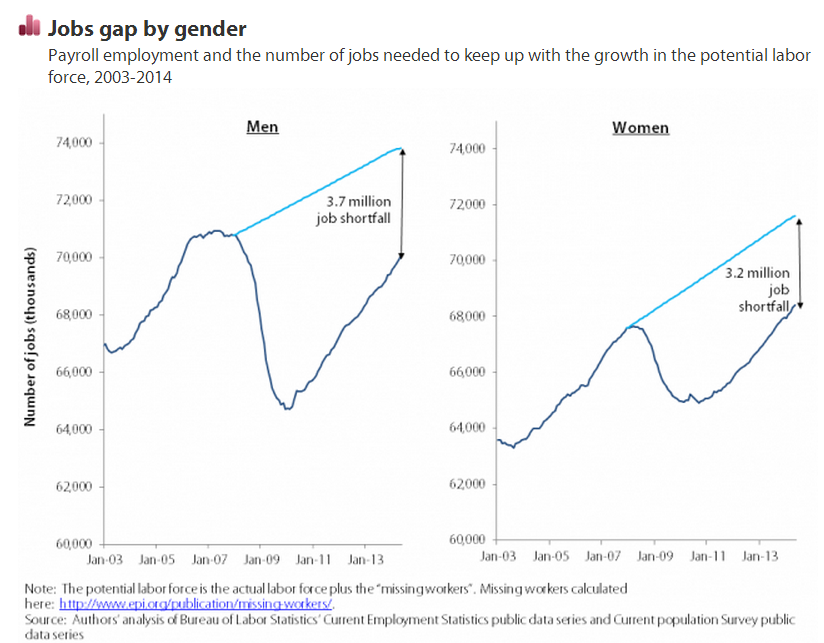
One interesting piece is the breakdown of that jobs gap by gender. As you can see in the chart below, women actually surpassed their pre-recession peak last August, but are still 3.2 million jobs in the hole given growth in the potential female labor force since December 2007. Men, on the other hand, are still nearly 700,000 jobs below their pre-recession employment peak, and given growth in the potential male labor force, are 3.7 million jobs down.
Statistics that Spin: Foreign Goods to Be Considered U.S. Goods?
This past year, President Obama’s commitment to rebuilding our nation’s manufacturing sector has taken center stage. In February, he explained why producing goods here at home is important to our country:
“For generations of Americans, manufacturing was the ticket to a good middle-class life. We made stuff. And the stuff we made—like steel and cars and planes—made us the economic leader of the world. And the work was hard, but the jobs were good. And if you got on an assembly plant in Detroit or in a steel plant in Youngstown, you could buy a home. You could raise kids. You could send them to college. You could retire with some security. And those jobs didn’t just tell us how much we were worth, they told us how we were contributing to the society and how we were helping to build America, and gave people a sense of dignity and purpose. They saw a Boeing plane or one of the Big Three cars rolling off the assembly line, and they said, you know what, I made that. And they were iconic. And people understood that’s what it meant for something to be made in America.”
The president has continually called for curtailing corporate incentives to outsource manufacturing to other countries, saying “it is time to stop rewarding businesses that ship jobs overseas, and start rewarding companies that create jobs right here in America.” A White House fact sheet summarizes his plans for restoring U.S. manufacturing jobs.
Apparently, some folks in the administration haven’t gotten the message. On May 22, the Office of Management and Budget issued a notice for comments on a proposal to dramatically alter the way government keeps statistics on domestic industries. The proposal suggests “that factoryless goods producers (FGPs) be classified” as manufacturers.
What to Watch on Jobs Day: An All-time High of an Indicator That is Almost Always Rising
It is very likely that when the jobs numbers are released tomorrow morning, we will learn that the total number of jobs in the U.S. labor market surpassed its pre-recession peak. I predict you will see many headlines along the lines of “U.S. Employment at All-Time High.”
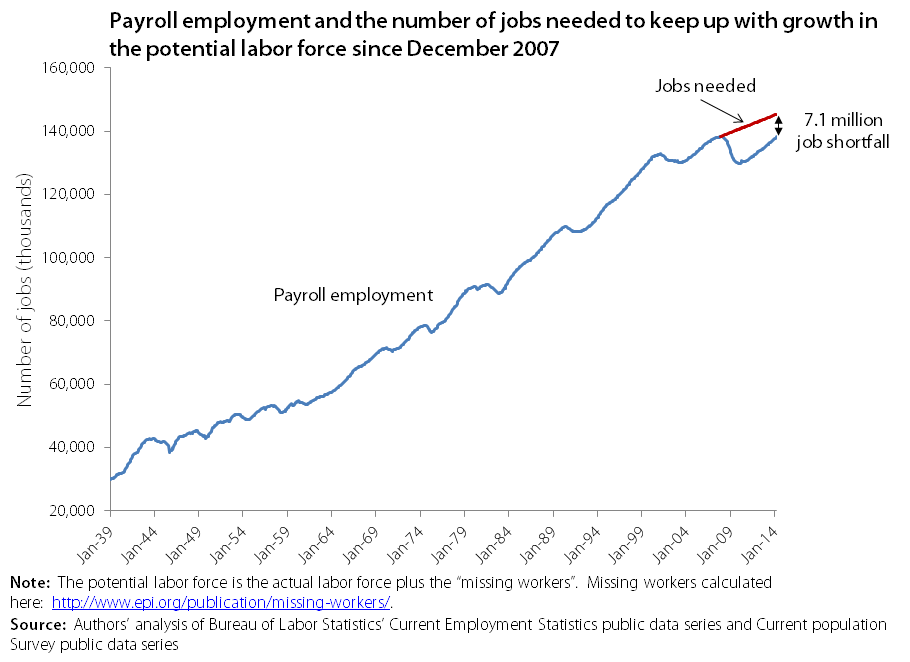
It is difficult to exaggerate how not a big deal this is. Total employment is almost always rising, as the figure below shows. An all-time high of something that is almost always rising is just not that interesting.
Furthermore, it is an utterly meaningless benchmark economically. Because the working-age population (and with it, the potential labor force) is growing all the time, we should have added millions of jobs over the last six-plus years just to hold steady. That means that when we get back to the prerecession employment level, there will still be a huge gap in the labor market. We currently have a gap in the labor market of 7.1 million jobs. When the numbers are released on Friday, that gap will likely drop to 7.0 million. We are far, far from healthy labor market conditions.
How Much Should You Be Making?
In honor of EPI’s new initiative, Raising America’s Pay, we updated our wage calculator, which shows how much you would be making if wages had kept pace with productivity. Having wages for the vast majority of American workers keep pace with productivity is a key indicator of an economy that is working for all.
Economic inequality is a real and growing problem in America, but the discussion around addressing inequality too frequently sidesteps a crucial component: the key to shared prosperity is to foster wage growth for the vast majority of Americans who rely on their paychecks to make ends meet. In fact, raising the pay for most Americans is the central economic challenge of our time—essential to ameliorating income inequality, boosting living standards for the broad middle-class, reducing poverty, and sustaining economic growth.
Crucially, the large and growing wedge between productivity and typical workers’ pay is not inevitable. For example, in the three decades following World War II, wages did rise with productivity and living standards improved throughout the income distribution. Since then, however, the rewards to a growing economy over the last three-and-a-half decades have primarily accrued to those at the top (except for the period of tight labor markets in the late 1990s). Since 1979, the workforce is more educated, is working more, and produces more goods and services in every hour worked. And yet the vast majority of workers are not reaping the rewards of their increased productivity.
Identifying the Channels Through which Regulatory Changes Affect Jobs
The Environmental Protection Agency is scheduled to release new regulations restricting the emissions of greenhouse gases (GHGs) from existing electrical generating units (EGUs, or power plants) next week. These new regulations will almost surely inspire a lot of debate over their effect on economic growth, and particularly on employment.
It is important to note first that the overall desirability of these proposed changes is dominated by their impact in forestalling global climate change. In strict economic terms, this consideration dwarfs any plausible estimate of the rule’s impact on jobs. Yet joblessness and weak labor markets continue to loom large as chief concerns of Americans (as well they should), and debate on these grounds will surely continue. Given this, even though the employment impacts of the rule are small relative to the environmental impacts, they still should be examined correctly.
Employment channels: Net versus gross and short versus long-runs
This blog post details the various channels through which environmental regulations have the potential to affect employment levels in the U.S. economy. To begin with, the effect of regulations on the net level of overall employment in the U.S. economy is the result of the sum of larger gross employment gains and losses across industrial sectors. So, for example, even if analysis finds that the new regulations will result in small net employment gains nationwide, this does not mean that no jobs in the U.S. economy will be lost due to the rules. Instead, it simply means that the total sum of employment gains and losses across all sectors is positive.