More Than Half a Million Jobs Are at Risk Due to Unfair Trade in the U.S. Steel Industry
Earlier this week, I estimated that up to half million (583,600) U.S. jobs are at risk due to surging imports of unfairly traded steel. A recent post by blogger Tim Worstall suggests that the number can’t possibly be that large because the steel industry employs only 150,000 people. But this misses the point—the risk to the steel industry goes far beyond the steel companies themselves, and the workers they employ. It also includes workers in iron ore and coal mines, in other manufacturing industries that support steel production, as well as lawyers, accountants, managers and other workers who supply services to the steel industry. All these jobs, 583,600 in total, are threatened by the flood of steel imports.
Half of the 46 top steel companies in the world were government-owned, and they accounted for 38 percent of global production. Illegally dumped and subsidized steel products are stealing market share and jobs from domestic producers. Worstall claims that we should ignore unfair import competition because, “if we get cheaper steel then this makes us all richer.” He concludes that “the market price is the fair price” for imports.
Responding to a similar question from a reporter this week, Ohio Senator Sherrod Brown said that this is “like arguing it’s OK to buy stolen TVs because they are cheaper.” Even a market economy needs rules to prevent cheating and unfair trade.
Worstall claims that we performed “some very heroic calculations” in estimating the jobs at risk due to unfair imports. He goes on to claim that “what is being done here is to assume that… steel workers buy restaurant meals so waiters are employed…and so on.” But this is exactly what we did not do.
Our model used standard data from the Bureau of Labor Statistics to estimate the direct and indirect jobs supported by U.S. steel production. Indirect jobs include those in production of “input commodities such as minerals and ore, coke, and other fuels, as well as downstream services and other resources consumed in the production of and distribution of steel products.” Furthermore, we very clearly stated that our estimate did “not include respending jobs supported by the wages of workers in the steel industry.”
The Deep Roots of Skilled Labor Shortages: Anti-Union, Anti-Worker Corporations
A recent story from NPR’s Andrew Schneider, about a construction boom and skilled labor shortage in Texas, is missing some of the links needed to understand what is happening there and why. The elements are all there: the huge loss of construction jobs following the financial crisis in 2008, the energy boom creating jobs regionally even while construction employment nationally remains about a million and a half jobs lower than its peak, a decline in unauthorized immigration, and contractors grudgingly increasing pay to attract workers.
The two missing links are the role of the construction owner, like Chevron, in crushing the unions that provide skilled journeymen in the construction trades, and a clear discussion of the wage levels needed to attract skilled workers from parts of the country the recovery hasn’t reached. The story says wages are rising in Texas, but from what to what? Are wage levels high enough to persuade a journeyman electrician from Michigan or Los Angeles to relocate to Houston? Or are they unreasonably low, given the scarcity of skilled workers and the years of training required to produce a journeyman? How do union wages compare with non-union wages? The story never says.
Oil giants like Chevron can afford to have their construction contractors pay well for skilled work, but they resist. Organizations they fund, such as the Business Roundtable, have led a decades-long campaign to weaken or destroy the building trades unions that actually train the greatest number of skilled tradesmen. Chevron, Koch Industries, ExxonMobil and many other energy industry corporations fund the American Legislative Exchange Council and its legislative efforts to kill unions and eliminate labor standards. It’s hard to hear Chevron complain about a labor shortage when Chevron and other Fortune 500 companies themselves are a major cause. They don’t merely fight unionization, they also oppose the state and federal prevailing wage laws that protect construction wages from being driven lower and allow union apprenticeship programs to continue providing the best-trained workers.
Schneider is wrong to suggest that community college vocational training programs are the long-term solution to the shortage of skilled labor in Texas. The real solution is to restore the power and reach of the unions, raise wages to attract more workers, and grow the only proven way to develop the necessary skilled labor—apprenticeship programs funded by employers and jointly administered by unions and employers.
Wages of Young Female College Grads Are Lower Today Than They Were In 1989
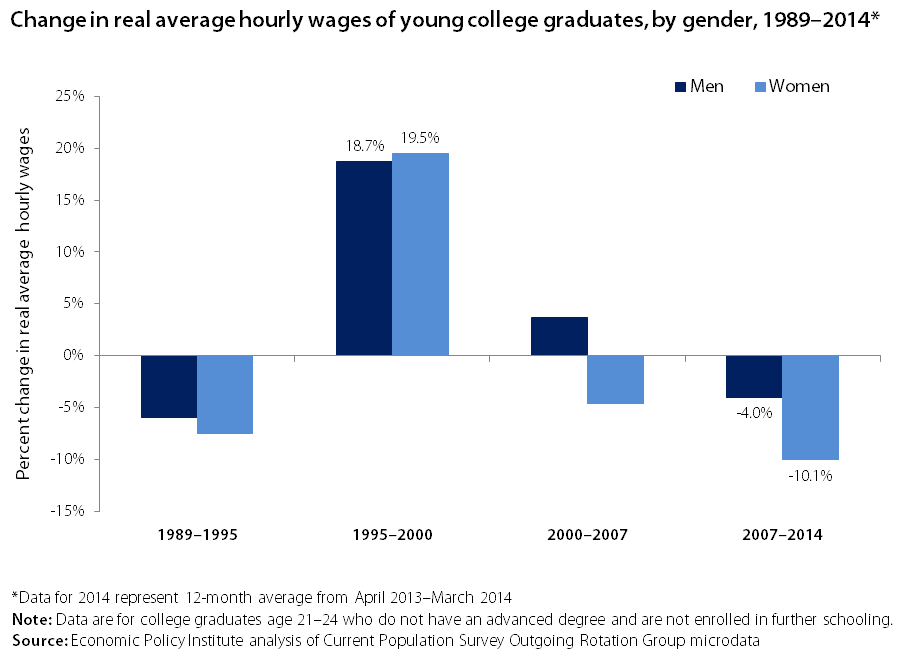
One of the most shocking findings from Heidi Shierholz’s, Will Kimball’s, and my research on young graduates is that inflation-adjusted wages for young female college graduates are lower today than they were in 1989. Average real wages for young female college graduates are currently $15.29, whereas 25 years ago they were $16.12 (in 2013 dollars)—a decrease of 5.2%.
This is part of a wider trend of wage stagnation and decline since 1989 for both men and women. For all college graduates ages 21-24 (male and female combined), wages today are only 2.4% higher than they were in 1989. This growth was driven entirely by the prosperous economy of the late 1990s, when young grads of both genders saw wage increases of close to 20%. Outside of that time period, however, wages have stagnated or declined, with women seeing especially large declines in the 2000s.
The figure below illustrates how the weak economy since 2000 has disproportionately hurt young women college grads’ wages as compared to men’s. Although women saw wage gains in the 1995-2000 period of strong economic growth, women’s wages have declined by 14.2% since 2000, with most of that loss in the period since the start of the Great Recession in 2007. In fact, since 2007, young women college grads have seen their wages fall 10.1%, while men’s wages declined 4%.
Our research showed that young college graduates’ fates are closely tied to the fate of the overall economy. The current weak labor market not only makes it difficult to find a job, but it also means that there is no need for employers to increase wages, as it is easy to keep the workers they need at lower wages when workers have no other options. If we want to reverse the wage losses that occurred due the Great Recession, we need to invest in our economy in ways that will boost aggregate demand and spur job growth, which will in turn improve wage growth for workers with jobs.
California School Board Rejects Rocketship Charter School
Last Thursday, the Alum Rock school district, part of metropolitan San Jose, California, voted to reject a charter school application from the Rocketship chain of schools. As I detailed in a recent paper, Rocketship’s model, which relies on cheaper, inexperienced teachers and completely replacing teachers with computer applications for a significant part of the day, is being promoted for poor urban children, but is dismissed as inadequate by more privileged families.
Rocketship is based in the San Jose area, and thus the Alum Rock rejection represents a rebuff in the part of the country with the most first-hand experience of their methods.
The vote at Alum Rock followed a report by school district staff that identified many of the same problems described in our report. Specifically:
- While Rocketship proposed to serve students from schools that had failed to make Adequate Yearly Progress under the federal No Child Left Behind Law, its application failed to mention that nearly all of Rocketship’s San Jose schools have themselves failed to make Adequate Yearly Progress for at least two years in a row.
- Rocketship’s statement to investors proclaimed that “no assurance is given” that Rocketship schools will make Adequate Yearly Progress in future years.
- Because Rocketship students spend a large portion of their day in computer labs with no licensed teacher, 4th and 5th graders will not receive the minimum instructional hours required by law.
- Rocketship was “misleading” in not including Learning Lab students in its calculation of student-teacher ratio. When all students are counted, “the true student/teacher ratio is, in fact, 37 students to 1 teacher.”
In Memoriam: Lynn Williams
Lynn Williams—president of the United Steelworkers of America from 1983 to 1994—died on May 5 at the age of 89.
Lynn was an extraordinary union leader—smart, compassionate, and a visionary. His strength and creativity helped protect and expand his union through the crisis years of mass layoffs, bankruptcies, and industry consolidation. He was also an enthusiastic and loyal supporter of EPI from the very beginning.
I first met Lynn in the mid-1970s when he was USWA’s Secretary-Treasurer. I was involved in an effort to revive a shut down steel mill in Youngstown, Ohio under worker and community ownership. The Steelworkers in Youngstown were of course totally supportive, but there was skepticism and even some hostility from the international union in Pittsburgh. But Lynn saw something important in the effort, and he helped steer me through some political land mines.
The Youngstown project failed, but the idea did not. And when Lynn became union president he aggressively and successfully used worker ownership—including seats on company board of directors—to negotiate agreements that kept at least 25 steel companies from disappearing.
The President Has This One Exactly Right: Cutting Corporate Taxes Should Not Be a Priority, but Extending Unemployment Insurance Should Be
Today (or possibly tomorrow) the House of Representatives will vote on H.R. 4438, which would permanently extend and expand the research and development tax credit. But unlike every other piece of legislation sponsored by the House GOP, this bill does not offset the $156 billion 10-year price tag. Apparently, tax cuts for corporations are such a high priority that passing them does not require the sacrifice elsewhere in spending or taxes that the House GOP demands for every other fiscal change. This flies in the face of everything the House GOP has done in this Congress. Last month, for example, House Republicans themselves passed a budget resolution that required offsetting with other revenue measures any tax extenders that were made permanent.
H.R. 4438 will cost 15 times more than the proposed extension of emergency unemployment benefits, which House Republicans insist be offset. And it is more than double the discretionary funding increases in the Bipartisan Budget Act of 2013, all of which were offset. President Obama has rightfully issued a statement that he would veto this bill if it passes.
House Republicans are making their priorities clear by rushing to make business tax cuts permanent without offsets and calling for raising taxes on millions of working families and students by letting important improvements to the Earned Income Tax Credit, Child Tax Credit, and education tax credits expire. Not to mention failing to reverse the cut-off of extended unemployment benefits at a time when long-term unemployment remains higher than it has ever been in the past when extended benefits were ended. If the House GOP were truly concerned about long-term fiscal challenges, then they would offset tax breaks by permanently closing other tax loopholes.
No Sign of Labor Shortages in Construction: There are Seven Unemployed Construction Workers for Every Job Opening
The National Association of Home Builders wants you to believe their members face a serious shortage of construction workers, even though construction employment is more than 1.7 million jobs below its pre-recession peak, and unemployed construction workers outnumber job openings in construction by well over seven-to-one. More and more news stories, even in respected sources like NPR and the Wall Street Journal, repeat the builders’ talking points and toss around wage figures with very limited resemblance to reality. (A healthy dose of skepticism is in order when employers complain about high wages. How many tile setters make “$100,000 a year,” which the WSJ story suggests is now the pay for experienced workers in Denver? Not many. The median hourly wage for tile setters in Denver is less than $18 an hour, and nationally, even the 90th percentile wage for tile setters is only $73,510 a year.)
The best way to identify a tight labor market, let alone a market beset by actual labor shortages, is to examine wages. Basically, if wages aren’t rising, the labor market isn’t tightening; if they don’t rise strongly, there are no shortages. As Adam S. Posen and David Blanchflower argue in a recent paper, if wages aren’t rising, it’s a sign of labor slack, weak demand, and a weak economy.
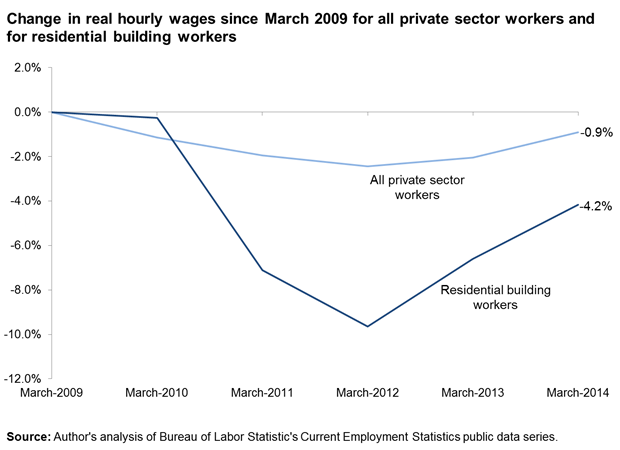
So what’s happening in residential construction? The Wall Street Journal describes a frenzied search for skilled labor, causing pay to soar “to boom-time levels and beyond.” While it’s true that construction wages have risen over the past two years, they’ve risen from such a deep depression that they are still well below the levels of 2009. In fact, the real hourly wages of residential building workers are still 4.2% below 2009, a loss significantly deeper than that of the overall private sector workforce, whose wages are 0.9 percent below 2009.
A Decidedly Weird Report
Today’s jobs report was, to say the least, strange. The first look was exciting—288,000 payroll jobs added! Now that is the kind of job growth that would get us back to a healthy labor market relatively soon. If we were to keep up this pace, we would get back to pre-recession labor market conditions by the end of 2016. Even I could live with that.
The second look was good, too—the household survey showed the unemployment rate plunged to 6.3 percent. But I should have stopped looking there, because the rest was pretty bad. It turns out the drop in unemployment was entirely due to people dropping out of the labor force. Employment in the household survey actually declined, and the labor force participation rate fell back down to its lowest point of the recovery. Our estimate of the number of “missing workers” (workers who are not working or actively seeking work but who would be if job opportunities were strong) increased to an all-time high of 6.2 million. If those missing workers were in the labor force looking for work, the unemployment rate would be 9.9 percent instead of 6.3 percent.
So this was one of those cases where the two surveys were telling completely different stories—the establishment survey was strong, the household survey was weak. As always, when the two surveys tell different stories, the rule of thumb is to place much more weight on the payroll survey, since it is larger and less erratic. But the weak household survey certainly dampens the fun of the payroll survey. If the economy really were entering a new stage of much stronger job growth, I’d expect both surveys to regularly be posting strong gains. That was far from the case in April.
The African American Labor Force Shows Remarkable Resilience
Today’s jobs report brings some positive news to balance the disappointing first quarter estimates of GDP growth (a meager 0.1 percent) announced earlier this week; there were 288,000 jobs added in April. At the same time, the unemployment rate fell to 6.3 percent, but this decline was entirely the result of people leaving the labor force, not people finding work. While all major race and ethnic groups experienced a similar pattern of declining unemployment rates and labor force participation rates in April, there are some interesting insights into the upward trend in the black-white unemployment rate gap to be gained from today’s numbers.
As unemployment rates have gradually declined over the last four years, the black-white unemployment rate ratio has been increasing and is currently higher than it was before the recession, meaning that there’s been less improvement in the black unemployment rate than the white rate. Indeed, the African American unemployment rate remains 3.3 percentage points higher than the 2007 average while the white unemployment rate is just 1.2 percentage points higher than in 2007.
Further, when we look at the difference between the current and 2007 employment-population ratios, we find that the decline in the share of employed working age adults in the population was greater for African Americans (down 4.6 percentage points) than for whites (down 3.9 percentage points).
Number of Missing Workers Jumps to All-Time High
After a few months of the labor force participation rate (LFPR) showing what was hopefully early signs of strength, it dropped back down to its low of the recovery in March. The biggest drops in labor force participation in March were among young workers; the LFPR of workers under age 25 dropped 1.3 percentage points, from 55.6 percent to 54.3 percent. (However, these series are erratic due to small sample sizes, and the April decline in the under-25 LFPR was simply a reversal of its jump up in March.) The biggest drop in LFPR in April was among men under the age of 20. To my knowledge, data on unemployment insurance exhaustions by age don’t exist, but it is unlikely that young workers are a big proportion of exhaustions. This means that the April drop in labor force participation is likely not being driven by the expiration of federal unemployment insurance benefits last December as some have suggested, but simply by the weak labor market.
There is currently an all-time-high of 6.2 million missing workers (potential workers who are neither working nor actively seeking work due to the weak labor market). Almost a quarter of them (1.4 million) are under age 25. The figure below shows that the unemployment rate for young workers would be 18.4 percent instead of 12.8 percent if the missing young workers were in the labor force looking for work and thus counted as unemployed.
For a complete picture of the labor market prospects facing the new cohort of young adults graduating from high school and college this spring, see the Class of 2014 report released yesterday. It includes, for example, a detailed discussion of the finding that there is little evidence that today’s missing young workers are “sheltering in school”.
