What to Watch on Jobs Day: The Teacher Gap, Wages, and Prime-age EPOP
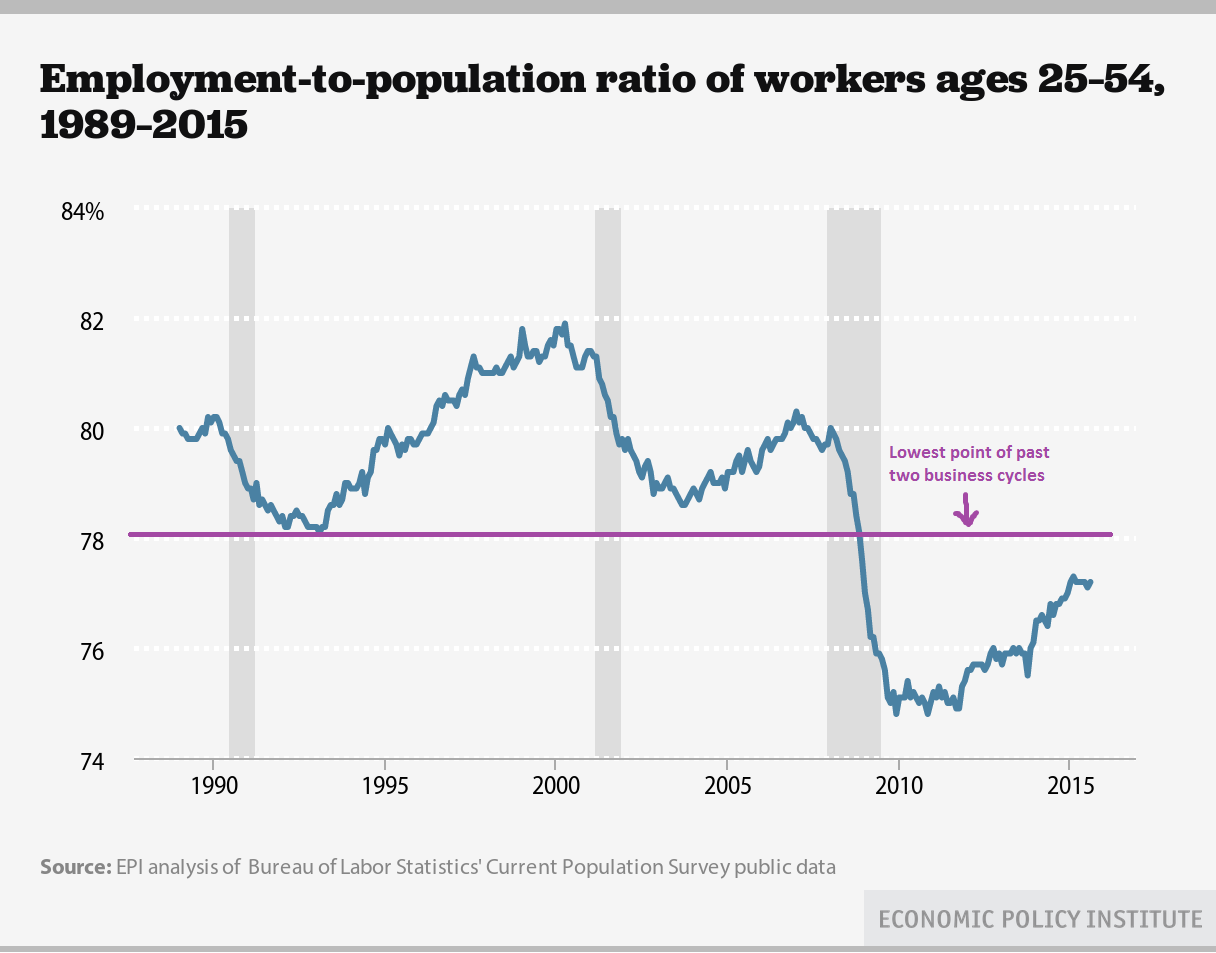
On Friday, the Bureau of Labor Statistics will release the September numbers on the state of the labor market. I will be watching for upward revisions to August’s employment numbers, which came in lower than expected. As usual, I’ll be paying close attention to the prime-age employment-to-population ratio (EPOP) and nominal wages, which are two of the best indicators of labor market health. Friday’s report will also give us a chance to examine the “teacher gap”— the gap between actual local public education employment and what is needed to keep up with growth in the student population
Prime-age EPOP—the share of the working age population who is actually working—fell dramatically during the Great Recession. It saw some solid increases once the recovery began to take hold, but unfortunately remains below the lowest point of the past two business cycles and has stagnated for much of this year, as job growth has only been fast enough to keep up with the growth of the working age population. Before we can say that the labor market is truly back to normal, we need to see faster job growth—to employ new labor market entrants, unemployed workers, and the 3+ million missing workers who have left or never entered the labor market because of weak job opportunities.
New Scandals Revealed by the New York Times: How the H-1B Visa is Used to Ship American Jobs Overseas
The New York Times has a front page story today about three new cases of H-1B abuse as a follow-up to the Disney scandal it reported on in June. This one, too, features household names: Toys R Us and New York Life. It also includes academic publishing powerhouse, Cengage, whose textbooks are used in college campuses across the country. Those companies have been outsourcing work to companies with track records as major H-1B abusers that use the program to ship jobs overseas: Accenture, TCS, and Cognizant.
The Times story, written by Julia Preston, outlines a process I have written quite a bit about over the years: how the H-1B program, which Congress created to help U.S. companies fill jobs here in the United States, is actually used to facilitate the shipping of American jobs overseas to low-cost countries like India. This, in fact, is the most common use of the H-1B program, which India’s Commerce Minister Kamal Nath dubbed the “outsourcing visa” in 2007.
Preston reports that Tata Consultancy Services sent Indian workers to a Toys R Us facility in New Jersey, where they shadowed U.S. accounting employees, learning their jobs and writing up manuals to train employees back in India how to do the same work and replace the U.S. employees. The result was unemployment for middle-class, middle-aged Americans and the loss of 67 jobs in New Jersey. A company spokesperson was unapologetic, telling the Times that the outsourcing “resulted in significant cost savings.”
The Case Against Raising Interest Rates Before Wage Growth Picks Up
This piece originally appeared in the Wall Street Journal’s Think Tank blog.
I’ve been arguing for the past year that until nominal wage growth picks up considerably, the Federal Reserve has little to fear about price inflation being pushed above its 2 percent target. The logic of focusing on wage growth is pretty easy to explain.
First, note that nominal (i.e., not inflation-adjusted) wage growth can rise as fast as economy-wide productivity without putting any upward pressure on prices. Say that both nominal wages and productivity rose 2 perecnt in a year. What would happen to the cost per unit of output? It would not rise at all. Hourly wages would climb 2 percent, but the amount produced in each hour of work—the definition of productivity—would also rise by 2 percent, so costs per unit of output (or, prices) would not budge. If we assume that trend productivity growth in the U.S. economy is roughly 1.5 percent per year, this means that only nominal wage growth faster than 1.5 percent puts any upward pressure on prices.
Now, the Fed isn’t committed to zero upward pressure on prices. Fed officials say they’re comfortable with 2 percent inflation. (I’d argue that they should be comfortable with inflation well above that, up to 5 percent, but we’ll take their target for now.) This price target means that nominal wage growth can be 2 percent higher than trend productivity growth before wages threaten to push inflation over the Fed’s target. We would need to see nominal wage growth of 3.5 percent, substantially higher than what it has been since the recovery began, before labor costs start threatening to push inflation beyond the Fed’s comfort zone. (There is a handy nominal wage tracker on the Economic Policy Institute’s website that covers a lot of this ground.)
All that said, in a speech last week, Federal Reserve Chairwoman Janet Yellen included a footnote that argued against the relevance of wage targeting. The upshot was this sentence: “More generally, movements in labor costs no longer appear to be an especially good guide to future price movements.” This footnote reinforced other recent statements from Dr. Yellen that seem to leave the door open to the Fed tightening well before any increase in nominal wages shows up in the data. I would argue that this is almost exactly wrong.
Disability and Employment Revisited
Alarming statistics that show large declines in the employment and labor force participation of Americans with disabilities are often cited to support the claim that workers in poor health but able to work are increasingly opting out of the workforce to claim disability benefits. However, these statistics don’t account for a weak labor market, an aging population, the rise in women’s labor force participation, or problems with self-reported disability measures. If one takes these factors into account, there’s no evidence that more workers with comparatively mild impairments are exiting the workforce to claim disability benefits.
The American Institutes of Research (AIR) has a new report by Michelle Yin and Dahlia Shaewitz showing that the labor force participation of Americans with disabilities fell from 25 percent in 2001 to 16 percent in 2014, based on data from the Current Population Survey Annual Social and Economic Supplement conducted by the U.S. Census Bureau (CPS-ASEC—henceforth CPS). Tying this to a broader decline in the labor force participation of working-age adults, the authors warn that “this situation leaves the United States with an even smaller pool of workers to support the recovering economy. “
In the same vein, a recent op-ed in the Wall Street Journal by Andrew Biggs of the American Enterprise Institute cites a “nearly 50 percent decline in the employment rate of Americans with disabilities since 1981.” Echoing critiques of the Social Security Disability Insurance (SSDI) program I’ve discussed in earlier blog posts, Biggs attributes the problem to “looser eligibility standards and stagnating wages that made disability benefits, averaging $1,222 a month for new beneficiaries last year, more attractive relative to work for the less-skilled.” Though Yin and Shaewitz appear more concerned with the plight of people with disabilities than with criticizing SSDI, they also suggest that the “growing number of discouraged workers with disabilities may be a result of policies that unintentionally make it easier to leave the workforce or stay out altogether.”
Pope Francis reminds us that our economic systems should reflect our moral values
During his first visit to the United States, Pope Francis is expected to address economic issues like inequality and poverty, continuing his criticism of trickle-down economic policy. These are issues that affect the lives of everyday Americans: wages for the vast majority of workers in the United States have been stagnant for 35 years despite growing productivity, lawmakers continue to chip away at workers’ right to unionize, and the gulf between top earners and the rest of the nation continues to grow.
While many have lauded Pope Francis for consistently discussing economic inequality and poverty, some on the right have been less enthusiastic. In response to the pope’s encyclical on poverty and the environment, Jeb Bush, for example, remarked, “I don’t get economic policy from my bishops or my cardinal or my pope. I think religion ought to be about making us better as people and less about things that end up getting in the political realm.”
Bush’s dismissal of the pope’s positions on economic issues not only contradicts his earlier claims about the relationship between religion and politics, but also ignores the history of his own church. Far from emerging from a vacuum, Pope Francis is continuing a tradition of Catholic social teaching that stretches back to Pope Leo XIII’s 1891 encyclical on the conditions facing working people. And this attempt to respond to economic and labor issues from a Christian framework is also not solely Catholic. At the same time Pope Leo XIII’s encyclical entered the intellectual sphere, American Protestants like Washington Gladden (a pastor and prominent early thinker of what would become the Social Gospel) were also working to address the conditions of working people through Christianity.
In Virtually Every State, the Poverty Rate is Still Higher than Before the Recession
Between 2013 and 2014, the poverty rate in most states was largely unchanged, according to yesterday’s release of state poverty statistics from the American Community Survey (ACS). While the poverty rate fell slightly for the country as a whole, most of the changes at the state level were too small to signify a meaningful difference. As of 2014, only two states—North Dakota and Colorado—have poverty rates at or below their 2007 values, before the Great Recession.
From 2013 to 2014, the national poverty rate, as measured by the ACS, fell from 15.8 percent to 15.5 percent. Poverty rates declined in 34 states plus the District of Columbia, but only five of these changes were large enough to signify a measurable difference: Mississippi (-2.5 percentage points), Colorado (-1.0 percentage points), Washington, (-0.9 percentage points), Michigan (-0.8 percentage points), and North Carolina (-0.7 percentage points). (A number of other states had similar reductions in their poverty rates, but the sample sizes for these states are too small to tell whether these changes were statistically significant.) Alaska was the only state where the poverty rate increased significantly, rising from 9.3 percent to 11.2 percent.
The lack of improvement in state poverty rates echoes the trends we’ve seen in household income. However, the data suggest that the lack of real income growth over the past decade and a half has been even more pronounced for households at the bottom of the income scale. As of 2014, 38 states had lower median household income than in 2000, yet 47 states—nearly the entire country—had higher poverty rates in 2014 than in 2000.
State-Level Data Show Incomes Continue to Stagnate in Households Across the Map
Thursday’s release of state income data from the American Community Survey (ACS) showed that the gradual improvement in state economies from 2013 to 2014 brought little change in overall economic conditions for households in most states. The ACS data showed a slight increase in median household income for the United States overall and similar modest increases in household incomes in a majority of states—although only a handful of these increases were statistically significant.
By and large, what little improvement in household incomes occurred tended to be in states where incomes were already relatively high or where the oil and gas boom has fueled growth. Higher income states in New England and the mid-Atlantic, as well as Washington state, experienced modest gains, while incomes elsewhere were essentially flat. Kentucky (-2.6 percent) was the only state where household incomes significantly fell.
After adjusting for inflation, the largest year-over-year percentage gains occurred in Maine (+3.6 percent), Washington (+3.4 percent), Connecticut (+2.7 percent), and Colorado (+2.5 percent). The District of Columbia (+4.3 percent), North Dakota (+4.2 percent), and Mississippi (+2.8 percent) also had relatively large increases, although these changes were not statistically significant.
Workers 65 and Older Are 3 Times as Likely to Die From an On-the-Job Injury as the Average Worker
As the Boomers age and retirement insecurity forces workers to delay retirement, workers 55 and older are a growing part of the workforce. In 2014, older workers were 21 percent of the adult workforce based on hours worked—8 percentage points higher than their 13 percent share in 2000.
One unfortunate effect of this increased labor force participation is an increased exposure to workplace hazards, and with hazards come injuries and even death. Older workers are much more likely to be the victims of fatal occupational injuries than are younger workers. In 2014, nearly 35 percent of all fatal on-the-job injuries (1,621 of 4,679) occurred among the 21 percent of the workforce age 55 or older. The fatality rate for workers 65 and older is especially high—three times that of the overall workforce.
In the last year there was an alarming 9 percent increase in fatal workplace injuries among workers 55 and older, and a 17.7 percent increase among workers 65 and older. Nationwide, among all age groups, fatal workplace injuries rose from 4,585 in 2013 to 4,679 in 2014, an increase of 94 deaths. The increase in deaths among workers age 65 and older more than accounted for the entire increase in fatal on-the-job injuries.
Poverty Day Numbers Show the Need for Higher Wages
This post originally appeared on Spotlight on Poverty and Opportunity.
This morning, the US Census Bureau released annual income and poverty data showing essentially no change in the economic status of low- and middle-income households from 2013 to 2014. Despite an improving economy, the same proportion of Americans is still struggling to make ends meet. This lack of improvement in the poverty rate illustrates one of the chief catalysts behind America’s persistent poverty: stagnant wage growth that has left too many people without the means to support themselves and their families.
The official US poverty rate for 2014 was 14.8 percent. This is slightly higher than the official poverty rate reported for 2013 last year; however, last year the Census Bureau redesigned the survey that determines the poverty rate. For last year’s release, Census used both the new and old surveys in parallel, but only reported the results from the old survey. This year, they released the 2013 values from the new survey, which showed a poverty rate in 2013 of 14.8 percent—the same rate reported for 2014 in this year’s release. In 2014, the share of the population in deep poverty – with incomes less than half the poverty line – was 6.6 percent, and the share of families with income less than twice the poverty line was 33.4 percent.
This is the second year in a row that the Census Bureau’s statistics have shown that 1 in 7 American families – roughly 47 million people – have incomes too low to meet the government’s official threshold for basic subsistence, a measure long recognized as inadequate for assessing true economic need. For 2014, the poverty line for a family of four was $24,418; alternative measures show that families require far higher levels of income to achieve modest economic security, even in the country’s least expensive areas.
Wrong Question Answered Badly: Industry Data Can’t Be Used To Infer Individuals’ Productivity
In the debate over the relationship between economy-wide productivity and typical workers’ pay the numbers are clear: typical workers’ pay hasn’t come close to keeping up with productivity, and a wide gap between the two has developed. There has been no credible challenge to this basic finding.
Some have moved past the debate over the numbers to argue that this divergence is not a sign that the economy, and economic policy, is failing these workers. Instead, they argue that the underlying productivity of most workers must have stagnated, and that it is their productivity stagnation that has driven their wage stagnation. This essentially argues that relatively stagnant pay for typical workers is because most Americans are no more productive now than decades ago, and hence did not deserve to see gains in hourly pay in recent decades. A corollary to this argument is the notion that the pay and productivity divergence therefore requires no policy response other than attempting to raise workers’ productivity.
We noted in our recent paper the glaring lack of any actual evidence for the claim that most workers have not become more productive in the past three decades. In fact, most evidence (which we’ll highlight a bit later) indicates that most American workers have become substantially more productive over time. However, in a recent blog post, Evan Soltas claims to have marshalled evidence indicating that most American workers have not seen productivity gains in recent years. Soltas’ conclusion that most American workers must not have become more productive in recent decades is predicated upon looking at industry-level measures of productivity and average pay. He claims to have found a strong correlation between the growth of industry productivity and industry pay, and then claims this (somehow) implies that we know the divergence between economy-wide productivity and typical workers’ pay must, therefore, have been driven by the failure of typical workers to become more productive in recent decades.
We explain in this post why his suggested empirical test for assessing this question is actually meaningless, and will also show how the execution of his test is flawed, and his empirical conclusions (which would be irrelevant in any case) are false. Estimated correctly, there is no correlation between industry productivity and average industry pay. More importantly, even if there was such a correlation, this would be entirely uninformative about the underlying productivity of individuals. In short, Soltas asked the wrong question and then answered it incorrectly.