Wages rose for the bottom 90 percent in 2016 as those for top 1 percent fell
Newly available wage data show that the annual wages of those in the bottom 90 percent grew 0.5 percent from 2015 to 2016, and did so because wage growth disproportionately favored the vast majority of wage earners. At the same time, the highest earners, those in the top 0.1 percent, saw a 6.3 percent drop in their annual wages. How is that for a change! Annual wages averaged over all workers remained basically unchanged in 2016, but the share of all wages earned by the bottom 90 percent increased in 2016, resulting in improved wages for that group. Who says reducing inequality does not matter!
These are the results of EPI’s updated series on wages by earning group developed from Social Security Administration data. These data, unlike the usual source of our wage analyses (the Current Population Survey) allow us to estimate wage trends for the top 1.0 and top 0.1 percent of earners, as well as those for the bottom 90 percent and other categories among the top 10 percent of earners.
Looking back further, the top 1.0 percent of earners certainly fared well over the 1979 to 2007 period, seeing their annual wages grow by 156.2 percent (Figure A), with those in the top 0.1 percent seeing more than double that wage growth, 362.5 percent (Table 1). In contrast, wages for the bottom 90 percent only grew 16.7 percent in that time. Since the Great Recession, we have seen very modest wage growth across the board, with wages up just 4.0 percent over the nine years from 2007 to 2016. Wages fell furthest among top 1.0 percent of earners during the financial crisis, declining by 15.6 percent from 2007-09, but then recovered fully by 2015. The fall in top 1.0 and top 0.1 annual wages in 2016 leaves both groups with wages that are below pre-recession 2007 levels. Annual wages for the bottom 90 percent, meanwhile, fell slightly after 2007 and didn’t return to their 2007 level until 2014, and then grew roughly 4 percent since then.
Don’t believe the news of a new “top rate” in the forthcoming Republican tax plan: Their enormous “pass-through” loophole makes it largely irrelevant
House Republicans look set to unveil their tax bill on November 1. The “Unified Framework” previewing their plan included only three tax brackets: 12, 25, and 35 percent. But given that all independent analysis of their plan shows it adds enormously to deficits, they have publicly contemplated adding a fourth tax bracket above 35 percent to boost revenue. That top bracket may stay at the current 39.6 rate or be lower than the current rate while remaining above 35 percent. But when the tax plan is unveiled, no one should be tricked by this rate. The rate they choose doesn’t really matter all that much thanks to another loophole they’ve added, which all but ensures that that high income households won’t be paying more than 25 percent. They have disguised the loophole as helping small businesses since it’s targeted at so-called “pass-through income.” But while all small businesses are “pass-throughs”, not all pass-throughs are small businesses—lots of them include wildly rich businesses like hedge funds and private equity firms and boutique law firms. 86 percent of households with pass-through income already pay 25 percent or less—think of these as genuine small businesses. But 49 percent of all pass-through income goes to just the top 1 percent of households. This means that lowering the pass-through rate to 25 percent clearly makes this a tax cut for hedge funds, law firms, and private equity partners, not genuine small businesses. But from that egregiously tilted starting point, the loophole will still get worse, as it leads to rich individuals hiring accountants to re-classify other forms of income as pass-through income.
This means that rich households won’t be paying the top rate on ordinary income, wherever Republicans set it. Instead, their lawyers and accountants will ensure that the income they earn is routed through pass-through businesses like LLCs. This will allow rich households to pay a 25 percent top rate instead of 35 or 39.6.
International evidence shows that low corporate tax rates are not strongly associated with stronger investment
The Trump administration’s Council of Economic Advisers (CEA) released a paper last week arguing that cuts in the statutory corporate tax rate would lead to gains in business investment, productivity, and wages. I noted in a piece released yesterday why this was unlikely to be true.
The key piece of evidence the CEA claimed was “highly visible in the data” and showed the wage-boosting effect of corporate tax cuts was simply a graph that showed faster unweighted wage growth in just two years in a set of “low-tax” countries relative to a set of “high-tax” countries. I noted in my paper yesterday why this was so unconvincing: a serious test of this claim would look at corporate tax rate changes (not levels), would look over a longer time-period than four years, and would not allow three countries with a combined national income that is less than 0.4 percent of American national income to drive the results.
Moving beyond ACA repeal to address real health reform: Negotiating for lower drug prices under the Medicare Drug Price Negotiation Act
The Republican push to repeal the Affordable Care Act (ACA) seems to be on another hiatus, which is good news. At least some members of Congress are spending the time between efforts to gut the ACA pursuing socially useful reforms. For example, Senators Bernie Sanders (I-Vt.) and Patrick Leahy (D-Vt.), and Representatives Elijah Cummings (D-Md.), Lloyd Doggett (D-Texas), and Peter Welch (D-Vt.) have just announced they will introduce a bill that would instruct the Department of Health and Human Services (DHHS) to negotiate with pharmaceutical companies to get the lowest prices possible for drugs paid for by the federal government under Medicare.
The 2003 law that introduced a pharmaceutical benefit to the Medicare program by creating Part D specifically forbade such negotiation, thereby insuring that the program would be far more expensive than it had to be and that it would generate the maximum possible benefits for pharmaceutical corporations rather than the maximum benefits for America’s seniors. Crucially, the proposed bill to allow negotiation comes with real leverage—instructing the secretary to establish a formulary that will make it substantially harder for manufacturers that do not lower prices sufficiently to be reimbursed by Medicare. 1
A 2013 paper by Dean Baker estimates substantial savings from such a program. He finds that the federal government alone would save between $22–54 billion annually. Including the savings to households (who have to pay co-pays for drugs) and state governments would boost these projected savings to $30 to 70 billion annually. This is real money, even in health care terms.
Proposal to change the H-2A program via appropriations would allow agribusiness to fill hundreds of thousands of permanent, year-round jobs with temporary guestworkers
It’s become a time-honored tradition. Every year for almost a decade, members of Congress—spurred by corporate lobbyists who can’t gather enough support from their fellow colleagues for an immigration policy that will lower wages and degrade working conditions for migrant and American workers—use the appropriations process to get what they want. Few people pay close attention to the deliberations about how to fund the government, so members of Congress can quietly tack their bad idea as a “rider” onto an appropriations bill that is folded into an “omnibus” appropriations bill to keep the government running. If the president vetoes the omnibus budget, the government may shut down. This makes a veto unlikely, which allows riders to become law without facing a debate and vote on the merits of it in the House and Senate.
Appropriations riders have become common in U.S. labor migration policy. President Obama’s attempts to improve wages and working conditions for American and migrant workers in the H-2B guestworker program—for jobs in landscaping, forestry, construction and seafood processing, for example—were thwarted again and again through appropriations riders that lowered minimum wage rates for workers and prohibited the Labor Department from enforcing key rules. Senators Grassley (R-IA) and Feinstein (D-CA) took a bipartisan stand against the practice when it happened again this year. This time around, the rules in the H-2A program—which allows agricultural employers and farmers to hire workers from abroad to fill temporary or seasonal jobs lasting for less than one year—may also be modified via an appropriations rider.
There is no annual limit on the number of H-2A workers that can be hired, and H-2A is the fastest-growing U.S. guestworker program, more than doubling over the past decade, with over 200,000 farm jobs certified in in 2017. The vast majority of H-2A workers are employed on crop farms, picking fruits and vegetables.
The House appropriations committee in charge of funding the Department of Homeland Security (DHS) has now added a rider that would allow H-2A guestworkers to be employed in year-round jobs, thus drastically expanding the scope of this program. By allowing year-round employment, employers could seek to bring in guestworkers for jobs on dairy, livestock, and poultry and egg farms, as well as in nurseries and greenhouses and other non-seasonal agricultural occupations. Next week, the Senate appropriations committee is expected to consider its DHS appropriations bill. If this year-round rider becomes law, there would be a major change in immigration policy, converting the H-2A program from a safety valve for farmers who cannot find enough seasonal workers into a program admitting guestworkers to do year-round, permanent jobs. The H-2A program could radically change in purpose and size without ever being debated in either the House or Senate Judiciary Committees which are responsible for crafting immigration legislation.
The Legal Workforce and Agricultural Guestworker Acts would push down wages and labor standards for Americans and immigrants alike
From the perspective of immigration and the labor market, perhaps the two worst pieces of proposed legislation that we’ll see all year will be considered and marked up in the House Judiciary Committee Committee starting today.
One of the bills is the Legal Workforce Act (H.R. 3711), proposed by Rep. Lamar Smith (R-TX); it would mandate that all U.S. employers use E-Verify, an electronic system used to check if new hires are authorized to be employed in the United States. For a number of reasons, E-Verify is not ready for prime time. First, E-Verify’s accuracy rate is simply not good enough. Many authorized workers, including American citizens, would be erroneously flagged as unauthorized if all employers were required to use it. Moreover, Congress has not set up a procedure or process for workers improperly flagged as unauthorized to contest E-Verify findings. Job seekers—including many of the working poor with few resources—would have to visit Social Security Administration and/or Department of Homeland Security offices on their own time and at their own expense to correct an E-Verify error, or else face losing their jobs. And if they lose their job because of a government error, there is no meaningful recourse for them to get reinstated or sue for lost wages.
Furthermore, E-Verify should not be expanded nationwide until the 11 million unauthorized immigrants in the United States—including 8 million unauthorized immigrant workers—are legalized. While E-Verify might make sense someday as a policy option to deter future unauthorized migration, without making necessary improvements or coupling it with a broad legalization, it will do much more harm to low-wage workers than good. Many unauthorized immigrants will begin working off of formal payrolls, making it nearly impossible for them to contribute to payroll taxes and the social safety net, or to file successful compensation claims when they are injured on the job. Expanding E-Verify without legalizing the 8 million employed unauthorized immigrants would leave 5 percent of the labor market even more exploitable and vulnerable to retaliation based on immigration status than they already are, putting downward pressure on labor standards for U.S. workers who are employed alongside unauthorized immigrants.
The Supreme Court has a chance to restore a critical right to women at work
In 2017, the nation has been publically discussing what many women have known privately for years —there is still a vast amount of sexual harassment and gender discrimination in America’s workplaces. The revelations about Harvey Weinstein are the latest example of predatory sexual conduct against women at work, but the list of business leaders engaging in or condoning a culture of sexual harassment at work is staggering: Fox News Chairman Roger Ailes and reporter Bill O’Reilly, Uber CEO Travis Kalanick, Amazon Executive Roy Price, SoFi CEO Mike Cagney, BetterWorks CEO Kris Duggan, Epic Records chairman Antonio “L.A.” Reid … even the current U.S. president has admitted to sexual assault, and referred to his own daughter in sexually explicit and derogatory terms.
Women are also paid less than men for the same work. The disparities are even worse for women of color. Relative to white non-Hispanic men, white non-Hispanic women are paid only 76 cents on the dollar, but Hispanic women are paid only 68 cents on the dollar and black women are paid only 67 cents on the dollar, even after controlling for education, years of experience and location.
So, what can women do in the face of all of this workplace discrimination? We could take our employers to court, seeking justice through a class-action lawsuit. But it turns out, many of us probably can’t anymore. That’s because many of us have signed away our rights to go to court: 56.2 percent of private-sector nonunion employees are subject to mandatory employment arbitration procedures.
Nominating Kevin Warsh as Fed Chair would be the latest way Trump reneged on promises to put workers’ interests over financial elites
A consistent drumbeat in Donald Trump’s campaign for the presidency was a promise that he would stand up for the American working class against financial elites who had rigged policy to enrich themselves, a message that clearly resonated with some voters. He has reneged on this commitment in virtually every area of public policy, including providing better health care coverage than Obamacare, crafting better trade agreements, making sure tax cuts go to the middle class, and standing up for workers’ rights at work.
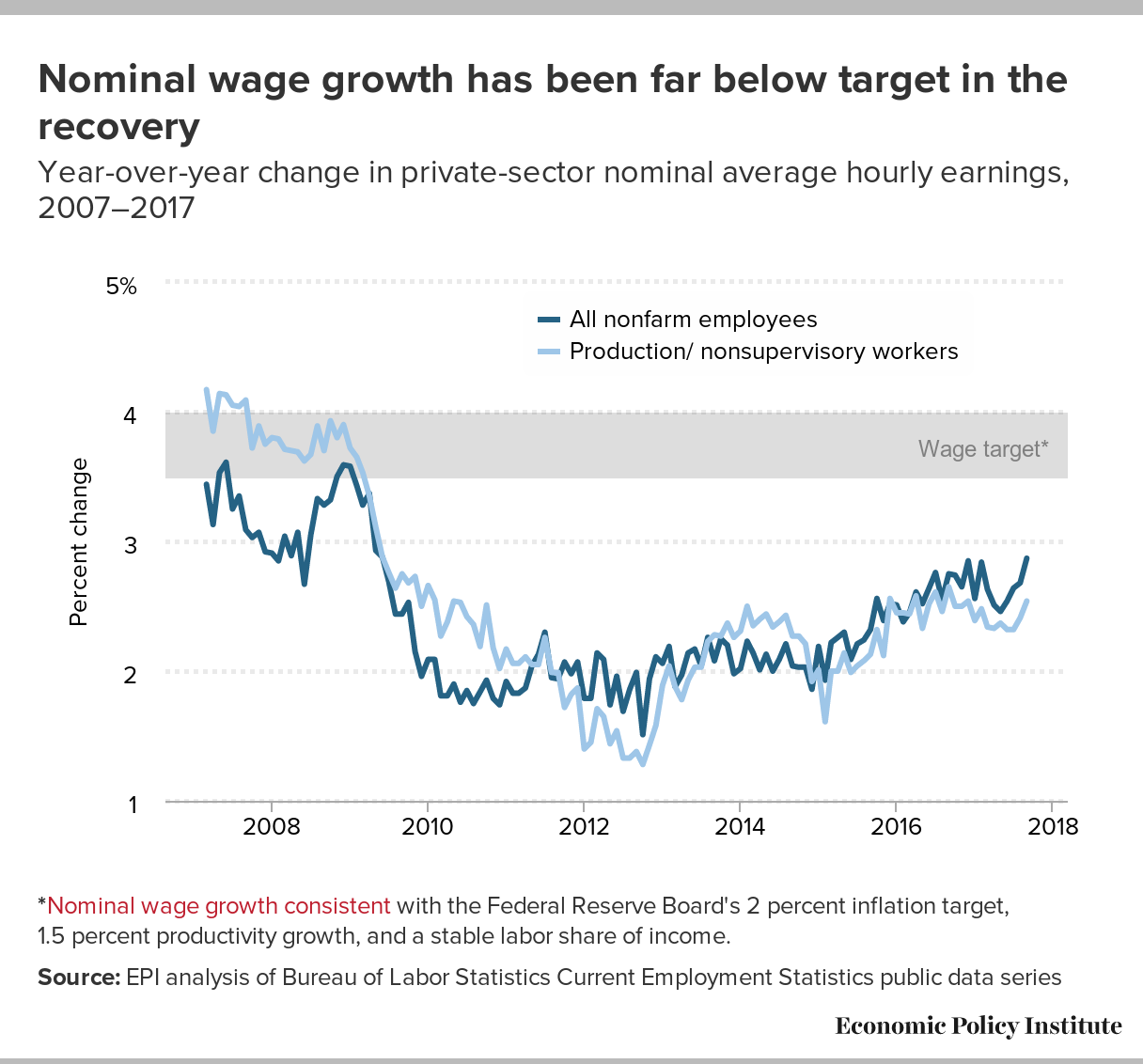
This month, workers who supported Trump may see another betrayal. It has been reported that Trump may pick Kevin Warsh, who married into a billionaire family, to replace Janet Yellen as the next Chair of the Federal Reserve Board of Governors (BOG). Decisions made by the Fed’s BOG are extraordinarily important for American workers. In recent years, pressure has built for the Fed to begin applying the brake to America’s economic recovery by raising interest rates. The rationale for this is that the Fed must slow growth to tamp down inflationary pressures. Warsh has consistently been on the side advocating for slowing growth to fight inflation. But these inflationary pressures appear nowhere in either wage or price data. And if the Fed hits the brake prematurely, millions of Americans could lose opportunities to work, and tens of millions could see smaller wage increases.

One underappreciated aspect of raising interest rates is that they will put upward pressure on the value of the U.S. dollar, and this stronger dollar will make U.S. exports less competitive on world markets while making foreign imports cheaper to American consumers. This will in turn lead to rising trade deficits which stunt growth in manufacturing employment. Warsh knows about this argument, but he just doesn’t really care.
“I would say that the academy’s view, the broad view of folks at the IMF and economics departments at elite universities, is that if only the dollar were weaker, then somehow we’d be getting this improvement in GDP arithmetic, we’d have an improvement in exports and we’d be getting much closer to trend. That’s not a view I share. My own views are that having a stable currency, now more than ever, provides huge advantages to the U.S. The U.S. with the world’s reserve currency is a privilege, but it is a privilege that we can’t just look to history to remind us of; it’s a privilege we have to earn and continually re-earn. And so it does strike me that those that think that dollar weakness, made possible by QE as one channel for QE, is the way to achieve these vaunted objectives are going to be sorely disappointed.”
What to Watch on Jobs Day: The teacher gap, the hurricanes, and how we know slack remains
Tomorrow, the Bureau of Labor Statistics will release September’s numbers on the state of the labor market. As usual, I’ll be paying close attention to the prime-age employment-to-population ratio (EPOP) and nominal wages, which are two of the best indicators of labor market health. There will likely be discussion of whether or how September’s storms affected the data, and I lay out some those issues below. Last, Friday’s report will give us a chance to examine the “teacher gap”—the gap between local public education employment and what is needed to keep up with growth in the student population.
Falling unemployment
The unemployment rate has fallen steadily over the last seven years, and many have said that the current rate of 4.4 percent means we are back (or at least very close) to full employment—meaning that pushing unemployment any lower would cause inflation to accelerate above the Federal Reserve’s preferred 2 percent target. That is why some observers are calling upon the Fed to continue to raise rates, even though low unemployment has not translated into consistently strong nominal wage growth for workers across the economy.
The unemployment rate is only one indicator of labor market health—and other indicators, like the prime-age employment-to-population ratio (EPOP), suggest an economy with a fair amount of slack. When the economy first hit its current 4.4 percent unemployment rate in April 2017, I noted that, historically, an unemployment rate of 4.4 percent was associated with higher participation and employment in the labor market. In fact, based on the relationship between unemployment rates and prime-age EPOPs in the last two business cycles, the current prime-age EPOP of 78.4 should be 2.3 percentage points higher (80.7 percent). Unfortunately, its current rate is still below its lowest level in the last full business cycle. Nominal wage growth is another key indicator of labor market health. Year-over-year nominal wage growth has remained at 2.5 percent for the last several months, below target levels and where it would be expected in a stronger economy.
All told, the Fed was correct to resist further rate increases in their September meeting. Reaching genuine full employment should be the main concern of the Fed so that workers—white and black, young and old—see the benefits of tight labor markets in their job prospects and wages.
What to watch out for in Trump’s speech on regulation later this morning
President Trump is scheduled to give a speech later this morning about his administration’s regulatory agenda. Given the administration’s statements and actions since Trump took office in January—one of his first actions after taking office was to issue an executive order requiring federal agencies to identify at least two existing regulations to “repeal” when proposing a new regulation—there is little doubt about what any speech by this president on regulation will contain.
Watch for false claims that government regulations cost jobs. The truth is that research on the relationship between employment and regulations generally finds that regulations have a modestly positive, or simply neutral, effect on employment. Though regulations sometimes reduce jobs in one area, they create jobs in another. For example, factories making lead paint shut down after regulations banning lead paint were issued in the late 1970s, but enterprises manufacturing lead-free alternatives arose in their place. And some of the older factories hired people to retool their machinery to begin manufacturing lead-free paint. Importantly, the lack of sensible regulations can do major damage to the economy and cost jobs. One recent, devastating example was the housing bubble, and the financial and economic crisis of 2008 and 2009 that ensued when the bubble burst, resulting in the loss of nearly 9 million jobs. Deregulation and lax enforcement based on the belief that financial markets could “self-regulate” played a major role in this crisis.
Watch for false claims that the costs of regulation outweigh the benefits. The truth is that while there are costs associated with regulations, they tend to be dramatically outweighed by benefits—federal regulations typically provide huge net benefits (benefits minus costs) to society. Federal agencies are required to undertake a cost-benefit analysis when issuing a major rule, and each year the Office of Management and Budget (OMB) reports to Congress on the costs and benefits of federal regulations. In its most recent report, OMB found that during the last administration, from January 21, 2009, to September 20, 2015, the estimated annual net benefits of major federal regulations was between $103 and $393 billion. In other words, these regulations are providing an overall benefit to society of over $100 billion per year.