What to Watch on Jobs Day: Putting wage growth in perspective
While payroll employment growth has continued to be more than fast enough to absorb working age population growth as well as workers idled by slack demand in previous years and the unemployment rate is holding at 4.1 percent, other economic indicators such as the labor force participation rate, the prime-age employment-to-population ratio, and wage growth resemble an economy with a fair amount of remaining slack. My attention this jobs day and in the discussion below is wage growth.
Last week, I released a paper on the State of American Wages in 2017, with comparisons to earlier periods as well as analysis by gender, race, and educational attainment. Key findings include a pickup in wages for the lowest wage workers over the last couple of years due in part to more workers finally feeling the effects of the growing economy in their wages plus state-level minimum wage increases occurring in states where about half of all workers reside. On the downsides, much of the 2000s and 2010s have been characterized by growing wage inequality and slow or stagnant wages for many. Black-white wage gaps have worsened over the 17-year period and the bottom 50 percent of college degreed workers have lower wages today than in 2000.
Tomorrow, the latest wage growth numbers from the Current Employment Statistics (CES) will come out. The paper I just referenced primarily examined the wage data found in the Current Population Survey Outgoing Rotation Group (CPS-ORG), which allows wage comparisons across the wage distribution and by demographic characteristics. For a read on the labor market and an assessment about whether wage growth reflects an economy at full employment, it’s important to look at nominal wage growth. What’s clear from both surveys, using different metrics (median versus average and total private versus production/non-supervisory) is that nominal wage growth is still below levels consistent with the Federal Reserve’s inflation target and with estimates of potential productivity growth—a sign that the economy still has considerable slack.
Congress should set the standard in being a good employer
The past year has provided countless examples of the ways in which our nation’s labor and employment laws fail workers. From the #MeToo social media campaign that helped expose that for many women sexual harassment is a daily fact of life in the workplace to a recent report revealing that the vast majority (74 percent) of Uber and Lyft drivers earn less than the minimum wage in their state, it is clear that American workers need policymakers to act to reform the current system of worker protections. That is why stories like the one in Vox today that some congressional lawmakers require unpaid interns to sign broad nondisclosure agreements that may discourage them from speaking out if they experience harassment or encounter other workplace issues are so troubling. How can we expect our elected representatives to legislate effective worker protection measures when they themselves adopt exploitative employment practices?
Congress has a long history of exempting itself from workplace protection measures. When the Fair Labor Standards Act was passed, Congress exempted itself from coverage. When the Civil Rights Act, including Title VII which protected workers from employment discrimination on the basis of race, color, religion, sex, or national origin, was signed into law, Congress again exempted itself from these protections. It was not until 1995 that Congress passed the Congressional Accountability Act, finally extending workplace protections to congressional staff. However, recent reports of congressional settlements surrounding harassment claims have shown that Congress is not holding itself accountable for workplace protections.
Many of the policy recommendations from the Kerner Commission remain relevant 50 years later
In 1967, young black men rioted in over 150 cities, often spurred by overly aggressive policing, not unlike the provocations of recent disturbances. The worst in 1967 were in Newark, after police beat a taxi driver for having a revoked permit, and Detroit, after 82 party-goers were arrested at a peaceful celebration for returning Vietnam War veterans, held at an unlicensed social club.
President Lyndon Johnson appointed a commission to investigate. Chaired by Illinois Governor Otto Kerner (New York City’s mayor John Lindsay was vice-chair), it issued its report 50 years ago today. Publicly available, it was a best-seller, indicting racial discrimination in housing, employment, health care, policing, education, and social services, and attributing the riots to pent-up frustration in low-income black neighborhoods. Residents’ lack of Fambition or effort did not cause these conditions: rather, “[w]hite institutions created [the ghetto], white institutions maintain it, and white society condones it… [and is] essentially responsible for the explosive mixture which has been accumulating in our cities since the end of World War II.”
The report warned that continued racial segregation and discrimination would engender “two societies, one black, one white—separate and unequal.” So little has changed since 1968 that the report remains worth reading as a near-contemporary description of racial inequality.
Of course, not everything about race relations is unchanged. Perhaps most dramatic has been growth of the black middle class, integrated into mainstream corporate leadership, politics, universities, and professions. We’re still far from equality—affirmative action remains a necessity—but such progress was unimaginable in 1968. Today, 23 percent of young adult African Americans have bachelor’s degrees, still considerably below whites’ 42 percent but more than double the black rate 50 years ago.
In the mid-1960s, I assisted in a study of Chicago’s power elite. We identified some 4,000 policymaking positions in the non-financial corporate sector. Not one was held by an African American. The only black executives were at banks and insurance companies serving black neighborhoods. Today, any large corporation would face condemnation, perhaps litigation, if no African American had achieved executive responsibility.
How new Fed Chair Jerome Powell should get ready for the next recession
New Federal Reserve Chair Jerome Powell testified before Congress this week, roughly a month after replacing Janet Yellen. The key question many have is whether or not a change in personnel will mark a break with past policy. If it does, and if the Fed starts crediting arguments for raising interest rates that they correctly rejected before, then today’s low unemployment rate might be unfortunately short-lived.
Under Yellen’s leadership, the Fed was notably “dovish” in that it strove to keep monetary policy expansionary with the goal of pushing unemployment down, rather than contractionary in the service of guarding against an outbreak of inflation. Her replacement, Jerome Powell, served on the Fed’s Board of Governors with Yellen between 2012 and early 2018. Powell was by most accounts supportive of the policy path blazed by Yellen, so in that sense a radical change in the Fed’s stance would be surprising. But Yellen wasn’t just a dovish vote on the Fed, she was an intellectual leader in the defense of expansionary monetary policy over the past decade. As a highly respected academic macroeconomist and policymaker, Yellen had the ability and confidence to push back hard on weak arguments about why the Fed should reverse course and begin worrying about containing inflation rather than pushing down unemployment.
One of these weak arguments is that the Fed needs to raise rates faster and sooner so that when the next recession hits, there will be enough “room” to lower them. Proponents of this argument point out that in previous recessions the Fed lowered the short-term “policy” interest rates that it controls by 3–5 percentage points in an effort to restart growth. Today these rates are at 1.5 percent, and, they really can’t go much below zero for any extended period of time. This “zero lower bound” (ZLB) on interest rates is driven by the fact that once these rates hit zero, wealth-holders will just stop demanding bonds and will be happy to hold cash instead. This means that further Fed purchases of bonds to lower rates will have no effect. What hitting the ZLB means for policy is that we could enter the next recession without the ability of the Fed to lower policy rates as far as they have in the past.
While the constraints put on monetary policymaking by the ZLB are real, raising rates now to clear out room for cutting them later remains a silly idea. First, raising rates sooner and further doesn’t just give the Fed more interest rate “room” to fight the next recession, it also makes the next recession more likely. Post-war recessions have largely occurred because of asset market bubbles popping or the Fed raising rates too far and too fast.
An analogy might help point out the absurdity of this. Say that your house is a cool 50 degrees and you hike the thermostat to your desired temperature of 70 degrees. After the heat has been running for a while, the house has warmed to 60 degrees, and your roommate argues you should turn the thermostat off because if the room gets really cold again, you’ll want “room” to warm it by cranking the thermostat up again.
Does this make sense? Of course not. So long as one believes that the economy has not warmed up to its optimal setting, then one should not be using policy tools to cool it back down. Is there a convenient summary measure that can guide us as to whether or not the economy is running hot enough? There are lots, actually, but let’s use the Fed’s own announced measure: 2 percent price inflation. The economy has been running beneath this 2 percent inflation target for years now, and there is little evidence of any acceleration. Further, if one excludes rental prices, then inflation has been even lower. Fighting rent inflation (which occurs due to low supply of housing units relative to demand) by raising interest rates which will curtail home-building would be perverse.

So, the economy is by the Fed’s own definition not running hot enough, yet they’ve already begun raising rates to cool it off, backed in part by arguments that this is necessary because one day they might want to try to heat it back up. This is a terrible way to prepare for the next recession.
Growth (or not) in real wages
There is no starker metric for our unequal age than the stagnation of American wages over the last generation. Since 1973, productivity has grown about 75 percent, while the compensation of the typical worker has grown only about 12 percent. Since 1979, the hourly median wage has grown less than 10 percent in real dollars, or an average annual raise of barely 4 cents. While wages grew for many workers in 2017, wage growth is still far slower—and more unequal—than where it needs to be.
The interactive graphic below shows the change in real (inflation-adjusted) wages by wage decile, with drop-down filters for gender, race, educational attainment, and time period. This affords comparison of the wage gains (or losses) experienced by particular workers, and comparison across the full 1979–2017 span, or its constituent business cycles. The choice of “African-American” and “1979–1989,” for example, charts how black workers fared during the dismal 1980s; the choice of “BA or higher” and “2009–2017” charts how well-educated workers fared during the long recovery from the Great Recession.
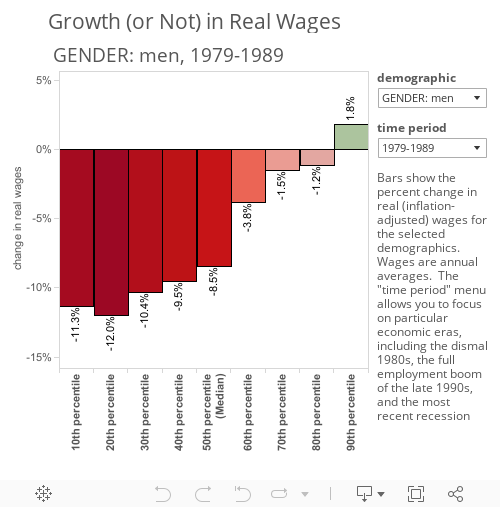
There are a lot of moving pieces here—including shifting economic opportunities, changes in educational attainment, policy drifts and shifts, and five recessions that swallow up almost 6 of the 39 years since 1979. But here are four key takeaways:
Ron Blackwell (1946–2018)
Ron Blackwell, a friend to EPI since its early days, died on February 25.
Ron had a long career in the labor movement, starting with the Amalgamated Clothing and Textile Workers Union in New York, moving to the AFL-CIO in Washington, D.C. until he retired in 2012.
Raised in Alabama, he was a steadfast defender of the rights of working people and a life-long enemy of economic injustice in its many forms.
He pioneered in the design and management of campaigns to use the financial and pension assets of labor unions as a tool of organizing and collective bargaining.
Having studied economics and political economy at the New School, he understood how elite decisions hidden from the public can destroy efforts by ordinary people to better their lives. His was a relentless voice urging the labor movement to demand a seat at the table of economic policy. He also played an important role in efforts to create international labor solidarity in a world of globalizing capital.
Above all, Ron Blackwell was the rare man of principle who actually had the courage of his convictions. As a young man, he chose to go to prison rather than submit to those who were waging the unjust and terrible war in Vietnam. In his years as a labor advocate, he was quick to spot hypocrisy among political leaders, who—as the late mineworkers’ leader John L. Lewis once put it—“supped at labor’s table and sheltered in labor’s house” but then, “cursed with equal impartiality both labor and its adversaries.”
Ron told it like it was.
EPI, the labor movement, and the country have lost a valiant warrior in the struggle for justice.
50 years after the riots: Continued economic inequality for African Americans
Anniversaries of major events are nearly irresistible opportunities to reflect on the past, often with the hope that there has been some progress. So it is this year, 50 years after the Kerner Commission Report on Civil Disorders found systemic inequality and racial discrimination to be at the root of riots across America.
In a new report, Janelle Jones, John Schmitt and I present statistics showing what life was like for African Americans in this country 50 years ago compared to now. That document is a straightforward, unfiltered presentation of the facts, covering a wide range of economic, social, and health outcomes. In the spirit of reflection, I want to use this blog post to focus on racial economic inequality in the labor market, which directly affects approximately 20 million African Americans who get up every day and either go to work or go to find work.
The bottom line is simple. Despite decades of policies, programs, protests and outstanding achievements by African American men and women in many aspects of American life, race far too often remains a deciding factor in the economic status of African Americans relative to whites.
Great strides have been made toward raising educational attainment among African Americans and closing the education gap relative to whites, especially with regard to completing high school. In 1968, just over half (54.4 percent) of African American adults age 25-29 were high school graduates, compared to nearly three-quarters (75.0 percent) of whites. In 2016, 92.3 percent of African American adults age 25-29 were high school graduates with 22.8 percent having gone on to complete a bachelor’s degree or higher (up from 9.1 percent in 1968). Among whites, 95.6 percent are high school graduates and 42.1 percent have a bachelor’s degree or higher (up from 16.2 percent in 1968).
Sen. Hatch’s H-1B bill and other guestworker proposals should be kept out of Senate immigration debate
In the context of this week’s immigration debate in the Senate, Republican Senators will push for the reforms in the Secure and Succeed Act of 2018, which reflect the White House’s policy priorities for immigration. It’s likely, however, that one or more Senators will try to attach legislation to increase the number of temporary migrant workers who lack adequate wage and worker protections onto any bill that emerges. The thrust of any guestworker proposals that may arise will be to widen the essentially lawless zone in the labor market that has been carved out by the proliferation of temporary work visa programs, which put American and permanent immigrant workers into competition with temporary migrants who are denied all opportunity to bargain meaningfully for higher wages. This week’s debate in the Senate should prioritize providing a path to citizenship for DREAMers, not opportunistically expanding the share of workers in America who are not protected by labor standards.
As the Los Angeles Times recently suggested, there may be an attempt to include a bill from Sen. Orrin Hatch (R-Utah) that would triple the number of college-educated temporary migrant workers who are employed in the H-1B visa program—a flawed guestworker program used mainly to outsource jobs in information technology and send high-tech jobs offshore. Hatch’s bill is known as I-Squared, and although Hatch is trying to sell it as an increase in “merit-based” immigration, it is primarily an attempt to increase the number of temporary migrant workers the tech industry can hire at low wages.
There is no question in anyone’s mind that the United States will always need to attract the best and brightest workers from abroad, and many employers claim the H-1B visas is a tool to achieve that. But any migrant workers who enter the U.S. labor market must do so with equal rights, fair pay, and a quick path to permanent residence and citizenship that the worker controls—not the employer. Unfortunately, the H-1B guestworker program fails to meet any of those requirements. Hatch’s I-Squared bill would exacerbate the problems the H-1B program creates by vastly increasing the number of H-1B workers while failing to fix the three main problems with the H-1B program: first, employers are allowed to legally underpay H-1B workers compared to similarly situated U.S. workers; second, employers do not have to recruit U.S. workers before hiring H-1B workers, allowing them to ignore the U.S. workforce altogether; and third, the H-1B program allows employers to replace U.S. workers with much lower-paid H-1B workers—a deplorable practice that has occurred far too many times—and the laid-off workers are often forced to train their own H-1B replacements as a condition of their severance pay.
Senate must pass legislation this week to legalize DREAMers but avoid unnecessary immigration enforcement measures and green card reductions
Spurred on by President Trump’s ending of the Deferred Action for Childhood Arrivals (DACA) initiative in September 2017, on Monday the Senate began an “open-ended” debate on immigration, which is set to only last for this week. The debate is centered around possible legislation to legalize and provide a path to citizenship for the up to 1.8 million unauthorized immigrants who entered the United States as minors, known as DREAMers, including the 700,000 current recipients of DACA. Without the protection of DACA or new legislation, DACA recipients will be left without the ability to attend college or work legally, leaving them unable to access labor and employment law protections because they’ll fear deportation. Passing a bill that legalizes DACA recipients and DREAMers is an urgent priority that Congress should focus on, but the debate will unfortunately spend far too much time this week on adding new immigration enforcement measures and cutting the number of permanent immigrant visas (also known as “green cards”).
The White House and some Republican senators have made it clear that in return for DREAMer legalization, they’d like a large expansion in immigration enforcement and cuts to the number of immigrants that can become permanent residents and American citizens in the future. It is obvious to any rational observer that President Trump intentionally created a crisis for DREAMers by ending DACA as a way to achieve these immigration policy goals—which reflect the misguided and draconian priorities of his administration and Republicans on the hard-right—in exchange for ending the crisis Trump created. Both Republican Senators Tom Cotton (R-Ariz.) and Majority Leader Mitch McConnell (R-Ky.) have expressed their support for Iowa Senator Chuck Grassley’s Secure and Succeed Act of 2018—which is based on the White House’s proposed framework for an immigration deal that includes DREAMer legalization—and both believe it’s the only piece of legislation that can become law. Other Republican Senators who have co-sponsored the Secure and Succeed legislation include Joni Ernst (R-Iowa), John Cornyn (R-Texas), Thom Tillis (R-N.C.), David Perdue (R-Ga.), and James Lankford (R-Okla.).
The Trump administration’s infrastructure plan remains empty talk and will be paid for by cuts to programs that help working people
The Trump administration has released another variation of their long-dormant infrastructure plan. Just like the previous version, the plan amounts to empty talk. To understand why, one must examine the fiscal year 2019 budget proposal, released alongside their infrastructure proposal. While the administration trumpets an infrastructure plan, their budget radically cuts federal investments.
Even their trumpeting of the stand-alone infrastructure plan is hugely misleading. Instead of the $1 trillion being claimed by the administration (already pared back from the $1.5 trillion they claimed they’d be investing in infrastructure in earlier discussions), the plan only calls for $200 billion in federal funds. Finding the rest of the $1 trillion will be left overwhelmingly to states and localities, despite the fact that they already bear the brunt of paying for public infrastructure spending. In total, state and local governments account for 77 percent of public infrastructure spending in the United States. They account for 62 percent of capital investment and 88 percent of operations and maintenance. It is odd to argue that the United States needs a substantial infrastructure push to deal with past underinvestment, and then to propose that the same system that yielded this underinvestment—relying too much on state and local governments—should just be continued. If we want a real investment in infrastructure, continuing to kick the problem to state and local governments won’t solve anything.
The Trump administration will claim that their plans are different because they will leverage the private sector. This claim doesn’t change anything. Private entities will not build infrastructure for free, but will expect a return on investment. That means state and local governments will have to pay for the infrastructure with taxes, tolls, or other user fees. And if state and local governments predictably dodge the task of financing and funding projects directly, public-private partnerships come with their own set of problems, as natural monopoly characteristics can leave the private partner in a position to hike tolls and degrade service quality.