We need a vaccine for false narratives about racial disparities: Taking statistics with a dose of history and context will bolster economic and racial justice for Black workers
Key takeaways:
- We need new narratives around Black economic disadvantage.
- In today’s heightened public awareness of racial inequalities, the ways we talk about racial economic disparities shape the solutions we develop for those disparities—and whether we consider disparities as problems worth solving at all.
- Americans have historically had a tendency to individualize both successes and failures—that is, to look at groups of individuals and assume their outcomes are just the combined result of individual decisions, something known as “methodological individualism.” It fails to account for the ways that structural features of the U.S. economy narrow the options for Black workers and their families.
- In this blog post, I offer tools for gaining the deeper understanding of statistics that allow us to actually tackle the problems of inequity with impactful solutions instead of explaining them away.
Black workers disproportionately experienced the darkest side of 2020, both in terms of health and labor market outcomes—a reality that was not unexpected.
Researchers, advocates, and activists have spent years pointing out that Black Americans are more likely to have the health conditions that significantly increase the mortality rate of COVID-19 infection. We have known for years that Black American households have a fraction of the wealth that white American households do, meaning that in the event of an economic shock they would be less resilient, more likely to default on loans, and unable to draw upon savings to pay rent, possibly leading to evictions.
The last 50 years of labor market data have given us two recognizable facts:
- The Black unemployment rate is consistently around double the white unemployment rate under normal economic conditions.
- Black workers find employment more slowly, especially in the wake of an economic downturn.
Today’s inflation data show zero sign of sustained economic overheating
Correction: The first paragraph of this blog post has been updated with the correct overall consumer price index (CPI) in March 2021 of 2.6% and “core” measure of the CPI of 1.6%. The initial analysis had accidentally switched the two numbers. The numbers in Figure A remain the same.
Today, the Bureau of Labor Statistics (BLS) reported that the overall consumer price index (CPI) in March 2021 was 2.6% higher than in March 2020, while the “core” measure of the CPI (which excludes volatile food and energy prices) was 1.6% higher than a year ago. Given that these are noticeable (if modest) increases over recent months’ year-over-year inflation rates, some might be tempted to argue that this data should make policymakers worry about economic “overheating” stemming from “too much” fiscal support provided in recent recovery legislation. This is clearly wrong, for a number of reasons:
- The data released today do not show that prices have risen rapidly since recovery legislation passed—instead they just show that prices plummeted during the near-total shutdown of large swaths of the economy a year ago in response to the COVID-19 shock.
- Measured on an annualized basis from February 2020—before the COVID-19 economic shock—inflation in March 2021 was running at just 1.5%.
- Measured since October—shortly before the $2.8 trillion in additional relief spending provided by legislation in December 2020 and the American Rescue Plan (ARP) in March—inflation is running at an annualized rate of 1.3%.
The American Jobs Plan’s tax provisions are valuable but not the limit on possible spending
The spending in the American Jobs Plan (AJP) is well targeted to meet several (but obviously not all) pressing social needs. Because so much of the spending is temporary and provides needed investments, there is no pressing economic need to “pay” for it with tax increases. Yet the tax provisions in the AJP are also smart and valuable. This post discusses some of the economics of the AJP, with a special focus on these tax provisions. Its main findings are:
- The bulk of these tax provisions undo some of the worst parts of the Tax Cuts and Jobs Act (TCJA) passed in the first year of the Trump administration. Given this, to make the case that rolling back these parts of the TCJA will harm the U.S. economy, one has to believe that the passage of the TCJA benefited the U.S. economy. There is no evidence this is the case.
- The entire case for corporate tax cuts benefiting the U.S. economy hinges on the effects on business investment. But business investment growth in the two years following the TCJA’s passage (even before the COVID-19 shock) was cratering, not rising.
- The vast majority of new revenue that will be raised from the AJP tax provisions will come from taxing “excess profits”—profits accrued by virtue of monopoly or other privileged market positions. As such, this extra revenue will have little to no effect on economic decision-making and hence will not reduce business investment or economic growth more generally.
- Two “model-based” analyses of the AJP find very different things: Moody’s Analytics forecasts strong positive effects on economic growth over the next 10 years, while the Penn Wharton Budget Model forecasts very slight negative growth effects by 2030. The finding that the AJP might reduce economic growth rests on a number of bad assumptions: that the corporate tax changes will significantly affect economic decision-making and reduce investment; that the productivity gains stemming from public investment are small; that budget deficits will crowd out large amounts of private capital formation over the next decade; and that AJP’s care investments will reduce labor supply. None of these assumptions are likely to be correct.
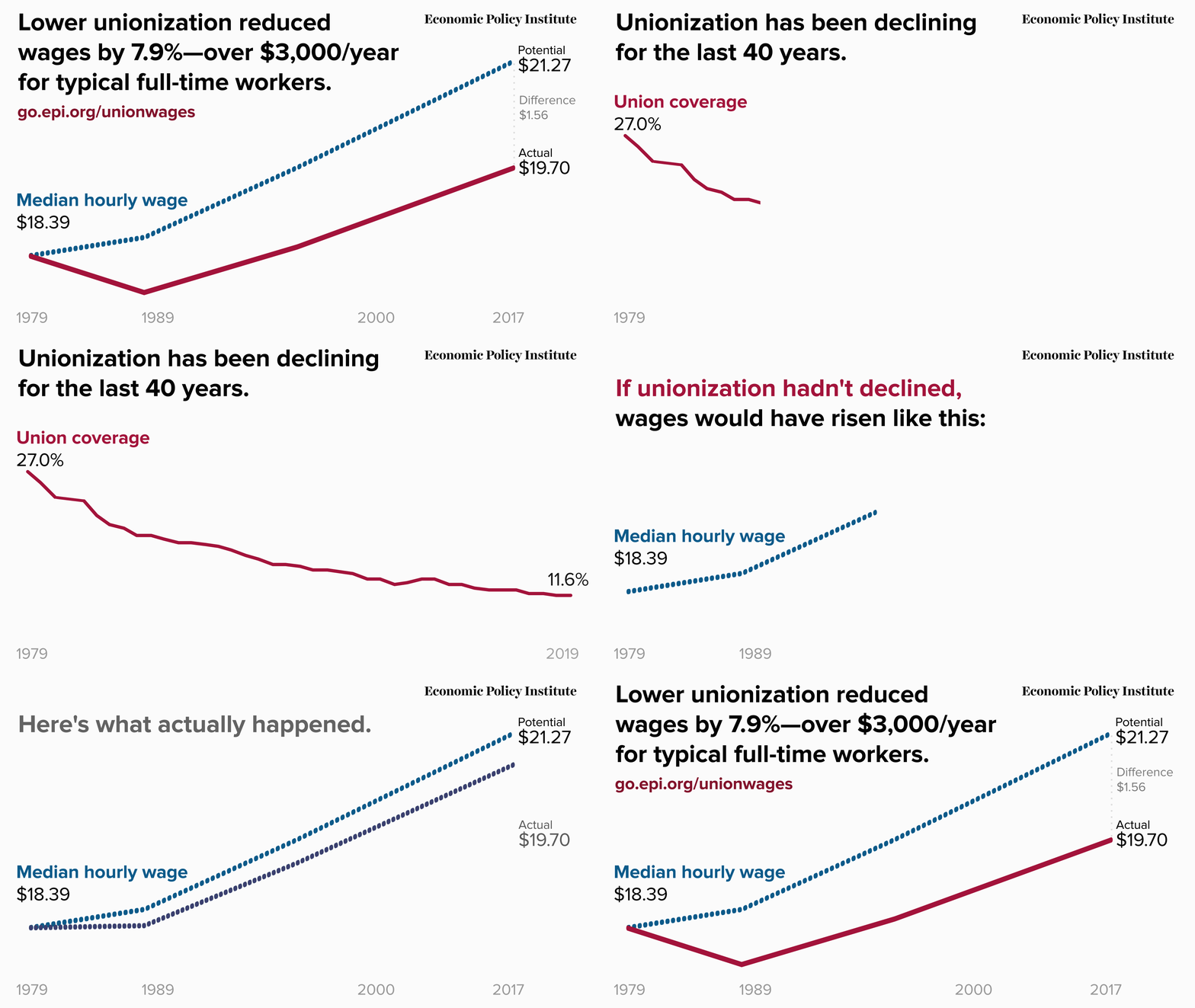
Lower unionization over the last 40 years decreased wages by 7.9%
In 1979, 27.0% of workers were covered by union contracts. By 2019, that number had dropped to 11.6%. New research finds that this single factor dragged down the typical full-time workers’ wages by over $3,000/year.
Read the report:
The enormous impact of eroded collective bargaining on wages
Job openings and hires ticked up in February
Today’s Job Openings and Labor Turnover Survey (JOLTS) reports a promising pickup in both job openings and hires in February 2021, a sign that the recovery is finally moving ahead. The increase in hires was notable in accommodation and food services, but decreases in state and local government education are particularly troubling (though we know from March jobs data that state and local government hiring began to pick up in March). Overall, hires remain below its level before the recession hit, but job openings have now edged above its pre-recession levels. Once public health experts indicate it is safe to reopen and the American Rescue Plan (which was passed after today’s JOLTS data were collected) takes effect, I’m confident those openings will grow and translate into hires. Layoffs have held steady over the last couple of months.
One of the most striking indicators from today’s report from the Bureau of Labor Statistics (BLS) is the job seekers ratio—the ratio of unemployed workers (averaged for mid-February and mid-March) to job openings (at the end of February). On average, there were 9.8 million unemployed workers compared with only 7.4 million job openings. This translates into a job seekers ratio of about 1.3 unemployed workers to every job opening. Put another way, for every 13 workers who were officially counted as unemployed, there were only available jobs for 10 of them. That means, no matter what they did, there were no jobs for 2.5 million unemployed workers.
As with job losses, workers in certain industries are facing a steeper uphill battle. In the construction industry as well as arts, entertainment, and recreation, there were more than three unemployed workers per job opening. In educational services, accommodation and food services, other services, and transportation and utilities, there were more than two unemployed workers per job opening. As bad as these numbers are, they miss the fact that many more weren’t counted among the unemployed: The economic pain remains widespread with 23.6 million workers hurt by the coronavirus downturn.
On the whole, the U.S. economy is seeing a significantly slower hiring pace than we experienced in May or June. While the pickup in job openings is a promising sign, hiring in February was below where it was before the recession. There was an increase in jobs in the mid-March employment report, but we still have a long way to go before recovering the large job shortfall—11.0 million when using a reasonable counterfactual of job growth if the recession hadn’t occurred—that remains.
Calls to establish a regionally adjusted federal minimum wage are dangerously misguided
We need to raise the federal minimum wage. Its deterioration in value over the past five decades has exacerbated poverty, widened inequality, and lowered wages for the bottom third of wage earners1—despite the fact that these workers typically are older and have more education than their counterparts a generation ago.
One misguided critique of the effort to raise the federal minimum to $15 in 2025 is that there is a need to establish a regionally adjusted federal minimum wage set to local conditions. In fact, federal minimum wage policy has always provided for tailored standards, by coupling a strong national wage floor with the ability for cities and states to adopt higher standards. Our ability to set a national wage floor is much easier now than it was decades ago when lawmakers last raised the federal minimum wage to new heights. In 1968, when the federal minimum wage was lifted to its highest value in U.S. history and coverage of the law was vastly expanded, there were much larger differences in wage levels throughout the country. Yet, we now have empirical evidence that establishing this unprecedented, nationwide minimum wage did not have adverse employment impacts.
Today, the wage levels of lower-wage states, primarily Southern ones, are much closer to overall national wage levels, so there is even less validity to claims that the federal minimum wage must be lowered to accommodate certain areas. Moreover, the ‘bite’ of a $15 minimum wage in 2025—i.e., the share of workers and businesses impacted, and the magnitude of resulting wage increases—will be well within the range of recent experiences of minimum wage increases in states and localities that studies have shown had little, if any, impact on employment. The proposed increase to $15 by 2025 will lead to improved annual earnings for nearly all low-wage workers.
Strong job growth in March as vaccine distribution expands and the American Rescue Plan ramps up
A solid 916,000 jobs were added in March, the strongest job growth we’ve seen since the initial bounceback faded last summer. Even with these gains, the labor market is still down 8.4 million jobs from its pre-pandemic level in February 2020. In addition, thousands of jobs would have been added each month over the last year without the pandemic recession. If we count how many jobs may have been created if the recession hadn’t hit—consider average job growth (202,000) over the 12 months before the recession—we are now short 11.0 million jobs since February.
Even at this pace, it could take more than a year to dig out of the total jobs shortfall. However, today’s number is certainly a promising sign for the recovery, especially as vaccinations increase and vital provisions in the American Rescue Plan (ARP) have continued to ramp up since the March reference period to today’s data. The benefits of the ARP will continue to be captured in coming months.
What to watch on jobs day: Signs of an improving labor market
Pursuing public health initiatives—including the production and distribution of the vaccine—is the most important priority for our health and economic well-being. Further, investments in state and local governments as well as direct assistance to workers and their families have been essential to their financial security and the economic recovery itself. Given advancements on both fronts in recent weeks and months, I expect the labor market recovery to finally pick up steam.
A year into the recession, the labor market is still down 9.5 million jobs from where it stood immediately before the COVID-19 shock. If we add in jobs that should have been created over that time to absorb new workers, we’re facing a jobs shortfall today of nearly 12 million jobs.
As the labor market finally picks up, the key indicators to watch are where the jobs are returning and for whom. The biggest deficit remains in leisure and hospitality, with 3.5 million fewer jobs relative to its February 2020 level. The economic pain caused by losses in this lowest-paying sector was enormous.
Meanwhile, public-sector employment—primarily education employment at the state and local level—remains 1.4 million jobs below pre-pandemic levels. I’m optimistic that the state and local relief that was part of the American Rescue Plan will provide tremendous support to this sector in terms of employment and the vital public services they provide.
Businesses can thrive with a higher minimum wage, and government can help
A great deal of research shows that higher minimum wages benefit workers by adding to their income while causing little unemployment, as this report and this report show. Employers can adjust to paying higher wages in three ways: (1) increasing prices, (2) accepting reduced profits, or (3) offsetting higher-wage costs with increased ability by adopting “high-road” practices.
In this blog post, I argue that insufficient attention has been paid to this third channel, and that government efforts to help firms “take the high road” could ease firms’ transition to higher wages in a way that also benefits workers and consumers.
Much research documents the ways that firms can utilize high-road policies or good-jobs strategies to tap the knowledge of all their workers to create innovative products and processes. In retail, for example, firms such as Costco and Trader Joe’s pay far above minimum wage, yet remain profitable, as MIT’s Zeynep Ton has shown. The key to their success is a mix of complementary practices in marketing (reducing the number of products and promotion so that stores can manage inventory efficiently), human resources (cross-training workers so they can respond to a variety of demands), and operations (avoiding unneeded steps, in part by soliciting feedback from employees).
The H-1B visa program remains the “outsourcing visa”: More than half of the top 30 H-1B employers were outsourcing firms
Key takeaways:
- Most of the biggest users of the H-1B visas—the U.S.’s largest temporary work visa program—are companies that have an outsourcing business model.
- These companies exploit the H-1B program’s weaknesses to facilitate the transfer of U.S. jobs offshore as a lower cost alternative to hiring U.S. workers, and sometimes to replace incumbent U.S. workers with H-1B workers who are paid wages that are far below market wage rates.
- The latest data show that over 33,000 new H-1Bs were issued to the top 30 H-1B employers, accounting for nearly 40% of all new H-1Bs in 2020 that are subject to the annual limit of 85,000.
- Of the top 30 H-1B employers, 17 of them were outsourcing firms. Those 17 outsourcing firms alone were issued 20,000 H-1B visas, nearly one-quarter of the total 85,000 annual limit.
- President Joe Biden can and should implement regulations so that outsourcing companies can no longer exploit the program and to prevent them from underpaying skilled migrant workers.
The U.S.’s largest temporary work visa program is the H-1B—an important program that allows U.S. employers to hire college-educated migrant workers. However, the H-1B program is not operating as intended and needs to be fixed: Instead of being used to fill genuine labor shortages in skilled occupations without negatively impacting U.S. labor standards, the latest data show that the H-1B’s biggest users are companies that have an outsourcing business model. President Joe Biden can and should implement regulations so that outsourcing companies can no longer exploit the program and to prevent them from underpaying skilled migrant workers.
Outsourcing companies exploit the H-1B program’s weaknesses to build and expand a business model based on outsourcing jobs from other companies. In this arrangement, rather than being employed directly by the outsourcing company that hired them, the outsourcer sends its H-1B workers to work for third-party clients, either on- or off-site. The aim of the outsourcing company is ultimately to move as much work as possible abroad to countries where labor costs are lower and profit margins are higher. The H-1B workers serve three purposes in this business model: to facilitate the transfer of jobs and tasks offshore; to coordinate offshore teams; and to serve as a lower cost alternative to hiring U.S. workers for on-site jobs. H-1B outsourcing companies also replace incumbent U.S. workers with H-1B workers and typically pay their H-1B workers the lowest wages permitted by law, far below market wage rates.