A closer look at Asian-American income
In her blog post on the earnings differences among interracial couples, the New York Times‘ Catherine Rampell concludes: “So basically, what these numbers are reflecting is that Asians earn more money, period, which is generally true across the population of Asian-Americans and has been the case for a while.” This is true when looking at household and family income, but there is a different and more complicated story underneath these numbers.
It is important to recognize that many more Asian Americans have college degrees than whites. This 2010 EPI report found that nearly 60 percent of Asian American workers have a bachelor’s or higher degree compared to about 40 percent of white workers. College-educated workers tend to earn more than less-educated workers and this pulls up the median Asian American earnings.
When one compares the annual personal income of Asian Americans and whites of the same gender and educational level, Asian Americans do not always come out on top. The figure below shows these comparisons for workers with a high school diploma and with a bachelor’s degree. In 2010, among workers with a high school diploma, white men earned about $11,000 more than white women and Asian American men and women.
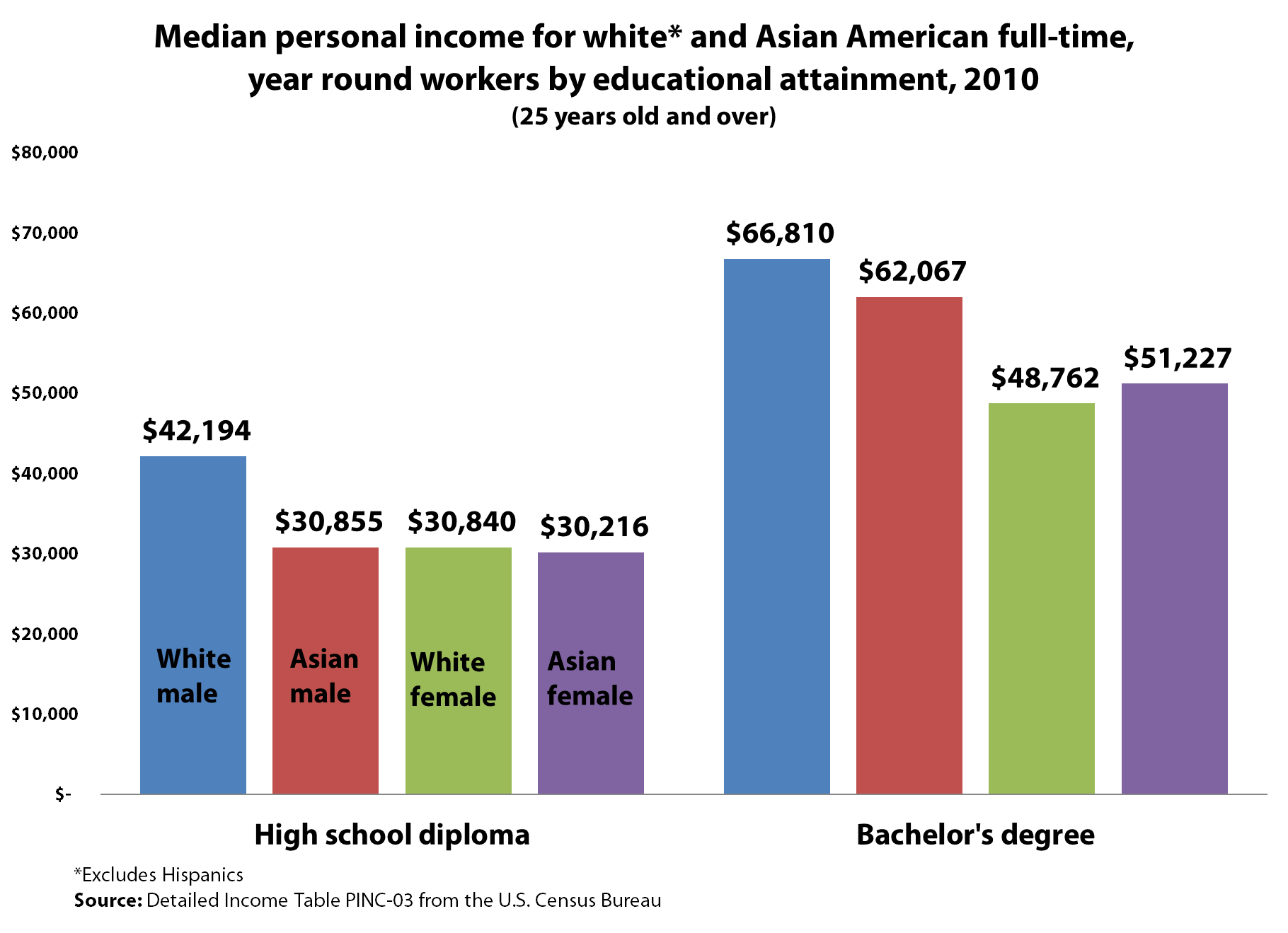
Among workers with a bachelor’s degree, white men remain the highest earners, but their earnings advantage over Asian American men is only about $5,000. In this comparison, Asian American and white women earn significantly less than Asian American men. Asian American women earn about $11,000 less than Asian American men, and white women earn about $13,000 less than Asian American men. This puts Asian American and white women at about $16,000 and $18,000 behind white men, respectively.
Another issue to consider is that Asian Americans are more concentrated than whites in high-cost-of-living areas. Asian Americans are overrepresented in expensive metropolitan areas like Los Angeles, New York, San Francisco, and Honolulu. Given this fact, controlling for educational attainment, Asian Americans should earn more than whites, but as the figure illustrates, they often don’t.
Coordinated investment as an alternative to doubling down on austerity’s failure
Former British Prime Minister Gordon Brown has a terrific piece in today’s Washington Post on European policymakers’ “fundamental miscalculation: a wrong-headed conviction, widely held across Europe, that if austerity is failing, it is because there is not enough of it.”
The failure of the “expansionary austerity” hypothesis has been growing increasingly apparent for quite some time, most recently highlighted by the euro zone economy falling back into contraction in the fourth quarter of 2011. More and more countries—including Italy and Spain—are projected to slide back into full-blown recessions. Via Ezra Klein, it’s clear to see that industrial production indices in the U.S. and the euro zone were closely tracking one-another until starkly diverging in the summer of 2011: U.S. production has continued to rebound and European output has fallen markedly.

But beyond this fiasco, Brown’s policy prescription is worth highlighting. Along the lines of advanced economies’ central banks coordinating monetary loosening and liquidity infusions during the financial crisis, Brown proposes coordinated fiscal expansion: “Europe and America should expand investment in infrastructure.” Now that would actually begin to address the global aggregate demand slump. This isn’t just Brown taking cheap political shots at Prime Minister David Cameron; this is sound macroeconomics. A massive U.S. public infrastructure project ($1.2 trillion) is also favored by prescient economist Nouriel Roubini, who similarly pegged “a front-loaded fiscal austerity that will sink us in a severe recession,” as the worst economic policy idea currently being floated.
Congress should be learning from Europe’s experience before we stray too far down the austerity path, as federal fiscal policy is all too set to do (state and local governments have already been down this path for years).
The Recovery Act: Evidence of success three years out
Today marks the three-year anniversary of the American Recovery and Reinvestment Act (ARRA). Despite overwhelming evidence of ARRA’s pivotal role in turning the economy around and boosting employment (including reports from the Congressional Budget Office, economists Alan Blinder and Mark Zandi, and the Federal Reserve Bank of San Francisco, among others), a vocal—mostly politically motivated—minority continues to misinform the debate, trying to convince the public that the stimulus failed.
That couldn’t be further from the truth.
As this recent video from the Center for American Progress nicely depicts, ARRA kept our economy from swerving over the cliff’s edge. In the video, Michael Linden of CAP uses three measures to demonstrate that the stimulus stopped the economy’s bleeding: He looks at annualized GDP growth, the monthly change in non-farm payroll employment, and monthly private-sector layoffs. As the housing collapse and financial crisis spread to the rest of the economy, these three indicators all grew dramatically worse, culminating in a dire situation in the fourth quarter of 2008—when GDP was plunging at an 8.9 percent annual rate—and the early months of 2009. After ARRA was enacted in mid-February, things started to turn around. In fact, here is what happened:
- In the second quarter of 2009—the first full quarter after the stimulus was passed—GDP declined at a much slower pace (0.7 percent), and growth resumed in the third quarter;
- Job losses slowed dramatically throughout 2009 and the economy started adding jobs in early 2010; and
- Private sector layoffs, which had peaked in Feb. 2009, began a rapid decline and returned to pre-recession levels by early Feb. 2010.
Now don’t get me wrong, ARRA wasn’t a cure-all (nor was it designed to be). The $831 billion 10-year cost of ARRA was smaller than the 2009 output gap and nowhere near the $3.0 trillion cumulative output gap since the start of the recession (which would be even bigger without ARRA). Unemployment remains unacceptably high, long after the official end of the recession. The economy needs 11 million more jobs to return to its pre-recession unemployment rate and the job seekers ratio has been higher for the last three years than it was at any point during the downturn of the early 2000s. Still, the stimulus prevented the situation from arguably being much worse than it otherwise would have been. Critics of the stimulus fail to recognize just how big of a hole ARRA was up against. As my colleague Josh Bivens explains in Failure by Design:
“The unemployment rate without the Recovery Act would have reached nearly 12%, not the 9% foreseen by the Obama administration. A good metaphor for this controversy is the temperature in a log cabin on a cold winter’s night. Say that the weather forecast is for the temperature to reach 30 degrees Fahrenheit. To stay warm, you decide to burn three logs in the fireplace. You do the math (and chemistry) and calculate that burning these three logs will generate enough heat to bring the inside of the cabin to 50 degrees, or 20 degrees warmer than the ambient temperature.
But the forecast is wrong—and instead temperatures plummet to 10 degrees outside and burning the logs only results in a cabin temperature of 30 degrees. Has log burning failed as a strategy to generate heat? Of course not. Has your estimate of the effectiveness of log burning been wildly wrong? Nope—it was exactly right—it added 20 degrees to the ambient temperature. The only lesson from this one is a simple one: since the weather turned out worse than expected, you need more logs.”
Unemployment of 8.3% is unacceptably high, no matter when and for whom
Unemployment in January was 8.3 percent, which is widely, and correctly, assessed to be unacceptably high. I agree. It should be noted that the unemployment rate for blacks in 2007 was the very same 8.3 percent, which barely registered much attention at all. That was at a time when the national unemployment rate was 4.6 percent and white unemployment was 4.1 percent. Well, the 8.3 percent for blacks in 2007 was also an unacceptable outcome. That’s why my colleague Algernon Austin organized an event, held yesterday at EPI: “Hit hard by the recession, left behind in the recovery: Achieving full employment for black workers.” Austin also wrote a new paper highlighting the currently very high unemployment among blacks and Hispanics, No relief in 2012 from high unemployment for African Americans and Latinos.
Whitewashing the Apple
I was skeptical when Apple chose the Fair Labor Association (FLA) to investigate conditions in its supplier factories. The FLA is paid by the companies whose factories it monitors, and it’s just hard to bite the hand that’s feeding you. A truly independent monitor, one with no financial dependence on Apple, would be the right choice if Apple really wanted the public to trust its motives and any eventual exoneration of its suppliers.
Well, we didn’t have to wait long. The head of the FLA has apparently exonerated first, with full investigation to follow. Steven Greenhouse reports in the New York Times that barely after the investigation has begun, FLA’s president, Auret van Heerden, has declared the factories of Apple’s biggest supplier, Foxconn, “first-class” and said, “Foxconn is really not a sweatshop.”
These precipitous assertions are beyond troubling; they suggest FLA is not proceeding in a fair, systematic and serious manner to uncover the reality of the work conditions.
It might be time for Apple’s board of directors to take a close look at an approach that may protect Apple’s brand, but will not protect Apple’s workers. Rather than stick with what may simply turn out to be a public relations whitewash, they might want to find someone who will do an independent unbiased investigation and tell them the truth about conditions in Apple’s factories.
CBO, CRS, EPI find toxics and other EPA rules have benign economic effects
A growing body of research is finding that new Environmental Protection Agency rules will not disrupt the economy and may in fact modestly boost employment. According to a new report by EPI and a January report by the Congressional Research Service, this is true for the air toxics rule, the most costly regulation finalized by EPA during the Obama administration. More generally, overlooked testimony by the director of the Congressional Budget Office from last November concludes that efforts to derail air quality regulations generally, if successful, would harm the economy.
On Dec. 16, 2011, EPA issued its final standards for mercury, arsenic, and other toxic air pollutants from power plants (the “toxics rule” or the “Utility MACT”). In January, CRS issued EPA’s Utility MACT: Will the Lights Go Out? As the title suggests, the report’s main focus is on whether the rule would, as some claim, affect the reliability of the power supply. CRS found otherwise, noting that while some facilities would be retired, “almost all of the capacity reduction will occur in areas that have substantial reserve margins,” meaning that the reductions can be easily absorbed without affecting power supply. CRS also observed that the rule includes additional time for compliance if in fact reliability is threatened in specific areas. The report’s bottom line conclusion: “…It is unlikely that electric reliability will be harmed by the rule.”
Last week, my colleague Josh Bivens released a report on the employment effects of the toxics rule. His analysis, unique in its comprehensive examination of both the positive and negative ways in which a regulation can influence employment, concluded that: “The toxics rule will lead to modest job growth in the near term and have no measurable job impact in the longer term.” His preferred single estimate is that 117,000 net jobs would be created.
The main reason why jobs would be created on balance in the near term is that the jobs generated by complying with the regulation, through pollution abatement activities such as increased investment on and the installation of scrubbers, will substantially exceed any jobs lost because of the modest increase in the price of electricity that would be produced. As Josh explains in his report and elsewhere, this is especially true today because of the large amount of capital and labor that is sitting on the sidelines; regulatory changes that spur investments to bring power plants into compliance with the new rules will mobilize this unused capital without leading to any offsetting rise in interest rates.
The Congressional Budget Office uses similar economic logic in assessing air toxics and other air quality rules. In testimony before the Senate Budget Committee on Nov. 15, 2011, CBO director Douglas W. Elmendorf included a general assessment of how initiatives to block EPA air quality rules would affect employment or output. He concluded: “On balance, CBO expects that delaying or eliminating those [EPA air] regulations regarding emissions would reduce investment and output during the next few years,” [emphasis added]. Essentially, CBO argued that the jobs created through investments to comply with the rules would exceed the number of jobs created due to alternative investments in the absence of the rules, because little such alternative investing would likely occur. (In my view, this reflects the fact that capacity utilization in the utility sector is at the lowest level on record, suggesting no need for further investments.) CBO also pointed out that the price increases that may result from these rules will not occur for several years, mitigating any near-term impact.
CBO’s use of the argument that regulatory changes are especially likely to spur job gains when, as is the case today, the economy has substantial slack in labor and capital markets, confirms that this reasoning is firmly based in mainstream economic analysis. It is an important argument that deserves greater attention in the ongoing regulatory debate.
Congress’ arbitrary ‘compromise’ on UI benefits
It’s good to hear that Congress has reached a deal to extend the payroll tax cut and long-term unemployment benefits.The tax relief to working families and the stimulus provided by unemployment payments is critical to protecting some of the recent improvements we’ve seen in the labor market.
But the nature of the “compromise” that congressional negotiators reached with regard to the length of unemployment benefits seems shockingly arbitrary. According to The New York Times, congressional Republicans wanted to end unemployment benefits after 59 weeks, while congressional Democrats pressed for coverage up to 93 weeks. They ultimately settled on a maximum of 73 weeks.I suppose given the state of Congress, we should be happy they could compromise on anything; but is this “let’s just meet near the middle” approach really the best way to decide when to end important social protections?
The point of unemployment insurance is, of course, to provide some level of income to workers during periods of joblessness. On a macro level, it also helps to counter economic downturns by mitigating the drop in consumer spending that inevitably occurs during periods of high unemployment.Thus, as Peter Orzag recently argued, if policies like unemployment insurance and payroll tax cuts are designed both to protect individual workers and the larger economy during times of distress, why would we want to affix them to arbitrary endpoints rather than overall economic conditions?Wouldn’t it be better to let the unemployment rate or even the long-term unemployment rate dictate how long we provide this additional economic support?
Roughly 2.3 million Americans, or 17 percent of the unemployed, have been searching for a job for at least 73 weeks – not including those that have given up looking for work and have exited the labor force. I should note that this is not the number of people who will lose benefits under the new proposal.Because each state has different unemployment eligibility requirements, differing lengths of state-sponsored coverage, and because federal support is also linked to state unemployment rates, it’s difficult to quickly estimate just how many will lose their benefits under this new cutoff.There are about 400,000 people who have been unemployed between 73 and 99 weeks, the existing cutoff point for unemployment benefits, but not all of these people have been collecting benefits.
Some will argue, of course, that cutting off unemployment benefits will spur some job seekers to redouble their efforts, as if it’s their lack of trying that is keeping them unemployed.I think the table below suggests otherwise.It shows the 20 states with the highest number of individuals unemployed for at least 73 weeks as a share of their states’ labor force.The cells highlighted in blue denote the top 10 values in each column.

As one might expect, the states with the highest unemployment rates are also states with the highest proportions of these “73-weekers.” In other words, in places with the highest proportions of long-term unemployed, it’s really hard to find a job. As Heidi Shierholz explains in greater detail, the reason so many have struggled to find work for so long isn’t because they are lazy or that they don’t have the proper skills, but that there simply aren’t enough jobs.The most recent Job Openings and Labor Turnover Survey (JOLTS) indicated 3.9 job-seekers for every posted job opening nationwide in December.
Unfortunately, JOLTS does not include state-level statistics, but I would comfortably wager that this ratio is even more extreme in places like Nevada and Florida.Congress should be focused on doing everything it can to stimulate job growth in these states, not negotiating some arbitrary line for when job seekers there will suddenly be without help.
The president’s jobs package would indeed create jobs
One of the best aspects of President Obama’s new budget plan is its near-term focus on job creation. This is a significant change from last year’s budget, where job creation was effectively ignored in favor of deficit reduction (likely in response to the GOP victory in the 2010 midterm elections, but that’s no excuse). This year, the president included $350 billion in job creation, $300 billion of which would hit the economy in the next year and a half. Here’s what’s in it though fiscal year 2013:
- $95 billion in the payroll tax cuts (employee-side)
- $80 billion in other business tax cuts (including a $25 billion hiring credit)
- $45 billion in emergency unemployment benefit extension
- $25 billion in transportation infrastructure investments ($50 billion over ten years)
- $20 billion in school facility repair and modernization
- $30 billion in retaining or rehiring teachers and first responders
- $25 billion miscellaneous neighborhood stabilization, job training, energy efficiency, VA conservation jobs, infrastructure bank, and manufacturing incentives
Last fall, the president proposed the American Jobs Act (AJA), a collection of policies designed to jump-start the economy. There are a few differences between the AJA and this jobs package—some policies were already enacted, some were scaled down, and there are a few new proposals—but this is essentially an updated and revised AJA.
And like the AJA, this jobs package would have an immediate positive impact on the economy and jobs. About 85 percent ($300 billion) of the package would hit the economy in the next year and a half. Using standard macroeconomic multipliers for the various policy categories, we find that the president’s job creation proposals would create 1.5 million jobs in fiscal year 2012 and 1.3 million jobs in fiscal year 2013 (through Sept. 2013).
The following graph shows by how much this proposal would lower unemployment relative to the unemployment levels under the Congressional Budget Office’s economic projections, if the historical relationship between GDP growth and unemployment held over the next two years. Note that CBO assumes that in Jan. 2013 the entirety of the Bush tax cuts will expire and the sequestration trigger will be implemented in full. A more realistic policy assumption that at least partially extends the Bush tax cuts and replaces the trigger would lower their projected unemployment levels. However, because the unemployment path under the jobs package was constructed off of the CBO baseline, the gap between the two would remain the same.

Some might argue that the full value of the $300 billion in the next year and half should not be included as “new” fiscal support, since the payroll tax cut is very likely to be extended for the full year (and full-year extension is included in the baseline of most macroeconomic forecasters’ models). In addition, the unemployment insurance extensions are also likely (though not guaranteed) to also run through all of 2012 (and many forecasts have some portion of these included in their baseline as well). Still, given the intense political pressure to move to immediate fiscal tightening, we think even just preserving the fiscal support already included in many forecast baselines is an important step in the president’s budget and should be highlighted.
For more on our job creation methodology, see our memo from last fall.
Morals, money and book promotion
Since an unexpected link from Noam Chomsky (whoa!) has brought it some attention, I may as well take the chance to introduce my book Failure by Design as a piece of evidence in the “morals versus money” debate going on.
David Brooks, channeling Charles Murray, argues that moral/social decay led to the poor economic performance in the bottom half of the income distribution in recent decades. Paul Krugman, Dean Baker, and Larry Mishel (I’m sure I’m missing others) demur – arguing that evidence for the poor economic performance is clear as day while evidence pointing to moral/social decay as an independent cause is awfully unpersuasive. (Wait! Don’t choose sides already based purely on teams – I have more evidence to offer!)
One thing that hasn’t been mentioned yet is that there’s plenty of reason to believe that things besides moral/social decay led to poor economic performance; policy changes alone just about guaranteed this poor performance. As Failure by Design notes, recent decades have seen: the inflation-adjusted value of the minimum wage fall for years (almost decades) at a stretch (leaving it still today below its late 1960s peak); an ongoing decline in the share of workers represented by a union (even while the share of workers desiring a union has not much moved); a much-larger share of the total U.S. economy accounted for by trade with much-poorer nations; and a Federal Reserve that has been less and less willing to push back hard against unemployment rates that rise above even their own conservative targets.


Nobody, absolutely nobody, disputes that these things should’ve been expected to do anything but inflict disproportionate harm on low- and moderate-wage workers. The conservative case for making these policy changes was that they would improve overall economic performance and if one was so inclined to make sure that low- and moderate-income workers were not harmed by these policy changes, one could have used the tax/transfer system to redistribute some of these overall gains their way.
I’d complain that not enough of these overall gains have found their way to the bottom half of the income distribution – but it’s awfully hard to believe these overall gains happened at all. Measures of aggregate economic performance are really no better (and are mostly worse) in recent decades even as incomes are shifted.
Bad Apple labor practices: Promises have been made before
The New York Times‘ brilliant two-part investigation of the wretched treatment of Apple’s manufacturing workforce is the obvious cause of the announcement that Apple is submitting to outside monitoring of conditions in its suppliers’ factories. No one at Apple headquarters had a religious epiphany; they were disgraced in the pages of the world’s greatest newspaper, and the public was beginning to react. This is not to say that a public relations gambit can’t lead to real change. But Steven Greenhouse’s story in the Times yesterday raises fair questions about the depth of Apple’s new commitment to labor rights.
Apple had two obvious choices for outside monitor: the Fair Labor Association, a monitoring group funded by the corporations it monitors, or a truly independent organization like the Worker Rights Consortium, which does not accept contributions from any for-profit corporation, let alone the corporations it monitors. The fact that it chose the in-house alternative tells me that Apple is less than fully committed to its new cause.
It’s worth noting that Apple has gone down this route before, with lousy results. In 2007, after China Labor Watch and Chinese journalists reported serious abuses at Apple’s key supplier, Foxconn, Apple hired Verite to monitor Foxconn’s labor law compliance. Foxconn is the company where—three years after Verite was hired—workers began committing suicide to escape their servitude, inhumanly crowded conditions, and personal abuse.
There are other reasons to doubt that anything material will change. The Fair Labor Association’s Executive Director, Jorge Perez-Lopez, with whom I worked at the Department of Labor, is a very decent guy. But when he says Apple will have no influence on which factories will be inspected or when, it’s hard to believe, especially when Apple’s CEO made the announcement that the first inspections would be in Foxconn factories in Shenzen and Chengdu. Oops! What Mr. Perez-Lopez didn’t say is equally interesting: How will the findings be released? We have seen that public shame is a powerful motivator. Will Apple have any control over the timing or content of the monitor’s reports on conditions?
And most important, will the Fair Labor Association be allowed to investigate the causes of the poor conditions, which include the price Apple is willing to pay for its products? Apple, like Wal-Mart, is famous for squeezing its suppliers, leaving them less and less to pass down to the workers in wages. Scott Nova, Executive Director of the Worker Rights Consortium, estimates that Apple could triple the wages its suppliers pay and reduce its gigantic profits by only 7 percent. That might be the fastest and surest way to improve the lives of its 700,000 workers. But it wasn’t part of Monday’s announcement.