Holding Out For a Better Retirement Plan
Details of the president’s new retirement plan emerged today, and it’s nothing to get excited about. On the bright side, it’s refreshing to see a focus on investment risk, since many 401(k) participants invest too aggressively based on the mistaken belief that cumulative returns average out over time, while risk-averse people may be put off from saving altogether.
However, cautious savers already have convenient access to low- or no-risk investment options, either through existing retirement accounts or by purchasing Treasuries through automatic payroll deduction. What the myRA plan does is offer a modest tax break for investing in a Treasury bond fund similar to one available to federal workers. The tax benefit is modest because it is based on taxes that would otherwise be paid on investment earnings, which would likely be low.
MyRA accounts would be structured like Roth IRAs, with taxes paid up front. Another selling point of the president’s plan is that participants would be able to change their minds and withdraw their money without paying a penalty, encouraging participation by risk-averse low-income workers. However, this would also likely lead to significant pre-retirement leakage. Finally, participants would earn slightly higher investment returns than they would by investing in short-term Treasury bills without being locked in to a longer-term investment.
Green Cards for Detroit? Interesting Idea, but Mostly a Distraction
Rick Snyder, the Republican Governor of Michigan recently introduced a new plan to “jump-start” the economically suffering city of Detroit. He proposes that over the next five years, the government authorize the granting of 50,000 EB-2 green cards—i.e., immigrant visas granting legal permanent resident (LPR) status in the employment-based, second preference category—to foreign workers who hold advanced degrees or have “exceptional ability” and are willing to live and work in Detroit. This could either be done by creating additional new immigrant visas, or by reallocating existing ones. There’s no question that Detroit needs many more people to move into its empty spaces and increase its tax base dramatically. But is this the way to do it? It’s an interesting idea worth exploring, but the mechanics of it would be complicated, the numbers are probably unrealistic, and the politics will undoubtedly be messy. It also takes the focus off the 18 percent of workers in Detroit who are unemployed, and those who are seeing their pensions plundered. With that being said, here are some of the main issues at play.
Allocating new or existing immigrant visas to an individual city or state has never been done in the United States. However, it is not unprecedented. Many Canadian provinces are able to sponsor permanent residence visas for immigrants who agree to live and work in the sponsoring province (what’s known as the Provincial Nominee Program). If enacted in the United States, an important question to consider would be the visa’s terms and conditions: Immigrants granted an EB-2 can live and work anywhere they wish, so to restrict them to Detroit, the government would have to make the visa provisional; that is, make it revocable if the holder doesn’t live and work in Detroit.
The President Drills Down to the Core Challenge: Creating Good Jobs and Raising Wages
In his State of the Union address last night, President Obama articulated some core truths that ought to guide economic policy, with lines like “the best measure of opportunity is access to a good job,” and “Say yes. Give America a raise.”
We need policies to create more jobs, but we must insure that they’re good jobs, with benefits and decent pay that can support a family and fuel economic growth based on what people earn on the job, as opposed to what households borrow or “gain” in asset bubbles.
The president highlighted the problem of stagnant wages, noting that “women hold a majority of lower-wage jobs—but they’re not the only ones stifled by stagnant wages.” This is absolutely true. I illustrated this point recently by pointing out that the share of young (ages 25-34) men earning poverty-level wages ($11.29 in 2012) had doubled from 1979 to 2012, jumping from 10.8 to 25.5 percent. Young women were even more likely to earn poverty-level wages, with 31.1 percent doing so in 2012. There’s been some, but not much, progress for women on this front, since a third earned poverty-level wages in 1979.
This is not news to us at EPI—we’ve focused on job quality and wage stagnation since our founding in 1986, and pounded on these themes in the twelve editions of the State of Working America and numerous other works. Generating better jobs and better pay is the key to addressing inequality and strengthening and expanding the middle class. Unfortunately, we have only seen broad-based wage growth for a few years (the late 1990s) over the last four decades. Over the last ten years there has been no wage growth for the vast majority of workers, white collar or blue collar, among college and high school graduates. We cannot get where we want to go unless different wage dynamics are generated and that has to be a central focus of economic policy. The president’s call for Congress to pass the Harkin-Miller minimum wage bill was absolutely right, as is his executive order requiring federal contractors to pay $10.10. Providing income to working families through a robust social insurance system, and work supports such as an improved EITC, are also pillars of economic growth and living standards.
Five Years of Lilly Ledbetter and Still More Work Needs To Be Done
Today marks the fifth anniversary of the Lilly Ledbetter Fair Pay Act. Named after Lilly Ledbetter, who worked for a production plant for years without knowing she was getting paid less than her male counterparts, the bill protects workers against pay discrimination. The Supreme Court had previously ruled that Ms. Ledbetter had filed her case too late, as the company’s decision on her case had been made years earlier. The law now says that pay discrimination on the basis of sex, race, origin, age, religion and disability occurs whenever an employee receives a discriminatory paycheck, when a discriminatory pay decision is adopted, or when a person is affected by a pay decision or practice. It is a great first step in giving women the tools to be economically secure in today’s workplace. But it’s not enough.
At a time when both women and men face the lingering effects of the Great Recession and stagnating wages at all education levels, a crucial step to improve women’s labor market success is to ensure a full recovery from the Great Recession. While it is true that women have regained pre-recession employment levels—contrasted with men, who are still 1.5 million short—women’s comparable return to 2007 employment is largely because the industries that have taken the biggest employment hits since 2007 also have a disproportionately larger share of male workers. However, within the majority of industries, women’s job growth has trailed men’s. Additionally, these numbers fail to address the fact that the working-age population (and with it the potential labor force) is growing all the time. Accounting for the growth in the potential female labor force, women are still 3.5 million jobs in the hole.
In this economy, it is clear that women need more jobs (as do men), but they also need pay equality. Women who work full time, year round still only earn 77 percent of what men earn, a pay gap that accumulates over time. For a 40-year working career, the average woman loses $431,000—no small amount. And, women with a college degree are no exception. Over their lifetime, women with at least a bachelor’s degree earn approximately $713,000 less than similarly educated men over their lifetime. Additionally, over half of women workers make poverty-level wages over half of the poverty-level wage workers are women (poverty-level wage workers are defined as workers who earn wage below what a full-time, full-year worker needs to give a family of four enough income to reach the poverty threshold). Fully, 32.0 percent of workers in 2011 earn poverty-level wages.
Good Eric Schmidt vs. Evil Eric Schmidt
Things are good for Google Executive Chairman Eric Schmidt. With $8.3 billion in his bank account, he’s the 49th wealthiest person in America. And he spent the week at the Davos World Economic Forum to celebrate.
During Schmidt’s Davos fireside chat, which was reported on by Henry Blodget at Business Insider, Schmidt had this to say, in the context of a discussion of income inequality:
“The stagnation in middle-class wages is not just a middle-class problem. It’s an economic problem. And it’s one of the main reasons that global economic growth is so lousy.
Why do stagnant middle-class wages hurt the economy?
Because the middle-class folks whose wages are stagnant are the global economy’s biggest spenders.”
He hit the nail right on the head. Wages for the vast majority of Americans have been basically flat for the last 40 years. To be specific, wages for the median worker have increased by just 5.0 percent between 1979 and 2012. During that time, workers gained a lot of education, and the economy as a whole became 75.4 percent more productive—we now produce more per hour worked than we ever have. Yet the typical American worker is being paid almost no more than his or her counterpart a half century ago.
The Tight Link Between the Minimum Wage and Wage Inequality
A higher minimum wage is an important way to address wage inequality, as the erosion of the minimum wage is the main reason for the increase in inequality between low-and middle-wage workers (in particular the 50/10 wage gap, that between the median and the 10th percentile earner). This is particularly true among women, the group for whom the wage gap in the bottom half grew the most. As the figure below shows, two-thirds of the increase in the 50-10 wage gap can be attributed to the erosion of the real value of the minimum wage. [The 50/10 wage gap grew 25.2 (log) percentage points between 1979 and 2009 and that two-thirds of this increase (16.5 percentage points, or 65 percent of the total) can be attributed to the erosion of the minimum wage.] The paper this figure draws on usefully and appropriately captures the spillover impact of the minimum wage—the impact on those earning above the legislated rate. This finding makes sense, since it was in the 1980s that the minimum wage eroded the most, and that was the same time period when the 50/10 wage gap among women expanded greatly. The erosion of the minimum wage explains over a tenth (11.3 percent) of the smaller 5.3 (log) percentage point expansion of the 50/10 wage gap among men. For workers overall more than half (57 percent) of the increase in the 50/10 wage gap was accounted for by the erosion of the minimum wage.

Life Is Worse In Right-To-Work States
University of Oregon labor scholar and EPI research associate Gordon Lafer often points out how relatively poor the quality of life is in right-to-work states, on average, compared to states that don’t restrict union contract rights.
Politico just came out with a new ranking of the 50 states, on a combination of 14 different measures of quality of life, including “high school graduation rates, per capita income, life expectancy and crime rate.” Then they average those 14 to create one overall ranking of the states.
The outcome suggests the opposite of corporate assertions that “right-to-work” states are doing better than others. According to Politico, 4 of the 5 best states to live in are non-right-to-work. In order, they are New Hampshire, Minnesota, Vermont, Utah, and Massachusetts.
Right-to-work states account for 8 of the 10 worst states, and all 5 of the 5 worst states (in order, from 46th-50th: Alabama, Tennessee, Arkansas, Louisiana, Mississsippi). The majority of RTW states are not only in the bottom half of the country, but in the bottom 20 of the 50 states.
Lafer’s home state, Oregon, where corporate backers are trying to pass a public sector right-to-work law, is ranked 23rd, outperforming nearly 2/3 of the states that currently have RTW laws.
The Federal Government Shouldn’t Directly Contribute To America’s Job-Quality Problem
As President Obama searches for ways to improve the wages of American workers by giving them a boost in bargaining for better job quality with their employers, he is limited by the dysfunctionality of Congress, which because of Republican opposition is unlikely to help even with a minimum wage increase. But the president, who manages the vast amount of work the government does through private contractors, should consider what he can do to set reasonable standards for the pay and compensation of the millions of employees of those federal contractors.
As EPI has estimated again and again, far too many people working for private firms— but for the benefit of the federal government, with their wages ultimately paid by the taxpayers—are likely working for poverty wages. This is unacceptable; it is damaging to those workers and their families, and it hurts the economy by reducing demand for goods and services—currently a problem of crisis proportions.
In November 2000, an EPI briefing paper by Chauna Brocht, The Forgotten Workforce, estimated that 162,000 federal contract workers earned less than the then-poverty level wage of $8.20 an hour (by poverty-level wage, we mean a wage for a full-time, full-year worker that would not lift a family of four out of official poverty). Most of the low-wage employers were large businesses and most were defense contractors.
What to Look for in the State of the Union
President Obama will deliver his State of the Union this coming Tuesday, the 28th. It seems obvious that no big new policy initiative that requires action from Congress will pass in the next year, given DC gridlock. This is a real shame, because the crisis of joblessness and failure to fully recover from the Great Recession remains the single largest economic challenge facing the country, and solving it would require a serious course correction on policy. The most reliable fix for this crisis of joblessness would be simply allowing public spending to rise to levels that characterized every other recovery since World War II. Even better would be to allow this spending to rise to levels characterizing the recovery from the similarly steep early 1980s recession. In short, what is needed is not some historically unprecedented stimulus program, but simply an end to the historically unprecedented austerity program now underway.

And it’s pretty easy to specify where the first $25 billion or so of this spending should be allocated: extending the Emergency Unemployment Compensation (EUC) program for long-term unemployed workers—a program begun in June 2008 when the unemployment rate was significantly lower than today and when long-term unemployment was literally half as high. I’d be shocked if the president did not issue a forceful call to pass EUC for the upcoming year.
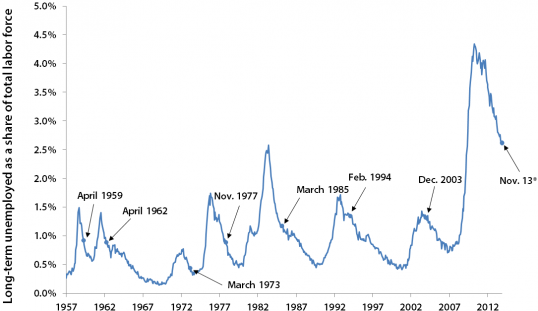
After this, a substantial program of public investment would be most welcome, boosting job-growth and economic activity in the short-run and boosting productivity in the longer-run. The talking point mobilized in favor of infrastructure investment—that it once was a bi-partisan priority—has the rare virtue of being true even today, so long as one listens to policy analysts and not politicians. For example, Martin Feldstein, Chair of the Council of Economic Advisors under Ronald Reagan, has endorsed a deficit-financed increase in infrastructure investment (granted, he endorses plenty of other things in that column that I’m not on board with, but the point remains). And Ken Rogoff, an economic adviser to John McCain in 2008, has also noted that infrastructure investment would be hugely beneficial in the current economic climate.1
Are House Republicans Sore Winners?
Treasury Secretary Jack Lew sent a letter to Congress yesterday warning that the federal government probably will breach the statutory debt limit in late February. To remind those who may have forgotten, there is no credible evidence that the U.S. economy is running up against any genuine economic constraint on debt. Interest rates remain historically low and federal budget deficits are actually closing historically rapidly. Yet because the United States (almost alone among advanced countries) has an arbitrary limit on the amount of outstanding federal debt that must be periodically renewed through legislative action, approaching the statutory debt limit provides members of Congress the chance to flirt with severe economic damage simply by refusing to raise the limit.
The House GOP leadership claimed that they did not want to get “even close” to a default. However, a spokesperson for House Speaker Boehner said a clean bill to raise the debt limit would not pass the House without some concessions to Republicans in order for them to “save face.” These concessions presumably would be more spending cuts. Given what should be considered a GOP “win” in the recent Murray-Ryan budget deal, one wonders what more do they want? It is worth taking a closer look at the GOP win in the budget deal and compare it to what might have been.
The chart below displays nondefense discretionary budget authority from fiscal year 2006 to fiscal year 2021 (when funds are appropriated by Congress, agencies are given budget authority to incur financial obligations—i.e., spend money). Nondefense discretionary spending includes spending for public investments such as roads, bridges, sewage systems, basic scientific research, and education—all the things that boost long-term economic growth. The Budget Control Act (BCA), the law that gave us the sequester, along with other steep cuts that have attracted less attention, specifies the limits on discretionary spending until 2021. It is specified in nominal dollar amounts, which rise over time. In inflation-adjusted terms, however, the spending is constant. But a better way to measure public spending is as a percentage of GDP—basically looking at public spending in relation to income available to pay for that spending.