Most Missing Workers Are Nowhere Near Retirement Age
In today’s weak labor market, there are around 6.0 million “missing workers”—potential workers who, because of weak job opportunities in the aftermath of the Great Recession, are neither employed nor actively seeking work. Some have suggested that many of these missing workers may be at or near retirement age and, in the face of weak job opportunities, have simply decided to retire earlier than they otherwise would have. While this would clearly indicate a huge waste of human potential and a serious indictment of macroeconomic policymakers that allowed economic weakness to linger on so long, it would also indicate that these workers are very unlikely to rejoin the labor force in coming years no matter how dramatically economic conditions improve. This would in turn mean that their absence is not in fact an indicator of current slack in the labor market.
The figure below provides an age breakdown of the missing workforce. It shows that nearly three-quarters of missing workers are age 54 or younger, which means they are unlikely to be early retirees. Even if all of the missing workers age 55 and over will never reenter the labor force no matter how strong job opportunities get, that still leaves 4.4 million missing workers age 54 or younger who would be likely to re-enter the labor force when job opportunities strengthen. In other words, weak labor force participation rate remains a key component of total slack in the labor market.
Women Surpassed Their Pre-recession Employment Peak 9 Months Ago, Men Still Haven’t
With the addition of 217,000 jobs in May, the U.S. labor market has now surpassed its pre-recession employment peak, a benchmark (the pre-recession employment peak) which is of zero economic interest. Given the growth in the potential labor force since December 2007, we should have added 7.0 million jobs since then, but instead we have added a net 113,000, so the labor market is still 6.9 million in the hole.
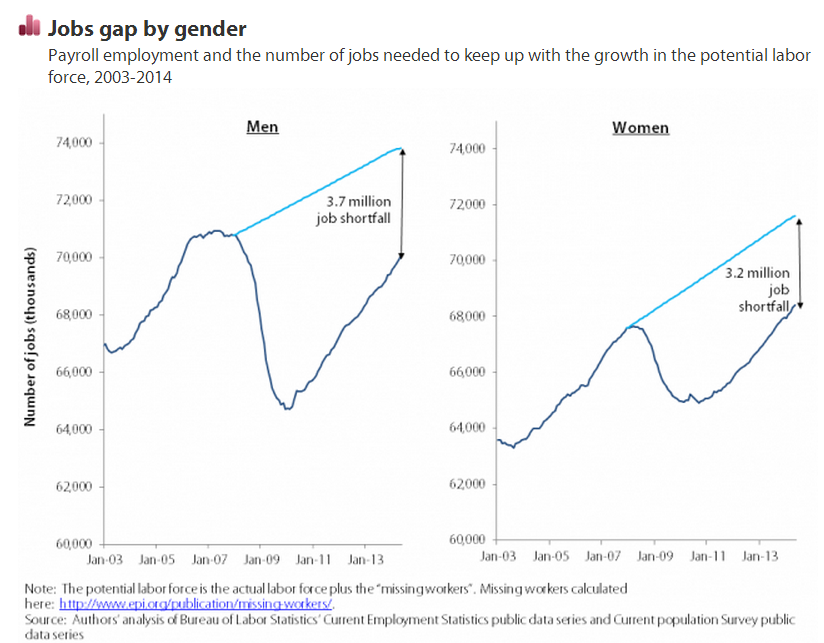
One interesting piece is the breakdown of that jobs gap by gender. As you can see in the chart below, women actually surpassed their pre-recession peak last August, but are still 3.2 million jobs in the hole given growth in the potential female labor force since December 2007. Men, on the other hand, are still nearly 700,000 jobs below their pre-recession employment peak, and given growth in the potential male labor force, are 3.7 million jobs down.
Statistics that Spin: Foreign Goods to Be Considered U.S. Goods?
This past year, President Obama’s commitment to rebuilding our nation’s manufacturing sector has taken center stage. In February, he explained why producing goods here at home is important to our country:
“For generations of Americans, manufacturing was the ticket to a good middle-class life. We made stuff. And the stuff we made—like steel and cars and planes—made us the economic leader of the world. And the work was hard, but the jobs were good. And if you got on an assembly plant in Detroit or in a steel plant in Youngstown, you could buy a home. You could raise kids. You could send them to college. You could retire with some security. And those jobs didn’t just tell us how much we were worth, they told us how we were contributing to the society and how we were helping to build America, and gave people a sense of dignity and purpose. They saw a Boeing plane or one of the Big Three cars rolling off the assembly line, and they said, you know what, I made that. And they were iconic. And people understood that’s what it meant for something to be made in America.”
The president has continually called for curtailing corporate incentives to outsource manufacturing to other countries, saying “it is time to stop rewarding businesses that ship jobs overseas, and start rewarding companies that create jobs right here in America.” A White House fact sheet summarizes his plans for restoring U.S. manufacturing jobs.
Apparently, some folks in the administration haven’t gotten the message. On May 22, the Office of Management and Budget issued a notice for comments on a proposal to dramatically alter the way government keeps statistics on domestic industries. The proposal suggests “that factoryless goods producers (FGPs) be classified” as manufacturers.
What to Watch on Jobs Day: An All-time High of an Indicator That is Almost Always Rising
It is very likely that when the jobs numbers are released tomorrow morning, we will learn that the total number of jobs in the U.S. labor market surpassed its pre-recession peak. I predict you will see many headlines along the lines of “U.S. Employment at All-Time High.”
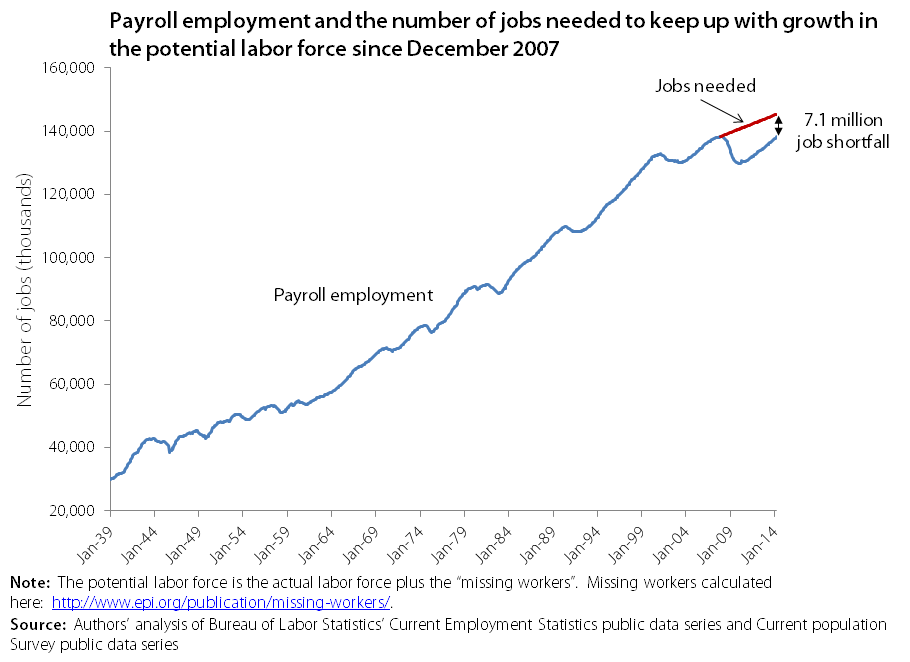
It is difficult to exaggerate how not a big deal this is. Total employment is almost always rising, as the figure below shows. An all-time high of something that is almost always rising is just not that interesting.
Furthermore, it is an utterly meaningless benchmark economically. Because the working-age population (and with it, the potential labor force) is growing all the time, we should have added millions of jobs over the last six-plus years just to hold steady. That means that when we get back to the prerecession employment level, there will still be a huge gap in the labor market. We currently have a gap in the labor market of 7.1 million jobs. When the numbers are released on Friday, that gap will likely drop to 7.0 million. We are far, far from healthy labor market conditions.
How Much Should You Be Making?
In honor of EPI’s new initiative, Raising America’s Pay, we updated our wage calculator, which shows how much you would be making if wages had kept pace with productivity. Having wages for the vast majority of American workers keep pace with productivity is a key indicator of an economy that is working for all.
Economic inequality is a real and growing problem in America, but the discussion around addressing inequality too frequently sidesteps a crucial component: the key to shared prosperity is to foster wage growth for the vast majority of Americans who rely on their paychecks to make ends meet. In fact, raising the pay for most Americans is the central economic challenge of our time—essential to ameliorating income inequality, boosting living standards for the broad middle-class, reducing poverty, and sustaining economic growth.
Crucially, the large and growing wedge between productivity and typical workers’ pay is not inevitable. For example, in the three decades following World War II, wages did rise with productivity and living standards improved throughout the income distribution. Since then, however, the rewards to a growing economy over the last three-and-a-half decades have primarily accrued to those at the top (except for the period of tight labor markets in the late 1990s). Since 1979, the workforce is more educated, is working more, and produces more goods and services in every hour worked. And yet the vast majority of workers are not reaping the rewards of their increased productivity.
Identifying the Channels Through which Regulatory Changes Affect Jobs
The Environmental Protection Agency is scheduled to release new regulations restricting the emissions of greenhouse gases (GHGs) from existing electrical generating units (EGUs, or power plants) next week. These new regulations will almost surely inspire a lot of debate over their effect on economic growth, and particularly on employment.
It is important to note first that the overall desirability of these proposed changes is dominated by their impact in forestalling global climate change. In strict economic terms, this consideration dwarfs any plausible estimate of the rule’s impact on jobs. Yet joblessness and weak labor markets continue to loom large as chief concerns of Americans (as well they should), and debate on these grounds will surely continue. Given this, even though the employment impacts of the rule are small relative to the environmental impacts, they still should be examined correctly.
Employment channels: Net versus gross and short versus long-runs
This blog post details the various channels through which environmental regulations have the potential to affect employment levels in the U.S. economy. To begin with, the effect of regulations on the net level of overall employment in the U.S. economy is the result of the sum of larger gross employment gains and losses across industrial sectors. So, for example, even if analysis finds that the new regulations will result in small net employment gains nationwide, this does not mean that no jobs in the U.S. economy will be lost due to the rules. Instead, it simply means that the total sum of employment gains and losses across all sectors is positive.
Not a Chimera: Global Economic Trends Tend to Have Global Economic Causes
The Brookings Institution’s Mark Muro and Scott Andes recently published two blog posts which claim that the problems of U.S. manufacturing demand being depressed by large trade deficits—particularly trade deficits with China—are “a manufactured chimera,” and that the problems facing U.S. manufacturing are actually just evidence of insufficient domestic innovation. By deflecting attention from China’s manufacturing surplus, and the trade and currency policies China has used to dominate the market for manufacturing exports, Muro and Andes are distracting, not educating, those genuinely concerned with giving U.S. manufacturing a chance to compete in global markets. Claiming that it’s the domestic pace of innovation that is somehow the real cause of trouble is oddly provincial, and ignores some key global facts—like the fact that China has doubled down on its currency manipulation policies in the past year, and that its manufacturing trade surplus is projected to grow in the future unless something is done about it.
The most fundamental problem facing U.S. manufacturing is a shortage of demand for U.S. manufactured products. Four years after the end of the Great Recession, real U.S. manufacturing output was 2.2 percent below its pre-recession level. Demand for U.S. manufactured products was much higher at this point in earlier business cycles: 11.1% higher in 2005 (after the end of the dot-com bubble), and 23.9 percent higher in 1995, four years after the 1990-1991 recession. In other words, our manufacturing problem today is, first and foremost, a macroeconomic problem. Without adequate demand, manufacturers will not invest in R&D, build new plants, or hire new workers. Demand for output from U.S. manufacturing can either come from domestic sources—American consumers, businesses and governments—or from foreign sources. Net foreign demand for U.S. manufacturing output is best measured simply as net exports (exports minus imports) of manufactured goods.
The Federal Reserve, Full Employment, and Financial Stability
The Federal Reserve, even after recent announced nominees take their jobs, will have two vacant slots on the seven-member Board of Governors. For a number of reasons, it even more vital than ever that these next two nominees be committed to using all the tools at their disposal (including the new ones provided by Dodd-Frank) to (1) generate genuine full employment in the American labor market and (2) rein in financial sector excesses that threaten economic growth and stability.
Targeting full-employment
Since roughly the end of 2008, a large majority of monetary policy observers have agreed that the Fed should focus entirely on boosting economic activity and employment, and not worry at all about inflationary pressures.
This is not the normal state of the world. Normally, it’s thought that the Fed must walk a narrow path between providing support to economic activity and employment, but not generating such an excess of aggregate demand that the economy overheats and unleashes inflation. But the extreme economic weakness of the Great Recession crushed inflationary pressures and led to a cratering of economic activity and employment. Hence, it was correctly recognized that this delicate balancing act wasn’t necessary and that attention should instead be laser-focused simply on jumpstarting economic growth.
Now, this large majority for aggressive action in boosting growth and employment looks to be fracturing, and worries about inflation and recommendations that the Fed stop its single-minded focus on generating a full recovery are surfacing.
These are odd arguments to be making with the unemployment rate still matching the highest peak it ever reached in the 2001-03 recession and ensuing jobless recovery, especially considering that the headline unemployment rate has been driven down largely by the 6 million potential workers who are not actively searching for work but who would very likely join the labor force should job opportunities become less scarce. In essence, the arguments for a Fed “exit” from extraordinary efforts to boost recovery hinge on claims that very low rates of employment and very high rates of unused productive capacity relative to historic norms are not actually signs that the economy is operating below potential, because the resources idled by the Great Recession cannot be re-mobilized and should be just be considered gone forever from productive life. Importantly, however, this pessimistic argument has not been bolstered by any evidence showing that wages and prices are rising atypically fast. Indeed, the key measure of inflation tracked by the Fed has actually been pretty steadily decelerating in recent years—which is normally a sure sign that there is indeed lots of productive slack in the economy.
Don’t Pull the Rug Out from Under PSLF Recipients
Earlier this month, EPI released its annual “Class of 2014” paper, which examines labor market trends for recent high school and college graduates. Among other trends, authors Heidi Shierholz, Alyssa Davis and Will Kimball highlight the problems recent graduates face when they graduate with high levels of student debt. Student debt continues to be one of the biggest reasons young people postpone major purchases like cars and houses, and repayment can be difficult if students can’t secure their first job after graduation. Congress’s past failures to keep interest rates on student debt low, let alone provide a comprehensive refinancing plan (although that could change with Senator Warren’s new bill), should be cause for concern for recent college graduates.
President Obama’s 2015 budget proposal, released in March, makes college affordability a priority by broadening the scope of the Pay as You Earn (PAYE) repayment program to all student borrowers. Currently, for qualifying students, PAYE allows high-debt, low-income students to pay a lower monthly payment (10 percent of their income) than the standard 10-year repayment plan requires, and provides total loan forgiveness to graduates after 20 years of qualifying repayments. The administration proposed expanding the program to all students beginning July 2015 and making it the only income based repayment option, providing access to affordable repayment options for all student s and simplifying the repayment experience.
While additional reforms proposed to PAYE (page 13 here) seem common sense (eliminating caps for high-income borrowers and calculating payments for married couples using combined household adjusted gross income instead of calculating payments separately), part of the budgetary cost of this expansion is recouped by capping loan forgiveness on a subset of the PAYE repayment program, graduates enrolled in the Federal Public Service Loan Forgiveness program (PSLF).
Stronger Overtime Rules and Job Creation
If I told you that the legislature of State X is going to make it easier for workers in the state, including public employees, to earn overtime pay, you might wonder what effect that would have on employment in the state. What if the cost to employers from having to pay more workers time and a half for overtime is so high that it causes businesses to move to a neighboring state that has a weaker requirement? Or what if it raises costs and employers respond by laying off employees?
Those fears are being raised by groups like the National Retail Federation, the Heritage Foundation, and the CATO Institute, all of which oppose President Obama’s plan to revise the Fair Labor Standards Act regulations that govern the right to overtime pay. The president wants to make it easier for relatively low-paid employees to earn overtime pay when they work more than forty hours in a week, but the conservative business lobbyists are already yelling about job loss—with no real explanation or evidence that job loss is a realistic outcome.
Fortunately, California provides a kind of natural experiment about what happens when more workers have a right to overtime pay, and the results are reassuring. Regardless of their job duties, California law guarantees overtime pay to employees earning less than $640 per week, while its neighboring states—Arizona, Nevada, and Oregon—only guarantee overtime pay to workers paid less than $455 per week, less than a poverty level wage for a family of four. Other rules in California make it harder for employers to deny overtime pay to even better paid workers whose jobs include duties that could be considered managerial or professional. In California, but not in its neighboring states, an employee has to spend a majority of his time doing managerial or professional work in order to be excluded from the right to receive overtime pay.