Despite seemingly stable U.S. trade balance, rapidly growing trade deficits in non-oil goods could lead to American job losses
The U.S. Census Bureau reported that the annual U.S. trade deficit in goods and services increased from $508.3 billion to $531.5 billion from 2014 to 2015, an increase of $23.2 billion (4.6 percent). The slow growth of the overall U.S. trade deficit hides massive underlying shifts in the trade deficit in petroleum products (which declined $157.3 billion, or 55.3 percent), compared with the trade deficit in all other goods, which increased from $547.7 billion to $673.1 billion—an increase of $125.4 billion, or 22.9 percent. In other words, the sharp decline in the petroleum trade deficit masked a large increase in the non-oil goods trade deficit, which could result in substantial U.S. job losses in the future.
Most U.S. goods trade consists of manufactured products. In 2015, manufacturing constituted 86.9 percent of total U.S. goods trade, and 94.3 percent of total trade in non-oil goods. Because manufacturing is such a large employer, rapidly growing trade deficits in non-oil goods are a threat to future employment in this sector. The growing trade deficit in manufactured products rose to 3.8 percent of GDP, only 0.7 percent (7 tenths) of a percentage point below the maximum reached in 2005. The manufacturing trade deficit also reached a record high of $681 billion in 2015, well in excess of the previous peak $619.7 in 2007. Rapidly growing manufacturing trade deficits were responsible for most, if not all, of the 4.8 million U.S. manufacturing jobs lost between December 2000 and December 2015, and there’s every reason to believe that these job losses will continue if the non-oil trade deficits keeps growing.
This analysis is primarily concerned with shifts in goods trade. The U.S. balance of trade in services declined slightly in 2015, falling from a trade surplus of $233.1 billion in 2014 to $227.4 billion in 2015. Trade in goods continues to dominate overall trade flows for the United States—trade in services totaled only 24.1 percent of total U.S. goods and services trade in 2015.
Should we care about slow nominal wage growth when price inflation is slow? YES.
Nominal wages for American workers rose by 2.6 percent in the 12 months ending in December 2015. Over the same time, prices have risen just under 0.7 percent (held down mostly by falling oil prices). This mean that real (that is, inflation-adjusted) wages have grown 1.9 percent in that year. In historical perspective, this is a very healthy rate of real wage growth (for example, real hourly wages for the bottom 70 percent of workers have averaged well under 0.5 percent annually since 1979).
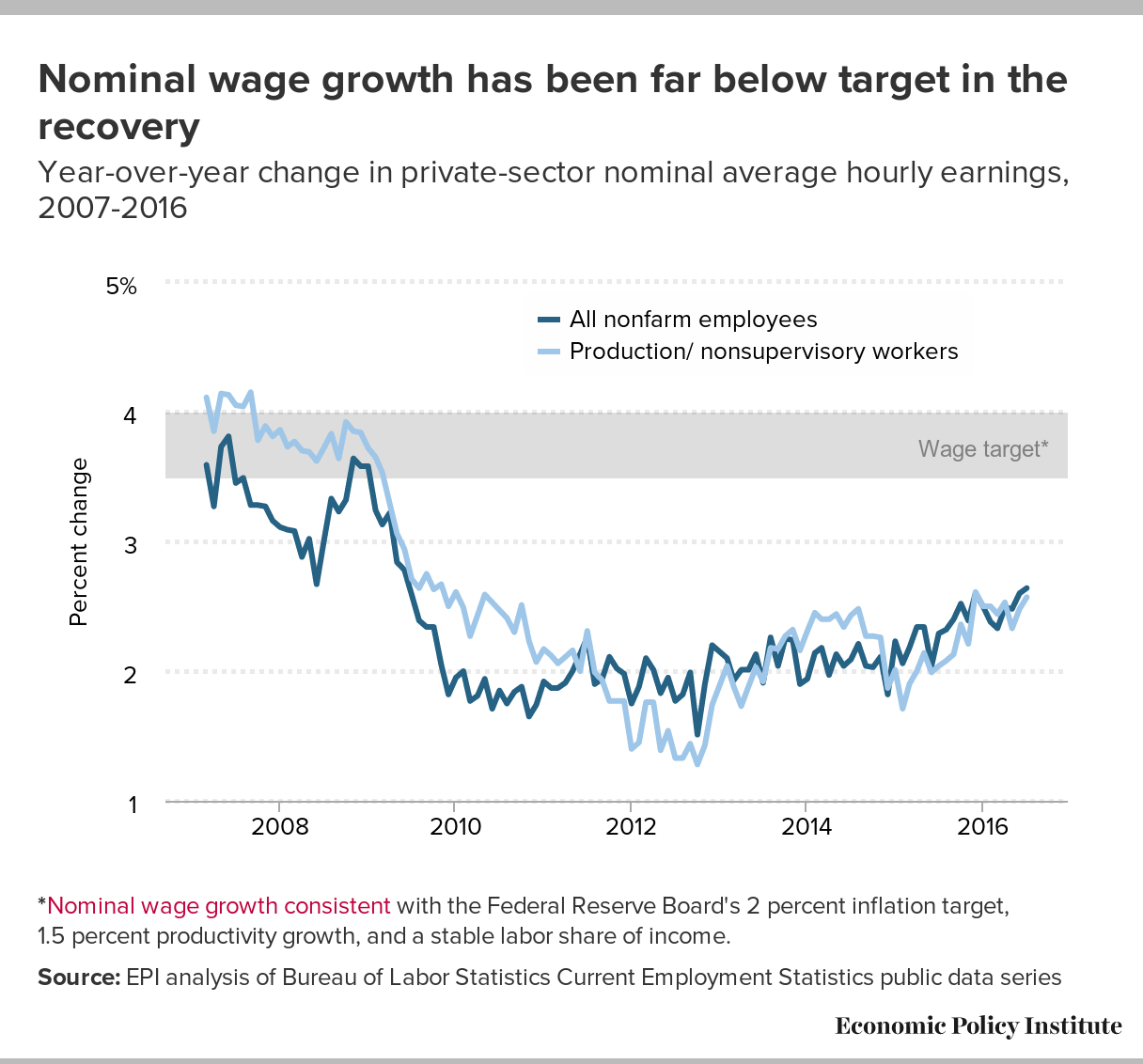
Since it is this real, not nominal, wage growth that influences living standards, shouldn’t we be perfectly happy with this constellation of wage and price inflation? Not really, for a number a reasons.
For one, the extraordinarily low rates of price inflation won’t continue. They’ve been driven by large declines in commodity prices. The gains to real living standards are genuine—cheap gas really does make paychecks stretch further (though how good cheap gas is in the long run for climate change is a whole other story), but we know that commodity prices are volatile and are likely to stabilize or even rise in the next year. If either of these things happens, the overall rate of inflation in the next year will rise.
Further, even if commodity prices remained depressed forever and overall price inflation really did permanently shift to a slower pace, it is far from clear that this would be a good outcome or that the real wage growth seen in the past year would continue.
What to Watch on Jobs Day: Will we finally reach full employment in 2016?
We’ve seen solid growth in employment over the past couple of years, and the unemployment rate has come down dramatically, but by any reasonable definition we are still not that close to genuine full employment. So, what is full employment? In a great book (pdf), Jared Bernstein and Dean Baker define full employment as “the level of employment at which additional demand [injected into] the economy will not create more employment.” Full employment should show up in indicators on both the quantity and the price side (i.e., wages) of the labor market. Unemployment is low during periods of full employment, and due to high demand for labor, employed workers have more bargaining power—as a result they will be better able to negotiate higher wages and get the hours they want.
Let’s look at some measures of employment on the quantity side. A good measure of slack in employment and hours is the BLS’s U6 measure of labor underutilization. It measures total unemployed, plus all persons marginally attached to the labor force, plus total employed part time for economic reasons, as a percent of the civilian labor force. Basically, people who want to work, plus employed people who want to work more hours, plus people who have looked for work in the last year but stopped looking for some reason in the last four weeks and are hence not classified as currently “in the labor force.”
The figure below shows these data by race, which demonstrates that, as with the unemployment rate, the underemployment rate is much higher for people of color. While the U6 has come down substantially but it is still elevated and has a ways to go before it gets to pre-recession levels. (And these pre-recession levels are elevated relative to the last time we had unambiguous full employment in the late 1990s and 2000.)
NPR report reveals the real reason why agricultural employers prefer guestworkers
A recent story from NPR’s Dan Charles titled “Guest Workers, Legal Yet Not Quite Free, Pick Florida’s Oranges,” provides a crucial glimpse into what it’s like being a guestworker in the United States. As the title suggests, it’s not pretty. The headline is probably using the word “free” as a double entendre: guestworkers are not free in the sense of the free market, nor in the sense of someone who has personal freedom and agency; i.e., is not a slave.
Guestworkers are foreign workers who are temporarily authorized to work in the United States with nonimmigrant visas. EPI and civil rights groups, farmworker advocates, and numerous media reports have highlighted how employers often prefer to employ guestworkers instead of Americans because they can be paid less and are indentured to their employers. Often, employers claim that guestworkers are doing “dirty jobs,” which Americans find so unappealing that they just flat out won’t do them. There’s plenty of evidence out there to suggest that the real reasons are much different. For instance, two recent investigative reports from Buzzfeed paint a bleak picture of the H-2A and H-2B programs (two guestworker programs that allow employers to hire temporary foreign workers for agricultural and non-agricultural jobs, respectively), documenting the ways in which these workers are indentured servants with few rights or labor protections. This happens because 1) guestworkers often arrive heavily in debt to labor recruiters who connect them to their temporary jobs, and 2) their employer controls the visa status, which means that 3) guestworkers do not have the legal right to switch employers if they don’t get paid an appropriate fair wage or if their boss breaks the law or exploits them in some other way. Ultimately, the result for guestworkers is a reasonable fear that if they complain about low pay or unsafe work conditions, they’ll get fired, which renders them deportable and means they won’t have a chance to earn back the thousands of dollars they had to borrow to pay the recruiter.
The labor rights of four million migrants hang in the balance at the Supreme Court
The Supreme Court deserves praise for agreeing to review United States v. Texas, a case that will determine the fate of the most significant of the executive immigration actions announced by the president on November 20, 2014. The Court will review a lower court’s decision that temporarily blocked President Obama’s Department of Homeland Security (DHS) guidance directive that “establish[es] a process for considering deferred action for certain aliens who have lived in the United States for five years and either came here as children or already have children who are U.S. citizens or permanent residents” (hereinafter referred to simply as “Guidance”). The Supreme Court will decide whether the president overstepped the bounds of his legal authority when DHS issued this Guidance.
More specifically, the Guidance in question would defer the deportation of unauthorized immigrants who are the parents of children who are either U.S. citizens or legal permanent residents, have resided in the United States for at least five years, and are not a DHS enforcement priority for deportation. This is known as the “DAPA” initiative, Deferred Action for the Parents of Americans and Legal Permanent Residents. The Guidance would also update and expand “DACA,” the Deferred Action for Childhood Arrivals initiative (in place since 2012), which to date has provided deferred action to over 660,000 persons who entered the country as young people without authorization. Combined, over five million persons could be eligible for DAPA, DACA, and expanded DACA (sometimes referred to as DACA+), out of a total unauthorized immigrant population of 11 million.
The Obama administration pushes for a better response to unemployment
President Obama has announced a package of reforms to repair some of the damage done in recent years to the unemployment insurance system and to provide more help to workers at risk of losing jobs—incentives for employers to retain workers, more income support for job losers, and more help getting retrained and back to work. Reforms are needed, and most of the president’s proposals are obviously helpful.
Background
When the economy crashed in 2007 the federal-state system of unemployment insurance (UI) was far from ready. States had had five years since the previous recession to replenish their UI trust funds, improve coverage (with the help of generous federal grants provided during the Bush administration) and plan for the next downturn. Yet when the crash came and the unemployment rate rose to 10 percent, UI trust funds had not been refilled. Many states had unwisely cut taxes rather than accumulate surpluses that could be drawn down in a recession. By 2007, only 17 states were minimally solvent. Some states—but not many—had extended coverage to workers with unstable employment histories, seasonal workers, and poorly paid individuals who previously would not have qualified for benefits. If you had to give the states a grade on preparedness, a D+ would be generous.
The result was a disaster. Thirty-six states ran out of money and had to borrow in order to pay benefits, with the loans peaking at $47 billion in 2010. Most of the state UI trust funds are still in bad shape, and—according to the White House—only 20 states have sufficient reserves to weather a single year of recession. As of January 13, 2016, California still owes $6.5 billion to the Federal Unemployment Account, Ohio owes $773 million, and Connecticut owes $100 million.
The Lilly Ledbetter Act is part of a more ambitious women’s economic agenda
This Friday is the anniversary of the Lilly Ledbetter Fair Pay Act of 2009, a reminder that a significant pay gap still exists between men and women in the United States. At the median, hourly pay for women is only 82.9 percent of men’s median wage ($15.21 versus $18.35). While over the last several decades women have made gains in terms of education attainment and labor force participation, compared to men, they are still paid less, are more likely to hold low wage jobs, and are more likely to live in poverty. This economic gap exists to a greater degree for women of color and remains persistent across women of varying education levels and working in different occupations.
But the gender wage gap is only one way the economy shortchanges women. At the same time the gender wage gap has persisted, hourly wages for the vast majority of workers have stagnated, as the fruits of increased productivity and a growing economy have accrued to those at the top. It hasn’t always been this way: pay rose with productivity in the three decades following World War II. But since the 1970s, pay and productivity have grown further apart, as the result of intentional policy decisions that eroded the leverage of the vast majority of workers to secure higher wages.
A progressive women’s economic agenda, one that seeks to truly maximize women’s economic potential, must focus on both closing the gender wage gap and raising wages more generally.
14 states raised their minimum wage at the beginning of 2016, lifting the wages of more than 4.6 million working people
At the beginning of the year, 14 states raised their minimum wages, lifting wages for over 4.6 million workers in states across the country. Unlike last year’s increases, the majority of these increases (12) were scheduled increases initiated by legislation or approved by voters through ballot measures. The other two (Colorado and South Dakota) were changed as a result of inflation indexing—a process adopted by 15 states by which the minimum wage is automatically adjusted each year to match increases in prices.
Table 1 below shows the magnitude of the minimum wage increase in each state, ranging from an increase of 5 cents in South Dakota to 1 dollar in four states (Alaska, California, Massachusetts, and Nebraska). Because inflation was very low in 2015, nine of the 11 states with inflation indexing set to go into effect at the beginning of the year did not adjust their minimum wages in 2016. Colorado and South Dakota were the only exceptions, yet their increases were small, and thus the increases affected relatively small shares of each state’s workforce: 2.1 percent and 3.4 percent, respectively. Minimum wage increases affected a much larger portion of the workforce in states that initiated larger increases through legislation. For example, California’s $1.00 minimum wage increase lifted wages for 18.6 percent of the state workforce.
All together, these increases will provide 4.6 million workers over $3.5 billion in higher annual wages. This additional pay, though modest, represents a significant boost to the spending power of low-wage workers and their families. For example, a worker in Nebraska who was previously earning the state minimum wage of $8.00 an hour in 2015 will see their hourly pay increase by 12.5 percent.
States with minimum wage increases effective January 1, 2016
| States with minimum wage increase | Amount of wage increase | New wage on Jan. 1, 2016 | Reason for change | Directly affected workers1 | Indirectly affected workers2 | Total affected workers | Share of state’s wage-earning workforce | Total wage increases for affected workers3 |
|---|---|---|---|---|---|---|---|---|
| Alaska | $1.00 | $9.75 | Legislation | 15,000 | 18,000 | 33,000 | 10.7% | $23,476,000 |
| Arkansas | $0.50 | $8.00 | Legislation | 45,000 | 45,000 | 90,000 | 7.8% | $38,036,000 |
| California | $1.00 | $10.00 | Legislation | 1,748,000 | 1,172,000 | 2,920,000 | 18.6% | $2,703,126,000 |
| Colorado | $0.08 | $8.31 | Inflation adjustment | 44,000 | 6,000 | 50,000 | 2.1% | $14,429,000 |
| Connecticut | $0.45 | $9.60 | Legislation | 79,000 | 27,000 | 106,000 | 6.7% | $57,813,000 |
| Hawaii | $0.75 | $8.50 | Legislation | 23,000 | 27,000 | 50,000 | 8.6% | $23,576,000 |
| Massachusetts | $1.00 | $10.00 | Legislation | 181,000 | 175,000 | 356,000 | 11.4% | $266,335,000 |
| Michigan | $0.35 | $8.50 | Legislation | 184,000 | 98,000 | 283,000 | 6.9% | $77,857,000 |
| Nebraska | $1.00 | $9.00 | Legislation | 58,000 | 42,000 | 101,000 | 11.5% | $67,741,000 |
| New York4 | $0.25 | $9.00 | Legislation | 273,000 | 213,000 | 486,000 | 5.9% | $143,521,000 |
| Rhode Island | $0.60 | $9.60 | Legislation | 37,000 | 27,000 | 64,000 | 13.5% | $32,186,000 |
| South Dakota | $0.05 | $8.55 | Inflation adjustment | 8,000 | 5,000 | 13,000 | 3.4% | $3,108,000 |
| Vermont | $0.45 | $9.60 | Legislation | 15,000 | 3,000 | 18,000 | 6.3% | $8,768,000 |
| West Virginia4 | $0.75 | $8.75 | Legislation | 49,000 | 26,000 | 75,000 | 11.5% | $46,700,000 |
| Total | 2,760,000 | 1,886,000 | 4,646,000 | $3,506,675,000 |

1. Directly affected workers will see their wages rise as the new minimum wage rate will exceed their current hourly pay.
2. Indirectly affected workers have a wage rate just above the new minimum wage (between the new minimum wage and the new minimum wage plus the dollar amount of the increase in the previous year's minimum wage). They will receive a raise as employer pay scales are adjusted upward to reflect the new minimum wage.
3. Total annual amount of increased wages for directly and indirectly affected workers.
4. Changes went into effect 12/31/2015.
Note: Totals may not sum due to rounding. "Legislation" indicates that the new rate was determined by legislature or ballot vote. "Inflation adjustment" indicates that the new rate was based on some measure of inflation.
Source: EPI analysis of Current Population Survey Outgoing Rotation Group microdata 2014Q4-2015Q3
The lead crisis in Flint will affect the city for years to come
By now, the story of what’s happening in Flint is well known. The city has been struggling since the decline of its automobile industry. Its financial troubles were severe enough that the city went into state receivership and an emergency manager was appointed by the state of Michigan to fix the budget. One way to lighten Flint’s financial woes was to cease piping water all the way from Detroit and instead source water locally. A water treatment facility that would be used to get water from Lake Huron would not be ready for a couple of years, so as a stopgap measure, the city began piping water from the polluted Flint River. Residents started complaining about the water almost immediately. City authorities waffled—issuing boil orders, telling residents to run their taps for five minutes before using the water, and adding large amounts of chlorine (creating another problem), before finally admitting that the water was undrinkable.
Since the switch to Flint River water, the number of children in Flint with blood lead levels over 5 micrograms per deciliter has doubled. In some Flint zip codes, the numbers are even higher. And those are only the children we know about. The number of children who are lead poisoned is likely much higher.
Children who have been exposed to lead suffer irreversible learning deficiencies and behavioral problems and the effects of early exposure persist throughout life. Even very low levels of lead contribute to cognitive impairment, including reductions in IQ, verbal, and reading ability, with no identifiable safe bottom threshold. Lead exposure also affects young children’s behavior, leading to a greater propensity to engage in risky behavior and violent or criminal activity later in life.
An annotated reading of Obama’s flawed framing of wage and income problems in the SOTU
Having closely followed all of President Obama’s speeches on income inequality, I’ve noticed a significant move forward, from an abstract discussion to one that focused on the key underlying issue—the need to generate robust, widespread wage growth. Unfortunately, this week’s State of the Union (SOTU) address was a huge step backward in how the president framed and discussed the issue. His policy agenda, which I view very favorably, has not shifted. President Obama actually has a wage growth agenda—he just does not highlight its elements as part of a coherent package. That’s unfortunate.
The president’s SOTU framed income inequality and the “strain” on working families as the result of ongoing technological disruption, a force widely considered to be something we cannot nor should not do something about. This is extremely disappointing, incorrect as a factual matter, and misdirects our policy focus and mis-educates the public. It is especially disappointing since the views of center-left economists have been converging on a recognition that technological change has not been a leading factor in our wage problems or inequality in the 2000s (see Mike Konzcal). One need only note the statements made by President Obama’s leading economic advisor in the first term, Larry Summers, last March at a Hamilton Project event on the role of robots:
“And I am concerned that if we allow the idea to take hold that all we need to do is there are all these jobs with skills and if we just can train people a bit then they will be able to get into them and the whole problem will go away. I think that is fundamentally an evasion of a profound social challenge… I think that the broad empowerment of labor in a world where an increasing part of the economy is generating income that has a kind of rent aspect to it, and the question of who is going to share in it becomes very large.”
In plainer terms, Summers is saying that economy’s winners at the top of the income scale have gotten more than their share gaining ‘rents’ (meaning they don’t reflect efficiency gains), and that giving working people the power to act collectively will be key to any rebalancing between the elites and the middle and working classes. He’s saying that any talk about “skill deficits” as the cause of wage problems—that is what the technology story is all about— is misguided, and evades the essential questions of power in the marketplace that drive inequality and wage stagnation.