Ignoring the role of profits makes inflation analyses a lot weaker
Washington Post columnist Catherine Rampell wrote last week that those pointing to the role of fatter profit margins in driving price inflation are engaged in “conspiracy theories,” and argued that the conspiracy theorists are distracting attention from things that could really lead to lower inflation: faster immigration and removing import tariffs. It’s a pretty unconvincing column all around.
First, the alleged inflation cures that attention is being pulled away from are really weak tea. The case for faster immigration helping to quell inflation runs through its effect on labor markets. If faster immigration increases labor supply this could in theory dampen wage growth. But wage growth has not been the source of the current inflation. And recent readings on wage growth have it roughly consistent with relatively normal rates of inflation. Putting further downward pressure on wage growth that is already lagging far behind inflation would just increase the burden of adjustment to more normal inflation that will be borne by workers.
No more union-busting. It’s time for companies to give their workers what they deserve
This is an excerpt from an op-ed in CNN Business. Read the full op-ed here.
This year, workers at Amazon, Starbucks and other major corporations are winning a wave of union elections, often in the face of long odds and employer resistance. These wins are showing it’s possible for determined groups of workers to break through powerful employers’ use of union-busting tactics, ranging from alleged retaliatory firings to alleged surveillance and forced attendance at anti-union “captive audience meetings.” But workers should not have to confront so many obstacles to exercising a guaranteed legal right to unionize and bargain for improvements in their work lives and livelihoods.
There are good reasons to believe workers’ organizing momentum will continue (union election filings are already up 57% during the first six months of this fiscal year). Frontline workers are asserting their worth after more than two years of risking their health during an ongoing pandemic while watching corporate profits and CEO pay continue to soar.
The U.S. tax code functionally rewards corporations who use anti-union consultants: Congress must take action
The U.S. tax system is deeply flawed. While millions of working-class Americans pay their fair share, corporations are dodging more and more of their tax responsibilities. Despite record profits, corporate taxes are way down, as corporations exploit loopholes that allow for offshore profit-shifting and various tax breaks and deductions. Specifically, the 2017 Tax Cuts and Jobs Act (TCJA) decreased the statutory corporate income tax rate from 35% to 21% and simultaneously introduced new tax loopholes. Consequently, the TCJA has slashed the effective tax rate for corporations almost in half, further damaging the progressivity of the overall federal tax system. In turn, this erosion of corporate liability and the proliferation of tax avoidance have exacerbated inequality, with the working class facing starved social services, reduced household incomes, and lower standards of living.
One proven tool to combat this rise in inequality is unions. By bringing workers’ collective power to the bargaining table, unions are able to win better wages and benefits for working people—reducing income inequality as a result. Yet data show that U.S. employers are willing to use a wide range of legal and illegal tactics to frustrate the rights of workers to form unions and collectively bargain. And much like our overall tax system favors corporations over working people, the tax code functionally rewards corporations for anti-union activities that suppress worker power.
Wage growth has been dampening inflation all along—and has slowed even more recently
Yesterday’s inflation data for April 2022 was a mixed bag but had some encouraging seeds in it. Measured year-over-year, overall and core inflation (inflation minus the influence of volatile food and energy prices) both ticked down slightly. Measured just over the past month, the overall index decelerated significantly, but the core index rose back up to the level it had plateaued at in the five months before March. This post is about why wage trends—both throughout the inflationary burst and in very recent months—should make us even a bit more encouraged that inflation can be brought back under control without the Federal Reserve having to move interest rates to a radically more contractionary stance.
There has been a lot of discussion—and confusion—recently about the role of tight labor markets (“the Great Resignation”) in the rise of inflation we’ve seen since early 2021. In this post, we make the following points about the wage/price relationship:
- To date, the rise of inflation has unambiguously not been driven by tight labor markets pushing up wages.
- Nominal wage growth has been fast over the past year relative to the past few decades, but it has lagged far behind inflation, meaning that labor costs are dampening—not amplifying—price pressures. Last week’s jobs report showed that average hourly earnings growth over the last quarter was 4.4% (at an annualized rate), with wage growth actually slowing in the last three months to under 4%.
- If the only change in the economy over the past year had been the acceleration of nominal wage growth relative to the recent past, then inflation would be roughly 2.5–4.5% today, instead of the 8.6% pace it ran through March. In short, nonwage factors are clearly the main drivers of inflation.
- Claims that the Federal Reserve needs to shift into a much more hawkish mode to keep wages from amplifying inflation and to bring inflation back down to more normal levels are often greatly overstated and understate how much damage this strategy could cause.
- As long as wage growth is dampening inflation (and it is), then the question of how hawkish the Fed must be is not a question of whether inflation will return to more normal levels, but just how quickly we want that happen.
- A much quicker return to more normal inflation would require sacrificing important gains that stem from low unemployment, even though a return to more normal inflation is quite likely to occur on its own. This makes the cost of a more hawkish stance (more joblessness) high and the benefits (a few months of slightly lower inflation as we get back to normal) pretty low.
Strong and equitable unemployment insurance systems require broadening the UI tax base
The COVID-19 pandemic showed how critical unemployment insurance (UI) is for sustaining workers and the economy during times of crisis, while also revealing deep fissures and inequities in UI systems. Federal programs that expanded UI eligibility, benefit levels, and benefit duration kept local economies afloat and became a lifeline for millions during the early stages of the pandemic, but the crush of UI claims at peak levels of unemployment also exposed the poor condition of state UI systems. From backlogs and delays caused by insufficient administrative capacity and outdated technology to inadequate benefit amounts, many state UI systems operate in a chronic state of underfunding that results in inequity and dysfunction.
One of the root causes of these problems is rarely discussed: Lawmakers have structured state UI financing in a way that permanently starves the UI system. UI is currently funded through a combination of federal and state taxes paid by employers, where state UI taxes pay for benefits during normal economic times. However, in most states, the amount of employee wages on which employers pay state UI taxes, i.e., the taxable wage base (TWB), is extremely low. At present, 14 states and Washington, D.C. have taxable wage bases below $10,000 and a remarkable 36 states have their bases set below $25,000. This means that in 71% of states, employers pay UI taxes at most on the first $25,000 of an employee’s annual earnings.
Job growth remains strong in April as wage growth cools
Below, EPI economists offer their initial insights on the jobs report released this morning, which showed 428,000 jobs added in April.
What to watch on jobs day: Wage growth continues to lag inflation
Tomorrow, the Bureau of Labor Statistics (BLS) will release the latest numbers on the state of the labor market. Given fiscal investments at the scale of the problem over the last two years and the resulting trends in payroll employment growth and labor force participation, the labor market is on track for a historically fast and full recovery by the end of 2022.
Even the reported contraction in gross domestic product (GDP) in the first quarter of 2022 won’t push this recovery off track. Most of the slowdown in GDP was due to weak exports (which reflect weakness in trading partner economies, not our own) and to a running down of business inventories, which had been built up at a furious pace in recent quarters. Looking at final sales (so stripping out the inventory effect) to domestic purchasers (so stripping out exports), growth was actually a bit faster in the first quarter of 2022 than it was at the end of 2021.
Moving forward to jobs day, it’s vital to keep tabs on job growth as well as participation to make sure the recovery keeps going strong and reaches all corners of the labor market. It’s also important to track the sectors with particularly large job deficits—like leisure and hospitality—but also state and local jobs, which have had a shallower fall and a slower recovery than the private sector.
Another important metric for a read on the health of the economy and what the Federal Reserve should be doing in the coming year is nominal wage growth. To date, the large increase in inflation since early 2021 has clearly not been driven by labor market trends. In fact, despite being high relative to the recent historical past, nominal wage growth today by every measure is lagging inflation, leading to real wage losses for workers. This is very different than the behavior of wages in previous periods when the unemployment rate was very low and the economy was heating up.
This lagging of nominal wage growth behind price growth has actually dampened inflation so far in this recovery. Tracking this growth going forward is key to deciding whether inflation will stay very high (or even accelerate) or will begin to relent.
Job Openings and Labor Turnover Survey: Job openings and quits edged up to series highs for March
Below, EPI senior economist Elise Gould offers her initial insights on today’s release of the Job Openings and Labor Turnover Survey (JOLTS) for March. Read the full Twitter thread here.
While there was “little changed” overall in the latest #JOLTS data released this morning from the Bureau of Labor Statistics, job openings and quits edged up to series highs for March. Hiring remains strong and hires still significantly outpace quits.https://t.co/djGEusO8gy
— Elise Gould (@eliselgould) May 3, 2022
Much has changed since the first May Day, but building worker power and combating racism and xenophobia remain just as important
May 1 is International Workers’ Day, a day workers around the world mark as Labor Day with marches, demonstrations, and renewed calls for workers’ rights. “May Day” got its start in 1886, when U.S. workers rallied in support of ongoing campaigns for an eight-hour day, setting May 1 as a deadline to begin mass strikes if employers failed to adopt shorter hours.
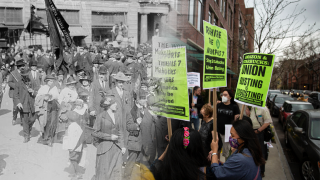
In 1886 Chicago, where tens of thousands joined May Day actions and thousands went on strike, subsequent police shootings of striking workers escalated into the well-known Haymarket Tragedy. Months of state-sanctioned, anti-immigrant repression of labor organizing followed. Police raids of union halls and arrests of organizers culminated in a sham trial, eight guilty verdicts, and public hanging of four prominent immigrant, working-class movement leaders (a fifth died by suicide prior to the execution date). The trial and executions were followed closely by workers across the country and around the world. In memory of the Haymarket Martyrs, labor and socialist organizations declared May Day International Workers’ Day, now an official public holiday in many countries.
Over 100 years later, our May Day 2022 economy has much in common with that of May Day 1886—rising inequality, economic upheavals affecting those with the least financial security, xenophobia, market concentration, and an upsurge in workers taking matters into their own hands while facing intense employer resistance. U.S. factory workers and railroad workers are still campaigning for shorter hours, in some cases striking (or threatening strikes) to challenge inhumane 12-to-14-hour shifts and unpredictable forced overtime. New generations of workers, including many immigrants, are breaking through barriers of employer union-busting to organize unions in warehouses, hospitals, nursing homes, coffee shops, retail stores, media outlets, universities, and beyond.
This Workers Memorial Day, honor lives lost by joining workers’ fight for a future that includes safe work
“Our health is just as essential,” read the homemade sign Chris Smalls carried in front of the Amazon JFK8 Staten Island warehouse on March 30, 2020, a moment when it had become clear that exposure to coronavirus could be deadly. After a week of appealing to management for masks, gloves, and a temporary shutdown to sanitize exposed areas, several JFK8 workers walked out and called on Amazon to take steps to protect those inside the warehouse where positive cases were known but not always being reported to employees.
This Workers Memorial Day, policymakers should listen to and follow the lead of workers at Amazon and elsewhere who are organizing to build the power necessary to demand safe work, often in the face of long odds and intense employer union-busting. With pandemic losses still mounting and untold numbers of worker deaths to mourn, it’s past time to ensure effective regulation of workplace safety and the protection of all workers’ rights to form a union.