With friends like these…
This past Wednesday on Marketplace, the regulation-and-jobs debate came up again. An NPR segment with two leading economists who have provided cutting-edge research on why many environmental regulations have very high benefit/cost ratios was … both unhelpful and wrong about the current debates regarding regulatory changes.
Rob Stavins argued that the effect on jobs of regulatory changes is second-order and shouldn’t be the driver of public debate. He’s clearly right. Then he said, “This is an area where unfortunately one has to curse both sides of the debate.” The NPR reporter immediately followed: “These aren’t end-of-the-economy-as-we-know-it job destroyers. They aren’t miracle economic growth engines.”
This is maddening. While it’s not clear whether it’s Stavins or the NPR reporter setting up the “crazies on both sides” frame, it is worth pointing out that the anti-regulatory side has indeed routinely made crazy claims about the job-destroying impact of regulations. But, on the pro side, who has claimed that new regulations would be “miracle economic growth engines?” Seriously, who? It’s true that proponents of green-jobs often make some large claims about their potential as economic growth engines – but these are always premised on policy proposals that are much larger than just regulatory changes. I really can’t think of a single analyst or advocate who has claimed that regulatory change alone could serve as a jobs program (ed note – To be clear, by “regulatory change” I mean specifically “adopting new regulations” – the other side’s contention is that doing away with all (or even some) regulations will indeed have a mammoth positive impact on jobs).
Michael Greenstone then argued, “The costs of these regulations are greater in challenging economic times like the current one.”
Again, this is just not right. In fact, when the economy has lots of excess slack and interest rates have run up against the zero-bound and cannot provide any further incentives for firms to borrow and undertake job-creating investments in plant and equipment, then any exogenous policy change that does shake free some plant and equipment investments will create new jobs and provide a boost to the economy. In short, the costs of passing regulations that require firms to make outlays on new investments to comply are lower, not higher, in times like these. In fact, for some rules, the net new jobs created by these investments lead the overall jobs-impact of undertaking them now to be positive.
And how has EPI described the jobs-impact of regulatory changes? In a comprehensive literature survey, John Irons and Isaac Shapiro conclude:
“this review of the studies of regulations in place finds little evidence of significant negative effects on employment. Overall, the picture that emerges from this review is a positive one. For decades, regulations have generally and consistently struck a reasonable balance, with their benefits to health, safety, and well-being far exceeding their costs.”
And, in a comprehensive look at a particular regulatory change, the “air toxics rule,” I wrote:
“The claims of this paper are conservative—the toxics rule is not a jobs program. Instead, it is a regulatory change that generates great benefits at moderate costs and, along the way, will likely create a relatively modest number of jobs.”
This is just not an issue (regulation and jobs) where both sides deserve a pox – one side is being careful and weighing evidence and the other side is just bloviating.
Snapshot: Areas with highest Hispanic unemployment are in Northeast
Quick, name the U.S. metropolitan area with the highest unemployment rate among Hispanics. Need a hint? It’s in the Northeast.
This may surprise many of you because when people think of high Hispanic unemployment, they think of metro areas like Las Vegas and Los Angeles. As Algernon Austin, director of EPI’s Race, Ethnicity, and the Economy program, pointed out earlier this week, this assumption is understandable because those areas have both large Hispanic populations and high levels of Hispanic unemployment.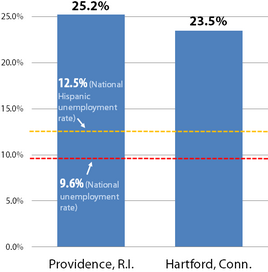
At 25.2 percent, the Providence, R.I., metropolitan area has the highest Hispanic unemployment rate. Another New England metro area, Hartford, Conn., is second with a Hispanic unemployment rate of 23.5 percent. Both areas also had the highest percentage-point increases in Hispanic unemployment from 2009 to 2010; Hartford went up 7.5 percentage points and Providence 4.6. According to 2010 Census data, Providence is 37th and Hartford 39th in Hispanic population in metropolitan areas.
SEE FULL SNAPSHOT: Metropolitan areas with highest rates of Hispanic unemployment
In order, here’s where the five metro areas with the largest Hispanic populations ranked in unemployment:
- Los Angeles: 9th, 13.4 percent
- New York: 23rd, 11.0 percent
- Miami: 12th, 12.8 percent
- Houston: 36th, 8.9 percent
- Riverside, Calif.: 5th, 18.4 percent
For more on this issue, read Austin’s piece Hispanic unemployment highest in Northeast metropolitan areas. And for a companion paper on black metropolitan unemployment, read High black unemployment widespread among nation’s metropolitan areas.
Calculating the cost of war
Today marks 10 years since the commencement of the U.S war against Afghanistan. To date, Congress has appropriated approximately $1.3 trillion dollars to prosecute that conflict along with the war in Iraq. This estimate is consistent across varied sources and is readily available from the Congressional Research Service, but tallying appropriated costs understates the true cost of our war efforts. In a nutshell, these figures do not include the debt service to finance the wars, which for the first time in U.S. history have been not been offset by tax increases. They also do not include war expenses hidden in the Pentagon’s base budget, or the costs of providing medical care and disability benefits for the thousands of veterans permanently injured by fighting abroad.
A group of academics has added it all up and estimates that the cumulative costs of the wars are up to $4 trillion and rising. Staggering though that number may be, what appalls me is that their estimate, the most comprehensive publicly available, is ultimately an unofficial one. There has been no official accounting or independent audit of Iraq and Afghanistan war costs so that taxpayers know exactly what value they have received for their money. Contrast that with the federal government’s accounting of the American Reinvestment and Recovery Act (ARRA), which has an entire website that gives laypersons, policy wonks and researchers customized looks at how virtually every dollar of ARRA funds were allocated and spent. Yet for war costs, already well above what was spent on ARRA, we are forced to rely on unofficial estimates.
This lack of transparency weakens our democracy by not allowing Americans to hold our elected officials accountable for decisions they make to engage in conflict. Rep. John Lewis (D-GA) has introduced The Cost of War Act, a bill that takes only 91 words to direct the Department of Defense to publish, on a public website, the cost of our current wars. The value of such an action—especially if the end result is as robust as Recovery.gov—would be to force this Congress to have an adult conversation about priorities, spending, deficits and debt. Right now, the only sunlight on federal spending shines on the non-defense, discretionary side, which is dwarfed by defense spending–all of which is discretionary. Exposing it all to the same level of scrutiny would lead to better debate among our policymakers.
To be sure, even if there were a definitive, transparent accounting of the financial obligations incurred by the war efforts, we would still not have an understanding of the true costs of war. What might we have used the money on, if not the wars? Imagine what hundreds of billions invested in infrastructure or education would do to reduce unemployment and increase competitiveness. Or, imagine the economic productivity that the more than 6,000 killed would have generated over their lifetimes. These opportunity costs are either difficult or impossible to calculate, but are nonetheless real. But even if the metaphysical costs of the Iraq and Afghanistan conflicts are too philosophical to consider, it is certainly possible to calculate and publicize the dollars and cents we have spent and continue to spend on our military efforts.
Could currency legislation lead to a trade war? Think again
On Wednesday, Senator Orrin Hatch claimed that the Currency Exchange Rate and Oversight Reform Act of 2011 (S 1619) (the Currency Reform Act) could cause “a huge trade war … with China.” Nothing could be further from the truth. A large share of our exports to China are intermediate products that are used to produce exports to the United States. If China raised tariffs or otherwise restricted imports of those products, it would simply raise the cost of their own exports to the United States. Furthermore, U.S. imports from China exceed our exports to that country by a ratio of more than 4 to 1. So every dollar in tariffs imposed by China would, in theory, be matched by four dollars in U.S. tariffs on their exports, if China ever tried to engage us in a trade war. But history shows us that they will not.
Senator Hatch also disparaged my latest report on China trade and U.S. employment, but I’ll save that argument for another post. We appreciate his use of our research, and are glad that he felt it necessary to respond.
In Aug. 2005, the Senate passed much a much tougher currency bill sponsored by Senators Chuck Schumer and Lindsey Graham (S. 295) that would have imposed a 27.5 percent tariff on all imports from China if it failed to revalue within 180 days. That bill never passed the House and never become law. Nonetheless, shortly after the bill was approved in the Senate (by a veto-proof majority), China began to revalue, for the first time in more than seven years, ultimately allowing the yuan (or RMB) to rise by 18.6 percent over the next three years. China did not retaliate.
China will not retaliate if the Currency Reform Act becomes law because it will hurt its own exporters if it does, and because China will benefit if it does revalue. If the yuan is allowed to appreciate, it will lower the cost of oil, food and other imported commodities in China. This will put downward pressure on inflation, which has been accelerating rapidly in China this year. Lower fuel and food prices will be particularly helpful to low-income families in China, who are very dependent on these basic commodities.
As shown in my most recent report on China trade and U.S. employment (Table 2), some of the most important U.S. exports to China are basic commodities used in producing exports such as chemicals ($11.6 billion, 13.5 percent of total U.S. exports to China), scrap and second hand goods ($8.5 billion, 10.0 percent) and semiconductors ($6.1 billion, 7.1 percent). Agricultural products ($15.4, 18.0 percent) could be vulnerable, but U.S. imports from China, which could be subject to some trade restrictions, were $363.6 billion and exceeded agricultural exports by a ratio of 23:1 in 2010.
When Senator Hatch referred to a “huge trade war,” most people think of the Smoot-Hawley Act of 1930, which raised tariffs on about one-third of U.S. imports to a peak of 59.1 percent. However, average tariff rates rose to only 19.8 percent in 1933. Canada, our largest trading partner retaliated with higher tariffs on about 30 percent of U.S. imports, and Germany developed a system of autarky (little or no trade).
The Currency Reform Act of 2011 would not impose sweeping, across-the-board tariff increases (as did the Smoot-Hawley Act). It defines a new process for determining which currencies are “fundamentally misaligned,” and defines new procedures for conducting negotiations with such countries including new consequences, especially when a country persistently fails to revalue despite continuing negotiations. These measures are intended to spur negotiated solutions to currency manipulation, not to spark a trade war.
The Currency Reform Act also authorizes the Commerce department to take currency manipulation into account in anti-dumping and countervailing duty investigations. But these changes will affect a small share of total U.S. trade with currency manipulators. Again, there is nothing similar in these proposals to the broad, across-the-board tariffs imposed in the Smoot-Hawley act.
“Trade war” is a term that is easily thrown around in legislative debate and by political commentators. As Fred Bergsten has noted, China’s currency manipulation “is by far the largest protectionist measure adopted by any country since the Second World War – and probably in all of history.” The Currency Reform Act is a measured response designed to bring about a negotiated end to China’s predatory economic policies. China has launched a trade war on the rest of the world. It is important to stand up to the bully, to restore balance to the global trading system and world demand.
The teacher gap
Over the last three years, state and local government employment has dropped by 641,000 as state and local budgets have been squeezed as a result of the recession. With kids heading back to the classroom this fall, it’s worth considering how much of that drop has hit public schools.
Of the decline in state and local government jobs over the last three years, close to half (278,000) was in local government education, which is largely jobs in public K-12 education (the majority of which are teachers but also includes teacher aides, librarians, guidance counselors, administrators, support staff, etc). On the other hand, over the same period, public K-12 enrollment increased by 0.6 percent (using the actual and projected enrollment growth rates found in Table 1 here). Just to keep up with this growth in the student population, employment in local public education should have grown at roughly the same rate, which would have meant adding around 48,000 jobs. Putting these numbers together (i.e., what was lost plus what should have been added to keep up with the expanding student population) means that the total jobs gap in local public education as a result of the Great Recession and its aftermath is around 326,000.
This decline means not only larger class sizes, but also fewer teacher aides, fewer extra-curricular activities and a narrower curriculum for our children. Furthermore, this number almost surely understates the real gap. Between 2008 to 2010, the number of children living in poverty increased by 2.3 million, and is likely even higher today. Increased child poverty increases the need for services provided through schools. Instead, public schools have fewer personnel and fewer resources to educate more students, and more students with greater needs.

Quick Take: Miserably low job growth
The unemployment rate is for the moment holding steady at 9.1 percent, but at the current rate of job creation, the unemployment rate will soon begin to rise again. We are mired in high unemployment with miserably low job growth. This country has 14 million unemployed people, and the job growth rate has unmistakably slowed down since the spring.
This morning’s data release shows that 103,000 jobs were added in September. That number, however, includes around 45,000 Verizon workers coming off the picket lines, so the net new jobs the economy created in September was actually around 58,000. This level of growth is in line with the dismal average of the last four months, which was 64,000, and that was a slowdown from the not-doing-much-more-than-keeping-up-with-population-growth average of 123,000 of the prior 14 months.
The H-2B guestworker program puts downward pressure on American wages
This past January, the Department of Labor (DOL) published a final rule establishing a new wage methodology for determining the appropriate wages to be paid to guestworkers in the “H-2B” program—a temporary immigrant guestworker category intended to help employers fill labor shortages. Among other things, U.S. law and regulation require that H-2B workers only be authorized to enter and work in the United States if the H-2B worker’s employment will not be “adversely affecting the wages” of United States workers. The DOL’s new rule will require that H-2B workers receive the average wage paid to all workers in the same occupation and geographical region in order to prevent downward pressure on the wages of U.S. workers. But for now, the rule’s implementation has been delayed—and a lobbying firestorm by businesses and members of Congress, led by Senator Barbara Mikulski from Maryland—has put its survival in doubt.
The chart below shows the difference between the hourly rate that H-2B crab pickers and landscape workers are currently paid in Maryland under the old (and still current) rule, and the statewide average for all workers in the given occupation, which is what workers should be paid in order to prevent wages from being depressed for U.S. workers. H-2B crab pickers and landscapers are underpaid by $4.82 and $3.35 per hour, respectively.
Click figure to enlarge

These data suggest that employers have been using the H-2B program as a way to degrade the wages of U.S. workers. H-2B crab pickers in Maryland (i.e., workers who literally pick the meat out of a crab, like this), who fall under the occupational category of “Meat, Poultry, and Fish Cutters and Trimmers” above, are paid the federal minimum wage ($7.25), when the state-wide average is $12.07 per hour.
Another way to look at this is that a crab picker earning the state average will earn $25,105 over the course of a year, which is above the poverty line for a family of four ($22,113). But current H-2B crab pickers only earn $15,080 a year—which is about $7,000 below the poverty line. For landscapers in Maryland, the results are similar—in both cases the increase in hourly wage will literally lift the H-2B worker out of poverty.
You can read more about the H-2B program and the Labor Department’s wage rule in my new extended commentary, H-2B employers and their congressional allies are fighting hard to keep wages low for immigrant and American workers.
So’s your mother. And Reagan. And you’ve never run a business!
A few days ago, Paul Krugman noted the evidence-free “rebuttal” offered up by the American Enterprise Institute to Larry Mishel’s takedown of the “regulation is what’s holding back recovery” argument. The title of Krugman’s post -“So’s your mother. And Reagan” – captured the useful content of what I generally hear from those engaged in hand-waving about “job-killing regulations.”
On Tuesday, though, I got to hear another argument from Peter Schiff on John Stossel’s show. I was making the case that it’s hard to see how regulation is driving up costs and robbing firms of profitability given that profit margins (unit profits as a share of total costs) were at their highest levels in either 42 or 45 years (depending on whether you looked at pre- or post-tax rates*). And, as Brookings’ Gary Burtless has pointed out, if you’re profitable now and fearful of future regulations, then you’d be doing everything you can to produce goods and services for sale now rather than later; we should see strong employment growth in the short-term.
Now, what would keep firms that were making record profits on each unit shipped from deciding to ship even more units and hire more workers to do so? A shortfall of demand (i.e., not enough customers) maybe?
Hearing this argument, Schiff made a careful, empirically-based case for why I was wrong started sneering that I had never run a business. It’s true, I haven’t. But I can look at data.
—
*The data came from Table 1.1.15 of the National Income and Product Accounts (NIPA) from the Bureau of Economic Analysis – Price, Costs, and Profit Per Unit of Real Gross Value Added of Nonfinancial Domestic Corporate Business.
Click figure to enlarge
China’s People’s Bank: The lady doth protest too much
On Monday, the Senate agreed to move ahead with debate on the China currency bill, approving a petition to proceed on the measure by a 79-19 margin; this morning they voted to proceed to a final vote, also by a strong margin. Predictably, the People’s Bank of China responded by claiming that the yuan (or RMB) has appreciated “greatly” and is close to a balanced level. The best indicator that China is manipulating its currency is simply that it must buy hundreds of billions of dollar in U.S. assets each year to keep it from moving ever higher. That’s how we know that they haven’t done enough.
China’s purchases of Treasury bills and other types of foreign exchange reserves have accelerated in the past year, as I showed on Monday. In the past 12 months (ending June 30, 2011), they acquired nearly $730 billion in additional reserves. Between 2005 and 2010 their reserve acquisitions averaged between $400 and $450 billion, which indicates that the yuan is even more undervalued than it was a year ago. This is true despite the yuan’s real, inflation-adjusted appreciation of 7.4 percent in the past year.
William R. Cline and John Williamson of the Peterson Institute have produced some of the best estimates of China’s currency manipulation. In a series of annual reports on fundamental equilibrium exchange rates (FEERs), they have estimated that China’s currency manipulation increased from 24.2 percent in 2010 to 28.5 percent in 2011, despite the fact that China’s real exchange rate appreciated over the past year. Three factors explain why China’s estimated FEERs increased in 2011.
First, the International Monetary Fund has estimated that China’s global current account surplus (the broadest measure of its trade balance) will more than double from $305 billion in 2010 to $852 billion in 2016 (an increase of 179 percent), as shown in the graph below. There is widespread agreement among the G-20 leaders (including China) that global trade flows must be rebalanced to help end mass unemployment around the world. These IMF predictions show that unless China sharply revalues, world trade flows will become even more distorted than they are today. Among the top five currency manipulators identified by Cline and Williamson (China, Malaysia, Hong Kong, Singapore, and Taiwan), China is responsible for the vast majority (83 percent) of the estimated global surpluses of these currency manipulators in 2016.
Click figure to enlarge
Second, the IMF predicts that China’s current account surplus will rise from 5.2 percent of GDP in 2011 to 7.2 percent in 2016. Cline and Williamson project in their latest research China’s that current account will rise even faster, to 7.8 percent of GDP in 2016. China’s rapidly growing GDP, combined with a rapidly growing trade surplus as a share of its GDP, and its stubborn addiction to currency manipulation will, if unchallenged, destabilize both the U.S. and global recoveries, as suggested by the IMF’s own forecast of global trade imbalances shown above.
The final nail in the case against the People’s Bank is its own massive and growing accumulation of foreign exchange reserves, as noted above. China has invested trillions of dollars to prevent the appreciation of their currency to a fair market value. China’s currency manipulation is a fundamental threat to the U.S. and world manufacturing system. It artificially suppresses the value of the yuan, subsidizing China’s exports to the United States and raising the cost of U.S. exports – both to China and to every country where U.S. exports compete with Chinese products. Enough is enough. It’s time to get tough with China and other currency manipulators.
Progressive counter-pressure for the Fed?
The Occupy Wall Street (OWS) protests have been spreading. In Chicago, protestors have gathered around the Chicago Federal Reserve Bank. Again, the protestors seem to have chosen an awfully good symbolic venue – over the past two years, the Fed has been under ferocious political attack from conservative politicians who want them to stop trying to reduce unemployment with monetary policy. If the Occupy Chicago protests provide counter-pressure from more progressive perspectives, this would be a great thing.*
We’ve already noted the letter from four GOP leaders to Federal Reserve Chairman Ben Bernanke last month demanding that he declare surrender in trying to help the faltering economy. This is just the latest in what has been a pretty remarkable effort by conservative politicians to stop the Fed from trying to boost the economy and to convince it to fret about the phantom danger of inflation.
It’s pretty telling that the best that prominent Democratic politicians have managed in response is some hand-wringing that such criticisms threaten the sanctity of central bank independence – essentially demanding that the GOP “leave Ben Bernanke alooooone!”
However, as Mike Konczal notes, even in the best of times, central bank independence as practiced by the Fed should hardly be a prime progressive demand. The Fed’s Open Market Committee – the body that sets the monetary policy direction of the economy – contains 12 slots. Seven of them are for Fed Governors (there are currently 2 vacancies on the Board of Governors), who are generally either economists or policymakers with some expertise in issues the Fed confronts. But five are set aside for presidents of the Fed’s regional reserve banks. These presidents are picked by the board of directors for each regional bank – and these boards are comprised of financial-sector (commercial bank) executives. Essentially, the finance sector gets to pick 5 of the 12 voting members of the FOMC. If one thinks that the interests of the financial sector are not necessarily the same as those of, say, unemployed workers (and I think they’re not) – perhaps the financial sector is more scared of inflation and less scared of unemployment – then central bank “independence” should probably be treated as less sacrosanct than it currently is in D.C.
Imagine, for example, that somebody demanded that the AFL-CIO get 5 voting slots on the FOMC. That would, of course, be considered absolutely crazy by those determined to preserve central bank independence as a principle (i.e., the vast majority of professional policymakers and analysts inside the Beltway). Of course, in practice, this would mean an FOMC that tried much, much harder to fight unemployment than the one we currently have, so crazy sounds pretty good to me.
Worse, this ingrained deflationary bias of the Fed is being reinforced in the current crisis by conservatives who want to abandon all the policy measures (fiscal, monetary and exchange-rate) that could actually help reduce joblessness. Some lonely (and admirable) voices calling on the Fed to do more are out there, but they’re few and far between (and sometimes working for the Bank of England, instead of the Fed).
Finally, however, there seems to be a little pushback. Besides Occupy Chicago, Massachusetss Representative Barney Frank wants to take away the voting power of the five rotating regional banks and replace them with political appointees that must be approved by the Senate. Given that the political appointees of the current Fed have consistently shown more concern over unemployment than their regional bank colleagues, this would be a good (if small) first step to privileging democracy over Fed “independence.”
—
*It’s true that the president of the Chicago Fed has been admirably aggressive in calling for more Fed action to reduce unemployment, especially relative to his other regional bank presidents. So, maybe protests can follow in Dallas, Minneapolis, and Philadelphia?