Unemployment of 8.3% is unacceptably high, no matter when and for whom
Unemployment in January was 8.3 percent, which is widely, and correctly, assessed to be unacceptably high. I agree. It should be noted that the unemployment rate for blacks in 2007 was the very same 8.3 percent, which barely registered much attention at all. That was at a time when the national unemployment rate was 4.6 percent and white unemployment was 4.1 percent. Well, the 8.3 percent for blacks in 2007 was also an unacceptable outcome. That’s why my colleague Algernon Austin organized an event, held yesterday at EPI: “Hit hard by the recession, left behind in the recovery: Achieving full employment for black workers.” Austin also wrote a new paper highlighting the currently very high unemployment among blacks and Hispanics, No relief in 2012 from high unemployment for African Americans and Latinos.
Whitewashing the Apple
I was skeptical when Apple chose the Fair Labor Association (FLA) to investigate conditions in its supplier factories. The FLA is paid by the companies whose factories it monitors, and it’s just hard to bite the hand that’s feeding you. A truly independent monitor, one with no financial dependence on Apple, would be the right choice if Apple really wanted the public to trust its motives and any eventual exoneration of its suppliers.
Well, we didn’t have to wait long. The head of the FLA has apparently exonerated first, with full investigation to follow. Steven Greenhouse reports in the New York Times that barely after the investigation has begun, FLA’s president, Auret van Heerden, has declared the factories of Apple’s biggest supplier, Foxconn, “first-class” and said, “Foxconn is really not a sweatshop.”
These precipitous assertions are beyond troubling; they suggest FLA is not proceeding in a fair, systematic and serious manner to uncover the reality of the work conditions.
It might be time for Apple’s board of directors to take a close look at an approach that may protect Apple’s brand, but will not protect Apple’s workers. Rather than stick with what may simply turn out to be a public relations whitewash, they might want to find someone who will do an independent unbiased investigation and tell them the truth about conditions in Apple’s factories.
CBO, CRS, EPI find toxics and other EPA rules have benign economic effects
A growing body of research is finding that new Environmental Protection Agency rules will not disrupt the economy and may in fact modestly boost employment. According to a new report by EPI and a January report by the Congressional Research Service, this is true for the air toxics rule, the most costly regulation finalized by EPA during the Obama administration. More generally, overlooked testimony by the director of the Congressional Budget Office from last November concludes that efforts to derail air quality regulations generally, if successful, would harm the economy.
On Dec. 16, 2011, EPA issued its final standards for mercury, arsenic, and other toxic air pollutants from power plants (the “toxics rule” or the “Utility MACT”). In January, CRS issued EPA’s Utility MACT: Will the Lights Go Out? As the title suggests, the report’s main focus is on whether the rule would, as some claim, affect the reliability of the power supply. CRS found otherwise, noting that while some facilities would be retired, “almost all of the capacity reduction will occur in areas that have substantial reserve margins,” meaning that the reductions can be easily absorbed without affecting power supply. CRS also observed that the rule includes additional time for compliance if in fact reliability is threatened in specific areas. The report’s bottom line conclusion: “…It is unlikely that electric reliability will be harmed by the rule.”
Last week, my colleague Josh Bivens released a report on the employment effects of the toxics rule. His analysis, unique in its comprehensive examination of both the positive and negative ways in which a regulation can influence employment, concluded that: “The toxics rule will lead to modest job growth in the near term and have no measurable job impact in the longer term.” His preferred single estimate is that 117,000 net jobs would be created.
The main reason why jobs would be created on balance in the near term is that the jobs generated by complying with the regulation, through pollution abatement activities such as increased investment on and the installation of scrubbers, will substantially exceed any jobs lost because of the modest increase in the price of electricity that would be produced. As Josh explains in his report and elsewhere, this is especially true today because of the large amount of capital and labor that is sitting on the sidelines; regulatory changes that spur investments to bring power plants into compliance with the new rules will mobilize this unused capital without leading to any offsetting rise in interest rates.
The Congressional Budget Office uses similar economic logic in assessing air toxics and other air quality rules. In testimony before the Senate Budget Committee on Nov. 15, 2011, CBO director Douglas W. Elmendorf included a general assessment of how initiatives to block EPA air quality rules would affect employment or output. He concluded: “On balance, CBO expects that delaying or eliminating those [EPA air] regulations regarding emissions would reduce investment and output during the next few years,” [emphasis added]. Essentially, CBO argued that the jobs created through investments to comply with the rules would exceed the number of jobs created due to alternative investments in the absence of the rules, because little such alternative investing would likely occur. (In my view, this reflects the fact that capacity utilization in the utility sector is at the lowest level on record, suggesting no need for further investments.) CBO also pointed out that the price increases that may result from these rules will not occur for several years, mitigating any near-term impact.
CBO’s use of the argument that regulatory changes are especially likely to spur job gains when, as is the case today, the economy has substantial slack in labor and capital markets, confirms that this reasoning is firmly based in mainstream economic analysis. It is an important argument that deserves greater attention in the ongoing regulatory debate.
Congress’ arbitrary ‘compromise’ on UI benefits
It’s good to hear that Congress has reached a deal to extend the payroll tax cut and long-term unemployment benefits.The tax relief to working families and the stimulus provided by unemployment payments is critical to protecting some of the recent improvements we’ve seen in the labor market.
But the nature of the “compromise” that congressional negotiators reached with regard to the length of unemployment benefits seems shockingly arbitrary. According to The New York Times, congressional Republicans wanted to end unemployment benefits after 59 weeks, while congressional Democrats pressed for coverage up to 93 weeks. They ultimately settled on a maximum of 73 weeks.I suppose given the state of Congress, we should be happy they could compromise on anything; but is this “let’s just meet near the middle” approach really the best way to decide when to end important social protections?
The point of unemployment insurance is, of course, to provide some level of income to workers during periods of joblessness. On a macro level, it also helps to counter economic downturns by mitigating the drop in consumer spending that inevitably occurs during periods of high unemployment.Thus, as Peter Orzag recently argued, if policies like unemployment insurance and payroll tax cuts are designed both to protect individual workers and the larger economy during times of distress, why would we want to affix them to arbitrary endpoints rather than overall economic conditions?Wouldn’t it be better to let the unemployment rate or even the long-term unemployment rate dictate how long we provide this additional economic support?
Roughly 2.3 million Americans, or 17 percent of the unemployed, have been searching for a job for at least 73 weeks – not including those that have given up looking for work and have exited the labor force. I should note that this is not the number of people who will lose benefits under the new proposal.Because each state has different unemployment eligibility requirements, differing lengths of state-sponsored coverage, and because federal support is also linked to state unemployment rates, it’s difficult to quickly estimate just how many will lose their benefits under this new cutoff.There are about 400,000 people who have been unemployed between 73 and 99 weeks, the existing cutoff point for unemployment benefits, but not all of these people have been collecting benefits.
Some will argue, of course, that cutting off unemployment benefits will spur some job seekers to redouble their efforts, as if it’s their lack of trying that is keeping them unemployed.I think the table below suggests otherwise.It shows the 20 states with the highest number of individuals unemployed for at least 73 weeks as a share of their states’ labor force.The cells highlighted in blue denote the top 10 values in each column.

As one might expect, the states with the highest unemployment rates are also states with the highest proportions of these “73-weekers.” In other words, in places with the highest proportions of long-term unemployed, it’s really hard to find a job. As Heidi Shierholz explains in greater detail, the reason so many have struggled to find work for so long isn’t because they are lazy or that they don’t have the proper skills, but that there simply aren’t enough jobs.The most recent Job Openings and Labor Turnover Survey (JOLTS) indicated 3.9 job-seekers for every posted job opening nationwide in December.
Unfortunately, JOLTS does not include state-level statistics, but I would comfortably wager that this ratio is even more extreme in places like Nevada and Florida.Congress should be focused on doing everything it can to stimulate job growth in these states, not negotiating some arbitrary line for when job seekers there will suddenly be without help.
The president’s jobs package would indeed create jobs
One of the best aspects of President Obama’s new budget plan is its near-term focus on job creation. This is a significant change from last year’s budget, where job creation was effectively ignored in favor of deficit reduction (likely in response to the GOP victory in the 2010 midterm elections, but that’s no excuse). This year, the president included $350 billion in job creation, $300 billion of which would hit the economy in the next year and a half. Here’s what’s in it though fiscal year 2013:
- $95 billion in the payroll tax cuts (employee-side)
- $80 billion in other business tax cuts (including a $25 billion hiring credit)
- $45 billion in emergency unemployment benefit extension
- $25 billion in transportation infrastructure investments ($50 billion over ten years)
- $20 billion in school facility repair and modernization
- $30 billion in retaining or rehiring teachers and first responders
- $25 billion miscellaneous neighborhood stabilization, job training, energy efficiency, VA conservation jobs, infrastructure bank, and manufacturing incentives
Last fall, the president proposed the American Jobs Act (AJA), a collection of policies designed to jump-start the economy. There are a few differences between the AJA and this jobs package—some policies were already enacted, some were scaled down, and there are a few new proposals—but this is essentially an updated and revised AJA.
And like the AJA, this jobs package would have an immediate positive impact on the economy and jobs. About 85 percent ($300 billion) of the package would hit the economy in the next year and a half. Using standard macroeconomic multipliers for the various policy categories, we find that the president’s job creation proposals would create 1.5 million jobs in fiscal year 2012 and 1.3 million jobs in fiscal year 2013 (through Sept. 2013).
The following graph shows by how much this proposal would lower unemployment relative to the unemployment levels under the Congressional Budget Office’s economic projections, if the historical relationship between GDP growth and unemployment held over the next two years. Note that CBO assumes that in Jan. 2013 the entirety of the Bush tax cuts will expire and the sequestration trigger will be implemented in full. A more realistic policy assumption that at least partially extends the Bush tax cuts and replaces the trigger would lower their projected unemployment levels. However, because the unemployment path under the jobs package was constructed off of the CBO baseline, the gap between the two would remain the same.

Some might argue that the full value of the $300 billion in the next year and half should not be included as “new” fiscal support, since the payroll tax cut is very likely to be extended for the full year (and full-year extension is included in the baseline of most macroeconomic forecasters’ models). In addition, the unemployment insurance extensions are also likely (though not guaranteed) to also run through all of 2012 (and many forecasts have some portion of these included in their baseline as well). Still, given the intense political pressure to move to immediate fiscal tightening, we think even just preserving the fiscal support already included in many forecast baselines is an important step in the president’s budget and should be highlighted.
For more on our job creation methodology, see our memo from last fall.
Morals, money and book promotion
Since an unexpected link from Noam Chomsky (whoa!) has brought it some attention, I may as well take the chance to introduce my book Failure by Design as a piece of evidence in the “morals versus money” debate going on.
David Brooks, channeling Charles Murray, argues that moral/social decay led to the poor economic performance in the bottom half of the income distribution in recent decades. Paul Krugman, Dean Baker, and Larry Mishel (I’m sure I’m missing others) demur – arguing that evidence for the poor economic performance is clear as day while evidence pointing to moral/social decay as an independent cause is awfully unpersuasive. (Wait! Don’t choose sides already based purely on teams – I have more evidence to offer!)
One thing that hasn’t been mentioned yet is that there’s plenty of reason to believe that things besides moral/social decay led to poor economic performance; policy changes alone just about guaranteed this poor performance. As Failure by Design notes, recent decades have seen: the inflation-adjusted value of the minimum wage fall for years (almost decades) at a stretch (leaving it still today below its late 1960s peak); an ongoing decline in the share of workers represented by a union (even while the share of workers desiring a union has not much moved); a much-larger share of the total U.S. economy accounted for by trade with much-poorer nations; and a Federal Reserve that has been less and less willing to push back hard against unemployment rates that rise above even their own conservative targets.


Nobody, absolutely nobody, disputes that these things should’ve been expected to do anything but inflict disproportionate harm on low- and moderate-wage workers. The conservative case for making these policy changes was that they would improve overall economic performance and if one was so inclined to make sure that low- and moderate-income workers were not harmed by these policy changes, one could have used the tax/transfer system to redistribute some of these overall gains their way.
I’d complain that not enough of these overall gains have found their way to the bottom half of the income distribution – but it’s awfully hard to believe these overall gains happened at all. Measures of aggregate economic performance are really no better (and are mostly worse) in recent decades even as incomes are shifted.
Bad Apple labor practices: Promises have been made before
The New York Times‘ brilliant two-part investigation of the wretched treatment of Apple’s manufacturing workforce is the obvious cause of the announcement that Apple is submitting to outside monitoring of conditions in its suppliers’ factories. No one at Apple headquarters had a religious epiphany; they were disgraced in the pages of the world’s greatest newspaper, and the public was beginning to react. This is not to say that a public relations gambit can’t lead to real change. But Steven Greenhouse’s story in the Times yesterday raises fair questions about the depth of Apple’s new commitment to labor rights.
Apple had two obvious choices for outside monitor: the Fair Labor Association, a monitoring group funded by the corporations it monitors, or a truly independent organization like the Worker Rights Consortium, which does not accept contributions from any for-profit corporation, let alone the corporations it monitors. The fact that it chose the in-house alternative tells me that Apple is less than fully committed to its new cause.
It’s worth noting that Apple has gone down this route before, with lousy results. In 2007, after China Labor Watch and Chinese journalists reported serious abuses at Apple’s key supplier, Foxconn, Apple hired Verite to monitor Foxconn’s labor law compliance. Foxconn is the company where—three years after Verite was hired—workers began committing suicide to escape their servitude, inhumanly crowded conditions, and personal abuse.
There are other reasons to doubt that anything material will change. The Fair Labor Association’s Executive Director, Jorge Perez-Lopez, with whom I worked at the Department of Labor, is a very decent guy. But when he says Apple will have no influence on which factories will be inspected or when, it’s hard to believe, especially when Apple’s CEO made the announcement that the first inspections would be in Foxconn factories in Shenzen and Chengdu. Oops! What Mr. Perez-Lopez didn’t say is equally interesting: How will the findings be released? We have seen that public shame is a powerful motivator. Will Apple have any control over the timing or content of the monitor’s reports on conditions?
And most important, will the Fair Labor Association be allowed to investigate the causes of the poor conditions, which include the price Apple is willing to pay for its products? Apple, like Wal-Mart, is famous for squeezing its suppliers, leaving them less and less to pass down to the workers in wages. Scott Nova, Executive Director of the Worker Rights Consortium, estimates that Apple could triple the wages its suppliers pay and reduce its gigantic profits by only 7 percent. That might be the fastest and surest way to improve the lives of its 700,000 workers. But it wasn’t part of Monday’s announcement.
Labor Department tackles guest worker problems
On Friday, Feb. 10, the Department of Labor (DOL) announced a new set of rules for the H-2B program, the country’s main temporary foreign labor program for less-skilled workers in non-agricultural positions. The new rules are set to become effective in late April, and as the New York Times reported on Saturday, “the changes were hailed by advocates for guest workers, who said they would make it more difficult for businesses to exploit vulnerable foreign migrants and hire them to undercut Americans.”
I join in the applause for the H-2B rule changes. For several years, the H-2B program has operated in ways that defy common sense. For example, in the District of Columbia, where more than 30,000 people were unemployed in 2010 and the unemployment rate hovered around 10 percent, common sense tells you that hotels should have an easy time finding local residents to take jobs as maids or cooks. And if they really couldn’t find anyone from D.C. to clean hotel rooms, surely they’d find qualified applicants in Northern Virginia or Maryland.
Yet lodging giant Marriott Hotels claimed they couldn’t find anyone here or elsewhere in the United States for 48 hotel maid and cook positions. They got government approval to bring 48 H-2B workers from abroad to do work that local people (with a high school education or less) could have been trained to do very quickly.
How did Marriott do it? How did they convince the DOL that no one in the D.C. area was interested in and qualified for these jobs? One possibility is that Marriott might have dishonestly claimed that they tried to recruit U.S. workers but failed. Under the old program rules, DOL didn’t have to check the accuracy of Marriott’s claims; DOL in all likelihood simply accepted Marriott’s “attestation,” i.e., simply took their word for it. Widespread fraud and abuse, documented by government and news reports and legal cases, are the main reason DOL has done away with the attestation procedure in its new rule.
More likely, Marriott fully complied with the minimal recruiting requirements mandated by the current rules, and few qualified local residents responded, because few ever heard there were positions open and because the wages offered were well below the prevailing wage in the D.C. area.
Marriott offered to pay the cooks $9.80 an hour. Here are the median, mean (or average), and annual wages paid to cooks in D.C. in 2010. Marriott’s wage offer was $3.80 an hour less than the average paid to the lowest paid of the hotel, cafeteria, or restaurant cook occupations in D.C.
 |
Marriott offered to pay the maids $8.50 an hour, even though the median wage for maids in D.C. was $14.58 and the mean was $14.44. Marriott’s offered wage was only 59 percent of the prevailing wage for maids in D.C. That might have been enough all by itself to discourage anyone in D.C. from applying for the jobs. It’s likely, however, that potential hotel maids in D.C. either didn’t see Marriott’s ad if it ran only for the required minimum of three days in some local paper, or if they did see it, it could have been months before the position was available and therefore job seekers ignored it.
|
If Marriott had been looking to employ cooks and maids in the broader, D.C.-Virginia-Maryland-West Virginia area, the prevailing wage would have been somewhat lower but still far above what the company actually offered.
|
It’s easy to see why employers like Marriott love the current H-2B program. They can legally pay temporary foreign workers less than the local market rate for essential jobs. Fixing this aspect of the H-2B program was the impetus for an earlier rule proposed by DOL, but that common sense rule was blocked by Congress after a lobbying firestorm. Employers claimed they’d go out of business if they were forced to pay the local average wage to maids and cooks (and especially landscapers), even though the employers they compete with are doing just that. But the fact that employers don’t have to document and prove their efforts to recruit U.S. workers—even at the below-average wages permitted by the H-2B program—exacerbates the problem and allows employers to ignore the employment needs of the local workforce where they do business, at the expense of the local workers’ ability to earn a living wage.
The new H-2B rules will help local workers find jobs at the prevailing wage for the work that they do. They will help put more unemployed Americans back to work, and also prevent the undercutting of employers who pay a living wage. Unfortunately, H-2B employers are already up in arms about these common sense reforms. Congress should not allow the desire of H-2B employers to lower American wages trump the need of unemployed workers to earn a decent wage.
Exports and growth: Running harder and falling behind
In his 2010 State of the Union address, President Obama pledged to double exports over the next five years, which would “support two million jobs.” How’s that working out? Not so well, despite claims to the contrary from the White House. In this year’s SOTU address, the president pointed to newly signed Free Trade Agreements (FTAs) with South Korea, Colombia and Panama as policies that will generate more exports, and they are, but the U.S trade deficit with those countries also increased last year. In short, it’s hard to argue that the Obama administration has taken any serious steps to make trade flows move from a minus to a plus in generating growth and employment in coming years.
Their rhetoric often suggests otherwise. Just last week, Deputy National Security Advisor for International Economic Affairs Michael Froman claimed that “last year our exports of goods alone to China exceeded $100 billion, and have been growing almost twice as fast as our exports to the rest of the world.” While this was a nice welcome for China’s Vice President Xi Jinping, who visits the White House today, it turns out that this nice round (and arbitrary number) was only reached if one is willing to overlook some key issues in trade data.
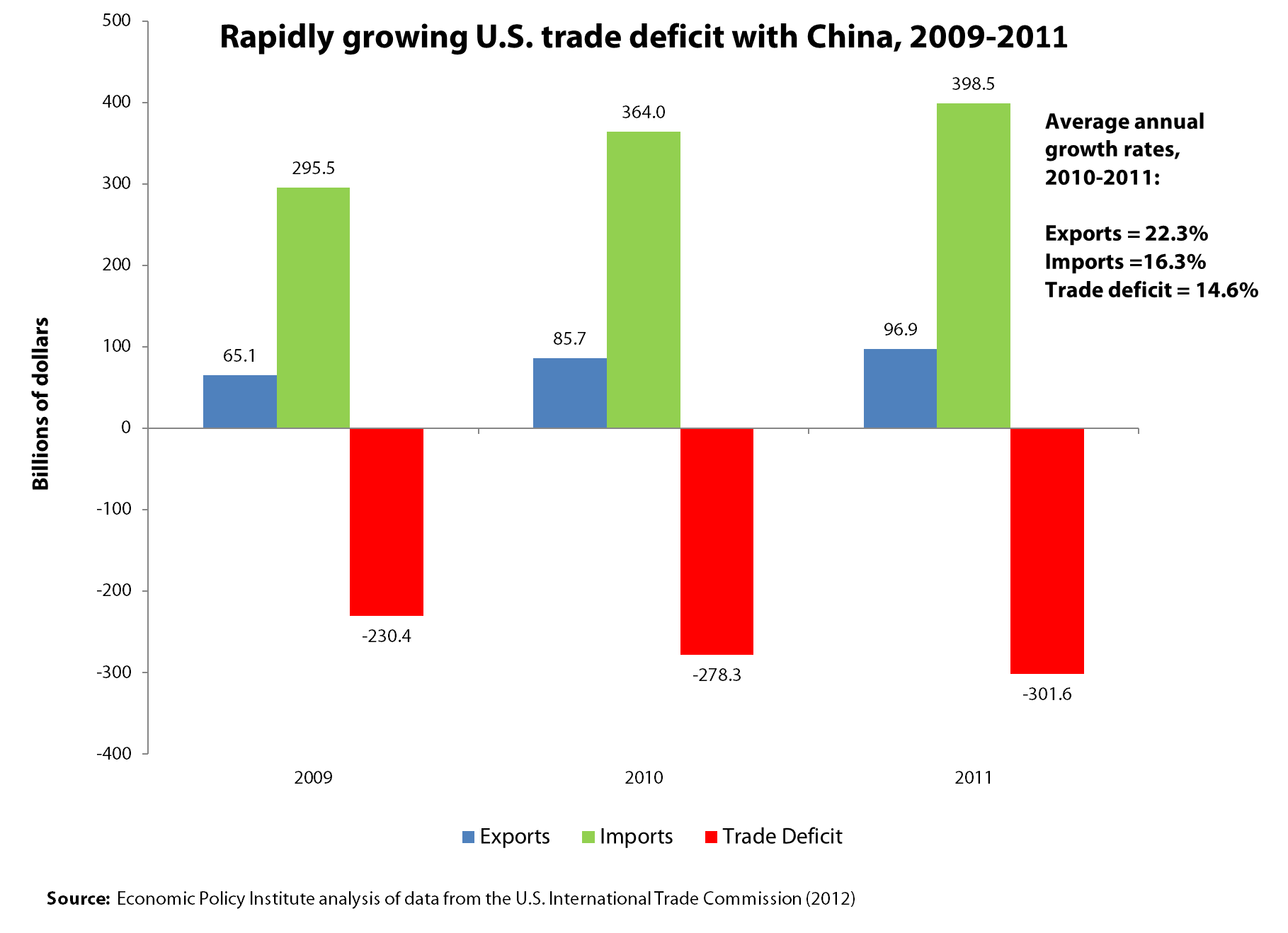
On the broader question of export growth, while exports to China and the world have been growing rapidly, the volume of U.S. imports increased much more rapidly – and this means that U.S. trade deficits with China and the world have increased rapidly over the past two years. This increasing trade deficit has generated a net loss in trade-related jobs with both China and the world as a whole. Thus, while export growth may have supported some new U.S. jobs, the growth in imports has displaced a much larger number of jobs. Between 2008 and 2010, the growth of U.S. trade deficits with China alone resulted in the loss of 453,100 U.S. jobs. A thorough jobs analysis of U.S. trade in the 2009-2011 period has not yet been completed. However, the U.S. trade deficit in non-oil manufactured goods, the most labor intensive portion of U.S. goods trade, increased by $129.3 billion in this period, displacing hundreds of thousands of U.S. manufacturing jobs.
Exports to China increase at a relatively brisk pace of 22.3 percent on average over the past two years (since President Obama’s announced goal of doubling exports), as shown in the figure below. While this number sounds great in isolation, it was more than offset by the growth of imports from China, as shown in the figure; and U.S. trade deficits with China have soared.¹ So, even though exports to China are growing rapidly, the base (their initial level) is tiny compared with imports, which exceeded exports by more than 4-to-1 throughout this period. Therefore, in order to merely stabilize our trade deficit with China, exports would have to grow at least four times as fast as imports. In fact, imports from China grew nearly as fast as our exports to that country, and our bilateral deficit has increased 14.6 percent per year on average over the past two years.
U.S. exports to the world have increased at a slightly slower rate of 18.4 percent per year over the past two years. Although this is slightly lower than the rate of growth of exports to China, at this rate, exports will double between 2009 and 2013, one year ahead of the goal set by President Obama. Time for a celebration and a tour of all those shiny new factories shipping exports to China, right? Not if we care about jobs. If imports and exports continue to grow at present rates, the U.S. global trade deficit will more than double by 2013 to more than $1 trillion. Millions more jobs will be lost, most of them in manufacturing. Again, the story is simple: Trade flows have two sides, imports and exports. Counting only one side tells you nothing about how policy has aided or hindered U.S. competitiveness in the global economy.
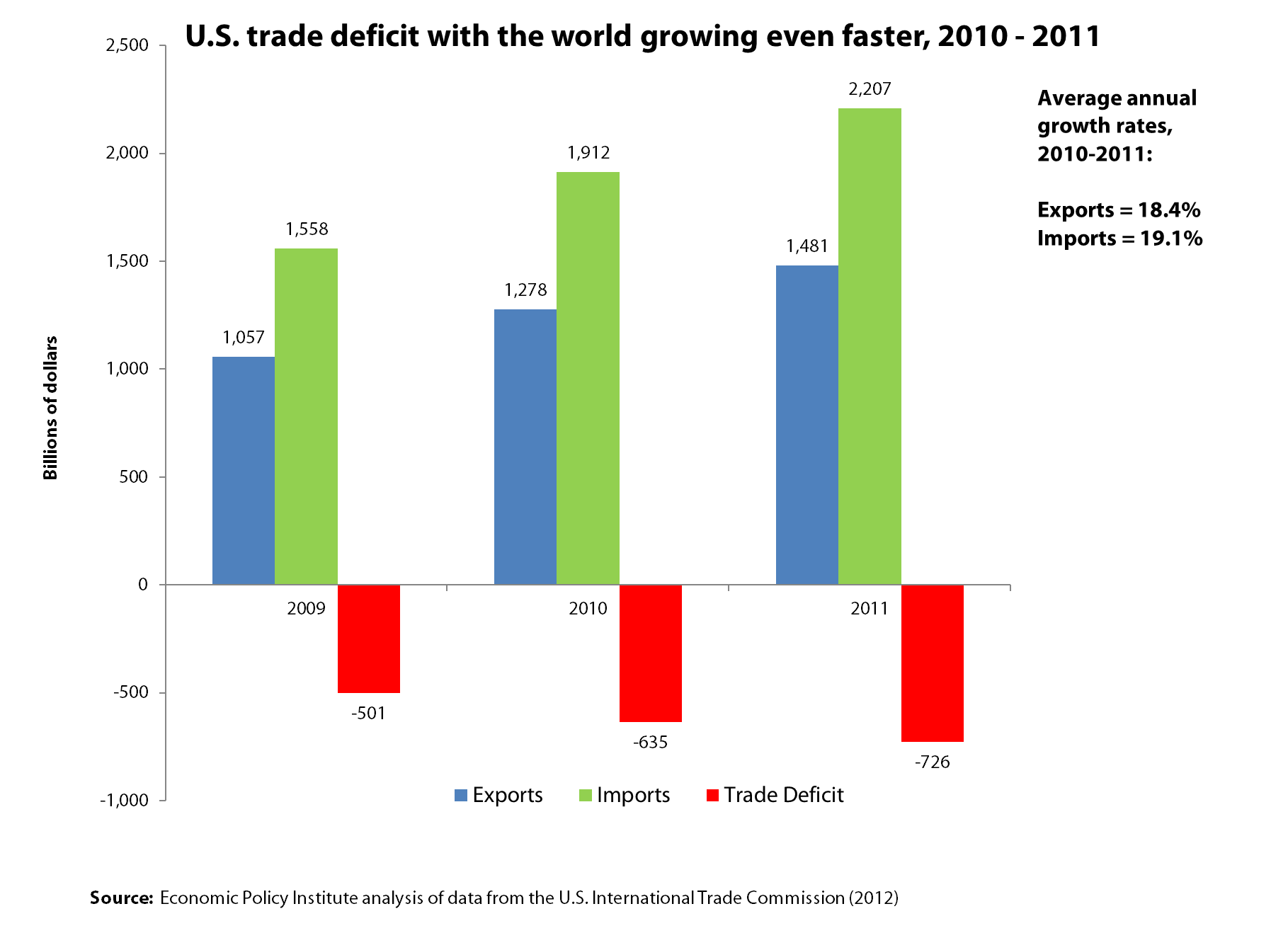
Readers will note that exports to China have grown only slightly faster than exports to the world over the past two years.Read more
Don’t cut the non-security discretionary budget!
One of the most overlooked items of the federal budget is the non-security discretionary budget. Despite accounting for only about 15 percent of federal expenditure, it includes some pretty important government functions. Half of the non-security discretionary budget accounts for the entirety of the federal government’s role in economic development, consumer protection, public safety, environmental protection, as well as portions of the safety net. The other half is made up of vital public investments in infrastructure, education, and research and development, which are necessary to keep the economy strong and globally competitive for decades to come. In fact, the non-security discretionary budget is practically the sole provider of these investments, with few existing elsewhere in the budget.
We’ve given good marks to President Obama’s 2013 budget for its upfront job creation proposals, efforts to promote tax fairness, and for realistically stabilizing the debt-to-GDP ratio over the second half of the decade (as the output gap shrinks). But unfortunately, his budget proposal achieves much of its savings by maintaining the non-security discretionary cuts in the first phase of the Budget Control Act, the debt ceiling deal that established 10-year caps on discretionary spending. As a result, his budget forces non-security discretionary outlays down to their lowest level as a share of GDP ever recorded (the data begins at 1962). That’s even lower than the Bowles-Simpson proposal!
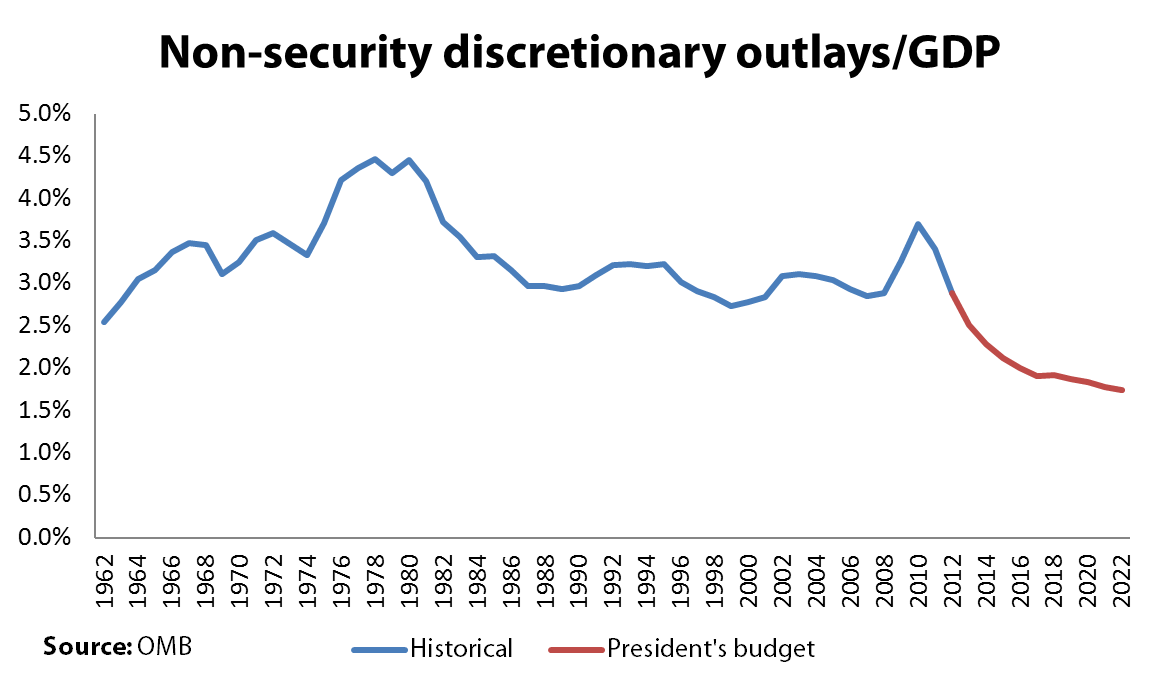
The president has admirably made public investments a high priority, promoting increases in transportation, school facility repair and modernization, job training, R&D, and college access. But this vision is hard to reconcile with a rapidly shrinking non-security discretionary budget, as it will lead to even steeper reductions to everything else, with disastrous consequences.