Obama too quiet on job creation track record
Jobs were, not surprisingly, a big topic in last night’s presidential debate. President Obama, however, did not seize the opportunity to discuss his administration’s job creation record and substantive job creation proposals—in particular the American Jobs Act (AJA), which would provide a quantifiably substantial economic boost but has largely been stonewalled by the House of Representatives for more than a year.
Those who watched the debate saw Republican presidential nominee Mitt Romney ding Obama on some of the trends that my colleagues here at EPI are constantly analyzing: A) a high unemployment rate (though he misspoke and said it was rising—it’s not); B) millions of unemployed workers (though he overstated by saying 23 million are unemployed—12.5 million were unemployed in August; Romney was likely conflating unemployment with the number of people underemployed); and C) insufficient job creation measures (something I wouldn’t disagree with, though Romney’s budget proposals would have the opposite effect of creating jobs in the near-term). And despite this last point on his budget’s employment impacts, Romney promised, again unsurprisingly, that as president he would Read more
Checking Alabama’s ‘status’: HB 56 no cure for a sick labor market
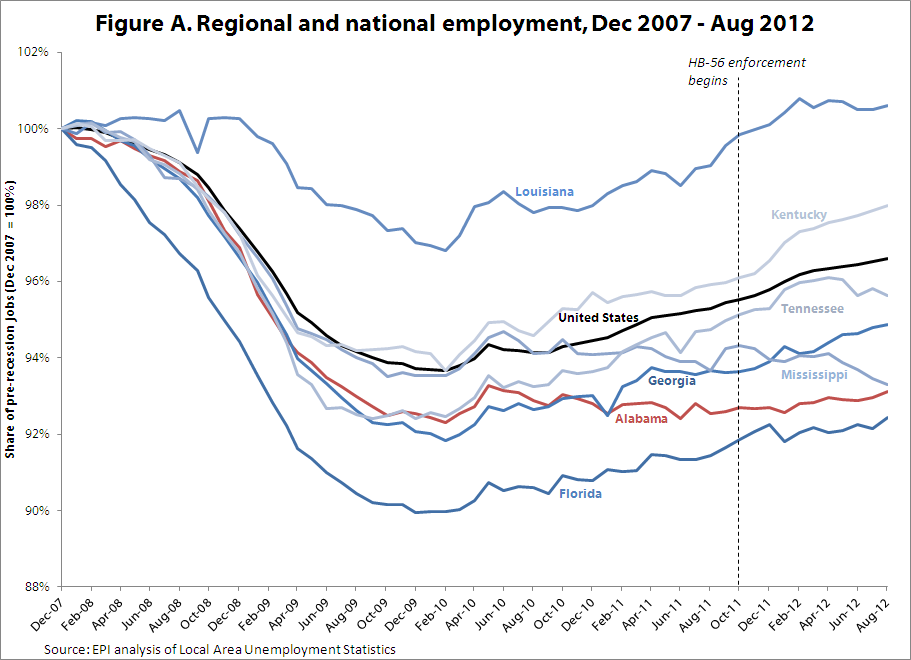
The evidence continues to mount that HB-56, Alabama’s extreme anti-immigrant law, is anything but the economic cure-all that proponents claimed it would be. In fact, the economic data suggest that the law is only exacerbating the state’s stagnating economy and setting Alabama up for even greater trouble down the road.
As Figure A shows, Alabama’s employment levels have essentially flat-lined since the end of the recession. HB-56, the law that would allegedly “free up jobs for other Alabama workers” and “put thousands of native Alabamians back in the work force” has done nothing to jump-start job growth. Table 1 shows the change in employment from Sept. 2011, the month before the law went into effect, to Aug. 2012. With the exception of Mississippi, which lost employment, Alabama had the slowest job growth in the region over the period—less than half the rate of job growth for the nation as a whole.
The payroll tax cut is likely to expire—let’s replace it with better stimulus
Annie Lowrey’s recent piece in the New York Times on the likely year’s end expiration of the 2 percentage-point employee-side payroll tax cut has sparked a welcomed broadening of the discourse over the so-called “fiscal cliff.” The punditry’s discussion of expiring provisions and pending spending cuts has, for months, been overly and narrowly focused on the looming sequestration cuts and expiration of the Bush-era tax cuts while ignoring the single largest pending fiscal headwind: expiration of the remaining ad hoc stimulus.
In our recent paper on the coming fiscal obstacle course (the “fiscal cliff” is a truly terrible metaphor as it implies a binary policy choice), my colleague Josh Bivens and I estimate that—should they all lapse—expiration of the payroll tax cut, emergency unemployment insurance, and recent expansions of refundable tax credits would shave 1.4 percentage points from real GDP growth in 2013 and lower employment by more than 1.6 million jobs, relative to full extension. This is not to suggest that the remaining ad hoc stimulus necessarily be continued in its existing form—the fiscal obstacle course represents an opportunity to fundamentally reorient fiscal policy to be Read more
No debate here, just facts on the presidential candidates’ economic policies
Tonight, President Obama and Republican nominee Mitt Romney will square off in Denver in the first presidential debate. In preparation, we’ve compiled some of our most relevant analyses of the economy and economic policy from the past few months:
BUDGET
- The so-called “fiscal cliff” isn’t one piece of take-it-or-leave-it legislation; rather, it’s a series of separable tax and spending provisions. Our experts identify which ones should be allowed to phase out (and perhaps be replaced by fiscal support that would more efficiently support economic recovery).
- States are facing $55 billion in budget shortfalls this year, and Romney’s proposed spending cap would decimate budgets further.
- Despite what Romney’s budget plan says, economic growth will come nowhere close to offsetting his proposed tax cuts for the wealthy.
- Would Romney or Obama do more to promote job growth in the near term? We analyze the macroeconomic impacts of both their budget proposals.
- Extending all of the Bush-era tax cuts will provide a massive windfall for the top 1 percent of households.
HEALTH CARE
- Obama’s Patient Protection and Affordable Care Act has increased employer-sponsored health insurance and dependent ESI coverage for young adults—even in a poor labor market.
- Paul Ryan, Romney’s running mate, has proposed a Medicare voucher that will shift around 11 percent of costs to seniors in 2023 (and even more in later years).
JOBS
- The economy would have added another million jobs in 2012 if Congress had fully enacted Obama’s American Jobs Act.
- More than three years after the end of the Great Recession, public-sector job loss resulting from state and local austerity continues to be a major drag on the recovery.
- The labor market’s struggles have meant declining wages and fewer opportunities for young graduates. Graduating in a bad economy also means long-lasting economic consequences for the Class of 2012.
What we read today
Here’s some of the thought-provoking content that EPI’s research team enjoyed reading today:
- “Leaders at Work on Plan to Avert Mandatory Cuts” (New York Times)
- “The Policy Priorities and Issue Preferences of Asian Americans and Pacific Islanders” (National Asian American Survey)
- “Paul Ryan Was Never a Moderate on Social Security” (Huffington Post)
- “Congress just let the farm bill expire. It’s not the end of the world … yet” (Washington Post)
- “If Congress Goes Over the Fiscal Cliff Your Taxes Will Likely Go Up” (TaxVox)
Capping federal spending at 20 percent of GDP would decimate state budgets
My colleagues Josh Bivens and Andrew Fieldhouse recently released a report finding that Republican presidential nominee Mitt Romney’s budget plan would reduce employment by between 550,000 and 1.9 million jobs over the next two years relative to current policy, depending on whether his tax cut is deficit-financed or fully paid for with base-broadening. This job loss is overwhelmingly fueled by his proposal to cap federal spending at 20 percent of GDP.
But the impact of any fiscal plan goes beyond the job impact—after all, a little over 17 percent of non-interest federal spending flows directly to states (e.g., matching funds for Medicaid and unemployment insurance), and with a half trillion dollars in cumulative shortfalls that states have faced in the last few years and another $55 billion in shortfalls faced this year, states would have difficulty handling another blow to their budgets. So how would Romney’s proposed spending cap affect state budgets?
To make this calculation, I started with the U.S. Census Bureau’s Annual Survey of State Government Finances, which shows total expenditures and federal transfers to state governments, each by state. I then applied the Read more
What we read today
Here’s some of the thought-provoking content that EPI’s research team enjoyed reading today:
- “The Real Referendum” (New York Times)
- “Obamanomics: A Counterhistory” (New York Times)
- “I am a job creator: A manifesto for the entitled” (Washington Post)
- “Payroll Tax Cut Is Unlikely to Survive Into Next Year” (New York Times)
Barry Commoner, visionary environmentalist, teacher and activist dies at 95
Barry Commoner, path-breaking scientist and social activist, passed away yesterday at the age of 95. I was fortunate enough to work for Barry in the late 1970s as a research assistant on two of his books, The Poverty of Power (1976) and The Politics of Energy (1979). Commoner, a botanist and biologist, was a founder of the environmental movement, along with peers such as Rachel Carson (The Silent Spring, 1962) and Margaret Meade. He believed that scientists have an obligation to share scientific information with the general public to enable them to participate in public debate on scientific issues. His work on the effects of nuclear fallout, documented through the collection of baby teeth and reinforced by a petition signed by 11,201 scientists worldwide, provided the scientific foundation for the adoption of the Nuclear Test Ban Treaty of 1963.
Commoner also helped establish the roots of today’s BlueGreen Alliance of labor and environmentalists. He first began working with Tony Mazzocchi, a longtime leader of the Oil, Chemical and Atomic Workers in the 1950s, who collected baby teeth from the children of members of his Long Island local union. Commoner’s work showed the connections between the environmental crisis and social and economic issues such as “poverty, injustice, public health, national security and war,” and that the roots of the environmental crisis lay in excessive corporate power and flawed systems of production. He argued that only by changing those systems—for example, by replacing nuclear power, coal and oil with renewable energy—could the root causes of our environmental problems be eliminated. Not coincidentally, these same policies would create millions of new domestic jobs, reducing pollution, inequality and our trade deficit simultaneously. As Commoner established in The Closing Circle (1971), the first of his “four laws of ecology” was, “Everything is connected to everything else.” Indeed.
What we read today
As you head into your weekend, here’s some of the thought-provoking content that EPI’s research team came across today:
- Plan Selection in Medicare Part D: Evidence from Administrative Data (National Bureau of Economic Research)
- Will pension plans stage a comeback? (Investment News)
- Shocked by the [NFL] refs? Where’ve you been the last 30 years? (Philly.com)
- No, NFL Owners Didn’t ‘Lose’ The Lockout Battle With Referees (Think Progress)
Another right-wing attack on public workers
How does government pay compare with that in the private sector? The answer is pretty much what you’d expect: Wages and salaries are lower, but benefits are better. Overall compensation is, if anything, slightly lower, though this varies by class of worker; less educated workers are better paid in the public sector and more educated workers are better paid in the private sector. This again is not surprising when you consider that less educated workers in the private sector often earn poverty wages with no health benefits and government employers have little incentive to shift costs onto Medicaid and other government programs.
But anti-government ideologues have deep pockets, so a minor industry has sprung up trying to show that government workers are overpaid. The latest report in this genre comes from Citizens Against Government Waste, and is typical of its kind. The research was done by an outfit called John Dunham and Associates, a.k.a. guerrillaeconomics.com. It shows many of the tell-tale signs of shoddy research:
1. Anecdotal evidence. Somewhere, there’s a government worker making an obscene amount of money and abusing the system. But focusing too much on specific examples is a sure sign they aren’t representative. The CAGW report claims the average San Diego firefighter makes more than $180,000 per yearRead more