What to Watch on Jobs Day: Looking for a Pickup in Job Growth, Signs of Wage Growth, and a Glimpse at the Future for the Graduating Class of 2015
Last month’s jobs numbers—plus the downward revisions to previous months—were disappointing at best. When the latest jobs report comes out this Friday, we’ll be watching the top-line employment numbers to see if that’s just a blip or a new trend. The recent slowdown in job growth could be largely due to unseasonably harsh weather. If that’s the case, then we can expect a solid bounce back this month. If not, and slower growth in recent months is actually the start of a new trend, more trouble may lie ahead—and policymakers should take the need to spur a stronger recovery more seriously.
Before the recent slowdown in job growth, it looked like the main lagging indicator was wage growth. Last week, the Employment Cost Index showed a pick-up in growth with year-over-year civilian nominal compensation rising 2.6 percent. While this is a bit faster growth than some other wage series indicate, it’s still far below thresholds that should prompt the Federal Reserve to begin raising interest rates to slow down the economy out of fear of wage-led inflationary pressure. It is true that real (inflation-adjusted) wage growth has been healthy in recent months, but this is driven by rapidly decelerating inflation, not strong nominal wage growth. The rapid price disinflation is driven in turn by a combination of transitory shocks (e.g., oil price declines) which will likely not continue and overall economic weakness. And, the fact remains that there is a long history of poor wages to make up. All indicators of wage growth need to be consistently stronger for a full recovery.
A $12 Minimum Wage Would Bring the United States in Line with International Peers
In We Can Afford a $12 Federal Minimum Wage in 2020, Larry Mishel, John Schmitt, and I explain that raising the federal minimum wage to $12 by 2020 is an eminently achievable and worthwhile goal. As the paper explains, $12 in 2020 would equal a modest 11 percent increase in purchasing power over the 1968 minimum wage, yet would essentially be the same as the 1968 minimum’s value as a percentage of the typical worker’s wage. In other words, raising the minimum wage to $12 by 2020 would simply restore the 1968 relationship between what minimum-wage workers were paid relative to what typical workers were paid—and in doing so, would raise the wages of more than a quarter of all working Americans.
Raising the federal minimum wage to $12 by 2020 would also bring the U.S. minimum wage more in line with the rest of the developed world. This relationship between the minimum wage and the median wage—also known as the “Kaitz index”—is tracked by the Organisation for Economic Co-operation and Development (OECD). As shown in the figure below, according to the OECD, in 2013, the United States had the third-lowest minimum-to-median wage ratio among developed countries—only Mexico and the Czech Republic had lower Kaitz indices. However, if the United States raised its minimum wage to $12, and other countries’ minimum-to-median ratios were to remain unchanged, the United States would move to the eleventh spot. 1

CEA Report Is Simply Not That Relevant to Current Trade Policy Debates
The White House Council of Economic Advisers (CEA) released a report last Friday touting the benefits of international trade for the American economy. The paper provides an interesting review of research on a range of trade’s economic effects, yet the report is largely irrelevant to current trade policy debates. Worse, when its findings are related to current trade policy debates, they are often reported in ways that could mislead readers.
The weaknesses of the report generally fall into one of three areas.
First, the overwhelming focus of the report touts the benefits of trade flows qua trade flows, and often even compares outcomes relative to a hypothetical scenario where trade barriers were raised so high that the U.S. economy became completely autarkic. Academics might find this interesting, but nobody in today’s economic debate argues for increasing U.S. trade barriers, let alone to historically never-seen levels. The CEA acknowledges this explicitly by noting that barriers to foreign imports coming into the U.S. economy are already extremely low and unlikely to be reduced significantly by treaties like the Trans-Pacific Partnership (TPP). Several times, the report alludes to potential benefits of the TPP and other treaties in pulling down barriers to U.S. exports abroad, but fails to mention what is by far the most important barrier to U.S. export success—several major trading partners (including some proposed TPP partners) managing the value of their own currencies for competitive gain vis-à-vis the United States.
Second, the report spends very little time on the most important non-currency issue regarding trade policy: the distribution of gains and losses. When the report does cite research on distribution, it is woefully incomplete, looking only at how the benefits from trade are distributed while ignoring the costs. The research on the comprehensive costs and benefits of this issue is pretty clear: trade with labor abundant trading partners, like many of those in the proposed TPP, tends to lower wages for the majority of U.S. workers and provide gains only to the upper end of the income distribution.
Minimum Wage Increase Hits the Bulls’ Eye
Social or labor market policies are measured by their reach, their adequacy, and their costs. By these metrics, a minimum wage increase is a slam dunk. A generation of research now demonstrates pretty decisively that markets can accommodate a reasonably higher minimum at no significant threat to job creation—especially when ancillary gains (productivity gains, less turnover, increase in aggregate demand) are taken into account. Raising the minimum wage makes almost no demands on the public purse, and could in fact recoup much of the current public subsidy (through working families’ reliance on means-tested tax credits, cash assistance, health care, and food security programs) of low-wage employment. Even a small increase promises to make a big difference: in 2013, Arin Dube estimated that an increase to $10.10 would raise the incomes of poor families (those at the 10th percentile) by 12 percent and lift five to seven million out of poverty. An increase to $12 would likely have even larger poverty-fighting effects.
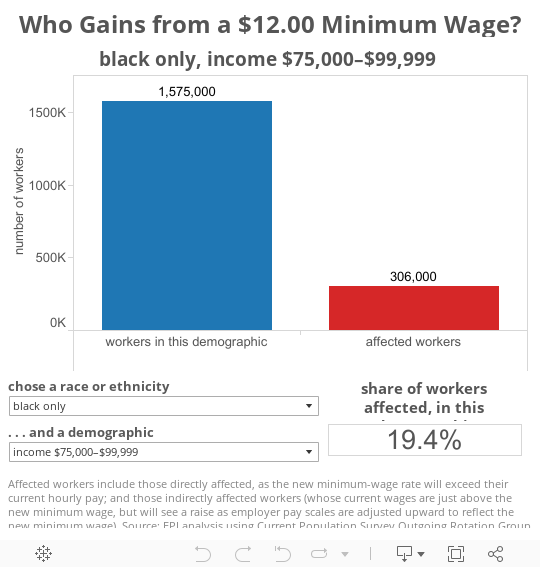
While much of our social and tax policy is either poorly targeted (it reaches the poor unevenly) or aimed in in the wrong direction (it benefits those who don’t need it), a minimum wage increase hits the bull’s-eye. As EPI’s new estimates of the impact of the “Raise the Wage Act” (bringing the minimum to $12.00/hour by 2020) underscore, the benefits of an increase would flow overwhelmingly to those—young workers, single parents, workers of color—who need it the most. The interactive graphic below summarizes this important new work: the first menu sorts workers by race, the second by income, age, family status, labor force participation, and educational attainment.
EPI Applauds the Issuance of Two New Rules Implementing the H-2B Visa Program
After more than five years of litigation in numerous jurisdictions by immigrant and worker advocates who challenged the Bush administration’s illegally promulgated regulations for the H-2B temporary foreign worker program, the Department of Homeland Security (DHS) and the Department of Labor (DOL) have jointly promulgated two new rules—the H-2B “Comprehensive Interim Final Rule” and the “Wage Methodology Final Rule”—which establish important but modest protections for low-wage U.S. workers and guestworkers.
The H-2B temporary foreign worker program—which has been only minimally regulated since 2008—has facilitated the exploitation and human trafficking of guestworkers who work for U.S. employers in various industries, including landscaping, hospitality, forestry, seafood, fairs and carnivals, and construction. A judgment of $14 million in damages was recently awarded to five Indian H-2B guestworkers by a federal jury in Louisiana; the case is just one example of the many abuses that have been inflicted upon H-2B workers over the years.
EPI applauds the new worker protections provided by the H-2B Comprehensive Interim Final Rule, which goes into effect immediately but will be finalized after a 60-day comment period. This rule was originally proposed and finalized in 2012, after notice to the public and the collection and analysis of comments, but was postponed by congressional appropriations riders and enjoined by federal courts at the request of employer associations. While the rules impose some new duties on H-2B employers, the burdens are minimal and justified. The rules will result in more U.S. workers being hired for open positions and prevent the exploitation of H-2B workers. We echo the sentiment of 10 senators who asked DHS and DOL to “mirror the 2012 rule as much as possible” when the rule is finalized after 60 days.
The new protections for H-2B guestworkers include: the right to a copy of their work contract in a language they can understand; a guarantee that they will be paid for at least three-quarters of the hours promised in their work contracts; and reimbursement for inbound travel expenses after a worker completes 50 percent of the employment contract, and employer-paid outbound transportation if the worker remains employed until the end of the job order or if the worker is dismissed before the end of the job order.
Skepticism About Trade Deals is Warranted
In 1993, it seemed obvious to me that NAFTA was about one main thing: providing a huge new (and much cheaper) labor force to U.S. manufacturers by making it safe for them to build factories in Mexico without fear of expropriation or profit-limiting regulation. But the Clinton administration claimed it would open a new market to U.S. business, and U.S. Trade Representative Mickey Kantor, President Clinton, and even Labor Secretary Bob Reich argued that it would create jobs for American workers and even increase job creation in the U.S. auto and steel industries. They said NAFTA would benefit Mexican workers and help create a bigger Mexican middle class, while deterring migrant workers from crossing the border to seek jobs in the United States with better wages. They also argued an alternative theory: that NAFTA would help keep U.S. manufacturers from moving to Southeast Asia, and that it was better to keep that off-shored work in our hemisphere and along our border.
What actually happened?
- The trade balance with Mexico went from positive to very negative, resulting in the loss of more than 600,000 jobs in the United States.
- Mexico’s corn farmers were overwhelmed by a flood of cheaper U.S. corn and almost 2 million agricultural workers were displaced. Most of them migrated illegally to the United States and remain here as exploited, undocumented workers.
- Wages fell for Mexican industrial workers, to the point that autoworkers in Mexico now make less than Chinese autoworkers. Some Japanese carmakers start paying Mexican workers at 90 to 150 pesos per day, or $6 to $10.
- U.S. auto companies shifted investment to Mexico to exploit its much cheaper labor. AP reports that “Mexican auto production more than doubled in the past 10 years. The consulting firm IHS Automotive expects it to rise another 50 percent to just under 5 million by 2022. U.S. production is expected to increase only 3 percent, to 12.2 million vehicles, in the next 7 years.” Since NAFTA’s enactment, employment in the U.S. motor vehicle and parts industry has declined by more than 200,000 jobs.
More recent claims about the expected benefits of free trade agreement with Korea have proven hollow, too. Instead of creating 70,000 jobs, the net effect has been a higher trade deficit and the loss of 60,000 jobs. Worse, the harshest impact of that deal won’t be felt for several more years, when protective tariffs on pickup trucks are eliminated, making Korean imports 25 percent cheaper than they are today. U.S. auto workers will be hard hit.
And then there’s Permanent Normal Trade Relations with China and China’s admission to the WTO, which led to an explosion of imports and the loss of more than 3 million jobs, mostly in manufacturing and mostly in occupations that paid more than the jobs created in exports industries.
One bad experience after another: that’s why so many are so opposed to fast track and more NAFTA-style free trade deals.
From Ferguson to Baltimore: The Fruits of Government-Sponsored Segregation
In Baltimore in 1910, a black Yale law school graduate purchased a home in a previously all-white neighborhood. The Baltimore city government reacted by adopting a residential segregation ordinance, restricting African Americans to designated blocks. Explaining the policy, Baltimore’s mayor proclaimed, “Blacks should be quarantined in isolated slums in order to reduce the incidence of civil disturbance, to prevent the spread of communicable disease into the nearby White neighborhoods, and to protect property values among the White majority.”
Thus began a century of federal, state, and local policies to quarantine Baltimore’s black population in isolated slums—policies that continue to the present day, as federal housing subsidy policies still disproportionately direct low-income black families to segregated neighborhoods and away from middle class suburbs.
Whenever young black men riot in response to police brutality or murder, as they have done in Baltimore this week, we’re tempted to think we can address the problem by improving police quality—training officers not to use excessive force, implementing community policing, encouraging police to be more sensitive, prohibiting racial profiling, and so on. These are all good, necessary, and important things to do. But such proposals ignore the obvious reality that the protests are not really (or primarily) about policing.
In 1968, following hundreds of similar riots nationwide, a commission appointed by President Lyndon Johnson concluded that “[o]ur nation is moving toward two societies, one black, one white—separate and unequal” and that “[s]egregation and poverty have created in the racial ghetto a destructive environment totally unknown to most white Americans.” The Kerner Commission (headed by Illinois Governor Otto Kerner) added that “[w]hat white Americans have never fully understood—but what the Negro can never forget—is that white society is deeply implicated in the ghetto. White institutions created it, white institutions maintain it, and white society condones it.”
Stagnant GDP at the Start of 2015 is the Latest Evidence That the Economy Hasn’t Reached Escape Velocity
The Commerce Department estimates that U.S. gross domestic product (GDP, the widest measure of overall economic activity) was near stagnant in the first three months of 2015, growing at only a 0.2 percent annualized rate. This is a clear deceleration from the 2.2 percent growth rate in the previous quarter. Final sales (GDP minus the volatile inventory components of GDP) actually declined in the first quarter.
Most of this deceleration is likely transitory—due in part to particularly bad weather in the first quarter. Growth in the rest of 2015 will most likely be faster than previously projected, as the economy bounces back from this weak start to the year. Yet data on GDP in recent years confirms that the U.S. economy has not reached escape velocity—growth rates have not broken past the 2-2.5 pace that normally is associated with rapid declines in economic slack. Because growth has been steady for years, it might be tempting for some policymakers to shrug their shoulders and declare that this is the “new normal” and the best we can do. The economic evidence clearly suggests otherwise—this economy still needs active measures to boost demand to achieve a full recovery. At a minimum, this means the Federal Reserve should put off interest rate increases for the rest of 2015.
Workers Memorial Day: We Need Strong Workplace Safety and Health Protections
Here are a few recent reports about the grim toll of industrial fatalities and the hazards workers are exposed to every day, from the Cal-OSHA Reporter and other sources. Hopefully, they will remind you why we need a strong federal enforcement effort and much better programs of workers compensation for occupational injuries and illnesses. A recent NPR/ProPublica report was a wake-up call about how state legislatures are gutting the programs that compensate employees for lost limbs, lost eyes and damaged hearing, compensate them for lost wages, and pay for the medical care of injured workers.
Bumble Bee Foods facing criminal charges over worker death: “Los Angeles County District Attorney Jackie Lacey on April 27 announced that Bumble Bee Foods LLC and two others are facing criminal charges related to willfully violating worker safety rules and causing the 2012 death of an employee who became trapped inside an industrial oven at the company’s Santa Fe Springs plant.”
OSHA: York workers exposed to asbestos: “A York County company is facing a nearly half-million-dollar fine for allegedly failing to protect employees from asbestos. The York City-based First Capital Insulation Inc. allowed workers to remove asbestos improperly, failed to make sure employees’ respirators fit correctly and did not decontaminate employees and their clothing before they left a work site, the Occupational Safety and Health Administration stated in a news release this week.”
Police: Man dies in Oklahoma City industrial accident: “Oklahoma City police say a worker has died at an area commercial printing business after being trapped under a piece of machinery.”
Worker killed in cinder block wall collapse, Ramsey police say: “A 56-year-old construction worker was killed in a wall collapse at a Ramsey, New Jersey building on Wednesday, officials said.”
Just the Facts: Trade and Investment Deals Are Bad for Working Families
Last week, the president claimed that critics who say that the Trans-Pacific Partnership (TPP) “is bad for working families… don’t know what they are talking about.”
But the truth is, there is an emerging consensus that globalization has put downward pressure on the wages of most working Americans, and has redistributed income from the bottom to the top. My colleague Josh Bivens has shown that expanded trade with low-wage countries has reduced the annual wages of a typical worker by $1,800 per year. Given that there are roughly 100 million non-college-educated workers in the U.S. economy, the scale of wage losses suffered by this group likely translates to roughly $180 billion. Trade and investment deals such as the Korea-U.S. Free Trade Agreement (completed by President Obama), and the agreement to bring China into the World Trade Organization in 2001 (negotiated by President Clinton), have contributed these lost wages. It’s not surprising that one commentator concluded that “the Trans-Pacific Partnership trade deal is an abomination,” precisely because of its impacts on “low-skilled manufacturing workers and income inequality.”