What to watch on Jobs Day: The call for a rate increase is not backed up by wage data
On Friday, the Bureau of Labor Statistics will release the November numbers on the state of the labor market. On December 15, the Federal Open Market Committee will meet to determine whether they should raise interest rates, and most prognosticators think that this time they will actually go through with it. Last month’s stronger than expected jobs report led many to declare, prematurely, that it is time to start raising rates in order to ward off incipient inflation. The reality is that we need to see strong wage growth that is consistent and strong enough so that labor share of income returns to pre-recession levels and the labor market achieves a full recovery. Then, and only then, should we begin a conversation about raising rates.
Over the last six years, nominal wage growth has continued hover around 2.0 to 2.2 percent, far below target (see below on the target). Yes, October’s year-over-year growth was stronger—2.5 percent for nonfarm employees, although it was lower for production and nonsupervisory workers (2.2 percent). But again, one month of data is not sufficient evidence, and even 2.5 percent is still far below the wage target.
The Department of Homeland Security’s proposed STEM OPT extension fails to protect foreign students and American workers
For decades, the Optional Practical Training (OPT) program has permitted foreign graduates of U.S. universities, who visit the United States to study through the F-1 nonimmigrant visa program, to be employed in the United States for up to 12 months immediately after graduation. In 2008, the George W. Bush administration extended the OPT program period to 29 months for F-1 graduates of a science, technology, engineering, or math (STEM) program—known as the STEM OPT extension—through an Interim Final Rule (IFR) promulgated by the Department of Homeland Security (DHS). On August 12, 2015, the U.S. District Court for the District of Columbia struck down the 2008 IFR, ruling that the regulation was illegally created in violation of the Administrative Procedure Act. Judge Ellen Segal Huvelle vacated the IFR effective February 12, 2016.
On October 19, 2015, President Obama proposed new DHS regulations that would reinstate the STEM OPT extension and increase its duration from 29 months to 36 months per STEM degree for foreign STEM graduates, and allow the extension eligibility to apply to up to two STEM degrees. Effectively, this would allow foreign graduates with STEM degrees to be employed for up to six years while on an F-1 visa. The DHS regulatory notice solicited comments from the public. In our comment, we argue that the president’s STEM OPT extension proposal is problematic for several reasons:
Closing loopholes in Buy American Act could create up to 100,000 U.S. jobs
By closing loopholes in the Buy American Act, the 21st Century Buy American Act will increase demand for U.S. manufactured goods and create at least 60,000 to 100,000 U.S. jobs. The Buy American Act requires “substantially all” direct purchases by the federal government (of more than $3,000) “be attributable to American-made components.” However, there are a number of exclusions or loopholes in the Buy American Act. The single largest is an exception for “goods that are to be used outside of the country,” and the 21st Century Buy American Act includes provisions to close it. In addition, current regulations interpreting the Buy American Act state that “at least 50 percent of the cost must be attributable to American content,” which can reduce net demand for American made content.
Between 2010 and 2015, the “goods used outside of the country exception” was used to purchase $42.3 billion in goods that were manufactured outside of the United States, an average of $8.5 billion per year.1 The 21st Century Buy American Act would require most or all of those goods to be U.S. made, increasing demand for U.S. manufactured goods by up to $8.5 billion per year.2 Although labor markets have improved in the United States since the recession, there remains substantial slack and 2.6 million jobs were still needed to catch up with growth in the potential labor force in September 2015. I assume, based on recent research by my colleague Josh Bivens (Table 5) that wages earned by new manufacturing workers will support a macroeconomic multiplier of 1.6 in the domestic economy over the next year.3 I also assume, based on total GDP and employment levels in 2014 that a 1 percent increase in GDP adds 1.3 million jobs to the economy. Thus, the $8.5 billion increase in spending on domestic manufactured goods (with 100 percent domestic content) would increase GDP by $13.6 billion (0.08 percent), creating up to 100,000 new jobs in the domestic economy.
Remarks by Congresswoman Rosa DeLauro at the unveiling of EPI’s Women’s Economic Agenda
Congresswoman Rosa DeLauro (D-Conn.) spoke at the unveiling of EPI’s Women’s Economic Agenda on November 18, 2015. Her remarks, as prepared for delivery, are posted below.
Good morning. Maya, thank you for that kind introduction. I have to first recognize EPI and Larry who have been a godsend in providing members of Congress great economic information that focuses on the impacts of public policies on low and middle class Americans and their families. The topics they cover are wide-ranging—from the impact of various trade agreements to the current jobs crises, where people are in jobs that don’t pay them enough to live on.
Let me also acknowledge my colleagues and the advocates who join me at the podium. Senator Warren—a woman who needs no introduction. The Boston Globe describes her as “a fierce advocate for the lot of working families.” Senator Warren has a reputation for knowing how to get things done.
Elise Gould at EPI—thank you for your tireless work on this Women’s Economic Agenda. Let me acknowledge Liz Shuler. Thank you for your leadership and advocacy at AFL-CIO. And all the advocates here today. Each of them put working families at the heart of everything they do.
Today we come together to push the policies as part of the Economic Policy Institute’s Women’s Economic Agenda to improve the lives of working women and families.
Reauthorizing ESEA: a first step in returning education to its roots
The Elementary and Secondary Education Act (ESEA) appears, finally, to be nearing reauthorization. Barring unforeseen circumstances, Congress will, after years of effort, begin to right some of the wrongs wrought by the excessive focus on standards and accountability in No Child Left Behind (ESEA’s current iteration). The draft framework sent to the conference committee swings the pendulum from federal overreach and prescription back toward state and local control. It claws back—but does not eliminate—accountability requirements by striking “Adequate Yearly Progress,” annual measurable objectives, and the unattainable goal of 100% proficiency from the act.
Not only would this ESEA do less wrong, it would do more right; key passages hold promise to return ESEA to its civil rights and antipoverty roots. Informed by rising rates of student poverty, the proposed framework recognizes that poverty poses a major impediment to effective teaching and learning.
It is true that much of the debate around reauthorization has been about testing, funding for charter schools and vouchers, the Common Core State Standards, and a range of other issues worthy of consideration. But these are not central to the core purpose of ESEA, which was originally passed as part of President Lyndon Johnson’s War on Poverty. Over the years, that purpose has been diluted. But as 10 organizations, led by the Broader, Bolder Approach to Education, wrote to education leaders of both houses last year, Congress has a unique chance to reverse course and bring ESEA back to its roots. We called on Congress to follow five key principles in ESEA reauthorization:
These five principles represent the original spirit and intent of the law, and they give states, districts, and schools the flexibility they need to address their specific concerns and meet the unique needs of their students. We propose that they be at the center of a reauthorized Elementary and Secondary Education Act.
Closing the pay gap and beyond: A brief explanation of the motivation behind EPI’s Women’s Economic Agenda
This morning, EPI released our Women’s Economic Agenda (and an accompanying research paper)—a set of policies designed to close the gender wage gap and ensure that women achieve real, lasting economic security.
In the last several decades women have made great strides in educational attainment and labor force participation. Nevertheless, when compared with men, women are still paid less, are more likely to hold low-wage jobs, and are more likely to live in poverty. And the problem is worse for women of color. As demonstrated in numerous research studies, gender wage disparities are present across the wage distribution and within education, occupations, and sectors, sometimes to a grave degree.
Closing the gender wage gap is absolutely essential to helping women achieve economic security. But to bring genuine economic success to American women and their families, we must do more. The gender wage gap is only one way the economy shortchanges women.
At the same time the gender wage gap has persisted, hourly wages for the vast majority of workers have stagnated, as the fruits of increased productivity and a growing economy have accrued to those at the top. It hasn’t always been this way. As you can see in the figure below, pay rose with productivity in the three decades following World War II. But since the 1970s, pay and productivity have grown further apart, as the result of intentional policy decisions that eroded the leverage of the vast majority of workers to secure higher wages.
A progressive women’s economic agenda, one that seeks to truly maximize women’s economic potential, must focus on both closing the gender wage gap and raising wages more generally.
Bad tax or no tax? The ACA excise tax debate, continued
Friend and former colleague Jared Bernstein made a defense of the ACA excise tax on expensive employer-provided health insurance plans a couple of days ago. It’s about as good a defense as there is of the excise tax, but at EPI we’re still largely unconvinced. He provides some arguments on the substance of the tax (which I’ll briefly touch on below), but mostly leans on a political argument, that this is a tax that actually exists, and given the anti-tax zealotry of congressional Republicans, we should be very leery of giving away any revenue that is currently on the books.
First, some economics, and then on to some politics.
Jared and I are roughly on the same page regarding the wage/health care trade off issue. As the excise tax is imposed on plan costs above a certain threshold, this will encourage people to shift into plans with lower upfront premiums. But these lower upfront premiums mean that more health costs are shifted onto households in the form of higher co-pays, deductibles, and co-insurance. The good news of lower premiums, however, is that this frees up money for employers to give more compensation to workers in the form of cash wages rather than health premiums. Elise Gould and I have argued in the past that this wage boost stemming from less-generous health plans is likely to be a long time coming, particularly if labor markets remain slack. Jared agrees. He argues this trade off likely will happen in the longer run. I agree (though I’m not 100 percent sure, and am troubled by the lack of robust empirical support in the research literature on this). My beef has mostly been with people who simply state that the excise tax will lead to a “raise” for American workers. That’s bunk. It will change the composition, not the level, of employee compensation. And it will increase total taxes on this compensation, hence cutting their take-home pay.
Hiring lags as economy slows over the summer
Today’s release of the September Job Openings and Labor Turnover Survey (JOLTS) data corroborates the story we saw in August and September’s jobs reports, as hiring slowed and the economy added a paltry number of jobs (note that the JOLTS data comes with a one-month lag relative to monthly jobs numbers, so the much-improved October jobs report data is not reflected in today’s release). Although the number of job openings increased to 5.5 million in September, this was after a large decrease to from 5.7 to 5.4 million in August. But the main data point we should focus on is the hires rate, which actually fell in September from 3.6 percent to 3.5 percent, the lowest it has been in a year.
In September, there were 1.4 active job seekers for every job opening. Although this decline is a welcome improvement in the JOLTS ratio, it is important to remember that there are still almost 8 million unemployed workers and over 3.5 million estimated “missing workers” who have left the labor force altogether because job opportunities have been so weak.
In fact, there is still a significant gap between the number of people looking for jobs and the number of job openings. The figure below shows the levels of unemployed workers and job openings. You can see the labor market improve over the last five years, as the number of unemployed workers falls and job openings rise. In a stronger economy (like the one shown in the initial year of data), these levels would be much closer together.
The National Association of Home Builders’ evidence supports DOL’s proposed rule on overtime
The National Association of Homebuilders (NAHB), both in congressional testimony and in the official comments it submitted to the Department of Labor, makes a strong case for the Obama administration’s proposed rule on the overtime rights of salaried workers. Yes, you read that right: NAHB makes an ironclad case that businesses will have little difficulty adjusting to the proposed rule change.
Naturally, NAHB, which claims to represent 140,000 members involved in “home building, remodeling, multifamily construction, property management, subcontracting, design, housing finance, building product manufacturing and other aspects of residential and light commercial construction,” testified before Congress that the DOL proposal would be the end of Western Civilization. But the data they presented tell a different story.
NAHB’s own survey of its members found that two-thirds would make no changes in their policies or operations. Many, of course, already pay their supervisors more than $50,440 a year and would be unaffected. Of the one-third that would make adjustments, most would do exactly what the rule contemplates: they would reduce the amount of overtime their supervisors work. Twice as many firms would raise the salary of their supervisors above the $50,440 threshold as would reduce their salary. And only 13 percent of the firms that said they would make a change would switch their supervisors from salary to hourly wage. In other words, just 4 percent of home builders would convert their salaried supervisors to hourly pay.
It is noteworthy that of the four top responses among the home builders who say they will make changes, two are undeniably positive—raising salaries and reducing overtime hours worked. Apparently, Ed Brady, the NAHB official who testified in the Small Business committee, is one of the few home builders in America who would contemplate outsourcing the role of construction supervisor in order to avoid paying overtime. Any contractor who employed that supervisor would have to deal with the same issues as Mr. Brady, and would charge for the costs they entail, plus a profit— so perhaps it’s not surprising that Mr. Brady is alone in planning to outsource his supervisors.
Clearly, the NAHB’s own evidence shows that DOL’s proposed changes in the overtime rules will have small, mostly positive effects on the homebuilding industry and its employees.
Looking beyond the topline employment number: Public-sector jobs remain depressed
An increase of 271,000 in payroll employment is a promising sign. One month is surely not predictive of the future, but if this continues, it is good news for the economy and the people in it. While the topline employment number for October is quite encouraging, other indicators continue to paint a picture of a plateaued economy, particularly the fact that there has been no growth in prime-age employment-to-population ratio (EPOP) this year.
The share of the 25–54 year old population actually employed is arguably one of the best measures of economic health. At 77.2 percent, it remains depressed— lower than the worst of the prior two recessions before the Great Recession. The effects of such low prime-age EPOPs may be far-reaching, affecting not only the incomes but also the health of the population.
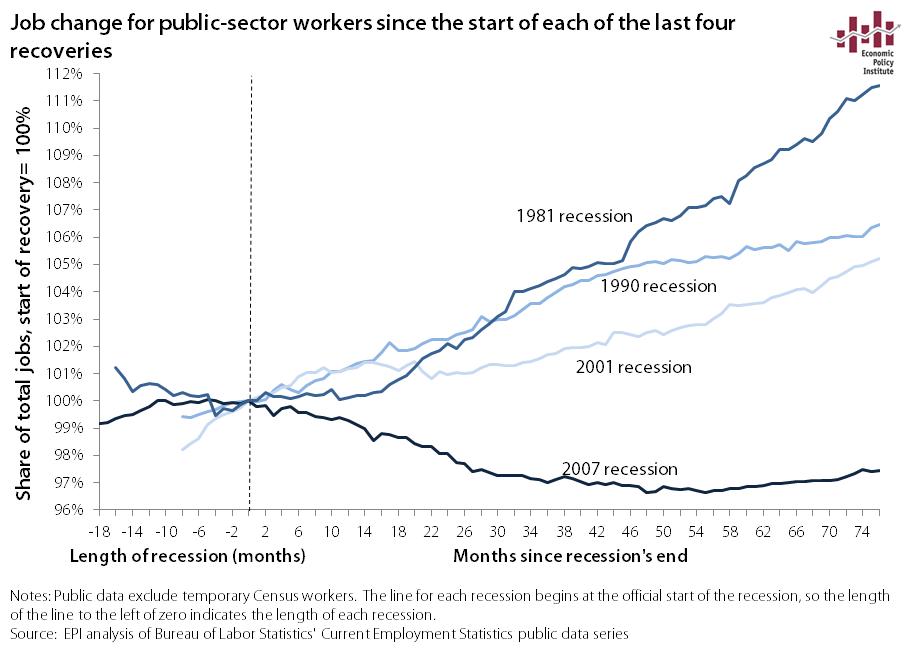
Public-sector employment also remains weak, and depressed government spending continues to be the leading cause of the sluggish pace of recovery in recent years. One thing that has been historically unique about this recovery is the unprecedented loss of and lack of recovery of public-sector jobs. The figure below compares public-sector employment in this recovery to the three prior recoveries. Recessions are marked by the lines to the left of the zero point on the x-axis, while recoveries are to the right. This graph clearly shows that the public sector has seen massive job loss in the current recovery. This is a direct result of austerity policy and a huge drag that has not weighed on earlier recoveries.