Why interest rate increases aren’t the solution to slow housing growth
This piece originally appeared in the Wall Street Journal’s Think Tank.
Some policy makers and observers have urged raising interest rates in June. Proponents argue that some inflation measures show faster growth than the Federal Reserve’s preferred measure and that a potential bubble in the commercial real estate market justifies a rate increase. Ultimately, both arguments hinge on thinking that too-slow growth in real estate construction should be solved by raising rates. Here’s why that is not convincing.
The Fed’s inflation target is 2% annual growth in “core” personal consumption expenditures (minus food and energy prices, which tend to be volatile). The last quarter with annual growth of 2% in such expenditures was in 2012, and consistent price growth greater than 2% has not been seen since 2008.
Another measure, the core consumer price index, has shown growth exceeding 2% in recent months, leading some to declare that the Fed’s price inflation target has been met (and exceeded).
What to Watch on Jobs Day: Is wage growth really strong enough for the Fed to raise rates?
On Friday, when we get the latest jobs numbers from the Bureau of Labor Statistics, I’ll have my eye on a few measures of slack in the labor market. As the economy continues to add more jobs than are needed to simply absorb working-age population growth, I expect to see increases in both the overall and the prime-age labor force participation rates. This in turn should lead to a continuation of the slow but steady rise in the employment-to-population ratio, a metric that has been rising but which remains far below full employment levels.
Besides these key quantity measures of labor market slack, I’m also monitoring key price measures of slack—particularly nominal wage growth—which the Federal Reserve will also be looking at when it meets later this month. The year-over-year measures of nominal wage growth we get with each month’s employment report are the most timely measures of labor market slack, and while there has been some slight uptick recently, wage growth is still far below what we should be targeting for a truly healthy economy.
Year-over-year private-sector nominal wage growth was 2.5 percent in April 2016. After maintaining relatively slow growth, in the 2.0 to 2.2 percent range for several years, an increase of 2.5 percent is a welcome improvement. However, given the Fed’s target for price inflation of 2.0 percent, long-term trend productivity growth, the length of slow growth, and the failure of labor’s share of corporate income to rebound, the labor market should produce wage growth in excess of 3.5 percent for a consistent period before concerns over wage led inflationary pressures lead the Fed to increase rates. Tightening before a period of strong wage growth will lead to price and wage targets hardening into ceilings, and that will cause grave damage to the economy. Such premature tightening will be avoided if the Fed’s decisions truly are data driven.
The overtime rule is the beginning of a much-needed cultural shift
A recent New York Times piece features some choice handwringing over the Labor Department’s new overtime rule, from executives in “prestigious” fields, like publishing, advertising, film and TV, and public relations. These are all fields where low-salaried junior employees are often encouraged or even expected to work well over 40 hours a week, and the executives quoted by the Times are worried that they will no longer be able to expect such long hours without paying overtime.
The change presents more than an economic challenge for the companies that rely on the willingness of young, ambitious workers to trade pay and self-respect for a shot at a prestige job down the road.
In the eyes of those who have survived the gauntlet of midday coffee runs and late-night emails, the administration’s overtime regulation represents nothing less than the beginnings of a cultural shift, and not necessarily a welcome one.
In order to ensure that low-paid employees are covered by the protections of the Fair Labor Standards Act’s overtime law, the Department of Labor mandates that workers must be paid time-and-a-half for every hour worked over 40 in a week, unless they qualify as an executive, administrator, or professional employee. In order to qualify for that exemption, a worker must make more than a salary threshold set by DOL and have sufficiently independent, high-level, and consequential duties, such that they truly are an executive, administrator, or professional worker. That salary threshold currently sits at $23,660 a year, but on December 1, 2016, it will be raised to $47,476 a year.
Fixing overtime won’t increase underemployment
The American Enterprise Institute’s Aparna Mathur wrote an article claiming that the new overtime rules finalized recently by the Department of Labor could increase underemployment. The argument does not make much sense, however. Mathur tries to add to the wonky feel of her case by citing a recent (and good) Federal Reserve research note (or FEDS note, as they call it) on underemployment, but this is pure water-muddying; the FEDS note has nothing to do with the overtime rule.
First, a quick clarification because many are misunderstanding how the new rule works. The rule is only relevant to salaried workers—all workers paid by the hour are already eligible for overtime. Before the rule, only salaried worker whose pay was less than $455 a week were automatically eligible for overtime pay. This did not mean merely that salaried workers earning more than this didn’t earn time-and-half for hours worked in a week in excess of 40—t means they earned zero for each of those hours. The rule raises the threshold for determining automatic eligibility for overtime to $913 a week. Now, all salaried workers earning less than this amount must be paid (at time-and-a-half rates) for hours worked in a week in excess of 40.
Mathur argues that this rule will increase involuntary underemployment, and highlights findings from a recent FEDS note arguing that underemployment is currently even worse than traditional measures signal. However, Mathur’s description of the paper’s results highlights why her analysis of the overtime rule is so wrong. She writes about the FEDs note: “Relying on the more recent HRS data, the authors show that between 1992 and 2012, approximately 25 percent of workers reported that they had faced work-hour constraints, meaning they wanted more work but were unable to find it.”
Not quite. The Fed authors are very clear on a crucially important point: that the proper definition of underemployment is workers having fewer hours of work available to them “relative to the numbers they would prefer to work at current wages.”
Larry Summers, the Congressional Progressive Caucus Budget, and the abandonment of fiscal policy
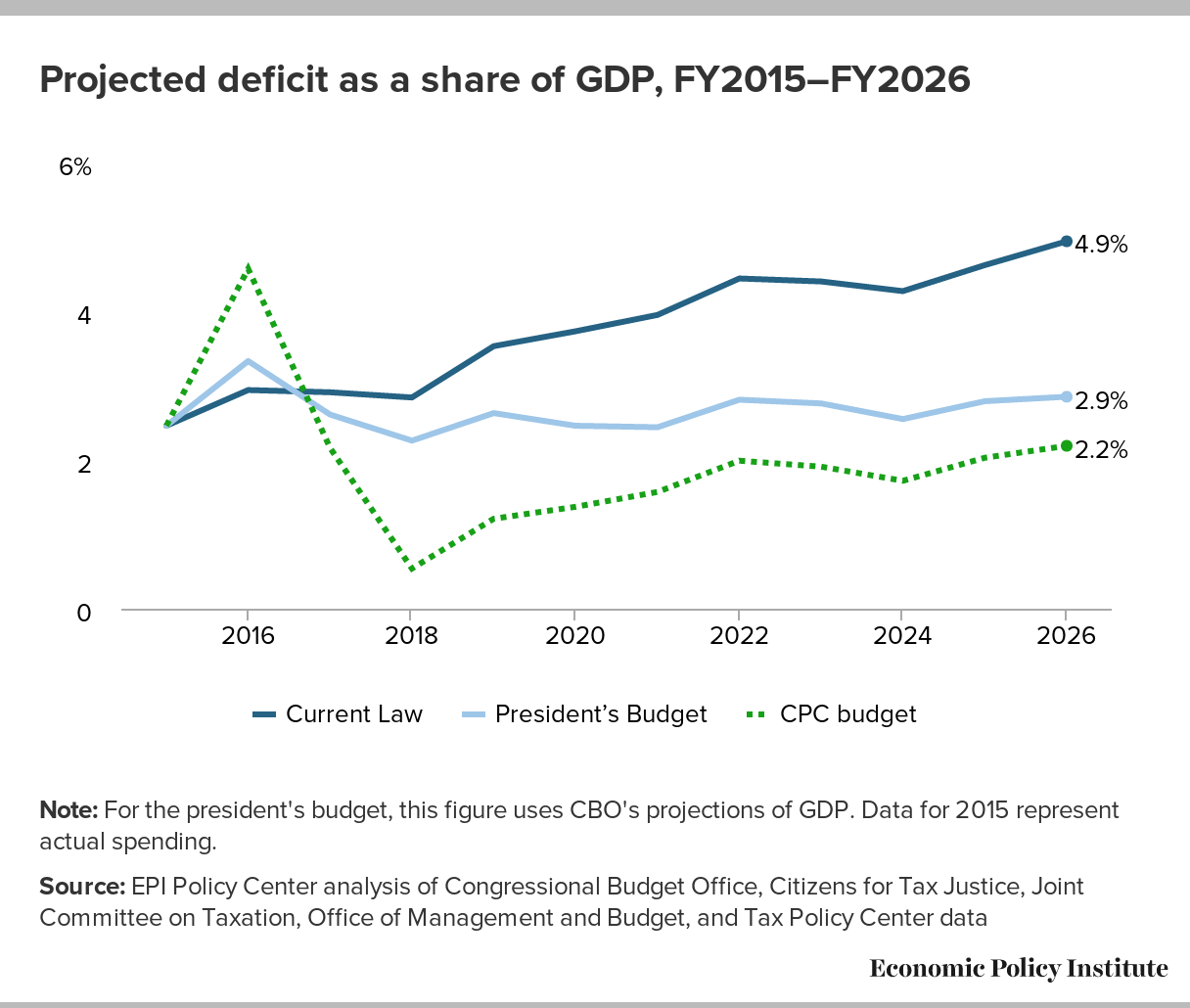
Federal budget season came and went this year without any budget proposal hitting the floor of the U.S. House of Representatives. This was an odd (and ironic) bit of incompetence by the GOP leadership, who couldn’t even wrangle a majority to support their own budget proposal. But it was especially damaging to U.S. economic policy debates because it limited attention paid to the budget of the Congressional Progressive Caucus (CPC).
It’s true that political gridlock has meant the only live macroeconomic policy debate in DC in recent years has been around monetary policy. And the Fed’s decisions are important! But the abandonment of fiscal policy as a tool that could boost the economy, which began not soon after the recovery from the Great Recession began, is a real tragedy.
The need to resuscitate fiscal policy was usefully underscored in a widely-discussed speech by former Treasury Secretary and National Economic Council Chair Larry Summers earlier this week. Because the CPC and Larry Summers are perhaps not always thought of as completely in sync in policy debates, it’s worth noting that Summers’s remarks can be read as a ringing endorsement of the CPC budget. Some examples:
- “I am here to tell you that the most important determinant of our long term fiscal picture is how successful we are at accelerating the economy’s growth rate in the next three to five years, not the austerity measures that we implement.”
The CPC budget includes substantial upfront fiscal stimulus (mostly front-loaded infrastructure investments projects) precisely to accelerate the economy’s growth rate in the near-term.
Universities oppose paying their postdocs overtime, but will pay football coaches millions of dollars
Colleges and universities have made the indefensible argument that they can’t afford to pay their low-level salaried employees for their overtime under the Department of Labor’s new overtime rule. Universities have singled out postdoctoral researchers, many of whom spend 60 hours a week or more running the labs that turn out the nation’s most important scientific advances, as a group of employees that would just cost too much if they had to be paid for the extra hours they work each week.
Analyzed on their own, these postdocs—who are among the best-educated and most valuable employees in the nation, on whom our future health and prosperity depend, in part—obviously deserve to be paid for their overtime hours. After all, at a salary of $42,000 a year, these postdocs are being paid about $13.50 an hour (less than fast food workers are demanding).
When juxtaposed against the inflated salaries of university administrators with less stellar academic credentials making $200,000 to $3 million a year, the case for overtime compensation is only stronger. The comparison that really drives home how unfairly universities are treating their postdocs, however, is with the universities’ football coaches.
Note: The highest available head coach salary was selected for each state. Source: Data from USA Today and HKM Employment Attorneys LLPUniversities oppose paying their postdocs overtime, but will pay football coaches millions of dollars: Top NCAA College Football Coaches' Salaries by State, 2015
State
University
Head coach
Salary
Alabama
University of Alabama
Nick Saban
$6,932,395
Alaska
University of Alaska
N/A
N/A
Arizona
Arizona State
Todd Graham
$3,000,000
Arkansas
University of Arkansas
Bret Bielema
$3,954,166
California
UCLA
Jim Mora
$3,350,000
Colorado
University of Colorado
Mike MacIntyre
$2,009,778
Connecticut
University of Connecticut
Bob Diaco
$1,550,000
Delaware
University of Delaware
Dave Brock
Unknown
Florida
Florida State
Jimbo Fisher
$5,150,000
Georgia
University of Georgia
Mark Richt
$4,000,000
Hawaii
University of Hawaii
Norm Chow
$550,000
Idaho
Boise State
Bryan Harsin
$1,100,004
Illinois
University of Illinois
Bill Cubit
$915,000
Indiana
Purdue
Darrell Hazell
$2,140,000
Iowa
University of Iowa
Kirk Ferentz
$4,075,000
Kansas
Kansas State
Bill Snyder
$3,000,000
Kentucky
University of Kentucky
Mark Stoops
$3,250,000
Louisiana
LSU
Les Miles
$4,300,000
Maine
University of Maine
Jack Cosgrove
$186,995
Maryland
University of Maryland
Randy Edsall
$2,110,648
Massachusetts
Boston College
Steve Addazio
$2,585,655
Michigan
University of Michigan
Jim Harbaugh
$7,004,000
Minnesota
University of Minnesota
Jerry Kill
$2,500,000
Mississippi
University of Mississippi
Hugh Freeze
$4,300,000
Missouri
University of Missouri
Barry Odom
$2,350,000
Montana
University of Montana
Bob Stitt
$175,000
Nebraska
University of Nebraska
Mike Riley
$2,700,000
Nevada
University of Nevada
Brian Polian
$575,000
New Hampshire
University of New Hampshire
Sean McDonnell
$200,000
New Jersey
Rutgers
Kyle Flood
$1,250,000
New Mexico
University of New Mexico
Bob Davie
$772,690
New York
University of Buffalo
Lance Leipold
$400,000
North Carolina
North Carolina State
Dave Doeren
$2,200,000
North Dakota
University of North Dakota
Kyle Schweigert
$1,500,000
Ohio
Ohio State
Urban Meyer
$5,860,000
Oklahoma
University of Oklahoma
Bob Stoops
$5,400,000
Oregon
University of Oregon
Mark Helfrich
$3,150,000
Pennsylvania
Penn State
James Franklin
$4,400,000
Rhode Island
University of Rhode Island
Jim Fleming
$175,000
South Carolina
University of South Carolina
Steve Spurrier
$4,000,000
South Dakota
University of South Dakota
Joe Glenn
$145,010
Tennessee
University of Tennessee
Butch Jones
$4,100,000
Texas
University of Texas
Charlie Strong
$5,100,000
Utah
University of Utah
Kyle Whittingham
$2,600,000
Vermont
University of Vermont
N/A
N/A
Virginia
University of Virginia
Mike London
$3,196,724
Washington
University of Washington
Chris Petersen
$3,400,000
West Virginia
University of West Virginia
Dana Holgorsen
$2,880,000
Wisconsin
University of Wisconsin
Paul Chryst
$2,300,000
Wyoming
University of Wyoming
Craig Bohl
$882,000

Uber and arbitration: A lethal combination
The recent settlements in the California Uber litigation demonstrate the perils of mandatory arbitration for our entire framework for regulating employment. Unfortunately, media coverage of the Uber controversies has not highlighted the damage that arbitration agreements have wrought to the individual workers involved and to our employment laws generally. But it is now more clear than ever that everyone who cares about employment rights and the fair treatment of workers should support federal legislation to end mandatory arbitration in employment and put workers and corporations on a more equal footing.
Uber has been in the news a lot lately. In the past month, it has settled a big class action lawsuit by California and Massachusetts drivers that was scheduled to go to trial in June, and it has agreed to permit its New York City drivers to form what they term a “drivers association”—that is to say, not a labor union. In each situation, Uber has preserved its right to treat its drivers as independent contractors. Uber also has pulled out of Austin rather than submit its drivers to the same fingerprinting requirements the city imposes on taxi drivers. Last fall, it pulled out of Alaska rather than provide its drivers with workers’ compensation.
This has also been a busy time for Uber litigation. There are currently dozens of lawsuits pending in state and federal courts, seeking to gain for its drivers all the various federal and state rights and benefits that accompany employee status. And the National Labor Relations Board is currently considering whether Uber drivers satisfy the test for employee status under the labor law.
The practices of Uber and other employers of on-demand workers raise many difficult issues under the labor and employment laws. The most important is the question of whether gig workers are employees or independent contractors. At stake is whether Uber has to provide the benefits of state and federal labor laws to its drivers. These include rights to minimum wage, overtime pay, and in many states, paid rest breaks, expense reimbursement, tips, workers compensation, and health and safety protections. The issue of employee status also implicates the ability of gig workers to form a labor union or whether their attempts to unionize make the workers liable for antitrust violations.
GAO report on segregation misses the bigger picture
Last week, the Government Accountability Office (GAO) issued a misleading report on school segregation, which I discussed with NAACP Legal Defense Fund President Sherrilyn Ifill and others on the Diane Rehm Show.
The takeaway line of the GAO report was:
From school years 2000-01 to 2013-14, the percentage of all K-12 public schools that had high percentages of poor and Black or Hispanic students grew from 9 to 16 percent.
(When the GAO referred to “poor” students, it was not really speaking of poor students, but rather of those from families with incomes less than nearly twice the poverty line and who are eligible for subsidized lunches in schools.)
Not by coincidence, the GAO report was released on Tuesday, May 17, the 62nd anniversary of the Supreme Court’s Brown v. Board of Education decision banning school segregation. So it was not unreasonable for those who did not read the GAO report very carefully to conclude that it described a dramatic increase in racial segregation over the last 13 years.
But it did not, and could not.
Arguments that better overtime pay protection means less flexibility are untrue
The Department of Labor has issued a new rule, which expands the right to be paid time-and-a-half for overtime to salaried employees who earn less than $47,476 a year. Business groups that oppose the new rule claim that salaried employees will lose important work schedule flexibility when they become eligible for overtime pay. But the evidence shows this fear is unfounded, and, in fact, salaried workers who earn less than $50,000 a year currently have barely more flexibility at work than hourly paid employees.
An EPI analysis using General Social Survey data by Penn State labor economist Lonnie Golden shows that:
- Almost half—47 percent—of salaried workers earning less than $50,000 a year report that on a daily basis they “never” or “rarely” are allowed to change their work starting time and quitting times, while only 20 percent of salaried workers who earn $60,000 or more per year report never or rarely being allowed to change their schedules.
- Salaried workers earning less than $50,000 a year have no more ability to take time off during work for personal or family matters than hourly workers at the same level. Thus, “switching” employees from salaried to hourly status or requiring employers to track or monitor their hours for purposes of overtime pay would not reduce this valuable type of work schedule flexibility for employees. If we consider regularly being required to work overtime an indicator of inflexibility in one’s work schedule, salaried workers earning between $25,000 and $50,000 a year have about the same or an even greater likelihood of working mandatory overtime than their hourly counterparts. Thus, raising the overtime pay salary threshold for exemption to $47,476 should, if anything, provide the newly eligible workers somewhat greater flexibility to refuse unwelcome work beyond their usual number of hours per week.
In light of these conditions and findings, it is unsurprising that salaried workers generally report higher levels of work-family conflict and work stress than do hourly paid workers. It is also important to note that nothing in the new rule requires any employer to change any employee from salaried pay to hourly pay. That decision is entirely within an employer’s discretion. Many employers, including small business owners such as the National Retail Federation’s witness at a congressional hearing last October, already track the hours of salaried employees and provide comp time and bonuses based on overtime hours.
Explaining the differences between EPI and DOL estimates of workers affected by the new overtime salary threshold
In our report on the new overtime rule, EPI estimates that it will directly benefit 12.5 million workers. At first blush, our evaluation of the impact of the rule differs significantly from the widely circulated Department of Labor (DOL) assessment that 4.2 million workers will directly benefit from raising the salary threshold—meaning they are currently legitimately exempt because of their duties, but will be covered by the new threshold. DOL also notes that 8.9 million workers, meanwhile, will have their rights strengthened by the higher salary threshold, for a total of 13.1 million directly affected by the rule (600,000 more than our estimate). Additionally, of the 8.9 million salaried workers whose overtime rights would be strengthened, DOL notes that about 732,000 regularly work more than 40 hours a week, but are currently incorrectly classified as ineligible for overtime—bringing the total number of workers DOL estimates will be newly eligible for overtime pay up to 5 million.
We believe that many more workers will be newly eligible for overtime pay. Our assessment differs from DOL’s because the department assumes, incorrectly in our view, that overtime eligibility was not eroded by changes to the OT rules implemented by the Bush administration in 2004. We provided detailed evidence last year showing that overtime eligibility has been severely eroded since the late 1990s, when DOL computed the exemption probability estimates by occupation that it still relies on today. We concluded that:
…reliance on judgments made in 1998 provides an unreasonably sunny view of today’s workplaces that ignores changes in the law implemented in 2004, various court decisions, and the corresponding behavior of employers to limit the ability of workers to obtain overtime pay.
The 4.2 million employees DOL estimates will be newly entitled to overtime pay are limited to those who both meet duties tests establishing that their primary duty is executive, administrative or professional, and earn a salary higher than the old exemption threshold ($23,660 a year) but less than $47,476. For example, an accountant earning $40,000 or a bank branch manager earning $45,000 are legitimately exempt under the current rules but will be entitled to overtime pay because their salary is below the new threshold.