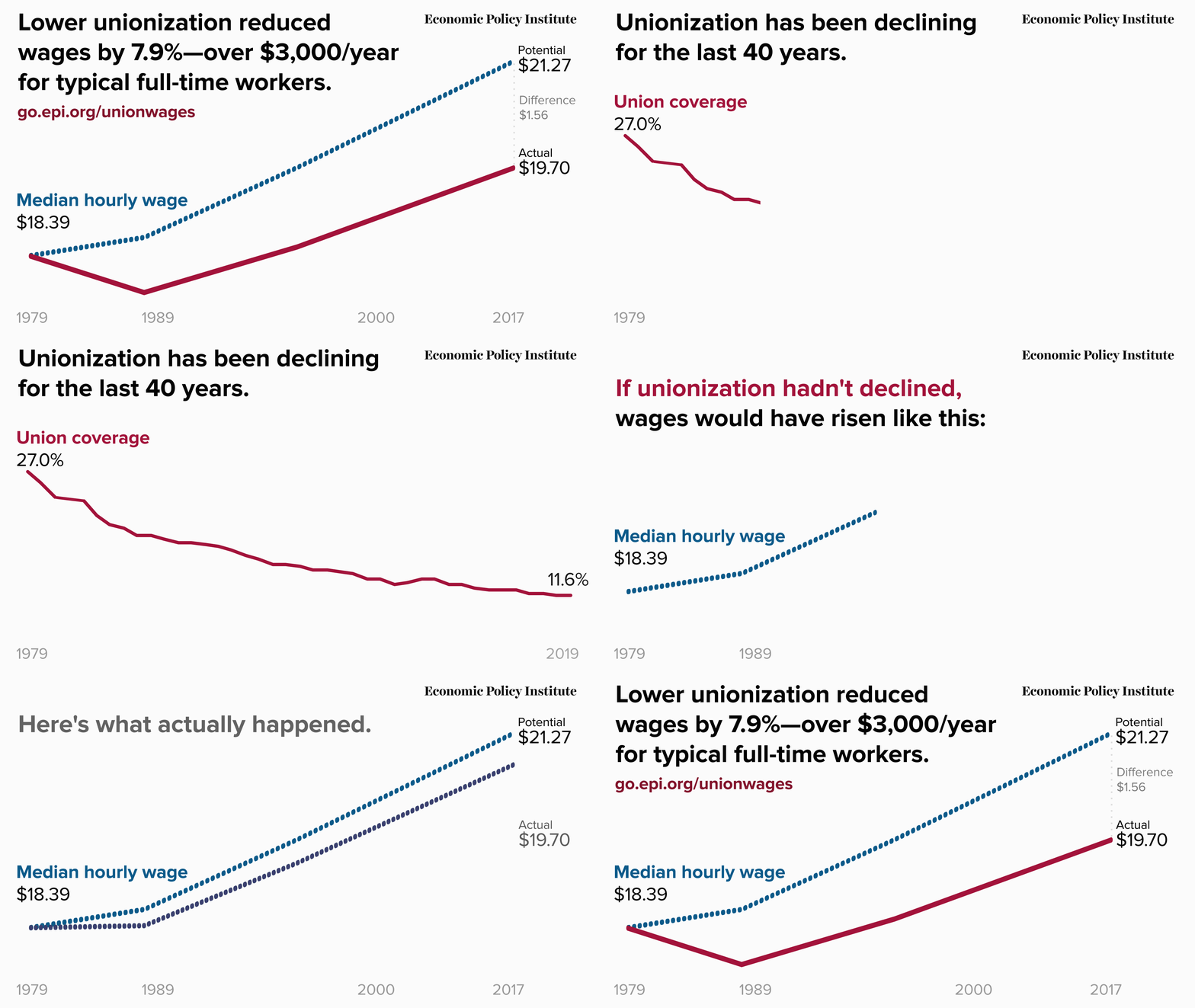
Lower unionization over the last 40 years decreased wages by 7.9%
In 1979, 27.0% of workers were covered by union contracts. By 2019, that number had dropped to 11.6%. New research finds that this single factor dragged down the typical full-time workers’ wages by over $3,000/year.
Read the report:
The enormous impact of eroded collective bargaining on wages
Job openings and hires ticked up in February
Today’s Job Openings and Labor Turnover Survey (JOLTS) reports a promising pickup in both job openings and hires in February 2021, a sign that the recovery is finally moving ahead. The increase in hires was notable in accommodation and food services, but decreases in state and local government education are particularly troubling (though we know from March jobs data that state and local government hiring began to pick up in March). Overall, hires remain below its level before the recession hit, but job openings have now edged above its pre-recession levels. Once public health experts indicate it is safe to reopen and the American Rescue Plan (which was passed after today’s JOLTS data were collected) takes effect, I’m confident those openings will grow and translate into hires. Layoffs have held steady over the last couple of months.
One of the most striking indicators from today’s report from the Bureau of Labor Statistics (BLS) is the job seekers ratio—the ratio of unemployed workers (averaged for mid-February and mid-March) to job openings (at the end of February). On average, there were 9.8 million unemployed workers compared with only 7.4 million job openings. This translates into a job seekers ratio of about 1.3 unemployed workers to every job opening. Put another way, for every 13 workers who were officially counted as unemployed, there were only available jobs for 10 of them. That means, no matter what they did, there were no jobs for 2.5 million unemployed workers.
As with job losses, workers in certain industries are facing a steeper uphill battle. In the construction industry as well as arts, entertainment, and recreation, there were more than three unemployed workers per job opening. In educational services, accommodation and food services, other services, and transportation and utilities, there were more than two unemployed workers per job opening. As bad as these numbers are, they miss the fact that many more weren’t counted among the unemployed: The economic pain remains widespread with 23.6 million workers hurt by the coronavirus downturn.
On the whole, the U.S. economy is seeing a significantly slower hiring pace than we experienced in May or June. While the pickup in job openings is a promising sign, hiring in February was below where it was before the recession. There was an increase in jobs in the mid-March employment report, but we still have a long way to go before recovering the large job shortfall—11.0 million when using a reasonable counterfactual of job growth if the recession hadn’t occurred—that remains.
Calls to establish a regionally adjusted federal minimum wage are dangerously misguided
We need to raise the federal minimum wage. Its deterioration in value over the past five decades has exacerbated poverty, widened inequality, and lowered wages for the bottom third of wage earners1—despite the fact that these workers typically are older and have more education than their counterparts a generation ago.
One misguided critique of the effort to raise the federal minimum to $15 in 2025 is that there is a need to establish a regionally adjusted federal minimum wage set to local conditions. In fact, federal minimum wage policy has always provided for tailored standards, by coupling a strong national wage floor with the ability for cities and states to adopt higher standards. Our ability to set a national wage floor is much easier now than it was decades ago when lawmakers last raised the federal minimum wage to new heights. In 1968, when the federal minimum wage was lifted to its highest value in U.S. history and coverage of the law was vastly expanded, there were much larger differences in wage levels throughout the country. Yet, we now have empirical evidence that establishing this unprecedented, nationwide minimum wage did not have adverse employment impacts.
Today, the wage levels of lower-wage states, primarily Southern ones, are much closer to overall national wage levels, so there is even less validity to claims that the federal minimum wage must be lowered to accommodate certain areas. Moreover, the ‘bite’ of a $15 minimum wage in 2025—i.e., the share of workers and businesses impacted, and the magnitude of resulting wage increases—will be well within the range of recent experiences of minimum wage increases in states and localities that studies have shown had little, if any, impact on employment. The proposed increase to $15 by 2025 will lead to improved annual earnings for nearly all low-wage workers.
Strong job growth in March as vaccine distribution expands and the American Rescue Plan ramps up
A solid 916,000 jobs were added in March, the strongest job growth we’ve seen since the initial bounceback faded last summer. Even with these gains, the labor market is still down 8.4 million jobs from its pre-pandemic level in February 2020. In addition, thousands of jobs would have been added each month over the last year without the pandemic recession. If we count how many jobs may have been created if the recession hadn’t hit—consider average job growth (202,000) over the 12 months before the recession—we are now short 11.0 million jobs since February.
Even at this pace, it could take more than a year to dig out of the total jobs shortfall. However, today’s number is certainly a promising sign for the recovery, especially as vaccinations increase and vital provisions in the American Rescue Plan (ARP) have continued to ramp up since the March reference period to today’s data. The benefits of the ARP will continue to be captured in coming months.
What to watch on jobs day: Signs of an improving labor market
Pursuing public health initiatives—including the production and distribution of the vaccine—is the most important priority for our health and economic well-being. Further, investments in state and local governments as well as direct assistance to workers and their families have been essential to their financial security and the economic recovery itself. Given advancements on both fronts in recent weeks and months, I expect the labor market recovery to finally pick up steam.
A year into the recession, the labor market is still down 9.5 million jobs from where it stood immediately before the COVID-19 shock. If we add in jobs that should have been created over that time to absorb new workers, we’re facing a jobs shortfall today of nearly 12 million jobs.
As the labor market finally picks up, the key indicators to watch are where the jobs are returning and for whom. The biggest deficit remains in leisure and hospitality, with 3.5 million fewer jobs relative to its February 2020 level. The economic pain caused by losses in this lowest-paying sector was enormous.
Meanwhile, public-sector employment—primarily education employment at the state and local level—remains 1.4 million jobs below pre-pandemic levels. I’m optimistic that the state and local relief that was part of the American Rescue Plan will provide tremendous support to this sector in terms of employment and the vital public services they provide.
Businesses can thrive with a higher minimum wage, and government can help
A great deal of research shows that higher minimum wages benefit workers by adding to their income while causing little unemployment, as this report and this report show. Employers can adjust to paying higher wages in three ways: (1) increasing prices, (2) accepting reduced profits, or (3) offsetting higher-wage costs with increased ability by adopting “high-road” practices.
In this blog post, I argue that insufficient attention has been paid to this third channel, and that government efforts to help firms “take the high road” could ease firms’ transition to higher wages in a way that also benefits workers and consumers.
Much research documents the ways that firms can utilize high-road policies or good-jobs strategies to tap the knowledge of all their workers to create innovative products and processes. In retail, for example, firms such as Costco and Trader Joe’s pay far above minimum wage, yet remain profitable, as MIT’s Zeynep Ton has shown. The key to their success is a mix of complementary practices in marketing (reducing the number of products and promotion so that stores can manage inventory efficiently), human resources (cross-training workers so they can respond to a variety of demands), and operations (avoiding unneeded steps, in part by soliciting feedback from employees).
The H-1B visa program remains the “outsourcing visa”: More than half of the top 30 H-1B employers were outsourcing firms
Key takeaways:
- Most of the biggest users of the H-1B visas—the U.S.’s largest temporary work visa program—are companies that have an outsourcing business model.
- These companies exploit the H-1B program’s weaknesses to facilitate the transfer of U.S. jobs offshore as a lower cost alternative to hiring U.S. workers, and sometimes to replace incumbent U.S. workers with H-1B workers who are paid wages that are far below market wage rates.
- The latest data show that over 33,000 new H-1Bs were issued to the top 30 H-1B employers, accounting for nearly 40% of all new H-1Bs in 2020 that are subject to the annual limit of 85,000.
- Of the top 30 H-1B employers, 17 of them were outsourcing firms. Those 17 outsourcing firms alone were issued 20,000 H-1B visas, nearly one-quarter of the total 85,000 annual limit.
- President Joe Biden can and should implement regulations so that outsourcing companies can no longer exploit the program and to prevent them from underpaying skilled migrant workers.
The U.S.’s largest temporary work visa program is the H-1B—an important program that allows U.S. employers to hire college-educated migrant workers. However, the H-1B program is not operating as intended and needs to be fixed: Instead of being used to fill genuine labor shortages in skilled occupations without negatively impacting U.S. labor standards, the latest data show that the H-1B’s biggest users are companies that have an outsourcing business model. President Joe Biden can and should implement regulations so that outsourcing companies can no longer exploit the program and to prevent them from underpaying skilled migrant workers.
Outsourcing companies exploit the H-1B program’s weaknesses to build and expand a business model based on outsourcing jobs from other companies. In this arrangement, rather than being employed directly by the outsourcing company that hired them, the outsourcer sends its H-1B workers to work for third-party clients, either on- or off-site. The aim of the outsourcing company is ultimately to move as much work as possible abroad to countries where labor costs are lower and profit margins are higher. The H-1B workers serve three purposes in this business model: to facilitate the transfer of jobs and tasks offshore; to coordinate offshore teams; and to serve as a lower cost alternative to hiring U.S. workers for on-site jobs. H-1B outsourcing companies also replace incumbent U.S. workers with H-1B workers and typically pay their H-1B workers the lowest wages permitted by law, far below market wage rates.
Next round of recovery spending is about meeting social needs, not filling macroeconomic gaps
Today, President Biden will give a speech laying the groundwork for a new legislative package his administration bills as “building back better.” Much of the debate around this new package has swirled around its headline cost, and we have frequently gotten questions about what is the “right” number for this upcoming proposal.
There is no one right answer to this question. The “right” number for this upcoming proposal depends on what particular set of social problems you think can and should be fixed through public investment and fiscal redistribution. For this reason, any headline cost number needs to be derived from a “bottom-up” assessment that figures out the “right” cost of a rescue package by deciding which specific proposals would be good things to do and scoring them based on that.
This focus on identifying some “right” number that is derived instead from some top-down macroeconomic analysis is understandable. Since the COVID-19 shock first hit the U.S. economy, there has been an obvious and measurable “output gap” that will eventually need to be filled in to restore the labor market to pre-COVID health (or even better). This output gap is the difference between what the economy could produce if most resources (most importantly, workers) were fully utilized and what is actually being produced. The gap between this potential and actual gross domestic product (GDP) is generally driven by a shortfall of demand (spending by households, businesses, and governments) relative to the economy’s productive capacity. This gap can be reasonably measured (not with real precision, but at least in rough magnitude). Once the gap is identified, policies that pump up spending—either by direct federal government expenditures or by transferring resources to households and state and local governments to spend—can quickly close the gap. It was this sort of rough gap analysis that informed debates about the proper size of the American Rescue Plan (ARP).
Justice for Asian Americans requires greater understanding and addressing economic realities beyond stereotypes
In the wake of the mass shootings in Atlanta on March 16, we must unite to decry the unacceptable hate and discrimination directed toward Asian Americans. But beyond immediate support and a commitment to justice, the Asian American and Pacific Islander (AAPI) community requires understanding and visibility. And this understanding—particularly with regard to their economic suffering from the pandemic—must be followed by policy, advocacy, and action.
The mass shootings that killed six women of Asian descent and two other people at Atlanta area spas have left the AAPI community in Atlanta and across the country in mourning and on high alert. While the man arrested for the murders has not yet been charged with a hate crime, the hate and discrimination being directed toward Asian Americans is an inescapable fact. According to Stop AAPI Hate, nearly 3,800 incidents targeting Asian-Americans were reported to the organization between mid-March 2020 and the end of February 2021. AAPI women were more than twice as likely to report hate incidents as men. And these incidents, which range from verbal harassment to civil rights violations to physical assault, “represent only a fraction of the number of hate incidents that actually occur,” a Stop AAPI Hate report said.
Advocates attribute the rise of hate and harassment of Asian Americans to the increasingly xenophobic language connecting the COVID-19 pandemic with Asian Americans. In reality, AAPI individuals are suffering under the pandemic, especially Asian American women.
Amazon’s anti-union campaign is part of a long history of employer opposition to organizing: Passing the PRO Act would be a critical first step
Today ends a seven-week union election voting period for workers at the Amazon fulfillment center in Bessemer, Alabama. If workers win a union, the results of the election will further energize the labor movement. If Amazon’s efforts at union avoidance prove successful, the election will serve as the most recent example of employers thwarting workers’ efforts to organize a union. Regardless of the outcome of the election, the coercion, intimidation, and retaliation workers at Amazon’s Bessemer facility have endured reveal a broken union election system.
Unfortunately, their experiences are far from unique—employers are charged with violating the law in 41.5% of all union elections supervised by the National Labor Relations Board (NLRB). The numbers are worse for large employers, like Amazon, where more than half (54.4%) of employers are charged with violating the law.
We have only to look to the recovery from the Great Recession to know that reforming this system is critical to an equitable recovery now. Even though the unemployment rate ultimately got down to 3.5% in the recovery from the Great Recession, low- and middle-wage workers did not get a fair share of that economic growth. If policymakers do not address our nation’s broken labor law system, then they will be the architects of an economy marked by continued inequality and injustice. This moment is an opportunity to prioritize policies that enable working people to have agency over their working lives and win both economic and democratic reforms for themselves and their co-workers.
The Protecting the Right to Organize (PRO) Act addresses many of the major shortcomings with our current law. Specifically, it would institute meaningful penalties for private-sector employers that coerce and intimidate workers seeking to unionize—as has been clearly documented in the Amazon organizing campaign in Bessemer.