Today’s Jobs Data More Evidence That Currency Manipulation Is Not a Problem That’s Behind Us
Recent debates over the Trans-Pacific Partnership (TPP) have highlighted the failure of the treaty to include a provision to stop countries from actively weakening the value of their own currency in order to run trade surpluses.
The way this currency management works is that countries (most notably China, though there are many others as well) buy assets denominated in dollars—mostly U.S. Treasuries. This boosts the demand for dollars in global markets and weakens demand for the Chinese renminbi. This in turn increases the value of the dollar, which makes U.S. exports expensive in global markets and makes foreign imports cheaper to U.S. consumers. The result is that exports are suppressed while imports grow and the U.S. trade deficit widens.
Opponents of including a currency provision in the TPP have made a number of bad arguments, and one of them is that currency management was once a problem, but isn’t anymore. They often point to recent appreciation of the Chinese currency as evidence that the problem of currency management is behind us. But this is incorrect—the evidence that currency management is still a problem is simply that foreign purchases of dollar-denominated assets remained strong in 2014. There is zero doubt that absent this continued intervention, the U.S. dollar would weaken. Further, the nearly $1 trillion in purchases of dollar denominated assets that has characterized each year since 2008 has led to a large stock of dollar assets held by foreign investors and governments, and this large stock (over and above the annual flow of dollar purchases) also keeps the value of the dollar stronger than it would otherwise be.
Further, two pieces of recent evidence suggest strongly that excess dollar strength could be becoming a real drag on recovery. In the first quarter numbers on gross domestic product, the rising trade deficit knocked 1.3 percentage points off the economy’s annualized growth rate. Then trade data for March came in showing a very large rise in the deficit. Finally, today’s jobs report shows that growth of employment in manufacturing has stagnated in the last quarter (rising at an average monthly rate of less than 2,000 jobs), after rising at an average monthly rate of 18,000 in 2014.
A $12 Minimum Wage Would Give More Than One in Four Working Moms a Raise
This post is crossposted on the National Women’s Law Center’s Womenstake Blog.
Here’s a Mother’s Day gift idea for Congress: Rather than getting mom flowers or chocolate, how about passing a policy that increases economic security for families, injects billions of dollars into communities, and ensures that women and people of color are paid more fairly?
That’s just what the Raise the Wage Act would do. Introduced last week by Sen. Patty Murray (D-WA) and Rep. Robert “Bobby” Scott (D-VA), the Raise the Wage Act would increase the minimum wage from $7.25 to $12 per hour by 2020 and then “index” it to median wages, so that the minimum would automatically go up as overall wages rose, beginning in 2021. It also would gradually phase out the lower tipped minimum cash wage so that tipped workers would be paid the regular minimum wage before tips—something that only happens in a handful of states today. Federal law currently allows employers to pay tipped workers a pre-tip wage of just $2.13 per hour, a policy that leaves tipped workers nearly twice as likely to live in poverty as other workers.
Passing the Raise the Wage Act would especially help women, particularly women of color. Women are the majority (56 percent) of workers who would benefit from increasing the federal minimum wage to $12 by 2020. As shown in the figure below, 30 percent of working women—roughly 20 million—would get a raise. The gains are even more substantial for working women of color, 37 percent of whom—8.6 million—would see their pay increase. (All of these statistics are available in EPI’s analysis of the proposal.)
Share of selected groups that would get a raise by increasing the federal minimum wage to $12 by 2020
| Share of each group that would get a raise by increasing the federal minimum wage to $12 by 2020 | |
|---|---|
| Women | 29.6% |
| Working moms | 27.3% |
| Single moms | 39.6% |
| Women of color | 37.1% |

Source: EPI analysis of Raise the Wage Act using Current Population Survey Outgoing Rotation Group microdata
Summing Up the Data on Jobs and Wages
Recent weeks have seen a raft of pretty bad economic news. Last month’s jobs report showed a marked slowdown in employment growth—with 126,000 new jobs reported in March, down from the 269,000 average pace of growth that had characterized the previous 12 months. And gross domestic product (GDP) in the first quarter was essentially stagnant—rising at just a 0.2 percent annualized rate. March trade data showed an enormous rise in the trade deficit, which will likely drive the revised numbers on GDP into negative territory.
Given this backdrop, there was a bit more at stake than usual in today’s monthly jobs report. So, what’s the verdict? Mixed.
Job growth in April was 223,000—much closer to the 2014 year-round average than March’s numbers. And the unemployment rate ticked down (insignificantly) to 5.4 percent. Both of these numbers are good news.
But the weak March job growth was revised down even further, to 85,000. The prime-age employment-to-population ratio remains slightly off its February peak (77.2 percent down from 77.3).
Worse, some very nascent signs of pickup in wage growth seem to have melted away. The three-month change in average hourly earnings picked up to 2.7 percent in the March jobs report, but receded down to 2.3 percent in this month’s data. For the year, average hourly earnings rose 2.2 percent—the same desultory pace that has characterized essentially the entire recovery. For production workers (80 percent of the private sector workforce) wage growth was even weaker, increasing just 1.9 percent over the past year.
Where does all of this leave us?
Indiana Politicians Act to Drive Down Constituents’ Wages
While policy makers in Washington are at least paying lip service to the need to lift the stagnant wages of America’s middle class, politicians in state capitals across the country are cutting the wages and benefits of public employees and school teachers, passing so-called “right-to-work” laws to weaken unions, and cutting back on unemployment insurance with the aim of forcing jobless workers to take any job, no matter how poor.
Indiana is a leader in this sorry parade. It passed right-to-work two years ago, and now the legislature has repealed (with the support of a governor with aspirations for national office) the state’s eight-decade old prevailing-wage law, which required contractors on state-funded construction projects to pay their construction workers the average wage in the locality where the work is done. Like the federal Davis-Bacon Act, the rationale for the law was straightforward: The state government should not be in the business of driving down wages. When it pays for construction work, rather than forcing a race to the bottom, it should respect local area standards.
But powerful interests, from the Koch Brothers and the American Legislative Exchange Council to the Associated Builders and Contractors, like the idea of a race to the bottom. From their perspective, the best wage is the lowest wage they can get away with, since companies’ profit margins will be higher with every dollar that isn’t paid to a construction worker. Indiana politicians are dancing to the tune the Kochs are calling.
What to Watch on Jobs Day: Looking for a Pickup in Job Growth, Signs of Wage Growth, and a Glimpse at the Future for the Graduating Class of 2015
Last month’s jobs numbers—plus the downward revisions to previous months—were disappointing at best. When the latest jobs report comes out this Friday, we’ll be watching the top-line employment numbers to see if that’s just a blip or a new trend. The recent slowdown in job growth could be largely due to unseasonably harsh weather. If that’s the case, then we can expect a solid bounce back this month. If not, and slower growth in recent months is actually the start of a new trend, more trouble may lie ahead—and policymakers should take the need to spur a stronger recovery more seriously.
Before the recent slowdown in job growth, it looked like the main lagging indicator was wage growth. Last week, the Employment Cost Index showed a pick-up in growth with year-over-year civilian nominal compensation rising 2.6 percent. While this is a bit faster growth than some other wage series indicate, it’s still far below thresholds that should prompt the Federal Reserve to begin raising interest rates to slow down the economy out of fear of wage-led inflationary pressure. It is true that real (inflation-adjusted) wage growth has been healthy in recent months, but this is driven by rapidly decelerating inflation, not strong nominal wage growth. The rapid price disinflation is driven in turn by a combination of transitory shocks (e.g., oil price declines) which will likely not continue and overall economic weakness. And, the fact remains that there is a long history of poor wages to make up. All indicators of wage growth need to be consistently stronger for a full recovery.
A $12 Minimum Wage Would Bring the United States in Line with International Peers
In We Can Afford a $12 Federal Minimum Wage in 2020, Larry Mishel, John Schmitt, and I explain that raising the federal minimum wage to $12 by 2020 is an eminently achievable and worthwhile goal. As the paper explains, $12 in 2020 would equal a modest 11 percent increase in purchasing power over the 1968 minimum wage, yet would essentially be the same as the 1968 minimum’s value as a percentage of the typical worker’s wage. In other words, raising the minimum wage to $12 by 2020 would simply restore the 1968 relationship between what minimum-wage workers were paid relative to what typical workers were paid—and in doing so, would raise the wages of more than a quarter of all working Americans.
Raising the federal minimum wage to $12 by 2020 would also bring the U.S. minimum wage more in line with the rest of the developed world. This relationship between the minimum wage and the median wage—also known as the “Kaitz index”—is tracked by the Organisation for Economic Co-operation and Development (OECD). As shown in the figure below, according to the OECD, in 2013, the United States had the third-lowest minimum-to-median wage ratio among developed countries—only Mexico and the Czech Republic had lower Kaitz indices. However, if the United States raised its minimum wage to $12, and other countries’ minimum-to-median ratios were to remain unchanged, the United States would move to the eleventh spot. 1

CEA Report Is Simply Not That Relevant to Current Trade Policy Debates
The White House Council of Economic Advisers (CEA) released a report last Friday touting the benefits of international trade for the American economy. The paper provides an interesting review of research on a range of trade’s economic effects, yet the report is largely irrelevant to current trade policy debates. Worse, when its findings are related to current trade policy debates, they are often reported in ways that could mislead readers.
The weaknesses of the report generally fall into one of three areas.
First, the overwhelming focus of the report touts the benefits of trade flows qua trade flows, and often even compares outcomes relative to a hypothetical scenario where trade barriers were raised so high that the U.S. economy became completely autarkic. Academics might find this interesting, but nobody in today’s economic debate argues for increasing U.S. trade barriers, let alone to historically never-seen levels. The CEA acknowledges this explicitly by noting that barriers to foreign imports coming into the U.S. economy are already extremely low and unlikely to be reduced significantly by treaties like the Trans-Pacific Partnership (TPP). Several times, the report alludes to potential benefits of the TPP and other treaties in pulling down barriers to U.S. exports abroad, but fails to mention what is by far the most important barrier to U.S. export success—several major trading partners (including some proposed TPP partners) managing the value of their own currencies for competitive gain vis-à-vis the United States.
Second, the report spends very little time on the most important non-currency issue regarding trade policy: the distribution of gains and losses. When the report does cite research on distribution, it is woefully incomplete, looking only at how the benefits from trade are distributed while ignoring the costs. The research on the comprehensive costs and benefits of this issue is pretty clear: trade with labor abundant trading partners, like many of those in the proposed TPP, tends to lower wages for the majority of U.S. workers and provide gains only to the upper end of the income distribution.
Minimum Wage Increase Hits the Bulls’ Eye
Social or labor market policies are measured by their reach, their adequacy, and their costs. By these metrics, a minimum wage increase is a slam dunk. A generation of research now demonstrates pretty decisively that markets can accommodate a reasonably higher minimum at no significant threat to job creation—especially when ancillary gains (productivity gains, less turnover, increase in aggregate demand) are taken into account. Raising the minimum wage makes almost no demands on the public purse, and could in fact recoup much of the current public subsidy (through working families’ reliance on means-tested tax credits, cash assistance, health care, and food security programs) of low-wage employment. Even a small increase promises to make a big difference: in 2013, Arin Dube estimated that an increase to $10.10 would raise the incomes of poor families (those at the 10th percentile) by 12 percent and lift five to seven million out of poverty. An increase to $12 would likely have even larger poverty-fighting effects.
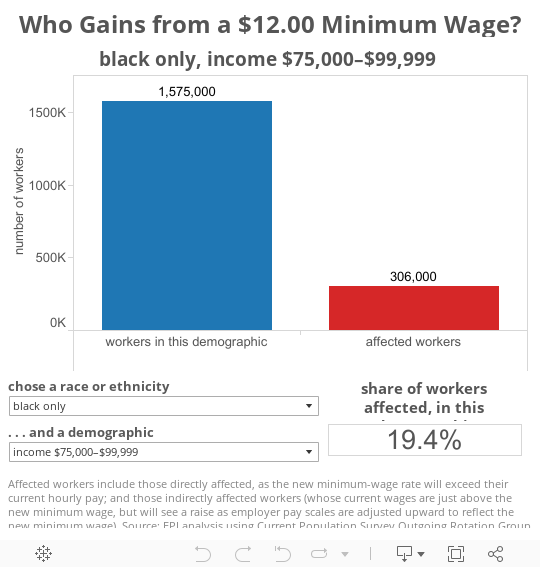
While much of our social and tax policy is either poorly targeted (it reaches the poor unevenly) or aimed in in the wrong direction (it benefits those who don’t need it), a minimum wage increase hits the bull’s-eye. As EPI’s new estimates of the impact of the “Raise the Wage Act” (bringing the minimum to $12.00/hour by 2020) underscore, the benefits of an increase would flow overwhelmingly to those—young workers, single parents, workers of color—who need it the most. The interactive graphic below summarizes this important new work: the first menu sorts workers by race, the second by income, age, family status, labor force participation, and educational attainment.
EPI Applauds the Issuance of Two New Rules Implementing the H-2B Visa Program
After more than five years of litigation in numerous jurisdictions by immigrant and worker advocates who challenged the Bush administration’s illegally promulgated regulations for the H-2B temporary foreign worker program, the Department of Homeland Security (DHS) and the Department of Labor (DOL) have jointly promulgated two new rules—the H-2B “Comprehensive Interim Final Rule” and the “Wage Methodology Final Rule”—which establish important but modest protections for low-wage U.S. workers and guestworkers.
The H-2B temporary foreign worker program—which has been only minimally regulated since 2008—has facilitated the exploitation and human trafficking of guestworkers who work for U.S. employers in various industries, including landscaping, hospitality, forestry, seafood, fairs and carnivals, and construction. A judgment of $14 million in damages was recently awarded to five Indian H-2B guestworkers by a federal jury in Louisiana; the case is just one example of the many abuses that have been inflicted upon H-2B workers over the years.
EPI applauds the new worker protections provided by the H-2B Comprehensive Interim Final Rule, which goes into effect immediately but will be finalized after a 60-day comment period. This rule was originally proposed and finalized in 2012, after notice to the public and the collection and analysis of comments, but was postponed by congressional appropriations riders and enjoined by federal courts at the request of employer associations. While the rules impose some new duties on H-2B employers, the burdens are minimal and justified. The rules will result in more U.S. workers being hired for open positions and prevent the exploitation of H-2B workers. We echo the sentiment of 10 senators who asked DHS and DOL to “mirror the 2012 rule as much as possible” when the rule is finalized after 60 days.
The new protections for H-2B guestworkers include: the right to a copy of their work contract in a language they can understand; a guarantee that they will be paid for at least three-quarters of the hours promised in their work contracts; and reimbursement for inbound travel expenses after a worker completes 50 percent of the employment contract, and employer-paid outbound transportation if the worker remains employed until the end of the job order or if the worker is dismissed before the end of the job order.
Skepticism About Trade Deals is Warranted
In 1993, it seemed obvious to me that NAFTA was about one main thing: providing a huge new (and much cheaper) labor force to U.S. manufacturers by making it safe for them to build factories in Mexico without fear of expropriation or profit-limiting regulation. But the Clinton administration claimed it would open a new market to U.S. business, and U.S. Trade Representative Mickey Kantor, President Clinton, and even Labor Secretary Bob Reich argued that it would create jobs for American workers and even increase job creation in the U.S. auto and steel industries. They said NAFTA would benefit Mexican workers and help create a bigger Mexican middle class, while deterring migrant workers from crossing the border to seek jobs in the United States with better wages. They also argued an alternative theory: that NAFTA would help keep U.S. manufacturers from moving to Southeast Asia, and that it was better to keep that off-shored work in our hemisphere and along our border.
What actually happened?
- The trade balance with Mexico went from positive to very negative, resulting in the loss of more than 600,000 jobs in the United States.
- Mexico’s corn farmers were overwhelmed by a flood of cheaper U.S. corn and almost 2 million agricultural workers were displaced. Most of them migrated illegally to the United States and remain here as exploited, undocumented workers.
- Wages fell for Mexican industrial workers, to the point that autoworkers in Mexico now make less than Chinese autoworkers. Some Japanese carmakers start paying Mexican workers at 90 to 150 pesos per day, or $6 to $10.
- U.S. auto companies shifted investment to Mexico to exploit its much cheaper labor. AP reports that “Mexican auto production more than doubled in the past 10 years. The consulting firm IHS Automotive expects it to rise another 50 percent to just under 5 million by 2022. U.S. production is expected to increase only 3 percent, to 12.2 million vehicles, in the next 7 years.” Since NAFTA’s enactment, employment in the U.S. motor vehicle and parts industry has declined by more than 200,000 jobs.
More recent claims about the expected benefits of free trade agreement with Korea have proven hollow, too. Instead of creating 70,000 jobs, the net effect has been a higher trade deficit and the loss of 60,000 jobs. Worse, the harshest impact of that deal won’t be felt for several more years, when protective tariffs on pickup trucks are eliminated, making Korean imports 25 percent cheaper than they are today. U.S. auto workers will be hard hit.
And then there’s Permanent Normal Trade Relations with China and China’s admission to the WTO, which led to an explosion of imports and the loss of more than 3 million jobs, mostly in manufacturing and mostly in occupations that paid more than the jobs created in exports industries.
One bad experience after another: that’s why so many are so opposed to fast track and more NAFTA-style free trade deals.