Media clips
-
These are anxious days for American workers. Many, like Ms. Woods, are underemployed. Others find pay that is simply not keeping up with their expenses: adjusted for inflation, the median hourly wage was lower in 2011 than it was a decade earlier, according to data from a forthcoming book by the Economic Policy Institute, “The State of Working America, 12th Edition.” Good benefits are harder to come by, and people are staying longer in jobs that they want to leave, afraid that they will not be able to find something better. Only 2.1 million people quit their jobs in March, down from the 2.9 million people who quit in December 2007, the first month of the recession.
“Unfortunately, the wage problems brought on by the recession pile on top of a three-decade stagnation of wages for low- and middle-wage workers,” said Lawrence Mishel, the president of the Economic Policy Institute, a research group in Washington that studies the labor market. “In the aftermath of the financial crisis, there has been persistent high unemployment as households reduced debt and scaled back purchases. The consequence for wages has been substantially slower growth across the board, including white-collar and college-educated workers.”
The Washington Post June 20, 2012 -
The recession has hit the underemployed and underpaid. “Throughout the Great Recession and the not-so-great recovery, the most commonly discussed measure of misery has been unemployment. But many middle-class and working-class people who are fortunate enough to have work are struggling as well, which is why Sherry Woods, a 59-year-old van driver from Atlanta, found herself standing in line at a jobs fair this month, with her résumé tucked inside a Bible…These are anxious days for American workers. Many, like Ms. Woods, are underemployed. Others find pay that is simply not keeping up with their expenses: adjusted for inflation, the median hourly wage was lower in 2011 than it was a decade earlier, according to data from a forthcoming book by the Economic Policy Institute, ‘The State of Working America, 12th Edition.’ Good benefits are harder to come by, and people are staying longer in jobs that they want to leave, afraid that they will not be able to find something better.”
The Washington Post June 20, 2012 -
The 12th edition of “The State of Working America,” a book from the Economic Policy Institute, reports that more Americans are taking jobs they are overqualified for and being hurt by income difficulties.
MarketWatch June 20, 2012 -
The national unemployment rate rose to 8.2% in May as Silsby was graduating as one of 2.6 million who got bachelor’s, master’s or doctoral degrees in the school year now ending. The non-partisan Economic Policy Institute called their labor market “grim” and said that over the previous year, unemployment among college graduates younger than 25 had averaged 9.4%, with an additional 19.1% in jobs for which they were overqualified.
Beneath this cascade of sobering statistics, a new pragmatism might be forming.
USA Today June 20, 2012 -
The cost of the Great Recession to their livelihoods is likely to continue for decades to come.
College students who graduated during the early 1980s economic downturn suffered wage losses of more than $100,000 during the next 15 years compared to those who came into the job market later in the decade, according to research by Yale School of Management economist Lisa Kahn.
“The group we’re seeing here is going to be hit harder,” said Heidi Shierholz, a market economist with the Economic Policy Institute in Washington. “This recession is deeper and longer.”
Bloomberg BusinessWeek June 15, 2012 -
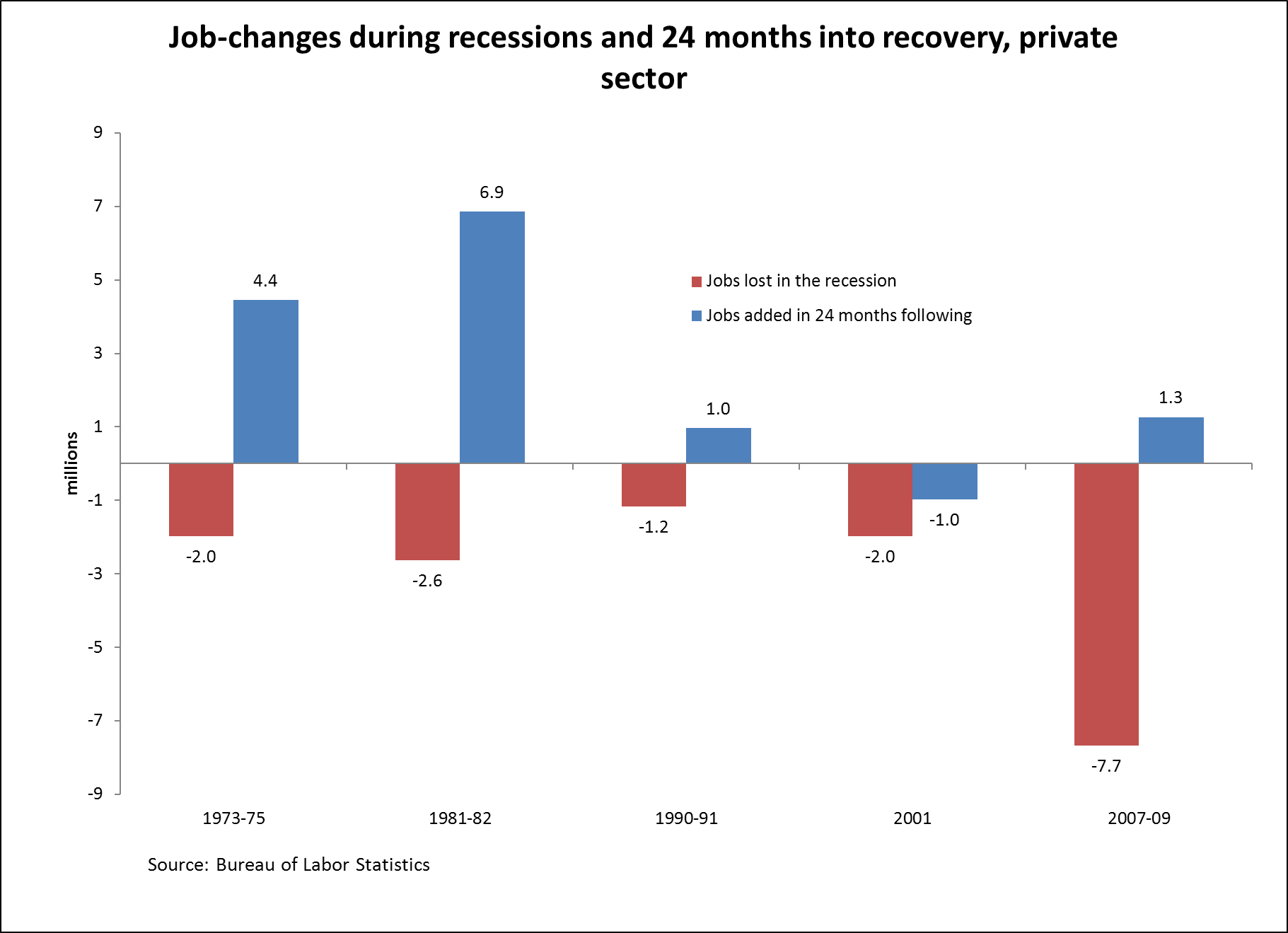
To illustrate exactly how near to high heaven the Obama recovery stinks, Mitt Romney put this graph in his official Plan for Jobs and Economic Growth. It shows the Obama recovery losing nearly 1 million jobs in the 24 months after the end of the recession, clearly the worst in modern history.

But here is the same graph, via Josh Biven at the left-leaning Economic Policy Institute, adjusted for private sector jobs only. Note the subtle change in the three blue bars to the right. Obama’s recovery is suddenly the best in 20+ years. The key distinction between Romney’s graph and EPI’s graph is the public sector, which withered under Obama despite the stimulus.

This recovery stinks, okay? No debate there. But if Romney’s contention is that its stinking is qualitatively different from the stinking of the last two recoveries, this particular statistic doesn’t make his case.
The Atlantic June 15, 2012 -
Meanwhile, a separate government survey of establishment payrolls shows that the U.S. economy gained 800,000 jobs over the two years after the recession. The household survey measures employed people, while the establishment survey measures nonfarm payroll jobs.
“The gold standard for employment trends is simply the payroll survey, and I literally can’t recall anybody using the full-time number from the household survey to compare cyclical job-trends anytime before, and I’ve seen a lot of such comparisons,” said Josh Bivens, director of research and policy at the Economic Policy Institute, a liberal-leaning think tank based in Washington.
MarketWatch June 15, 2012 -
While employers looking to import lower skilled H-2B workers must at least advertise those jobs briefly locally, that is not true in many cases for other work visas and J-1 visas. Daniel Costa, an expert on the guest worker issue at the Economic Policy Institute in Washington, is particularly critical of lax H-1B regulations.
“They are not required to test the labor market to see if there are able and available U.S. workers,” he says. “They can simply hire a foreign worker if they like and don’t ever have to advertise the job in the newspaper or online, even if the local unemployment rate is sky high.”
Costa says many U.S. citizen systems analysts, programmers and other workers in the computer field are unemployed, as as are many electrical engineers.
“The main argument for hiring guest workers is that there’s a labor shortage in these occupations ,” Costa says, “but if you look at any data, it’s clear that those claims are bogus.”
Palm Beach Post June 12, 2012 -
Take a look, would you, at this very fascinating chart via Media Matters but originated by the Economic Policy Institute on public-sector job growth during recent American recessions.
In each of the three previous recent recessions of 1981, 1990 and 2001, the number of public-sector jobs increased during the darkest days. Now, first of all: hey, isn’t it interesting that our three recent recessions started under Republican presidents? Huh.
At any rate, the chart shows you that in all those bleak periods, while the private sector was draining jobs, the public sector was gaining jobs. By about 1 percent in the 2001 recession, by 3 percent in the 1990 one, and by more than 3 percent in the 1981 one. Yes, as is often the case, Ronald Reagan was the most socialistic of the lot.
The Daily Beast June 12, 2012 -
4.1 million—that’s how many jobs Paul Ryan’s budget, which Mitt Romney called “an excellent piece of work,” would eliminate through 2014, according to the Economic Policy Institute (EPI). +11.5 million—that’s how many jobs Romney claimed last September he would create in the first term of his administration. But true to form, Romney never said how he would create that many jobs, nor has any reputable economist backed up his claim. “Nowhere in the 160 page plan could I find a stated job creation number,” wrote Rebecca Thiess of EPI. “
The Nation June 12, 2012