The Great Recession depressed wages for all young graduates, according to the report. Wages for young high school grads dropped 10 percent from 2007 to 2011. Pay for young college grads dropped by about 5 percent.
In 2011, young college grads earned an average of $16.81 per hour – about $35,000 annually, according to the Economic Policy Institute.
National Journal
June 11, 2012
On a year-over-year basis, however, the U.S trade deficit widened by nearly 8 percent from about $40 billion in April 2011. “If it continues to grow at this rate, the trade deficit at the end of this year will be $40 billion more than what it was in 2011,” said Robert E. Scott, director of trade at the Economic Policy Institute.
International Business Times
June 11, 2012
The dramatic rise in inequality has corresponded quite neatly with the decline in union membership, according to an analysis from the left-leaning Economic Policy Institute.
As EPI notes, that divergence in income growth, especially noticeable since 1979, corresponds with a decline in union influence, as an increase in union membership would help to boost worker incomes. Indeed, if the incomes of the union rank-and-file rose by just one-tenth, middle-class incomes would go up $1,479 per year, even for middle-class families who aren’t union members, according to a September analysis from the Center for American Progress.
The Huffington Post
June 11, 2012
In April, the Economic Policy Institute(EPI) showed how much better.
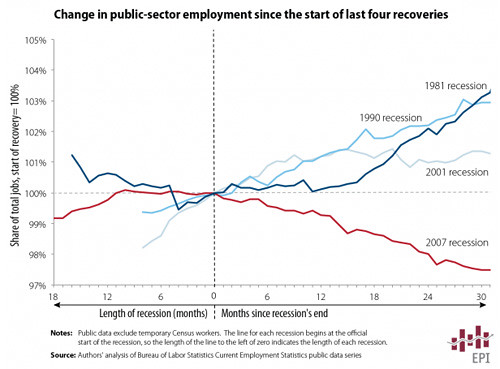
Noting that the private sector had gained 2.8 million jobs while federal, state and local governments shed 584,000 just since June 2009, EPI concluded that the public sector job losses constituted “an unprecedented drag on the recovery”:
“The current recovery is the only one that has seen public-sector losses over its first 31 months.”
Daily Kos
June 11, 2012
This is bad news for labor and for a Democratic Party dependent on union cash and manpower. But it’s bad new for the country, too, as a report from the Economic Policy Institute shows. EPI finds that inequality has corresponded to the rise and fall of unionization in the United States “to a remarkable extent.” For instance, the passage of the National Labor Relations Act in 1935 led to both a massive increase in unionization and a massive decrease in inequality, because “the ‘countervailing power’ of labor unions … gave them the ability to raise wages and working standards for members and non-members alike.” This correlation between unionization and relative equality has been consistent since. If you think massive and growing inequality is a problem for our democracy, then here’s one more reason to lament Tuesday’s result.
Rolling Stone
June 8, 2012
But the most striking evidence is the glaring contrast between the 1990s and 2000s.
A 2008 study by the liberal Center for American Progress and Economic Policy Institute showed that private investment, GDP, wages, household income, employment and federal revenue all grew faster — sometimes much faster — during the high-tax Clinton years than they did during the low-tax Reagan and Bush eras.
In August 1993, President Clinton signed a law that boosted the top personal income tax rate dramatically, to 39.6% from 31%.
Wall Street Journal
June 8, 2012
The current minimum wage is also covering a much smaller percentage of health care and tuition costs than it did just a few decades ago. Already this year, San Francisco has increased its minimum wage to $10, while 1.4 million workers are benefiting from scheduled increases in the minimum wage in eight states. According to the Economic Policy Institute, boosting the minimum wage particularly helps women and minorities, who make up a disproportionate share of minimum wage-earners.
Think Progress
June 8, 2012
Since Obama took office, 636,000 state and local jobs have been cut. In 2011 alone, 113,000 jobs were cut in local schools, 68,000 jobs were cut in local government administration, and 78,000 jobs were cut in state government administration, according to a Commerce Department report.
“It’s the public sector that’s the thing contributing to that entire overall decline of jobs since he took office,” said Heidi Shierholz, a labor market economist at the left-leaning Economic Policy Institute. “It just wipes out a huge share of the job growth.”
ABC News
June 7, 2012
The current median wage for employed high school graduates working full time is $9.50, $2 above the federal minimum wage. That means those working full time earn barely enough to keep them out of poverty. By comparison, college graduates make an average hourly wage of $16.81 per hour, which amounts to an annual salary of roughly $35,000, according to the Economic Policy Institute, a nonpartisan think-tank.
CBS News
June 7, 2012
Perhaps even more outrageous, more than 10,000 wealthy households paid no federal income taxes at all, according to a recent IRS study.
But it’s not just those wealthy households that got a lucky break. Tax rates have fallen the most for the richest Americans since the mid-1990s. Tax rates for the top 0.01 percent plunged 9.4 percent between 1995 and 2007, while tax rates for the 20th to 99th percentiles fell just 2.9 percent, according to the Economic Policy Institute.
The Huffington Post
June 7, 2012