Media clips
-
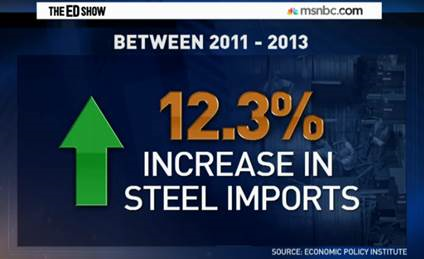 The Ed Show June 24, 2014
 -
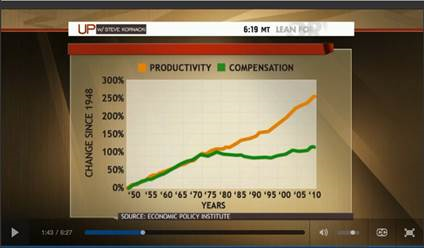 MSNBC June 24, 2014
 -
A separate paper, from left-leaning economist Dean Baker, argues that the trade deficit is a significant impediment to full employment. U.S. imports exceeded exports by $500 billion in 2013—that is, $500 billion of American demand for goods and services supported jobs overseas. In response, Baker proposes lowering the value of the dollar and cracking down on currency manipulators like China who artificially lower the value of their currency so that their goods and services are cheaper, boosting exports. Yet, trade policy is not an exciting or accessible issue to most voters. A candidate could include it as part of their economic platform, but it cannot form the backbone of it.
Bernstein and Larry Mishel, the president of the Economic Policy Institute, have both proposed a monetary policy regime that prioritizes low unemployment along with low inflation. Given the Federal Reserve’s independence from the federal government, though, it’s hard to imagine how better monetary policy could become a focal point of a campaign, as it hardly energizes voters. “You are basically getting at the fundamental problem for Democrats in terms of their economic agenda, in terms of the relationship between what they can run on and what they can actually do,” Teixeira said. “The public is not Keynesians or anything close to it. They don’t understand the relationship between spending, debt and growth. And, therefore, it’s the hardest sell.” Republicans, as the minority party, can simply promise a change from the Democratic agenda, regardless of voters’ understanding of their actual economic proposals.
New Republic June 24, 2014 -
Pedro’s Op-Ed, which ran in the WSJ. You can find it online here. Thanks so much to Danyoung and Erica for quick acquisition of key points, both included in this final version
Wall Street Journal June 24, 2014 -
Third, and perhaps most important, the distribution of wages has spread out drastically. According to compilations by the Economic Policy Institute, the median real wage—that is, the real wage earned exactly in the middle of the wage distribution—rose by a mere 5% over the years 1979-2012. The implied annual rate of increase is close enough to zero that you can taste it. By contrast, the wage at the 95th percentile rose a healthy 39% over those same 33 years. And the rewards for work grew vastly faster in the top 1%—that’s the top 1% in wage earnings, not in total incomes—where the increase was 154% over this period. Let’s remember that the top 1% now comprises roughly 1.35 million workers. So we are not only talking about CEOs, movie stars and hedge-fund operators here—though their earnings have shot off the charts.
At the bottom, things have been truly dismal. At the 20th percentile of the wage distribution, real wages were essentially flat over the 33 years; at the 10th percentile, they fell 6%. And this is for people who have jobs. Most of the poor do not.
Wall Street Journal June 24, 2014 -
The national jobless rate was 6.3% in May, down from 7.5% a year earlier, and nonfarm employers added more than 200,000 jobs for a fourth straight month. Most states saw their jobless rates fall or hold steady in May from the prior month, and the unemployment rates in 49 states fell from a year earlier. (Alabama was the only exception.)
But the U.S. labor force participation rate has dropped in recent years, in part because unemployed workers stopped looking for jobs and dropped out of the labor force. “There’s been so many exits from the labor force in the last few years that, at this point, we’re seeing exits slowing,” said David Cooper, senior economic analyst at the Economic Policy Institute, a left-leaning Washington think tank. “But so many people are on the sidelines, and we’re not seeing them resume their job searches.”
Below is a sortable chart for all 50 U.S. states, plus the District of Columbia, Puerto Rico and the Virgin Islands, showing their peaks for payroll employment before or after the recession and where they stood in May.
Wall Street Journal June 24, 2014 -
Josh Bivens, director of research and policy at the left-leaning Economic Policy Institute, said economic conditions in recent years had few precedents, making it hard to predict the pace of the recovery. Traditional models assume the Fed can restore growth by cutting interest rates, but the Fed has held interest rates near zero since late 2008, and that has proved insufficient. That has left forecasters guessing, he said.
“You can definitely be sympathetic with them,” he said. “We’re just in uncharted territory.”
The New York Times June 20, 2014 -
The latest head-scratcher when it comes to matching policymaking with rhetoric about the evils of deficits came last week, when the idea was floated to finance the rapidly emptying Highway Trust Fund not by raising the gasoline tax, its only dedicated source of revenue, but by . . . cutting corporate taxes. Arithmetic sticklers among us should think that’s odd to imagine that spending can be “paid for” by cutting taxes. More precisely, the proposal would allow U.S. corporations to bring back profits currently being held overseas and to pay a temporary preferential tax rate on these repatriated profits. Because the U.S. corporate tax code allows deferral of corporate income taxes until the money is repatriated, large amounts of profits sit offshore in lower-tax jurisdictions. By offering a preferential tax rate in the short term, the thinking goes, a flood of profits from U.S. multinationals will come into this country and boost tax collections. Read column here.
Wall Street Journal June 20, 2014 -
It would be a huge mistake for the Fed to prematurely raise rates. A new report from the Economic Policy Institute titled “Raising America’s Pay” finds that wage growth for the bottom 20 percent of hourly workers was -0.4 percent per year from 2000 to 2013. For the bottom 50 percent, it was just 0.1 percent per year. In other words, for half of Americans, their wages have been nearly stagnant.
But just as we have seen hints of slightly higher inflation in the past few months, we have also seen anecdotal evidence of slightly higher wages. A major staffing agency for temporary workers, Robert Half International, recently increased their rate 2.6 percent, a sign that workers are both scarcer and in higher demand. Business Insider’s Joe Weisenthal also reports on two other indicators—the job opening rate and a survey of businesses that intend to increase compensation in the next three months—that suggest wage growth may be around the corner.
The New Republic June 20, 2014 -
Josh Bivens, director of research and policy at the left-leaning Economic Policy Institute, said economic conditions in recent years had few precedents, making it hard to predict the pace of the recovery. Traditional models assume the Fed can restore growth by cutting interest rates, but the Fed has held interest rates near zero since late 2008, and that has proved insufficient. That has left forecasters guessing, he said.
“You can definitely be sympathetic with them,” he said. “We’re just in uncharted territory.”
New York Times June 20, 2014