Media clips
-
The new estimates will bolster calls from low-income labor activists to increase federal, state and local minimum wages. “If anybody was ever wondering why the people of this country are feeling so ornery and expressing that in their political choices, you should look no further than this report. There was incredible income stagnation across the entire income spectrum,” said Lawrence Mishel, president of the Economic Policy Institute, a pro-labor think tank.
McClatchy September 17, 2015 -
Valerie Wilson of the Economic Policy Institute told NPR’s Pam Fessler that these numbers were not encouraging, especially considering 2014 was a year with strong jobs growth.” Unfortunately that did not translate into wage growth, income growth or significantly reduced poverty rates,” she said.
NPR September 17, 2015 -
Ahead of the Census’ data release, experts had expected to see lower poverty rates and higher median income thanks to a stronger job market, but that failed to bear out. “If anyone was wondering why the people in this country were feeling so ornery, you should look no further than this report,” Lawrence Mishel, president of the Economic Policy Institute, a left-leaning think tank, said on a conference call to discuss the data. “There was incredible income stagnation across the spectrum.”
CBS Moneywatch September 17, 2015 -
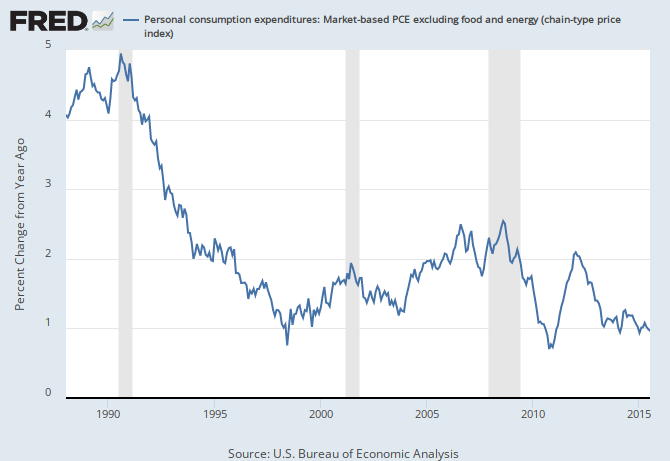
The case against the Federal Reserve raising short-term interest rates at the end of the Federal Open Market Committee meetings Thursday is so clearly strong that is should carry the day. The point of raising rates is to rein in an overheating economy that is threatening to push inflation outside the Fed’s comfort zone. But inflation has been running below the Fed’s target for years–and its recent moves have been down, not up. This subdued price inflation is not a puzzle; it’s the outcome of a labor market that remains so slack that nominal wage growth is running about half as fast as a healthy recovery would be churning out. And this slack is pretty easy to see so long as one is willing to look past the (welcome) progress in reducing the headline unemployment rate. The employment-to-population ratio of prime-age adults (25 to 54 years old) has recovered less than half of its decline during the Great Recession. Worse, progress in boosting this measure has stalled for all of 2015.
Wall Street Journal September 17, 2015 -
The Economic Policy Institute has taken economist Emmanuel Saez’s research on U.S. income tax returns and produced an account of just how America-altering that transfer of income has been. Between 1935 and 1980—that is, between the year in which both Social Security and the National Labor Relations Act were enacted and the year Ronald Reagan was elected as president—of all the income growth (excluding government benefits and transfer payments) that Americans reported on their taxes, fully 70 percent was income accrued by the bottom 90 percent of American households.
The American Prospect September 16, 2015 -
If passed, the rate would be the highest of any city in the nation—an honor (or curse, depending on your views) that currently belongs to SeaTac, Washington, the city that’s home to Seattle-Tacoma International Airport and currently has a minimum wage is $15.24, according to the Economic Policy Institute’s minimum wage tracker.
Last week, David Cooper with the Economic Policy Institute told Fortune that if the federal minimum wage had kept up with American workers’ productivity, it would land in the $18 or $19 per hour territory.
Fortune September 16, 2015 -
But a new study from the Economic Policy Institute— an admittedly left-leaning but tenaciously exact think tank in Washington — reminds us of the clarion differences that exist in the way Democrats and Republicans see economic growth and, increasingly, the need to address a widening inequality among earners.
Detroit Free Press September 16, 2015 -
As pointed out by writer Nelson Schwartz, one explanation for this may lie in another study conducted by the Economic Policy Institute. That report indicates that even as labor productivity has improved steadily since two thousand, the benefits of improved efficiency have nearly all inured to companies, shareholders and top executives rather than to rank-and-file employees. Remarkably, wage declines in low paying occupations were much worse, falling nine percent for restaurant cooks and six percent for home health aides.
WYPR September 16, 2015 -
Labor conditions and recessionary effects don’t explain everything, argues Josh Bivens, research and policy director of the left-leaning Economic Policy Institute. To fully explain why wages haven’t gotten the same jolt from the Fed’s rock-bottom interest rates as other parts of the economy, he points a finger at another branch of the government: Congress. Bivens argues that fiscal policy following the recession failed to stimulate sufficient demand. “After the recession, fiscal policy has been historically austere,” he says. Despite two rounds of stimulus passed in 2008 and 2009, Bivens says the government still did too little in the way of programs like infrastructure building and providing unemployment benefits. Bivens isn’t alone in that notion. Yellen called fiscal policy an economic “headwind” in a 2013 speech. “In the year following the end of the recession, discretionary fiscal policy at the federal, state, and local levels boosted growth at roughly the same pace as in past recoveries,” she explained. “But instead of contributing to growth thereafter, discretionary fiscal policy this time has actually acted to restrain the recovery.”
International Business Times September 16, 2015 -
Blow asked Sanders about his campaign to win over black voters in an interview. Sanders said (as he’s said before) that the media is to blame. He argued that black voters would listen if reporters would only cover the substance of the senator’s speeches on the campaign trail. He’s said again and again that African Americans are at a disadvantage in the U.S. economy. “I have talked in 20 different speeches that 51 percent of young African-American kids are unemployed and underemployed,” he argued, citing research by the liberal Economic Policy Institute. “I don’t know that it’s made the newspapers yet.”
The Washington Post September 15, 2015