Media clips
-
Who are the unionized construction workers and who are the nonunion construction workers? Last year, the New York Building Congress reported that the construction workforce is about 40% white, 37% Hispanic, 13% African-American and 10% Asian-American. The assumption is that union workers are primarily white and nonunion workers primarily not. However, the unions point to a 2013 blog post by the Economic Policy Institute that claimed 21% of unionized workers are black. It was admittedly preliminary research, and a follow-up study has yet to be released. This is important because this is a winners-losers situation. Who will get the jobs if union labor is required on affordable housing, and who will lose jobs?
Crain's New York May 5, 2016 -
But a new paper from Josh Bivens, director of research and policy at the Economic Policy Institute, and Dean Baker, co-director for the Center for Economic and Policy Research, suggests that interest rates aren’t a good tool for popping bubbles at all.
“The housing bubble was an international phenomenon,” Bivens tells The Week. “You had a lot of different countries with quite different monetary policy tightness see very large increases in home prices. So it’s a little hard to say it was all about the interest rates.”
The Week May 5, 2016 -
Amid a national debate over the $15 minimum wage and two competing proposals for implementing it in the District, a new report found that 14 percent of the D.C. workforce would be directly or indirectly affected by such an increase. And of the estimated 114,000 people who would benefit, 80 percent are workers of color, according to the Economic Policy Institute study.
The report, though, uses the example of states that already guarantee the same minimum for tipped workers to argue in favor the single wage. “This is not some radical new idea. There are eight states that have already eliminated their tipped minimum wage,” said David Cooper, the author of the report and a senior analyst at EPI, adding that all but Hawaii have data going back decades. The report cites a study that showed tipped workers made 20 percent more per hour (measuring both base pay and tips) in states that had a single minimum wage in 2013, in comparison to those that used the federal tipped minimum wage of $2.13 per hour.
DCist May 5, 2016 -
The Economic Policy Institute said the rule would restore a protection that has been missing for some time. “It’s a very, very simple rule to implement,” said Ross Eisenbrey, vice president of the D.C. think tank. “All it requires is looking at your workforce and seeing how you’re paying overtime. It’s something an automated payroll processing system could do in five minutes or a human resource manager could do in a couple hours.”
The Hill May 4, 2016 -
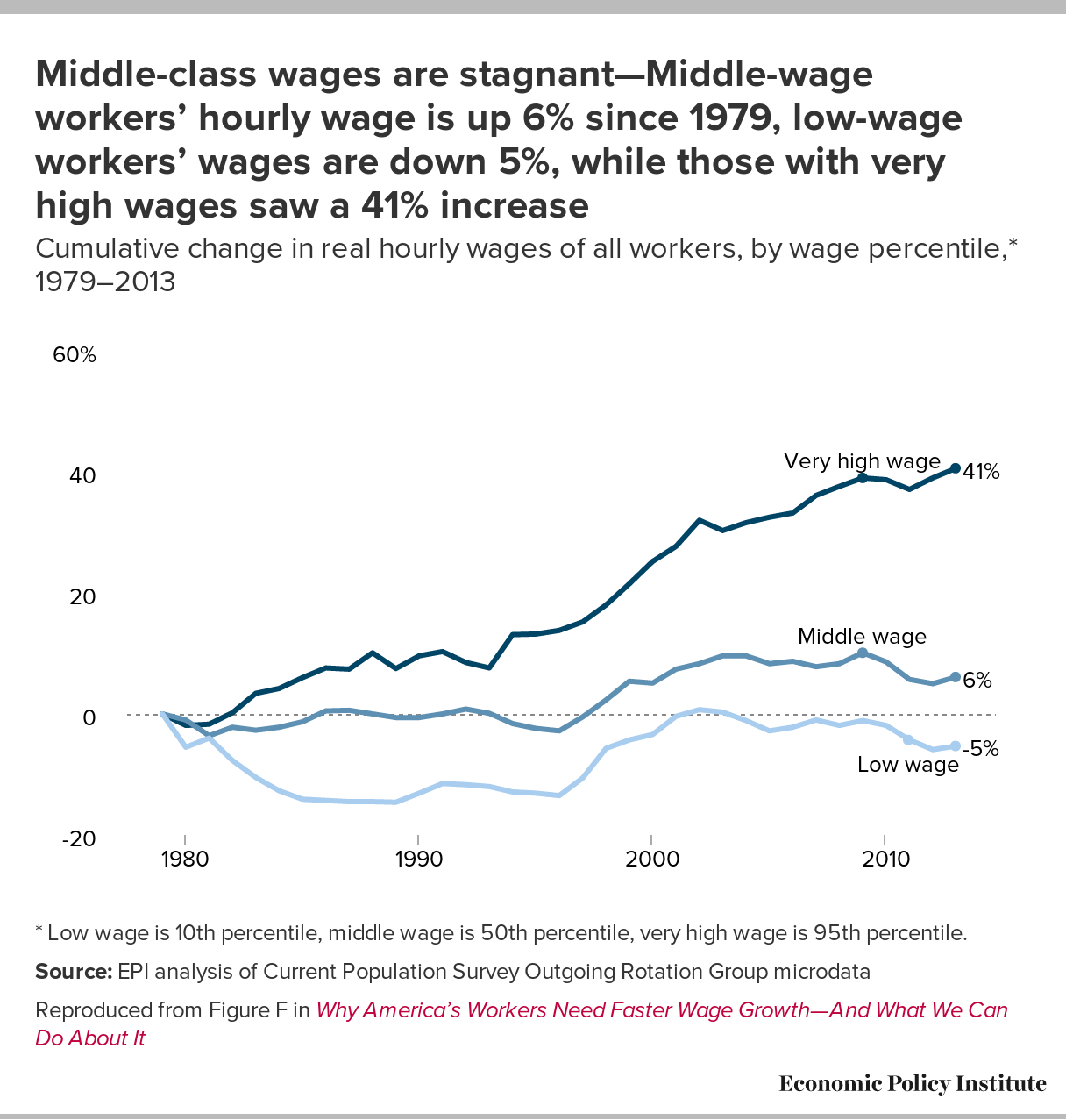
Supporters hope the new measure will help stem a decades-long stagnation in U.S. wages. Between 1979 and 2013, middle-income wages rose just 6%, according to an analysis by the Economic Policy Institute. Low-income wages did even worse, actually declining by 5%. Meanwhile very- high-income wages rose 41%.
Teen Vogue May 4, 2016 -
Officially, Trump has promised to rework the nation’s immigration laws into a system that requires companies to hire Americans first before considering foreign workers. Yet Trump has defended his use of temporary immigrant workers at his luxury Mar-a-Lago resort, saying he has “no choice but to do it.” Two House lawmakers who signed on to Long’s letter — Republican Reps. Renee Ellmers of North Carolina and Chris Collins of New York—have also endorsed Trump. “People who like him are seeing him as this restrictionist, but in practice, it’s really hard to tell what he’s going to be,” said Daniel Costa, director of immigration law and policy research at the liberal Economic Policy Institute. “But he can certainly influence the bill.”
Politico May 4, 2016 -
The Trump Company is now appealing that decision. If Trump loses again, his company is legally obligated to negotiate a contract. That doesn’t mean they will though. “If an employer is really hostile and determined to fight, they have legal routes that can keep the union from getting to the point of negotiating a contract for years and years,” said Ross Eisenbrey with the left-leaning Economic Policy Institute in Washington.
Public Radio International May 4, 2016 -
And while the economy has improved since the Great Recession ended, it’s still not back to precrisis levels. The class of 2016 will enter a job market that continues to suffer from higher levels of unemployment for young Americans and relatively stagnant wage trends, according to a study from left-leaning Economic Policy Institute last month. The percentage of recent grads who are “idled”—meaning neither employed nor in school—is about 10 percent now, up from 8.4 percent in 2007.
CBS Moneywatch May 4, 2016 -
If the last few years are any indication, the average Class of 2016 graduate will leave school with five-figure debt. That albatross likely will force graduates to accept jobs without long-term prospects for career or wage growth, according to a new study from the Economic Policy Institute. Analysts at the think tank say that despite the rosy overall employment picture, graduates actually face a tougher labor market than they would have before the 2008 recession. Degree-holders, they say, still contend with elevated levels of unemployment and underemployment, and a large share are neither employed nor pursuing advanced degrees—in other words, they are idling. “Although there have been small improvements, there is still a lot that’s problematic about this economy for young college grads,” said Teresa Kroeger, a research assistant at EPI who co-authored the study. “Wages are still performing poorly. And we see still disparities between genders and racial groups.”
The Washington Post May 3, 2016 -
“Well, only about 1.3 million people earn the federal minimum wage of $7.25 an hour. That’s a small number, that’s like one percent of the workforce, but of course many more people earn a little bit more than the minimum wage and half of all states have a minimum wage above the federal level, so another way to think about it, the economic policy institute says that 53.6 million workers, a third of the labor force, earns less than $15 an hour.”
Here & Now May 3, 2016