The Federal Reserve Bank of New York’s search for a new president was a flawed process that should go back to the drawing board
It is now widely recognized that the president of the Federal Reserve Bank of New York is a uniquely powerful economic policymaking position. More crucially, it’s likely the most important such position that is not chosen by President Trump. Given the poor choices Trump has already made in choosing the leadership of the Fed, it is more important than ever to make a great choice for the NY Fed presidency.
The process so far has not been encouraging. Several on a list of highly qualified and diverse candidates were not contacted by the NY Fed. Worse, the leading candidate in today’s news reports wasn’t even being mentioned a week ago. This is not how a transparent and publicly accountable process should work, and it’s why the Fed needs fundamental reform.
This leading candidate is John Williams, the current president of the San Francisco Fed. Hiring the current leader of another regional Fed bank hardly constitutes out-of-the-box thinking for the NY Fed. Further, while Williams has done valuable economic research, his tenure as a policymaker at the Fed is frankly disappointing. He has consistently underestimated how much lower the unemployment rate could sustainably go. In 2012, he even thought that 6.5 percent might be the lower limit on the unemployment rate. Since then, he has modified his estimates, but he has seemingly not been chastened about making firm before-the-fact predictions about how low unemployment could go before sparking accelerating inflation.
The Federal Open Market Committee (FOMC) has lost some of its leading proponents for testing the lower limits of unemployment, and has gained some members who have been deeply wrong in arguing that unemployment should not be allowed to fall as far and fast as it has in recent years. Shifting John Williams from the San Francisco Fed to the NY Fed does nothing to push back on this drift of the FOMC away from valuing genuine full employment.Read more
Congress is trying to use appropriations expand the H-2B temporary worker program—where migrants are exploitable and have few rights—by 73 percent
The GOP-led Congress is aiming to pass an omnibus appropriations bill to fund the federal government before the current temporary spending bill expires on March 23, 2018. Part of the negotiations include a major effort by legislators in both parties—who are being bombarded by corporate lobbyists in the hospitality, seafood, landscaping, and construction industries—to expand the H-2B temporary migrant worker program. We estimate the proposal would increase the number of H-2B workers that employers can hire in lesser-skilled occupations by at least 73 percent, from 66,000 per year to 114,000.
The H-2B program—like other temporary migrant worker programs—is not a work program that brings immigrants to the United States with equal rights and the option to stay permanently. Instead, it is used by employers carve out a lawless zone in the labor market where migrant workers have few workplace rights in practice, because they arrive indebted to labor recruiters and indentured to U.S. employers.
Nevertheless, rather than focusing on the most urgent immigration issues at hand, including a path to citizenship for immigrants who are in danger of becoming undocumented, like DACA recipients, and those who have Temporary Protected Status, Congress is instead focusing on making changes to temporary worker programs via the appropriations process. Congress has done this a number of times in recent years, something that Republican Senate Judiciary Chairman Sen. Chuck Grassley and Democratic Ranking Member Sen. Diane Feinstein came together last year to criticize for usurping the committee’s jurisdiction over immigration legislation. Other Senators have done the same, including Dick Durbin and Bernie Sanders. The New York Times editorial page and migrant worker advocates alike have also criticized this end-around the normal legislative process.
Using the H-2A guestworker program for year-round agricultural jobs would lower wages for farmworkers
The H-2A guestworker program provides an unlimited number of temporary work visas to agricultural employers to hire farmworkers from abroad to fill temporary or seasonal jobs lasting for less than one year. Last year, over 200,000 H-2A jobs were certified by the U.S. Department of Labor (DOL)—the most ever—despite the many abuses and exploitation that continues to occur at the hands of employers and labor recruiters. Members of Congress are currently negotiating and debating the fiscal 2018 omnibus appropriations bill to fund the federal government, and hope to pass it before the current temporary spending bill expires on March 23, 2018. On the table is a proposal to allow employers to use the H-2A program to fill year-round, permanent jobs in agriculture with H-2A workers who have few rights and no path to permanence and citizenship. It was first proposed in July 2017 by Rep. Dan Newhouse (R-WA) but never became law.
We have already explained why making H-2A year-round via appropriations is a bad idea, but one other major consequence that Congress should consider is that it will result in allowing agricultural employers to pay much lower wages to H-2A workers in year-round jobs than they pay to the Americans and immigrants who are currently employed in those jobs.
Making H-2A year-round would expand the scope of H-2A by allowing employers offering year-round employment on dairy, livestock, and poultry and egg farms, as well as in nurseries and greenhouses and other non-seasonal agricultural occupations, to hire H-2A workers—bringing H-2A workers into sectors that offer approximately 260,000 year-round full-time equivalent (FTE) jobs. Table 1 lists some of the main year-round agricultural industries in major agricultural states, accounting for 123,000 of the 260,000 full-time equivalent jobs, and shows how much farmworkers earned annually, on average in 2016 in those occupations (according to the Quarterly Census on Employment and Wages, from DOL).
Preemption laws prevent cities from acting on everything from labor and employment to gun safety
On Valentine’s Day, a 19 year-old with a legally purchased AR-15 assault rifle stormed into Marjory Stoneman Douglas High School in Parkland, Florida and murdered 14 students, and 3 educators. In Florida, an AR-15 military-style assault rifle is easier to buy than a handgun. Understandably, many of the students who survived the mass shooting and the families of the 17 victims have called for a change in the law, arguing that it shouldn’t be so easy to legally purchase weapons that powerful. I write here not to weigh in on the merits of any given gun law, but to comment on the process of advocating for legislative change, and the challenges at the local level with the preemption laws on the books.
In terms of advocating for a change in federal law, Congress’s ban on AR-15s and other semiautomatic assault weapons expired in 2004, and federal lawmakers have not been able to pass a similar ban since.
In terms of advocating for change in state law, dozens of Florida high school students recently loaded onto buses and drove to the Florida state capital to lobby for a bill banning assault rifles, which was voted down by the state’s House of Representatives.
In terms of advocating for a change in gun laws at the city and county level, the students, families of the victims, or anyone else won’t even have a chance because of Florida’s preemption law. “Preemption” in this context refers to a situation in which a state law is enacted to block a local ordinance from taking effect—or dismantle an existing ordinance.
What to Watch on Jobs Day: Putting wage growth in perspective
While payroll employment growth has continued to be more than fast enough to absorb working age population growth as well as workers idled by slack demand in previous years and the unemployment rate is holding at 4.1 percent, other economic indicators such as the labor force participation rate, the prime-age employment-to-population ratio, and wage growth resemble an economy with a fair amount of remaining slack. My attention this jobs day and in the discussion below is wage growth.
Last week, I released a paper on the State of American Wages in 2017, with comparisons to earlier periods as well as analysis by gender, race, and educational attainment. Key findings include a pickup in wages for the lowest wage workers over the last couple of years due in part to more workers finally feeling the effects of the growing economy in their wages plus state-level minimum wage increases occurring in states where about half of all workers reside. On the downsides, much of the 2000s and 2010s have been characterized by growing wage inequality and slow or stagnant wages for many. Black-white wage gaps have worsened over the 17-year period and the bottom 50 percent of college degreed workers have lower wages today than in 2000.
Tomorrow, the latest wage growth numbers from the Current Employment Statistics (CES) will come out. The paper I just referenced primarily examined the wage data found in the Current Population Survey Outgoing Rotation Group (CPS-ORG), which allows wage comparisons across the wage distribution and by demographic characteristics. For a read on the labor market and an assessment about whether wage growth reflects an economy at full employment, it’s important to look at nominal wage growth. What’s clear from both surveys, using different metrics (median versus average and total private versus production/non-supervisory) is that nominal wage growth is still below levels consistent with the Federal Reserve’s inflation target and with estimates of potential productivity growth—a sign that the economy still has considerable slack.
Congress should set the standard in being a good employer
The past year has provided countless examples of the ways in which our nation’s labor and employment laws fail workers. From the #MeToo social media campaign that helped expose that for many women sexual harassment is a daily fact of life in the workplace to a recent report revealing that the vast majority (74 percent) of Uber and Lyft drivers earn less than the minimum wage in their state, it is clear that American workers need policymakers to act to reform the current system of worker protections. That is why stories like the one in Vox today that some congressional lawmakers require unpaid interns to sign broad nondisclosure agreements that may discourage them from speaking out if they experience harassment or encounter other workplace issues are so troubling. How can we expect our elected representatives to legislate effective worker protection measures when they themselves adopt exploitative employment practices?
Congress has a long history of exempting itself from workplace protection measures. When the Fair Labor Standards Act was passed, Congress exempted itself from coverage. When the Civil Rights Act, including Title VII which protected workers from employment discrimination on the basis of race, color, religion, sex, or national origin, was signed into law, Congress again exempted itself from these protections. It was not until 1995 that Congress passed the Congressional Accountability Act, finally extending workplace protections to congressional staff. However, recent reports of congressional settlements surrounding harassment claims have shown that Congress is not holding itself accountable for workplace protections.
Many of the policy recommendations from the Kerner Commission remain relevant 50 years later
In 1967, young black men rioted in over 150 cities, often spurred by overly aggressive policing, not unlike the provocations of recent disturbances. The worst in 1967 were in Newark, after police beat a taxi driver for having a revoked permit, and Detroit, after 82 party-goers were arrested at a peaceful celebration for returning Vietnam War veterans, held at an unlicensed social club.
President Lyndon Johnson appointed a commission to investigate. Chaired by Illinois Governor Otto Kerner (New York City’s mayor John Lindsay was vice-chair), it issued its report 50 years ago today. Publicly available, it was a best-seller, indicting racial discrimination in housing, employment, health care, policing, education, and social services, and attributing the riots to pent-up frustration in low-income black neighborhoods. Residents’ lack of Fambition or effort did not cause these conditions: rather, “[w]hite institutions created [the ghetto], white institutions maintain it, and white society condones it… [and is] essentially responsible for the explosive mixture which has been accumulating in our cities since the end of World War II.”
The report warned that continued racial segregation and discrimination would engender “two societies, one black, one white—separate and unequal.” So little has changed since 1968 that the report remains worth reading as a near-contemporary description of racial inequality.
Of course, not everything about race relations is unchanged. Perhaps most dramatic has been growth of the black middle class, integrated into mainstream corporate leadership, politics, universities, and professions. We’re still far from equality—affirmative action remains a necessity—but such progress was unimaginable in 1968. Today, 23 percent of young adult African Americans have bachelor’s degrees, still considerably below whites’ 42 percent but more than double the black rate 50 years ago.
In the mid-1960s, I assisted in a study of Chicago’s power elite. We identified some 4,000 policymaking positions in the non-financial corporate sector. Not one was held by an African American. The only black executives were at banks and insurance companies serving black neighborhoods. Today, any large corporation would face condemnation, perhaps litigation, if no African American had achieved executive responsibility.
How new Fed Chair Jerome Powell should get ready for the next recession
New Federal Reserve Chair Jerome Powell testified before Congress this week, roughly a month after replacing Janet Yellen. The key question many have is whether or not a change in personnel will mark a break with past policy. If it does, and if the Fed starts crediting arguments for raising interest rates that they correctly rejected before, then today’s low unemployment rate might be unfortunately short-lived.
Under Yellen’s leadership, the Fed was notably “dovish” in that it strove to keep monetary policy expansionary with the goal of pushing unemployment down, rather than contractionary in the service of guarding against an outbreak of inflation. Her replacement, Jerome Powell, served on the Fed’s Board of Governors with Yellen between 2012 and early 2018. Powell was by most accounts supportive of the policy path blazed by Yellen, so in that sense a radical change in the Fed’s stance would be surprising. But Yellen wasn’t just a dovish vote on the Fed, she was an intellectual leader in the defense of expansionary monetary policy over the past decade. As a highly respected academic macroeconomist and policymaker, Yellen had the ability and confidence to push back hard on weak arguments about why the Fed should reverse course and begin worrying about containing inflation rather than pushing down unemployment.
One of these weak arguments is that the Fed needs to raise rates faster and sooner so that when the next recession hits, there will be enough “room” to lower them. Proponents of this argument point out that in previous recessions the Fed lowered the short-term “policy” interest rates that it controls by 3–5 percentage points in an effort to restart growth. Today these rates are at 1.5 percent, and, they really can’t go much below zero for any extended period of time. This “zero lower bound” (ZLB) on interest rates is driven by the fact that once these rates hit zero, wealth-holders will just stop demanding bonds and will be happy to hold cash instead. This means that further Fed purchases of bonds to lower rates will have no effect. What hitting the ZLB means for policy is that we could enter the next recession without the ability of the Fed to lower policy rates as far as they have in the past.
While the constraints put on monetary policymaking by the ZLB are real, raising rates now to clear out room for cutting them later remains a silly idea. First, raising rates sooner and further doesn’t just give the Fed more interest rate “room” to fight the next recession, it also makes the next recession more likely. Post-war recessions have largely occurred because of asset market bubbles popping or the Fed raising rates too far and too fast.
An analogy might help point out the absurdity of this. Say that your house is a cool 50 degrees and you hike the thermostat to your desired temperature of 70 degrees. After the heat has been running for a while, the house has warmed to 60 degrees, and your roommate argues you should turn the thermostat off because if the room gets really cold again, you’ll want “room” to warm it by cranking the thermostat up again.
Does this make sense? Of course not. So long as one believes that the economy has not warmed up to its optimal setting, then one should not be using policy tools to cool it back down. Is there a convenient summary measure that can guide us as to whether or not the economy is running hot enough? There are lots, actually, but let’s use the Fed’s own announced measure: 2 percent price inflation. The economy has been running beneath this 2 percent inflation target for years now, and there is little evidence of any acceleration. Further, if one excludes rental prices, then inflation has been even lower. Fighting rent inflation (which occurs due to low supply of housing units relative to demand) by raising interest rates which will curtail home-building would be perverse.

So, the economy is by the Fed’s own definition not running hot enough, yet they’ve already begun raising rates to cool it off, backed in part by arguments that this is necessary because one day they might want to try to heat it back up. This is a terrible way to prepare for the next recession.
Growth (or not) in real wages
There is no starker metric for our unequal age than the stagnation of American wages over the last generation. Since 1973, productivity has grown about 75 percent, while the compensation of the typical worker has grown only about 12 percent. Since 1979, the hourly median wage has grown less than 10 percent in real dollars, or an average annual raise of barely 4 cents. While wages grew for many workers in 2017, wage growth is still far slower—and more unequal—than where it needs to be.
The interactive graphic below shows the change in real (inflation-adjusted) wages by wage decile, with drop-down filters for gender, race, educational attainment, and time period. This affords comparison of the wage gains (or losses) experienced by particular workers, and comparison across the full 1979–2017 span, or its constituent business cycles. The choice of “African-American” and “1979–1989,” for example, charts how black workers fared during the dismal 1980s; the choice of “BA or higher” and “2009–2017” charts how well-educated workers fared during the long recovery from the Great Recession.
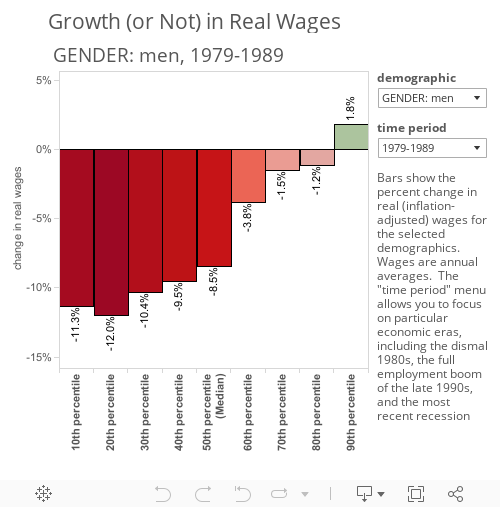
There are a lot of moving pieces here—including shifting economic opportunities, changes in educational attainment, policy drifts and shifts, and five recessions that swallow up almost 6 of the 39 years since 1979. But here are four key takeaways:
Ron Blackwell (1946–2018)
Ron Blackwell, a friend to EPI since its early days, died on February 25.
Ron had a long career in the labor movement, starting with the Amalgamated Clothing and Textile Workers Union in New York, moving to the AFL-CIO in Washington, D.C. until he retired in 2012.
Raised in Alabama, he was a steadfast defender of the rights of working people and a life-long enemy of economic injustice in its many forms.
He pioneered in the design and management of campaigns to use the financial and pension assets of labor unions as a tool of organizing and collective bargaining.
Having studied economics and political economy at the New School, he understood how elite decisions hidden from the public can destroy efforts by ordinary people to better their lives. His was a relentless voice urging the labor movement to demand a seat at the table of economic policy. He also played an important role in efforts to create international labor solidarity in a world of globalizing capital.
Above all, Ron Blackwell was the rare man of principle who actually had the courage of his convictions. As a young man, he chose to go to prison rather than submit to those who were waging the unjust and terrible war in Vietnam. In his years as a labor advocate, he was quick to spot hypocrisy among political leaders, who—as the late mineworkers’ leader John L. Lewis once put it—“supped at labor’s table and sheltered in labor’s house” but then, “cursed with equal impartiality both labor and its adversaries.”
Ron told it like it was.
EPI, the labor movement, and the country have lost a valiant warrior in the struggle for justice.