Full Report
This report provides an update to the series that has tracked public school teacher wages and compensation for more than two decades.1 Because public school teachers must attain at least a bachelor’s degree to teach in the U.S., this research compares weekly earnings of public school teachers (elementary, middle, and secondary)2 with those of college graduates that chose other careers. Documenting the widening divergence between the wages of teachers and their college-educated counterparts over time allows for a historical analysis of an issue that is critical to the future of the United States.
Providing teachers with compensation commensurate with that of similarly educated and experienced professionals is necessary to retain and attract qualified workers into the teaching profession. Worsening trends in teacher pay influence students’ career choice. While there are many important factors impacting teacher retention and the recruitment of highly qualified students into the profession, one that consistently lands near the top of any list is pay.3 And closing the growing pay gap between teachers and other college graduate professionals is critical to public education, as teacher quality is the most important school-related factor influencing student achievement.4
Data and relevant information
In analyzing differences in pay between public school teachers and other college graduates, I use two sources of data, both from the Bureau of Labor Statistics (BLS).5 First, I use Current Population Survey Outgoing Rotation Groups (CPS-ORG) data for the weekly wage analyses (BLS 2024a). I focus on weekly wages, as opposed to weekly hours worked or the length of the work year, to account for the “summers off” issue that affects teachers but not other college graduates.6 The sample is restricted to full-time workers (working at least 35 hours per week) aged between 18 and 64, with at least a bachelor’s degree, because teachers today need at least a bachelor’s degree to teach.
The sample is further limited to those who reported their wage information directly (those who didn’t respond and whose wages were estimated by BLS are excluded).7 To preserve data confidentiality, the BLS records weekly wages only up to a defined threshold, so the wage amounts above this threshold aren’t specifically identifiable in the data. This is called top-coding. Historically, the threshold was rarely updated. As a result, a growing share of workers are assigned top-coded wages that are below their actual wages, which has generated a growing understatement of college graduate wages relative to those of teachers. I replace original top-coded values with Pareto-distribution implied means above the original CPS top-code separately for men and women.8 My regression analyses also use CPS demographic variables (e.g., gender, race/ethnicity, state of residence, marital status, and age).
The BLS’s National Compensation Survey’s Employer Costs for Employee Compensation program (BLS 2024b) is the second data source. Specifically, I pull data on employer costs per hour worked for detailed categories of compensation for “primary, secondary, and special education school teachers” in the public sector, and the same data for “civilian professionals,” which is the broadest category available that largely corresponds to college graduates. “Benefits,” in this analysis, refer to employer costs for health and life insurance, retirement plans, and payroll taxes (covering Social Security, unemployment insurance, and workers’ compensation).
The remaining components of compensation are “W-2 wages,” a measure that corresponds to the wages captured in the CPS data used above. W-2 wages are the wages reported to employees and to the Internal Revenue Service. They include “direct wages,” defined by the BLS as “regular payments from the employer to the employee as compensation for straight-time hourly work, or for any salaried work performed” and other wage items, including “supplemental pay.” Supplemental pay includes premium pay for overtime, bonus pay, profit-sharing, and paid leave.
Findings
I present results of this research in four sections. I begin with trends in the simple (not regression-adjusted) average weekly wages for public school teachers and other college graduates from 1979 through 2024 (adjusted for inflation). Second, I report annual estimates of the national teacher weekly wage gap using standard regression techniques to control for systematic differences in age, education, state of residence, and other factors known to affect wage rates. Third, I present the regression-adjusted estimates of the teacher wage gap for each state and the District of Columbia in a figure and a map. Lastly, I factor in nonwage benefits are to estimate a total compensation penalty that accounts for the estimated teacher wage penalty, along with the teacher “benefits advantage,” to estimate a total compensation differential at the national level (which is not possible to calculate for each state).
Simple level differences: Weekly wage trends
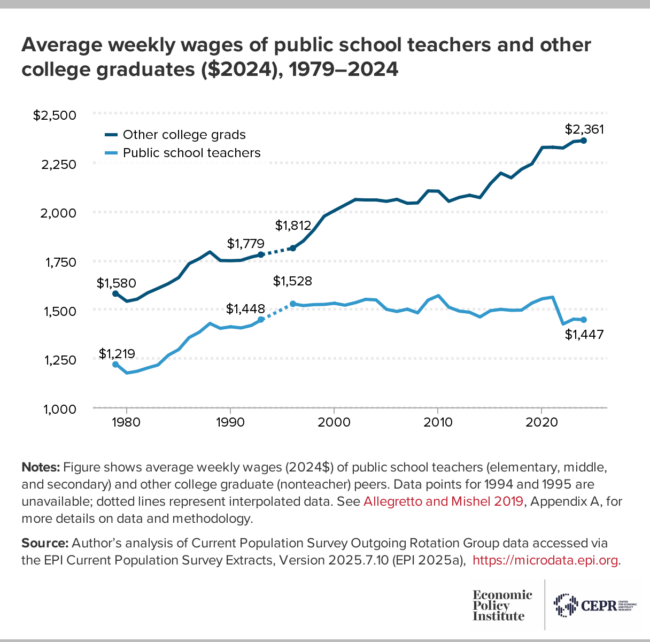
The trends in the average weekly wages of public school teachers and other college graduates are shown in Figure A. These data are national annual averages adjusted only for inflation (i.e., not regression-adjusted). It is important to keep in mind that real improvements in living standards require wages to outpace inflation, which has been the case for other college graduates but not for teachers.
Average weekly wages of public school teachers and other college graduates ($2024), 1979–2024
| Year | Public school teachers | Other college grads | Public school teachers | Other college grads | Public school teachers | Other college grads |
|---|---|---|---|---|---|---|
| 1979 | $1,219 | $1,580 | ||||
| 1980 | $1,175 | $1,541 | ||||
| 1981 | $1,184 | $1,552 | ||||
| 1982 | $1,201 | $1,584 | ||||
| 1983 | $1,216 | $1,607 | ||||
| 1984 | $1,266 | $1,631 | ||||
| 1985 | $1,295 | $1,662 | ||||
| 1986 | $1,356 | $1,733 | ||||
| 1987 | $1,384 | $1,759 | ||||
| 1988 | $1,428 | $1,793 | ||||
| 1989 | $1,403 | $1,749 | ||||
| 1990 | $1,411 | $1,748 | ||||
| 1991 | $1,405 | $1,750 | ||||
| 1992 | $1,418 | $1,767 | ||||
| 1993 | $1,448
|
$1,779
|
$1,448 | $1,779 | ||
| 1994 | $1,474 | $1,790 | ||||
| 1995 | $1,501 | $1,801 | ||||
| 1996 | $1,528 | $1,812 | $1,528
|
$1,812
|
||
| 1997 | $1,519 | $1,849 | ||||
| 1998 | $1,524 | $1,905 | ||||
| 1999 | $1,525 | $1,975 | ||||
| 2000 | $1,531 | $2,004 | ||||
| 2001 | $1,521 | $2,032 | ||||
| 2002 | $1,534 | $2,060 | ||||
| 2003 | $1,551 | $2,058 | ||||
| 2004 | $1,548 | $2,058 | ||||
| 2005 | $1,500 | $2,051 | ||||
| 2006 | $1,489 | $2,061 | ||||
| 2007 | $1,501 | $2,041 | ||||
| 2008 | $1,482 | $2,043 | ||||
| 2009 | $1,547 | $2,104 | ||||
| 2010 | $1,570 | $2,103 | ||||
| 2011 | $1,511 | $2,051 | ||||
| 2012 | $1,491 | $2,071 | ||||
| 2013 | $1,485 | $2,082 | ||||
| 2014 | $1,461 | $2,070 | ||||
| 2015 | $1,493 | $2,141 | ||||
| 2016 | $1,500 | $2,195 | ||||
| 2017 | $1,495 | $2,171 | ||||
| 2018 | $1,496 | $2,215 | ||||
| 2019 | $1,532 | $2,242 | ||||
| 2020 | $1,554 | $2,326 | ||||
| 2021 | $1,562 | $2,327 | ||||
| 2022 | $1,425 | $2,323 | ||||
| 2023 | $1,450 | $2,356 | ||||
| 2024 | $1,447
|
$2,361
|

Notes: Figure shows average weekly wages (2024$) of public school teachers (elementary, middle, and secondary) and other college graduate (nonteacher) peers. Data points for 1994 and 1995 are unavailable; dotted lines represent interpolated data. See Allegretto and Mishel 2019, Appendix A, for more details on data and methodology.
Source: Author’s analysis of Current Population Survey Outgoing Rotation Group data accessed via the EPI Current Population Survey Extracts, Version 2025.7.10 (EPI 2025a), https://microdata.epi.org.
As shown in Figure A, the inflation-adjusted weekly wages for teachers were relatively flat from 1996 through 2021, indicating that teacher wages, on average, were just keeping up with the rate of inflation. By 2024, teacher wages were 5.3% less than they were on average in 1996. The average weekly wages of other college graduates also experienced a stretch of stagnation, but for a shorter time span (2002–2014), after which real increases ensued. Since 1996, the wages of other college graduates increased by just over 30%.
Addressing the long-term stagnation of teacher wages requires that future increases in pay exceed future rates of inflation to recover the loss in wages since 2021 and to drive an increasing trend in teacher wages.
Relative differences: Regression-adjusted trends
The average weekly wages discussed in Figure A are simple averages (i.e., they are not regression-adjusted) for teachers and other college graduates; they represent the underlying data used in the regression analyses. Regression estimation helps to account for ways the two groups may differ fundamentally which typically affect pay on margins such as age, educational attainment, race/ethnicity, and state of residence. For instance, all else being equal, one would expect experienced workers to earn more than younger workers who are just starting out in their careers. Controlling for age within a regression model therefore accounts for such differences across the two samples. Thus, standard regression techniques are used to estimate weekly wages of public school teachers relative to other similarly situated college graduates working in other professions, which can provide a more apples-to-apples comparison of earnings.9
Regression-based results are reported in Figure B. They show how much less (or more) teachers earn in weekly wages relative to other college graduates, estimated via regression analysis. A weekly wage “penalty” for teachers is reported when the regression estimates suggest that teachers, all else equal, are paid less than other college graduates. A penalty appears as a negative number in Figure B. When teachers are paid relatively more, the number is positive and is referred to as a “premium.” Estimates are reported for all teachers (which includes a gender control), as well as separately for women and men.
Teachers earn 26.9% less than comparable college graduates: Public school teacher weekly wage penalty (or premium) for all teachers and by gender, 1979–2024
| Year | All | Female | Male | All | Female | Male | All | Female | Male |
|---|---|---|---|---|---|---|---|---|---|
| 1979 | -7.1%
|
6.5%
|
-16.6%
|
||||||
| 1980 | -9.3% | 4.5% | -19.2% | ||||||
| 1981 | -10.1% | 3.1% | -19.0% | ||||||
| 1982 | -10.2% | 2.8% | -19.4% | ||||||
| 1983 | -11.8% | 1.0% | -20.7% | ||||||
| 1984 | -10.0% | 2.5% | -19.7% | ||||||
| 1985 | -10.2% | 1.9% | -19.5% | ||||||
| 1986 | -8.8% | 3.2% | -18.4% | ||||||
| 1987 | -7.9% | 3.9% | -18.1% | ||||||
| 1988 | -8.0% | 5.1% | -18.2% | ||||||
| 1989 | -8.2% | 3.0% | -17.0% | ||||||
| 1990 | -7.7% | 4.0% | -17.9% | ||||||
| 1991 | -9.1% | 0.6% | -16.3% | ||||||
| 1992 | -7.0% | 3.1% | -15.6% | ||||||
| 1993 | -5.1%
|
4.1% | -13.1%
|
-5.10% | 4.10% | -13.10% | |||
| 1994 | -5.40% | 2.70% | -13.70% | ||||||
| 1995 | -5.70% | 1.30% | -14.40% | ||||||
| 1996 | -6.1% | -0.1% | -15.1% | -6.1% | -0.1% | -15.1% | |||
| 1997 | -6.2% | 1.2% | -18.6% | ||||||
| 1998 | -9.0% | -1.5% | -20.5% | ||||||
| 1999 | -10.4% | -2.7% | -21.7% | ||||||
| 2000 | -11.8% | -5.1% | -22.7% | ||||||
| 2001 | -12.1% | -4.0% | -25.3% | ||||||
| 2002 | -12.1% | -5.1% | -24.1% | ||||||
| 2003 | -11.3% | -4.9% | -21.2% | ||||||
| 2004 | -12.8% | -6.2% | -23.3% | ||||||
| 2005 | -13.3% | -6.3% | -24.5% | ||||||
| 2006 | -15.0% | -8.0% | -27.3% | ||||||
| 2007 | -11.7% | -4.7% | -23.4% | ||||||
| 2008 | -14.5% | -7.7% | -25.7% | ||||||
| 2009 | -12.5% | -4.5% | -24.7% | ||||||
| 2010 | -11.9% | -4.6% | -23.7% | ||||||
| 2011 | -12.8% | -6.4% | -24.2% | ||||||
| 2012 | -16.0% | -10.0% | -26.2% | ||||||
| 2013 | -16.4% | -10.1% | -27.3% | ||||||
| 2014 | -16.5% | -10.5% | -26.2% | ||||||
| 2015 | -18.4% | -13.4% | -26.7% | ||||||
| 2016 | -19.4% | -12.2% | -31.6% | ||||||
| 2017 | -20.9% | -15.5% | -30.5% | ||||||
| 2018 | -22.0% | -15.9% | -31.8% | ||||||
| 2019 | -19.2% | -13.2% | -30.2% | ||||||
| 2020 | -21.6% | -15.2% | -33.8% | ||||||
| 2021 | -23.5% | -17.1% | -35.2% | ||||||
| 2022 | -26.4% | -21.3% | -36.6% | ||||||
| 2023 | -26.6%
|
-21.4%
|
-36.3%
|
||||||
| 2024 | -26.9%
|
-21.5%
|
-36.4%
|
Notes: Figure shows regression-adjusted weekly wage penalties (or premiums) for public school teachers (elementary, middle, and secondary) relative to their college-educated, nonteaching peers. Data points for 1994 and 1995 are unavailable; dotted lines represent interpolated data. See Allegretto and Mishel 2019, Appendix A, for more details on data and methodology.
Figure reports regression-adjusted teacher weekly wage penalties: how much less, in percentage terms, public school teachers (elementary, middle, and secondary) earn in weekly wages relative to their college-educated, nonteaching peers. College-educated workers refers to workers who have a bachelor’s degree or more education. The dependent variable is (log) weekly wages with indicator controls on public school teacher, private school teacher, gender, and married, along with indicator sets on education (M.A., professional degree, Ph.D.) and race/ethnicity (Black, Hispanic, other); also included are age as a quartic and state fixed effects. See Allegretto and Mishel 2019, Appendix A, for more details on data and methodology.
Source: Author’s analysis of Current Population Survey Outgoing Rotation Group data accessed via the EPI Current Population Survey Extracts, Version 2025.7.10 (EPI 2025a), https://microdata.epi.org.
The main takeaway from Figure B is the nearly 30-year trend of relative teacher weekly wages increasingly falling behind those of other similarly qualified professionals. Pre-1994, the teacher wage gap averaged 8.7%, but the shortfall worsened considerably starting in the mid-1990s. The teaching penalty hit a record of 26.9% in 2024, which was slightly worse than the penalty recorded in 2023 (26.6%). Otherwise, on average, teachers earned 73.1 cents on the dollar in 2024, compared with what similar college graduates earned working in other professions—much less than the relative 93.9 cents on the dollar that teachers earned in 1996.
Separating the analysis by gender shows that in the pre-1994 period, the relative female teacher weekly wage (i.e., comparing female teachers with other female college graduates) was at a premium that averaged 3.3%. But starting in 1996, the female gap quickly went from parity to a penalty, landing at a 21.5% penalty in 2024.
My previous research (using decennial Census data) confirmed that, over a longer timeframe, the relative wage estimates for female teachers moved from significant premiums to large penalties. For example, I documented that relative female teacher earnings were at a 14.7% premium in 1960, which lessened to 10.4% in 1970 and to near parity in 1980 (pre-1979 years not shown in Figure B). Using the estimates from 2024, the cumulative change has been a 36.2 percentage-point deterioration in the relative wage of female teachers since 1960.10
There is an important story behind the declining relative wages experienced by female teachers. Historically, the teaching profession relied on a somewhat captive labor pool of educated women who had few employment opportunities. This is thankfully no longer the case, but increased opportunity costs are a part of the story and reflected in these results. Expanding opportunities for women enabled them to earn more as they entered occupations and professions from which they were once barred.
In fact, the simple average weekly wages (inflation-adjusted) of female teachers compared with their nonteaching counterparts grew in lock step from 1979 until they started to diverge in the late-1990s. They were close to parity in 1996, when other female college graduates earned just 0.7% more than female teachers. But this divide grew nearly every year—reaching 40.9% in 2024.
Conversely, the trends in the weekly wages of male teachers compared with other male college graduates were never at parity. But like their female counterparts, men also experienced a considerable increase in the pay gap—from 24.1% in 1996 to 81.7% in 2024.11 Therefore, the regression-adjusted relative wages of male teachers have seen sizable penalties throughout the timeframe of this paper (1979–2024) and in my earlier analyses using 1960, 1970, and 1980 decennial Census data. Over the long run, the male relative penalty worsened from 20.5% in 1960 to 36.3% in 2024.12
The growing male teacher penalty partly explains why approximately three in four teachers today are women—a ratio that has not changed much since 1960. The pay penalty experienced by male teachers is unfortunate given the recent statistics and reporting of boys struggling in school. Performing poorly in school is associated with problems encountered later in life—including addiction, mental and physical health issues, and involvement with the criminal justice system.13 Further, Thomas Dee (2010) found that a teacher’s gender has large effects on student test performance, teacher perceptions of students, and students’ engagement with academic material.
So, it is not surprising that today a much smaller share of educated women choose the teaching profession over expanding opportunities with better pay—even as three of four teachers are women. Moreover, the very large male teaching penalty that persists today goes a long way in explaining why men who may want to teach are compelled to choose other career paths, which are on average much more lucrative.
Relative teacher weekly wage penalties by state
Thus far I have reported that the relative teacher weekly wage penalty in the United States was 26.9% in 2024. But there is much variation across the country. To produce regression estimates by state, I pool six years (2019–2024) of CPS data to assure ample sample sizes for each state. Again, I compare public school teachers with nonteacher college graduates within each state and estimate regression-adjusted weekly wage gaps for each state and the District of Columbia.
The teacher weekly wage penalty is greater than 25% in 20 states: Regression-adjusted estimates by state, pooled CPS data for 2019–2024
| State | Teacher weekly pay penalty |
|---|---|
| Colorado | -38.5% |
| Alabama | -34.3% |
| Arizona | -33.8% |
| Minnesota | -33.3% |
| Virginia | -32.7% |
| Oklahoma | -32.6% |
| Missouri | -32.5% |
| New Hampshire | -32.2% |
| Kentucky | -30.8% |
| Utah | -29.5% |
| Oregon | -29.4% |
| Michigan | -28.8% |
| Tennessee | -28.5% |
| Louisiana | -28.2% |
| Washington | -28.1% |
| Georgia | -27.5% |
| Idaho | -27.3% |
| Kansas | -27.1% |
| Maryland | -26.9% |
| North Carolina | -25.4% |
| Wisconsin | -24.6% |
| Arkansas | -24.5% |
| Nebraska | -24.5% |
| Indiana | -24.4% |
| Connecticut | -24.3% |
| Florida | -23.9% |
| Illinois | -23.7% |
| Montana | -23.2% |
| Texas | -23.0% |
| Massachusetts | -22.5% |
| West Virginia | -21.4% |
| Maine | -20.7% |
| North Dakota | -20.0% |
| California | -19.8% |
| Alaska | -19.7% |
| Hawaii | -19.6% |
| Nevada | -19.5% |
| Pennsylvania | -19.5% |
| District of Columbia | -19.5% |
| Iowa | -19.3% |
| New Mexico | -17.3% |
| Ohio | -17.3% |
| New York | -17.0% |
| Delaware | -15.9% |
| Mississippi | -15.8% |
| South Dakota | -15.8% |
| South Carolina | -14.1% |
| Vermont | -13.0% |
| New Jersey | -12.7% |
| Wyoming | -11.0% |
| Rhode Island | -10.0% |
Notes: Figure shows state-specific regression-adjusted weekly wage penalties for public school teachers (elementary, middle, and secondary) relative to their college-educated, nonteaching peers. See Allegretto and Mishel 2019, Appendix A, for more details on data and methodology.
Figure reports state-specific regression-adjusted teacher weekly wage penalties: how much less, in percentage terms, public school teachers (elementary, middle, and secondary) earn in weekly wages relative to their college-educated, nonteaching peers. College-educated workers refers to workers who have a bachelor’s degree or more education. The dependent variable is (log) weekly wages with indicator controls on public school teacher, public school teacher interacted with each state (relevant estimate), private school teacher, gender, and married, along with indicator sets on education (M.A., professional degree, Ph.D.) and race/ethnicity (Black, Hispanic, other); also included are age as a quartic, state fixed effects. See Allegretto and Mishel 2019, Appendix A, for more details on data and methodology.
Source: Author’s analysis of Current Population Survey Outgoing Rotation Group data accessed via the EPI Current Population Survey Extracts, Version 2025.7.10 (EPI 2025a), https://microdata.epi.org.
As in previous reports, Figure C shows that in no state does the relative (i.e., regression-adjusted) weekly wage for teachers equal or surpass that of their nonteaching college graduate counterparts. The results are sorted from the largest (38.5%) to the smallest (10.0%) penalties across the United States.
The teaching penalty was at least 25% in 20 states and at least 30% in nine states. In those nine states, teachers on average earn less than 70 cents on the dollar compared with similar college graduates in their respective states—ranging from 69.2 cents on the dollar in Kentucky to 61.5 cents in Colorado.
Figure D depicts a map of the state penalties reported in Figure C.
How big is the teaching penalty in your state?: Depending on the state, the relative teaching penalty ranges from 10.0% to 38.5% less than comparable college-educated workers
| State | Penalty |
|---|---|
| Alabama | -34.3% |
| Alaska | -19.7% |
| Arizona | -33.8% |
| Arkansas | -24.5% |
| California | -19.8% |
| Colorado | -38.5% |
| Connecticut | -24.3% |
| Delaware | -15.9% |
| District of Columbia | -19.5% |
| Florida | -23.9% |
| Georgia | -27.5% |
| Hawaii | -19.6% |
| Idaho | -27.3% |
| Illinois | -23.7% |
| Indiana | -24.4% |
| Iowa | -19.3% |
| Kansas | -27.1% |
| Kentucky | -30.8% |
| Louisiana | -28.2% |
| Maine | -20.7% |
| Maryland | -26.9% |
| Massachusetts | -22.5% |
| Michigan | -28.8% |
| Minnesota | -33.3% |
| Mississippi | -15.8% |
| Missouri | -32.5% |
| Montana | -23.2% |
| Nebraska | -24.5% |
| Nevada | -19.5% |
| New Hampshire | -32.2% |
| New Jersey | -12.7% |
| New Mexico | -17.3% |
| New York | -17.0% |
| North Carolina | -25.4% |
| North Dakota | -20.0% |
| Ohio | -17.3% |
| Oklahoma | -32.6% |
| Oregon | -29.4% |
| Pennsylvania | -19.5% |
| Rhode Island | -10.0% |
| South Carolina | -14.1% |
| South Dakota | -15.8% |
| Tennessee | -28.5% |
| Texas | -23.0% |
| Utah | -29.5% |
| Vermont | -13.0% |
| Virginia | -32.7% |
| Washington | -28.1% |
| West Virginia | -21.4% |
| Wisconsin | -24.6% |
| Wyoming | -11.0% |
Notes: Figure shows state-specific regression-adjusted weekly wage penalties for public school teachers (elementary, middle, and secondary) relative to their college-educated, nonteaching peers. See Allegretto and Mishel 2019, Appendix A, for more details on data and methodology.
Figure reports state-specific regression-adjusted teacher weekly wage penalties: how much less, in percentage terms, public school teachers (elementary, middle, and secondary) earn in weekly wages relative to their college-educated, nonteaching peers. College-educated workers refers to workers who have a bachelor’s degree or more education. The dependent variable is (log) weekly wages with indicator controls on public school teacher, public school teacher interacted with each state (relevant estimate), private school teacher, gender, and married, along with indicator sets on education (M.A., professional degree, Ph.D.) and race/ethnicity (Black, Hispanic, other); also included are age as a quartic, state fixed effects. See Allegretto and Mishel 2019, Appendix A, for more details on data and methodology.
Source: Author’s analysis of Current Population Survey Outgoing Rotation Group data accessed via the EPI Current Population Survey Extracts, Version 2025.7.10 (EPI 2025a), https://microdata.epi.org.
Adding benefits to the analysis
In this section, I examine the teachers’ “benefits advantage” and how it impacts total compensation. The benefits advantage refers to the view that, on average in the U.S., teachers generally receive a larger share of their total compensation as benefits—such as health or other insurance and retirement plans—compared with other professionals. Keep in mind that a larger share of total compensation via benefits means a smaller wage share, given that total compensation is made up of these two components. Here, I calculate how the relatively more generous benefits package for teachers may partially offset the large teacher wage penalty.
The BLS Employer Costs for Employee Compensation (ECEC) series measures the average employer cost per employee hour worked for total compensation, wages and salaries, benefits, and costs as a share of total compensation. I compare benefits packages of primary, secondary, and special education public school teachers with those of comparable workers (specifically, workers in professional occupations).14 Table 1 shows a summary of my calculations.
The teacher compensation penalty was 17.1% in 2024: Trends in the teacher total compensation penalty, selected years, 1979–2024
| W-2 wage share of compensation | Public school teachers | ||||
|---|---|---|---|---|---|
| Year | Professionals | Public school teachers | Wage penalty | Benefits advantage | Compensation penalty |
| 1979 | n.a. | n.a. | -7.3% | n.a. | n.a. |
| 1993 | n.a. | n.a. | -5.1% | 2.4% | -2.7% |
| 2004 | 81.3% | 79.3% | -12.8% | 2.2% | -10.7% |
| 2007 | 80.7% | 77.2% | -11.7% | 4.0% | -7.7% |
| 2010 | 79.8% | 75.6% | -11.9% | 4.9% | -7.1% |
| 2017 | 78.1% | 71.4% | -20.9% | 7.4% | -13.5% |
| 2018 | 78.5% | 70.9% | -22.0% | 8.3% | -13.7% |
| 2019 | 78.6% | 70.7% | -19.2% | 9.0% | -10.2% |
| 2020 | 78.4% | 70.5% | -21.6% | 8.8% | -12.8% |
| 2021 | 78.5% | 70.1% | -23.5% | 9.3% | -14.2% |
| 2022 | 78.7% | 69.8% | -26.4% | 9.4% | -17.0% |
| 2023 | 79.0% | 69.6% | -26.6% | 9.9% | -16.7% |
| 2024 | 78.9% | 69.6% | -26.9% | 9.7% | -17.1% |
| Percentage-point change | |||||
| 1993–2007 | n.a. | n.a. | -6.6 | 1.6 | -5.0 |
| 1994–2007 | -0.6 | -2.1 | n.a. | n.a. | n.a. |
| 2004–2019 | -2.7 | -8.6 | -6.4 | 6.8 | 0.4 |
| 2019–2024 | 0.3 | -1.1 | -7.7 | 0.7 | -6.9 |
| 2004–2024 | -2.4 | -9.7 | -14.0 | 7.6 | -6.4 |
Notes: The benefits advantage is the degree to which higher benefits offset the wage penalty. See the “Computing the Benefits Advantage” section in Appendix A of Allegretto and Mishel 2019 for data and methodology details. “n.a.” indicates that data are not available. Explanations of missing data and other data issues are documented in the “Historical Data Issues” section of the 2019 appendix.
Source: Author’s analysis of Current Population Survey Outgoing Rotation Group data and Bureau of Labor Statistics Employer Costs for Employee Compensation Data.
The first two columns in Table 1 under “W-2 wage share of compensation” report the share of W-2 wages that make up total compensation for professionals in all occupations and for state and local K–12 public school teachers. The shares of compensation for W-2 wages and benefits add up to 100. The W-2 shares allow for an examination of how important wages are relative to benefits in the total compensation package.
In 2024, W-2 wages made up 69.6% of teachers’ total compensation, while the share was 78.9% for nonteaching professionals. That means that for every dollar of teachers’ total compensation, 69.6 cents went to wages and 30.4 cents went to benefits. For nonteaching professionals, 78.9 cents went to wages and 21.0 cents went to benefits. Therefore, for every dollar of total compensation, public school teachers receive more in benefits than other professionals, but less in wages. I refer to this as the “benefits advantage.”15
The columns under “public school teachers” in Table 1 provide the information needed to assess total compensation on average for the United States. The “wage penalty” column reports the teacher wage penalty estimates from Figure B, followed by the benefits advantage calculation for teachers. Combining the two gives us a measure of how teachers compare with other professionals on total compensation, which is reported in the last column. Per usual, the benefits advantage for teachers partially offset their estimated relative wage disadvantage, but still left teachers with a significant total compensation gap of -17.1% in 2024—up slightly from -16.7% in 2023. This slight change was due to a 0.2 percentage point decrease in the teacher benefits advantage, and a 0.3 percentage point increase in the teacher wage penalty.
Over the last five years (2020–2024), the benefits advantage that favors teachers varied from 8.8% to 9.9%, but over the same timeframe the teacher wage penalty grew substantially. Thus, in 2024, the teacher total compensation gap widened to -17.1%—the largest on record. Of course, even if the teacher benefits advantage could exceed the large teacher wage penalty, the standard of living for teachers would likely fall, as they would have little in the way of earnings to make ends meet.
Final thoughts
The success of teachers and public education is critically important to students, their families, and communities. It is hard to think of a profession that is more consequential than teaching. After all, one of our highest ideals as a country is to educate each and every child regardless of means, and the future of the U.S. economy depends on this. The highest standard is still worth fighting for, even as we have repeatedly fallen short of the ideal.16
To that end, are teachers sufficiently supported and compensated in the U.S to retain current staff and recruit a pool of highly skilled college students into the profession? The trends documented in this series over the last three decades have no doubt already had profound consequences on teacher retention and recruitment as evidenced in research on teacher staffing challenges (Fortin and Fawcett 2023; NCES 2023), college students forgoing teaching careers citing pay as a main barrier (Croft, Guffy, and Vitale 2018), parents actively steering their children into professions that pay better than teaching (PDK 2019), fast-tracking credentials in response to shortages of permanent teachers (Povich 2023), the heavy use of unqualified teachers (Tamez-Robledo 2023; Lopez and Van Overschelde 2024), and the reliance of unqualified substitute teachers (Franco and Kemper Patrick 2023).
The quality of a public education greatly hinges on our efforts to sufficiently invest in our schools and teachers. This includes the public school workforce and its infrastructure along with all the essential wrap-around services. I have long asserted that providing teachers a standard of living commensurate with similar nonteacher professionals is not simply a matter of fairness. Teacher pay is a central issue in public education; it affects our ability to retain currently credentialed teachers, address teacher shortages, and ensure teaching remains an attractive career option for a large pool of highly qualified students.
Targeted and sustained investments in public education are needed to mitigate (let alone reverse) the growing teacher pay penalty. Funding efforts at the local and state levels, along with support from the federal government, are needed to improve teacher pay and compensation. Additionally, public-sector collective bargaining should be upheld and expanded, given the role of unions in advocating for improved job quality and better pay.
Regrettably, sustained and effective policy interventions capable of mitigating, much less substantially improving, the trends outlined in this long-running series have been lacking. This is a troublesome reality, especially in the United States—a country that has more than enough resources and wealth to be the envy of public education around the world.
Notes
Notes
1. See Allegretto, Corcoran, and Mishel 2004, 2008; Allegretto and Tojerow 2014; Allegretto and Mishel 2016, 2018, 2019; and Allegretto 2023 and 2024.
2. The teacher sample does not include kindergarten or pre-kindergarten; if included, the teacher pay penalties would even larger.
3. See Blad 2024; Merod 2023; and Steiner, Woo, and Doan 2023.
4. For example, high quality teachers can increase test scores (see Rockoff 2004); students taught by highly effective teachers are more likely to attend college, earn higher salaries, and are less likely to have children as teenagers (see Chetty, Friedman, and Rockoff 2014); international evidence points to a positive association of teacher cognitive skills and student performance (see Hanushek, Piopiunik, and Wiederhold 2019).
5. Allegretto and Mishel 2019, Appendix A provides a comprehensive discussion of the data and methodologies that were used to produce our teacher weekly wage and total compensation estimates.
6. In Allegretto and Mishel 2019, we provide evidence that teachers work weekly hours similar to those of other professionals.
7. Our earlier work documents that BLS’s imputation method overstates teacher earnings, which is not the case for the other college graduate sample (Allegretto, Corcoran, and Mishel 2008, 9).
8. For more about top-code adjustments, see Economic Policy Institute 2024b.
9. The wage model includes controls for both public and private school teachers. The weekly wage penalty estimates are based on the coefficient on the public school teacher indicator. Regression for all teachers includes a gender control. The percentage gap is calculated as (eb -1) x 100. See Allegretto and Mishel 2019, Appendix A, for specification details.
10. See Allegretto, Corcoran, and Mishel 2008 for 1960, 1970, and 1980 estimates using decennial censuses.
11. Not shown but available upon request from the author.
12. The 1960 results are not shown in Figure B. They can be found in Allegretto, Corcoran and Mishel 2008, 7.
13. See Abrams 2023.
14. The ECEC provides compensation data for a narrower category of “primary, secondary, and special education school teachers” and for a broader category of “teachers.” I analyze the narrower category, which closely matches the definition of teachers in the CPS-ORG data, using data limited to state and local public-sector workers. The inclusion of kindergarten and special education teachers in the benefits analysis does not produce any more substantial differences than if they were excluded (as they are in the CPS sample used to estimate the wage penalty). Greater methodological detail is provided in Appendix A of Allegretto and Mishel 2019.
15. My analysis accounts for differences in annual weeks worked, as it is based on the usual weekly wages of teachers and other college graduates, not hourly wages or annual earnings. One reason health and pension costs are higher for teachers is that teacher health benefits are provided for a full year, while teacher salaries are for less than a full year.
16. See Allegretto, Garcia, and Weiss 2022. This paper describes inequities in public education funding. We also argue that the federal government should play a larger role in funding public education.
References
Abrams, Zara. 2023. Boys Are Facing Key Challenges in School. Inside the Effort to Support Their Success. American Psychological Association, April 2023.
Allegretto, Sylvia A. 2023. The Teacher Pay Penalty Still Looms Large. Economic Policy Institute and the Center for Economic and Policy Research, September 2023.
Allegretto, Sylvia A. 2024. Teacher Pay Rises In 2023—But Not Enough to Shrink Pay Gap with Other College Graduates. Economic Policy Institute and the Center for Economic and Policy Research, September 2024.
Allegretto, Sylvia A., Sean P. Corcoran, and Lawrence Mishel. 2004. How Does Teacher Pay Compare? Methodological Challenges and Answers. Washington, D.C.: Economic Policy Institute.
Allegretto, Sylvia A., Sean P. Corcoran, and Lawrence Mishel. 2008. The Teaching Penalty: Teacher Pay Losing Ground. Washington, D.C.: Economic Policy Institute.
Allegretto, Sylvia A., Emma García, and Elaine Weiss. 2022. Public Education Funding in the U.S. Needs an Overhaul: How a Larger Federal Role Would Boost Equity and Shield Children from Disinvestment During Downturns. Economic Policy Institute, July 2022.
Allegretto, Sylvia A., and Lawrence Mishel. 2016. The Teacher Pay Gap Is Wider Than Ever: Teachers’ Pay Continues to Fall Further Behind Pay of Comparable Workers. Economic Policy Institute, August 2016.
Allegretto, Sylvia A., and Lawrence Mishel. 2018. The Teacher Pay Penalty Has Hit a New High: Trends in the Teacher Wage and Compensation Gaps Through 2017. Economic Policy Institute, September 2018.
Allegretto, Sylvia A., and Lawrence Mishel. 2019. The Teacher Weekly Wage Penalty Hit 21.4 Percent in 2018, a Record High. Economic Policy Institute, April 2019.
Allegretto, Sylvia A., and Ilan Tojerow. 2014. Teacher Staffing and Pay Differences: Public and Private Schools. Monthly Labor Review. U.S. Department of Labor, Bureau of Labor Statistics, September 2014.
Blad, Evie. 2024. Teachers Report Lower Pay, More Stress Than Workers in Other Fields. Education Week, June 19, 2024, sec. Teaching & Learning, Teaching Profession.
Bureau of Labor Statistics (BLS). 2024a. Current Population Survey.
Bureau of Labor Statistics (BLS). 2024b. Employer Costs for Employee Compensation Historical Listing: National Compensation Survey, data tables accessed July 11, 2024.
Chetty, Raj, John N. Friedman, and Jonah E. Rockoff. 2014. Measuring the Impacts of Teachers II: Teacher Value-Added and Student Outcomes in Adulthood. American Economic Review 104, no. 9 (September 2014): 2633–2679.
Croft, Michelle, Gretchen Guffy, and Dan Vitale. 2018. Encouraging More High School Students to Consider Teaching. ACT Research & Policy, June 2018.
Dee, Thomas S. 2010 The Why Chromosome. Education Next, January 26, 2010.
Economic Policy Institute (EPI). 2024a. Current Population Survey Extracts, Version 2025.7.10, https://microdata.epi.org. Accessed August 9, 2024.
Economic Policy Institute (EPI). 2024b. “Methodology: Wage Variables.” EPI Microdata Extracts documentation.
Fortin, Jacey, and Eliza Fawcett. 2023. How Bad Is the Teacher Shortage? Depends Where You Live. New York Times, August 29, 2023.
Franco, Marguerite, and Susan Kemper Patrick. 2023. State Teacher Shortages: Teaching Positions Left Vacant or Filled by Teachers Without Full Certification. Learning Policy Institute, July 2023.
Hanushek, Eric A., Marc Piopiunik, and Simon Wiederhold. 2019. Do Smarter Teachers Make Smarter Students? Education Next, February 20, 2019.
Lopez, Minda, and James P. Van Overschelde. 2024. Unlicensed Teachers Now Dominate New Teacher Hires in Rural Texas Schools. The Dallas Observer, June 20, 2024.
Merod, Anna. 2023. Low Pay, Long Hours Top Reasons Teachers Consider Leaving. K-12 Dive, September 12, 2023.
National Center for Education Statistics (NCES). 2023. Most Public Schools Face Challenges in Hiring Teachers and Other Personnel Entering the 2023-24 Academic Year. October 2023.
Phi Delta Kappan (PDK). 2019. Teaching: Respect but Dwindling Appeal. The 50th Annual PDK Poll of the Public’s Attitudes Toward the Public Schools. Supplement to Kappan magazine.
Povich, Elaine S. 2023. Plagued By Teacher Shortages, Some States Turn to Fast-Track Credentialing. Stateline, July 24, 2023.
Rockoff, Jonah E. 2004. The Impact of Individual Teachers on Student Achievement: Evidence from Panel Data. American Economic Review 94, no. 2; 247–52. May 2004.
Steiner, Elizabeth D., Ashley Woo, and Sy Doan. 2023. All Work and No Pay — Teachers’ Perceptions of Their Pay and Hours Worked: Findings from the 2023 State of the American Teacher Survey. RAND Corporation, September 12, 2023.
Tamez-Robledo, Nadia. 2023. These States Have the Most ‘Underqualified’ Teachers Stepping in to Fill Open Positions. EdSurge, April 4, 2023.