Media clips
-
Ross Eisenbrey, vice president of the liberal Economic Policy Institute, and Jared Bernstein, a former White House economist, recently proposed the limit be increased to $984 a week, or roughly $50,000 a year.
“That would mean between five- and 10-million people could be affected, but they might choose a lower number,” Mr. Eisenbrey said about the White House plans.
Economists like Mr. Eisenbrey point to stagnant wages as one cause behind the U.S.’s sluggish growth. Average hourly earnings, adjusted for inflation, rose 0.4% from January 2013 to January 2014. A bump in the threshold would “move more money from employers into employee pockets. That will be good for the economy,” Mr. Eisenbrey said.
Wall Street Journal March 14, 2014 -
EPI’s Richard Rothstein presented research at the Atlantic’s Reinventing the War on Poverty conference on March 6th. Watch the video.
The Atlantic March 7, 2014 -
A rising minimum wage is a tide that lifts all ships. This is common sense: If a shift worker gets a raise and is now making what the line manager has earned, the line manager is also going to get a bump in pay. Raise the minimum wage, and the bottom 20 percent of wage earners soon enjoy larger paychecks, says Dube of UMass.
A $10.10 minimum wage would boost the incomes of 27.8 million workers, according to an analysis by the Economic Policy Institute. Far from the image of a teen flipping burgers at Jack in the Box, the median worker who would benefit is a full-time working woman in her thirties, responsible for half of her family’s income.
Because these workers spend all the money they make, the $35 billion in extra wages they would earn as $10.10 is phased in would get pumped right back into the U.S. economy – doing far more to stimulate growth than if the same dollars were bloating some billionaire’s bank account.
Rolling Stone March 7, 2014 -
Recent college graduates are ending up in more low-wage and part-time positions as it’s become harder to find education-level appropriate jobs, according to a January study by the Federal Reserve Bank of New York.
The share of Americans ages 22 to 27 with at least a bachelor’s degree in jobs that don’t require that level of education was 44 percent in 2012, up from 34 percent in 2001, the study found.
Competition can leave less-educated — yet still qualified — individuals with few employment options, said Heidi Shierholz, economist at the Economic Policy Institute in Washington.
“College graduates might not be in a job that requires a college degree, but they’re more likely to have a job,” she said.
Less-educated young adults are then more likely to drop out of the labor market, said Paul Beaudry, an economics professor at the University of British Columbia in Vancouver who studies U.S. employment trends.
Bloomberg March 7, 2014 -
As part of an effort to revamp America’s complex tax code, U.S. Congressman Dave Camp last week proposed to curb CEO pay by tightening a tax giveaway created in the 1990s. Perhaps unexpected for a Republican, Camp’s plan would raise $12.1 billion in taxes over 10 years by prohibiting U.S. companies from taking income-tax deductions for their top executives’ pay exceeding $1 million, even if it’s based on performance.
Currently, laws exempt performance-based pay from the $1 million limit. The problem with that is it has encouraged companies to raise base salaries to that level and reward executives with options.
Camp’s proposal is a welcome move to help tame the ballooning CEO pay we’ve seen over the years. CEO pay began to escalate in the early 1980s, but salaries took off in big ways after the passage of the Omnibus Budget Reconciliation Act (OBRA) in 1993, which allowed unlimited deducibility of executive pay based on performance; at the time, President Bill Clinton signed it into law and it has been one of his greatest follies. In 2000, CEO pay was 383 times that of the average worker, compared with 123 times in 1995, according to a June 2012 study by the Economic Policy Institute.
CNNMoney March 7, 2014 -
The U.S. is among only three nations in the world that does not guarantee paid maternal leave (the other two are Papua New Guinea and Swaziland). This means many poor American mothers must choose between raising their children and keeping their jobs. The U.S. education system is plagued with structural racial biases, like the fact that schools are funded at the local, rather than national level. That means that schools attended by poor black people get far less funding than the schools attended by wealthier students. The Department of Education has confirmed that schools with high concentrations of poor students have lower levels of funding. It’s no wonder America has one of the highest achievement gaps between high income and low income students, as measured by the OECD. Schools today are actually more racially segregated than they were in the 1970s. Our higher education system is unique among developed nations in that is funded almost entirely privately, by debt. Students in the average OECD country can expect about 70 percent of their college tuition to be publicly funded; in the United States, only about 40 percent of the cost of education is publicly-funded. That’s one reason the U.S. has the highest tuition costs of any OECD country.
Rolling Stone March 7, 2014 -
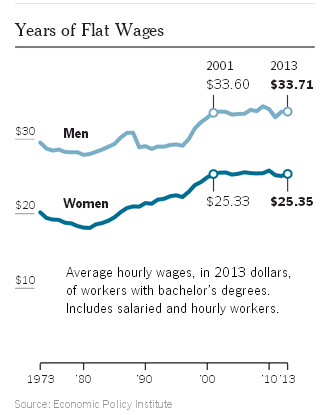 New York Times March 5, 2014
 -
Expanding the EITC would help reduce poverty in two ways, according to Thomas Hungerford, a senior economist at the Economic Policy Institute, another left-leaning think tank. First, it would give childless low-income Americans who are already working an income boost. And expanding the credit would encourage more people to work.
“It was designed to get people into the workforce because you can only get it if you have earned income,” Hungerford said.
Many argue that this is one of the most direct ways to help low-income workers. In 2011, the credit lifted 6.6 million people above the poverty line, according to an IRS estimate cited by the Associated Press. An EITC expansion only benefits the poor, unlike a minimum-wage hike, which could help some people who are not poor, like those working minimum-wage jobs for extra cash.
Expanding the EITC is also more politically palatable than a minimum-wage hike, which many conservatives oppose, arguing it will discourage businesses from hiring minimum-wage workers.
The Huffington Post March 5, 2014 -
March 3 (BNA) — Following Connecticut’s lead, Vermont and Massachusetts could be the next states to enact employer-paid sick leave laws, which tend to help workers with low wages who disproportionately lack access to this benefit, proponents of such policies told Bloomberg BNA.
The Economic Policy Institute said in a report released last October that almost 40 million U.S. employees, or about 40 percent of the nation’s private-sector workforce, currently have no right to any paid sick leave. As a result, EPI said, these employees commonly go to work sick or leave their ill children home alone because they fear they will be fired for missing work.
“Even if they are not terminated, the loss of pay they suffer takes a dramatic toll—particularly since jobs without sick pay are concentrated among low-wage workers,” EPI said in “The Legislative Attack on American Wages and Labor Standards, 2011-2012.”
Bloomberg BNA March 5, 2014 -
A new report from the Economic Policy Institute showsthat all 50 states have experienced lopsided income growth in recent decades. In fact, between 1979 and 2007, the top 1 percent of U.S. taxpayers took home nearly 54 percent of the total increase in income.
To put it another way, while the bottom 99 percent of earners experienced an 18.9 percent average growth in income, the income of the top 1 percent grew more than 10 times that much — a whopping 200.5 percent increase.
MSN Money March 5, 2014