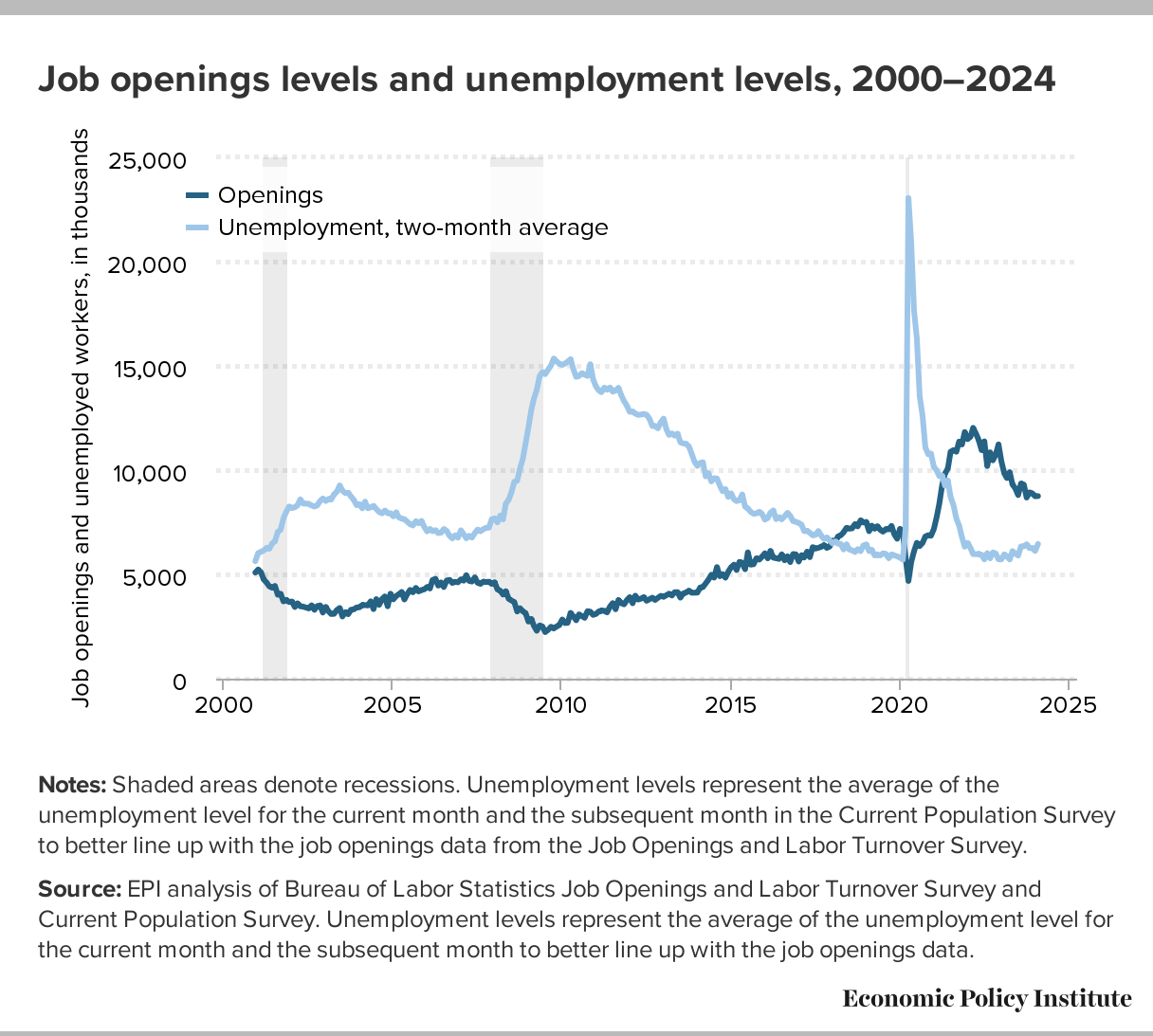
Despite this improvement in the unemployment rate, the country is now approximately in line with where it was during the worst of the Great Recession. In July, the Economic Policy Institute, a non-partisan think-tank, estimated that for every one job opening in the country there were three unemployed workers.
Urban Milwaukee
August 10, 2020
For Elise Gould, senior economist at the Economic Policy Institute, a non-profit, non-partisan think tank in Washington, DC, the unemployment figures are a little disappointing. “I know these are historically high numbers, but I would say that job gains have slowed considerably from what we had seen in May and June,” says Gould. “And we are still nearly 13 million jobs in the hole from where we were in February.”
CBS New York
August 10, 2020
Desde el Economic Policy Institute, EPI, se recuerda que en este nivel, la tasa de desempleo se mantiene por encima de la registrada en el peor mes de la Gran Recesión en 2009 (10% entonces).
El Diario
August 10, 2020
The gap between those high on the income ladder and those in the middle and lower rungs did not change substantially from the end of the war until the 1970s, when the gap began to widen. The share of income growth captured by the top 1 percent in Massachusetts between 1945 and 1973, for example, was 2.9 percent. That figure rose to 50.4% in the period from 1973 to 2007, then to 58.4 percent in the eight years that followed, according to the Economic Policy Institute.
The Boston Globe
August 10, 2020
As the Economic Policy Institute clearly explained earlier this year: Occupational Safety and Health Administration (OSHA) “penalties are insufficient to serve as a deterrent. Companies merely factor these penalties into the cost of doing business. Therefore, it is imperative that corporations have some legal incentive to adhere to health and safety guidelines.”
Business Insider
August 10, 2020
That eye-opening analysis came right after Congress passed the $2.0 trillion Trump/McConnell Tax Cut and Jobs Act, which in its first year bestowed 50 percent of the tax cuts on the top five percent income earners, according to a study by the Economic Policy Institute and the Center for Popular Democracy.
And, while the “tax benefits to middle or low-income individuals are modest and will expire in 2025… the enormous tax breaks for corporations are permanent. By 2027, after the individual provisions expire, the top 1 percent of households alone will see 83 percent of the benefits of the TCJA.”
Insider NJ
August 10, 2020
If Republicans refuse to come to an agreement with Democrats to provide financial relief to jobless Americans, the national impact is expected to be severe. The Economic Policy Institute has cautioned that “cutting off or reducing the $600 will cause enormous hardship and further damage the economy.”
Gothamist
August 10, 2020
Growing income inequality in the U.S. is partly due to the disparity between what CEOs are paid and what they pay their workers. From 1978 to 2018, CEO compensation grew by 1,007.5% while wages for employees grew by only 11.9%, according to a 2019 report from Washington, D.C.-based Economic Policy Institute.
Dallas Morning News
August 10, 2020
Alva said that while he was driving with Lyft, he paid $35 for gas refills every two days, paid $1,200 a month for car maintenance, and last year spent between $1,000 and $1,500 on fixing flat tires. According to a 2018 study from the Economic Policy Institute, Uber drivers earned roughly $9.21 an hour after paying and vehicle expenses and commission fees to Uber.
48 hills
August 10, 2020
The insular microcosms of Twitter and other social media platforms can quickly lead one to believe that everyone in the city had a similar quarantine experience, but in fact, as the Economic Policy Institute reports, under 30 percent of workers were able to work from home.
Miscellany News
August 10, 2020