Black workers' earnings are more sensitive to increases in the unemployment rate: Regression coefficients of earnings growth contingent on overall unemployment rates
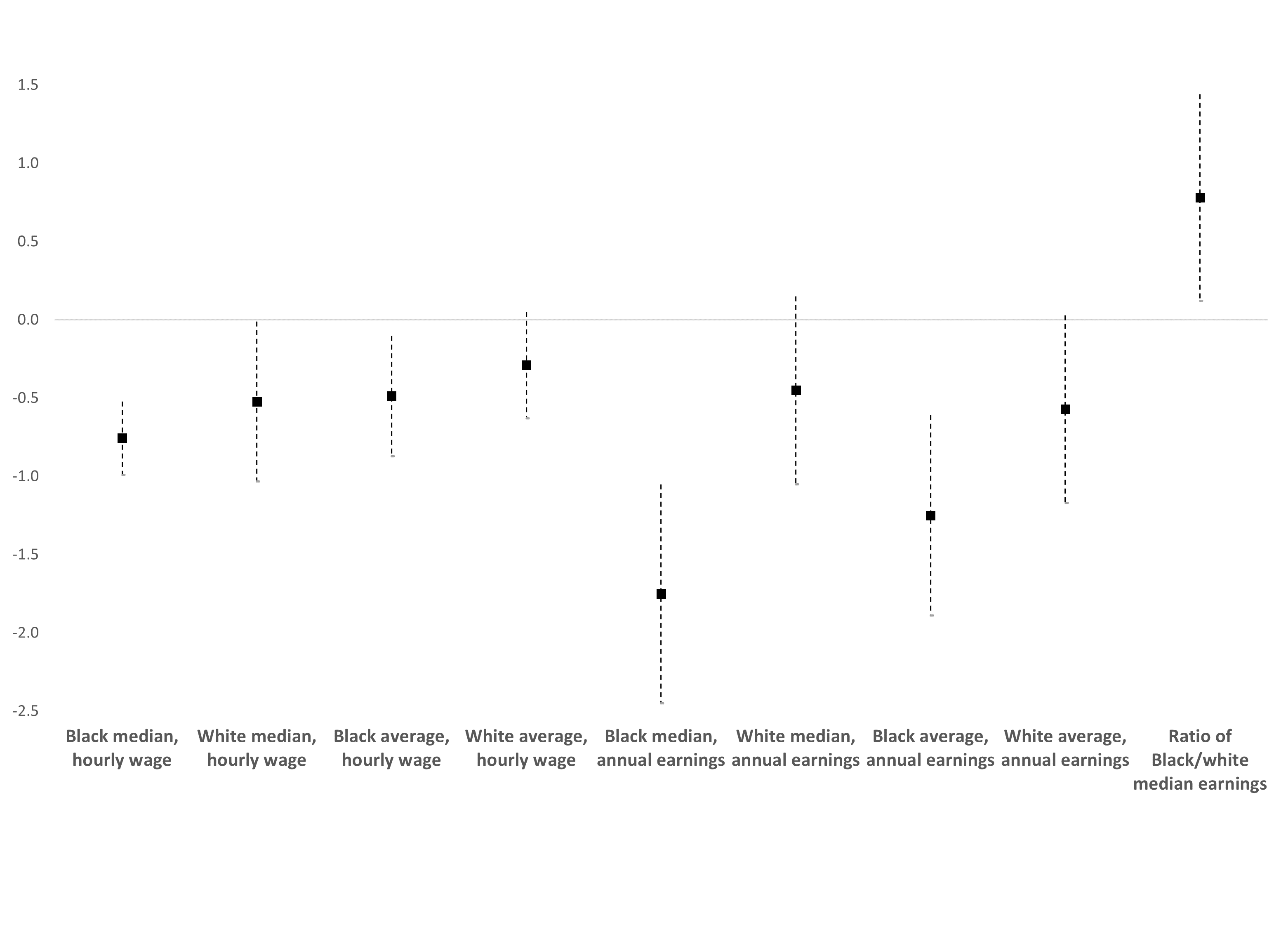

Notes: For all regressions, a three-year centered moving average of all variables is used, with Newey-West calculations of standard errors. Controls in the wage and annual earnings regressions include inflation, productivity growth, a time trend, and dummies for the following periods: 1979–1988, 1989–2000, 2001–2007, and 2008–2014. For the regression of the median Black–white wage ratio, the unemployment variable is lagged two periods and the ratio is multiplied by 100. The annual earnings measure includes only workers with earnings during the year.
Source: Author’s analysis of Current Population Survey (CPS) microdata (EPI 2021a; Flood et al. 2021) and CPS, CPI, and productivity data from the Bureau of Labor Statistics (BLS 2021a–c).
This chart appears in:
Previous chart: « Hourly wage gaps of black and white women and black men relative to white men (regression-adjusted), 1979–2019
Next chart: More to lose, more to gain: Responsive of labor market indicators to changes in overall economic conditions »